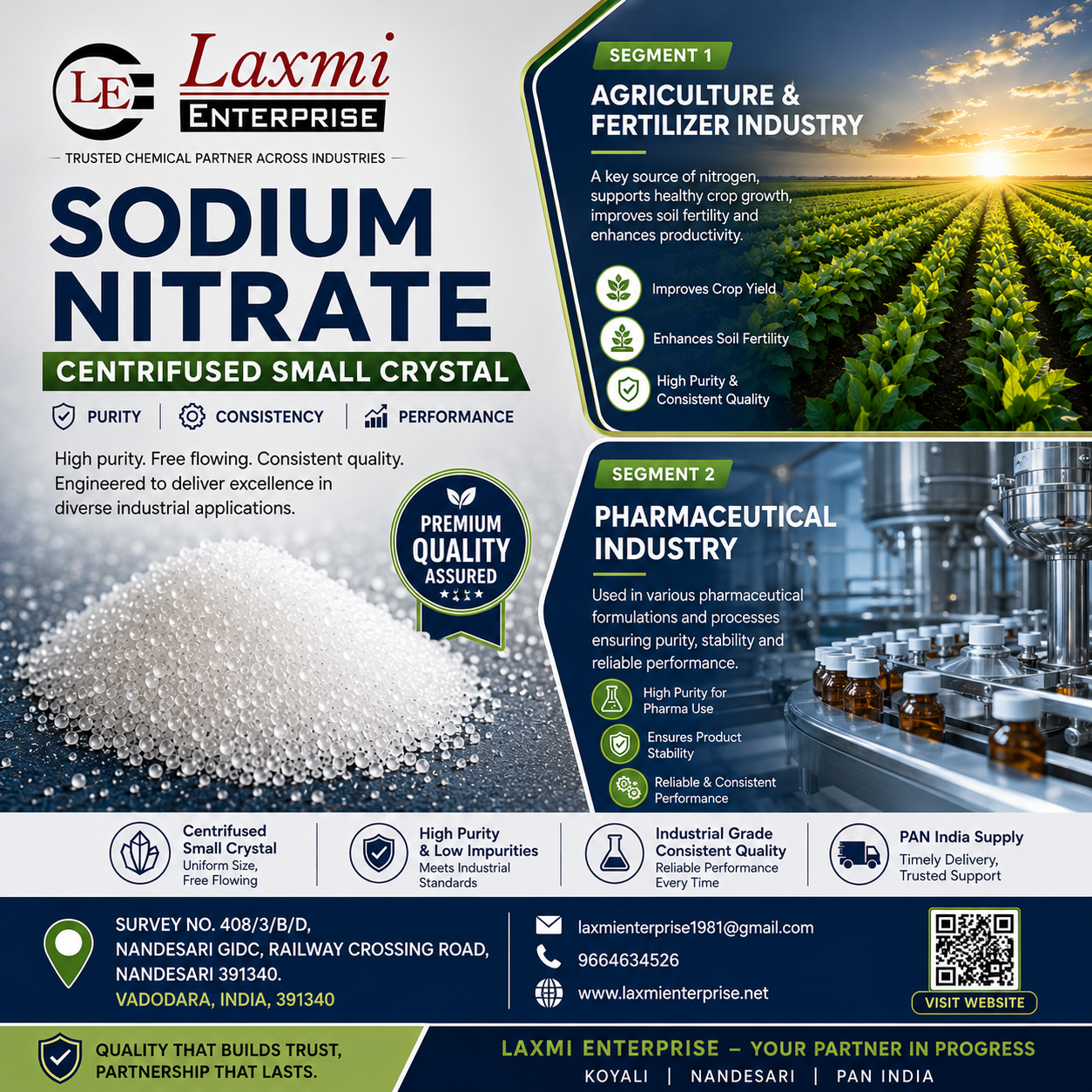
Chemical Engineering Fundamentals of Sodium Nitrate Free Flow
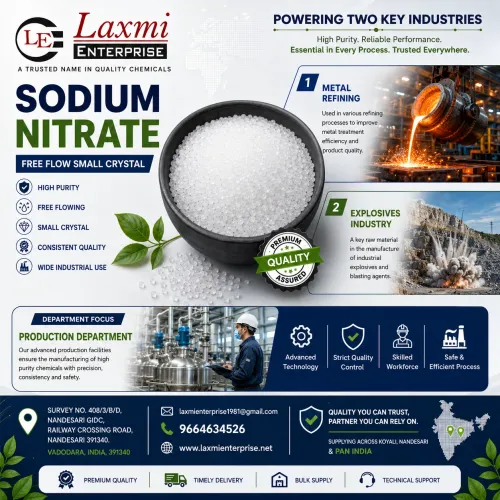
Sodium Nitrate (NaNO₃) is an industrial inorganic nitrate salt whose performance is governed by both its chemical composition and its engineering properties. In industrial manufacturing, the product is evaluated not only for purity but also for its ability to integrate efficiently into production systems.
Chemical engineers consider Sodium Nitrate a process raw material because it influences reaction consistency, material handling, solution preparation, storage stability, and production efficiency.
A well-manufactured Free Flow Sodium Nitrate provides predictable handling characteristics while maintaining chemical consistency, making it suitable for continuous and batch manufacturing operations.
Crystal Engineering
Crystal engineering is an important aspect of Sodium Nitrate production because the crystal morphology influences industrial handling.
High-quality Free Flow Sodium Nitrate is manufactured with controlled crystallization to produce:
Uniform crystal morphology
Controlled particle size
Reduced fine particles
Improved flowability
Better storage stability
Consistent bulk handling
The engineering objective is to produce crystals that remain free flowing throughout transportation, warehouse storage, and production.
Particle Size Engineering
Particle size is one of the most important engineering parameters.
Instead of focusing only on purity, manufacturers evaluate how particle size affects production.
Smaller Particles
Advantages
Faster dissolution
Larger surface area
Better dispersion
Possible limitations
Higher dust generation
Increased moisture sensitivity
Larger Particles
Advantages
Better handling
Reduced dust
Improved storage
Possible limitations
Slower dissolution in some processes
Optimized Free Flow Crystal
Industrial Free Flow Sodium Nitrate is typically produced with a controlled particle size distribution that balances:
Material handling
Dissolution rate
Dust control
Storage stability
Production efficiency
Flow Engineering
Flow behavior is one of the most critical performance indicators.
Poor flow can cause:
Hopper bridging
Arch formation
Rat-holing
Uneven feeding
Production delays
Free Flow Sodium Nitrate is designed to reduce these handling challenges under appropriate storage and operating conditions.
Moisture Engineering
Moisture control directly affects physical performance.
Excess moisture may contribute to:
Lump formation
Reduced flowability
Increased handling difficulty
Storage problems
Proper moisture management helps preserve:
Crystal integrity
Free-flowing characteristics
Production consistency
Dissolution Engineering
When Sodium Nitrate is dissolved in water, several engineering factors influence the process:
Water temperature
Agitation intensity
Particle size distribution
Solution concentration
Mixing equipment
Addition rate
Optimizing these variables can improve dissolution efficiency and reduce preparation time.
Bulk Material Engineering
Chemical engineers classify Sodium Nitrate as a bulk solid.
Bulk solid behavior affects:
Silo design
Hopper geometry
Screw feeder performance
Conveyor selection
Packaging
Warehouse storage
Understanding these factors supports more reliable material handling.
Storage Engineering
Storage conditions influence long-term product performance.
Recommended engineering practices include:
Dry warehouse conditions
Controlled humidity
Good ventilation
Appropriate pallet storage
Protection from water exposure
Clear batch identification
FIFO inventory management
These practices help maintain free-flowing properties.
Packaging Engineering
Packaging protects both chemical quality and physical integrity.
25 kg Bags
Suitable for:
Manual handling
Small production
Laboratory support
Batch manufacturing
50 kg Bags
Recommended for:
Regular industrial production
Medium-scale manufacturing
Routine warehouse handling
500 kg Jumbo Bags
Designed for:
Bulk handling
High-volume production
Automated transfer systems
Large manufacturing plants
Selecting the correct packaging improves logistics efficiency and reduces handling costs.
Process Engineering Considerations
Before introducing Sodium Nitrate into a manufacturing process, engineers often evaluate:
Chemical compatibility
Required purity
Particle size requirements
Storage environment
Feeding method
Dissolution requirements
Mixing sequence
Equipment compatibility
Inventory strategy
Quality documentation
This systematic approach helps support reliable and repeatable manufacturing.
Risk Management in Industrial Operations
Risk can be reduced through:
Receiving inspections
Batch verification
Proper storage
Controlled handling
Regular warehouse audits
Equipment maintenance
Personnel training
Document control
Supplier qualification
A proactive approach helps maintain consistent production.
Chemical Engineering FAQs
Why is crystal engineering important for Sodium Nitrate?
Crystal engineering influences particle size, flowability, storage stability, and handling performance. Well-controlled crystal formation contributes to consistent industrial processing.
What is particle size distribution?
Particle size distribution describes the proportion of different particle sizes within a product. A controlled distribution supports uniform mixing, consistent feeding, and predictable dissolution.
Why is flow engineering important?
Flow engineering focuses on how bulk solids move through industrial equipment. Good flow behavior reduces blockages, improves dosing accuracy, and supports continuous production.
How does moisture affect Free Flow Sodium Nitrate?
Moisture can increase the likelihood of caking and reduce flowability. Proper storage and packaging help preserve the product's handling characteristics.
What factors influence dissolution?
Dissolution performance depends on particle size, water temperature, agitation, concentration, and mixing conditions. Optimizing these variables can improve solution preparation.
Why do engineers evaluate bulk material properties?
Bulk material properties affect storage, conveying, feeding, packaging, and process efficiency. Understanding these properties helps optimize plant design and operation.
How does packaging support engineering performance?
Appropriate packaging protects the product during transportation and storage, helping maintain its physical quality until it reaches the production line.
Why is supplier qualification important?
Qualified suppliers help provide consistent product quality, technical documentation, reliable deliveries, and ongoing support, all of which contribute to stable manufacturing operations.
Sodium Nitrate (NaNO₃) is an industrial inorganic nitrate salt whose performance is governed by both its chemical composition and its engineering properties. In industrial manufacturing, the product is evaluated not only for purity but also for its ability to integrate efficiently into production systems.
Chemical engineers consider Sodium Nitrate a process raw material because it influences reaction consistency, material handling, solution preparation, storage stability, and production efficiency.
A well-manufactured Free Flow Sodium Nitrate provides predictable handling characteristics while maintaining chemical consistency, making it suitable for continuous and batch manufacturing operations.
Crystal Engineering
Crystal engineering is an important aspect of Sodium Nitrate production because the crystal morphology influences industrial handling.
High-quality Free Flow Sodium Nitrate is manufactured with controlled crystallization to produce:
Uniform crystal morphology
Controlled particle size
Reduced fine particles
Improved flowability
Better storage stability
Consistent bulk handling
The engineering objective is to produce crystals that remain free flowing throughout transportation, warehouse storage, and production.
Particle Size Engineering
Particle size is one of the most important engineering parameters.
Instead of focusing only on purity, manufacturers evaluate how particle size affects production.
Smaller Particles
Advantages
Faster dissolution
Larger surface area
Better dispersion
Possible limitations
Higher dust generation
Increased moisture sensitivity
Larger Particles
Advantages
Better handling
Reduced dust
Improved storage
Possible limitations
Slower dissolution in some processes
Optimized Free Flow Crystal
Industrial Free Flow Sodium Nitrate is typically produced with a controlled particle size distribution that balances:
Material handling
Dissolution rate
Dust control
Storage stability
Production efficiency
Flow Engineering
Flow behavior is one of the most critical performance indicators.
Poor flow can cause:
Hopper bridging
Arch formation
Rat-holing
Uneven feeding
Production delays
Free Flow Sodium Nitrate is designed to reduce these handling challenges under appropriate storage and operating conditions.
Moisture Engineering
Moisture control directly affects physical performance.
Excess moisture may contribute to:
Lump formation
Reduced flowability
Increased handling difficulty
Storage problems
Proper moisture management helps preserve:
Crystal integrity
Free-flowing characteristics
Production consistency
Dissolution Engineering
When Sodium Nitrate is dissolved in water, several engineering factors influence the process:
Water temperature
Agitation intensity
Particle size distribution
Solution concentration
Mixing equipment
Addition rate
Optimizing these variables can improve dissolution efficiency and reduce preparation time.
Bulk Material Engineering
Chemical engineers classify Sodium Nitrate as a bulk solid.
Bulk solid behavior affects:
Silo design
Hopper geometry
Screw feeder performance
Conveyor selection
Packaging
Warehouse storage
Understanding these factors supports more reliable material handling.
Storage Engineering
Storage conditions influence long-term product performance.
Recommended engineering practices include:
Dry warehouse conditions
Controlled humidity
Good ventilation
Appropriate pallet storage
Protection from water exposure
Clear batch identification
FIFO inventory management
These practices help maintain free-flowing properties.
Packaging Engineering
Packaging protects both chemical quality and physical integrity.
25 kg Bags
Suitable for:
Manual handling
Small production
Laboratory support
Batch manufacturing
50 kg Bags
Recommended for:
Regular industrial production
Medium-scale manufacturing
Routine warehouse handling
500 kg Jumbo Bags
Designed for:
Bulk handling
High-volume production
Automated transfer systems
Large manufacturing plants
Selecting the correct packaging improves logistics efficiency and reduces handling costs.
Process Engineering Considerations
Before introducing Sodium Nitrate into a manufacturing process, engineers often evaluate:
Chemical compatibility
Required purity
Particle size requirements
Storage environment
Feeding method
Dissolution requirements
Mixing sequence
Equipment compatibility
Inventory strategy
Quality documentation
This systematic approach helps support reliable and repeatable manufacturing.
Risk Management in Industrial Operations
Risk can be reduced through:
Receiving inspections
Batch verification
Proper storage
Controlled handling
Regular warehouse audits
Equipment maintenance
Personnel training
Document control
Supplier qualification
A proactive approach helps maintain consistent production.
Chemical Engineering FAQs
Why is crystal engineering important for Sodium Nitrate?
Crystal engineering influences particle size, flowability, storage stability, and handling performance. Well-controlled crystal formation contributes to consistent industrial processing.
What is particle size distribution?
Particle size distribution describes the proportion of different particle sizes within a product. A controlled distribution supports uniform mixing, consistent feeding, and predictable dissolution.
Why is flow engineering important?
Flow engineering focuses on how bulk solids move through industrial equipment. Good flow behavior reduces blockages, improves dosing accuracy, and supports continuous production.
How does moisture affect Free Flow Sodium Nitrate?
Moisture can increase the likelihood of caking and reduce flowability. Proper storage and packaging help preserve the product's handling characteristics.
What factors influence dissolution?
Dissolution performance depends on particle size, water temperature, agitation, concentration, and mixing conditions. Optimizing these variables can improve solution preparation.
Why do engineers evaluate bulk material properties?
Bulk material properties affect storage, conveying, feeding, packaging, and process efficiency. Understanding these properties helps optimize plant design and operation.
How does packaging support engineering performance?
Appropriate packaging protects the product during transportation and storage, helping maintain its physical quality until it reaches the production line.
Why is supplier qualification important?
Qualified suppliers help provide consistent product quality, technical documentation, reliable deliveries, and ongoing support, all of which contribute to stable manufacturing operations.
Keywords