How to Choose the Right Sodium Sulphate Grade
Technical Product Identity
Property Details
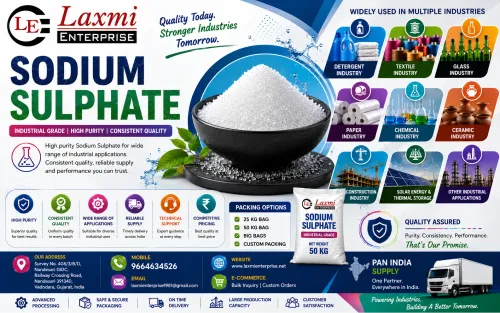
Product Name Sodium Sulphate
Chemical Formula Na₂SO₄
CAS Number 7757-82-6
HSN Code (India) 2833 11 00
Molecular Weight 142.04 g/mol
EINECS Number 231-820-9
Appearance White crystalline powder or granules
Available Grades Industrial Grade, Technical Grade, Application-Specific Grades
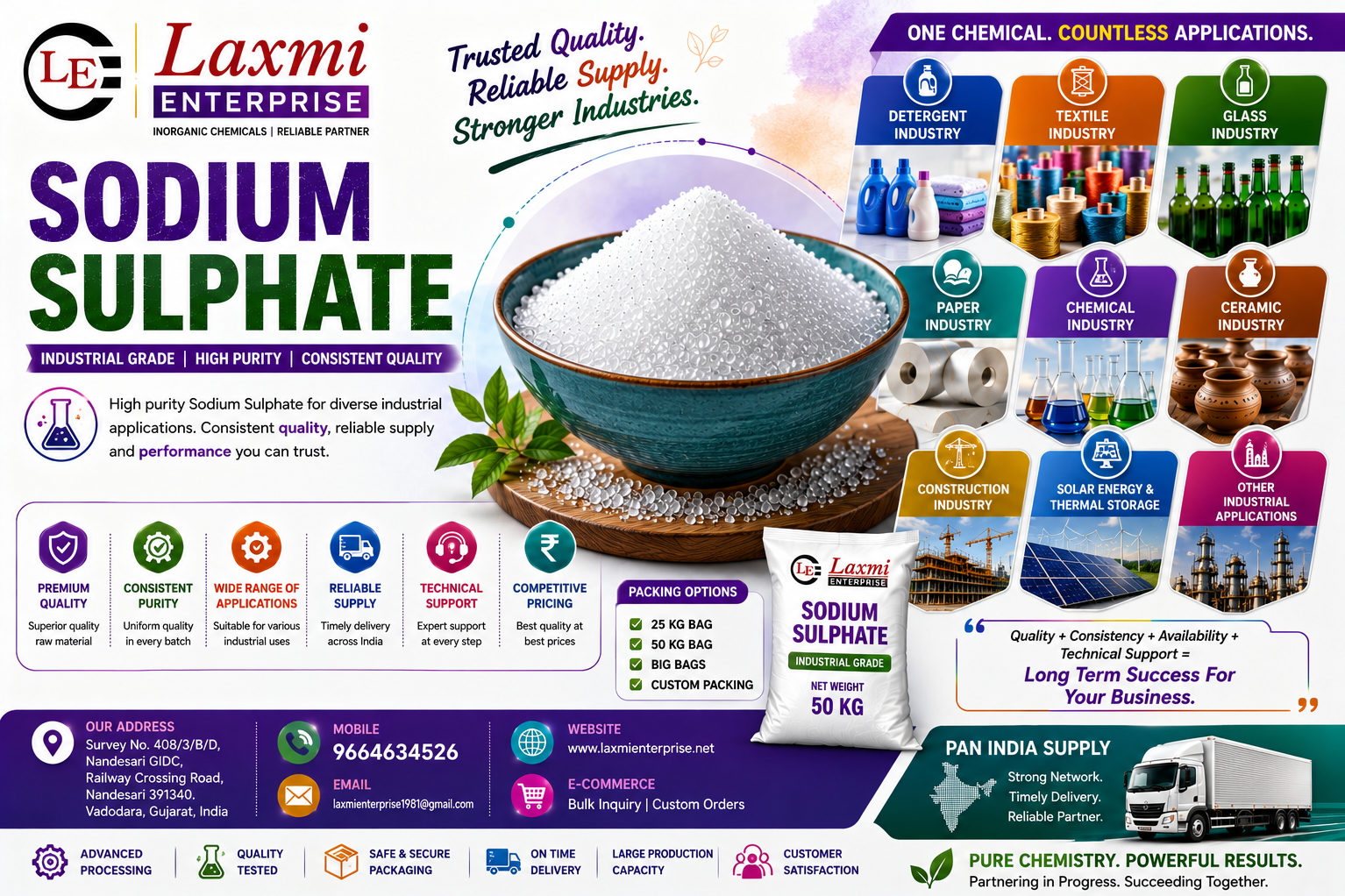
Typical Packaging 25 kg, 50 kg, 500 kg & 1000 kg FIBC (Jumbo Bags), subject to agreement
Quick Answer
Selecting the correct Sodium Sulphate grade depends on how the material will be used, not simply on the highest purity available. Different industries—including detergent manufacturing, glass production, textile dyeing, kraft pulping, and chemical processing—often specify different requirements for purity, moisture, particle size, chloride content, water-insoluble matter, and documentation. A structured technical evaluation helps buyers choose material that is appropriate for their process and quality expectations.
Why Grade Selection Is Important
Industrial procurement teams often compare quotations from several suppliers. While pricing is an important factor, selecting a grade that does not match the intended application can result in:
Inconsistent production.
Additional incoming inspection.
Increased material handling challenges.
Rework or process adjustments.
Higher overall operating costs.
A well-defined specification helps reduce these risks.
Step 1 – Define the End Use
Quick Answer
The first step is to identify where and how Sodium Sulphate will be used. The intended application determines which quality parameters are most important.
Examples include:
Industry Typical Technical Focus
Powder Detergents Flowability, particle size, moisture
Glass Manufacturing Purity, iron, consistency
Textile Dyeing Purity, chloride, water-insoluble matter
Kraft Pulping Product consistency, handling, documentation
Chemical Manufacturing Application-specific specifications
The exact requirements should be established by the buyer's technical team.
Step 2 – Review the Product Specification
A supplier's technical specification should clearly describe the product.
Typical parameters include:
Product name.
Chemical formula.
CAS Number.
Purity.
Moisture.
Water-insoluble matter.
Particle size.
Appearance.
Packaging.
Comparing these values against your purchase specification is more useful than comparing marketing descriptions.
Step 3 – Evaluate Quality Parameters
Purity
Purity indicates the proportion of Sodium Sulphate present in the product.
A higher purity may be appropriate for some applications, but the optimum specification depends on the manufacturing process rather than a universal benchmark.
Moisture
Moisture affects:
Storage stability.
Flowability.
Handling.
Caking tendency.
Maintaining product in sealed packaging and dry storage conditions helps preserve its characteristics.
Water-Insoluble Matter
Applications requiring complete dissolution often monitor water-insoluble matter as part of incoming quality control.
Acceptable limits depend on the process.
Particle Size
Particle size influences:
Blending.
Conveying.
Dissolution.
Dust generation.
Automated feeding systems.
Procurement teams should communicate any particle size requirements before placing an order.
Chloride
Some industries include chloride limits within their product specification.
The acceptable level varies according to:
Product application.
Internal standards.
Customer requirements.
Step 4 – Review Product Documentation
Quick Answer
Technical documentation provides evidence that the supplied material has been identified and tested. Reviewing these documents supports traceability and incoming quality assurance.
Industrial buyers commonly request:
Certificate of Analysis (COA).
Technical Data Sheet (TDS).
Safety Data Sheet (SDS/MSDS).
Batch identification.
Packing list.
Commercial invoice.
Documentation should correspond to the delivered batch wherever applicable.
Step 5 – Evaluate Packaging
Packaging should suit the buyer's warehouse facilities and material handling systems.
Typical options include:
Packaging Typical Users
25 kg Bags Laboratories, pilot plants
50 kg Bags Standard industrial operations
500 kg FIBC Medium-volume production
1000 kg FIBC High-volume manufacturing
Appropriate packaging helps protect the product during storage and transportation.
Step 6 – Assess Supplier Capability
A technically capable supplier should be able to demonstrate:
Consistent product quality.
Batch traceability.
Reliable documentation.
Flexible packaging.
Responsive communication.
Delivery planning.
Long-term supply capability.
These factors contribute to dependable procurement.
Step 7 – Verify Incoming Material
Many manufacturers perform an incoming inspection before releasing material to production.
Typical checks include:
Product identity.
CAS Number: 7757-82-6.
HSN Code: 2833 11 00 (commercial documentation).
Packaging condition.
Batch number.
COA review.
Visual inspection.
Laboratory confirmation where required.
Inspection procedures vary according to each organization's quality management system.
Detergent Industry Buying Guide
Quick Answer
Detergent manufacturers typically prioritize product consistency because large-scale powder production depends on predictable raw material behaviour.
Procurement teams often review:
Particle size distribution.
Flowability.
Moisture.
Bulk density.
Packaging integrity.
Batch consistency.
Reliable deliveries are especially important for continuous production schedules.
Glass Industry Buying Guide
Glass manufacturers commonly evaluate:
Purity.
Iron content.
Water-insoluble matter.
Batch consistency.
Technical documentation.
Requirements should be aligned with the specific glass formulation and process.
Textile Industry Buying Guide
Textile processors generally focus on:
Purity.
Chloride.
Water-insoluble matter.
Moisture.
Dissolution characteristics.
Incoming quality verification supports consistent dyeing operations.
Kraft Pulp Buying Guide
For kraft mills, procurement typically emphasizes:
Product consistency.
Reliable documentation.
Handling characteristics.
Continuous supply.
Because Sodium Sulphate serves as a makeup chemical in the recovery cycle, stable quality and dependable logistics are important.
Pan-India Supply
Industrial demand for Sodium Sulphate exists across manufacturing regions including:
Gujarat
Maharashtra
Rajasthan
Delhi NCR
Uttar Pradesh
Punjab
Haryana
Madhya Pradesh
Chhattisgarh
Odisha
West Bengal
Karnataka
Telangana
Andhra Pradesh
Tamil Nadu
Kerala
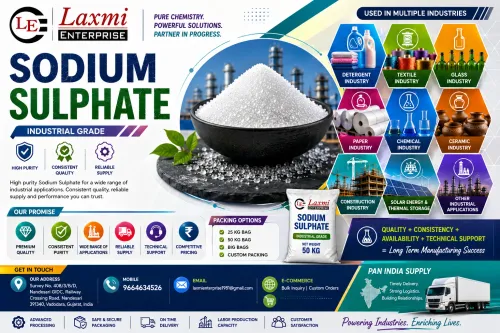
Laxmi Enterprise, based in Nandesari GIDC, Vadodara, Gujarat, supplies industrial-grade Sodium Sulphate (CAS 7757-82-6, HSN 2833 11 00) to customers across Pan India, supporting manufacturers with technical documentation, packaging options, and logistics planning.
Buyer Checklist
Before approving a purchase order:
Confirm the intended application.
Verify CAS Number: 7757-82-6.
Verify HSN Code: 2833 11 00.
Review the technical specification.
Request the COA.
Review TDS and SDS/MSDS.
Confirm packaging requirements.
Check delivery schedule.
Ensure batch traceability.
Frequently Asked Questions
Should I always buy the highest purity grade?
Not necessarily. The most appropriate grade depends on your process requirements and technical specification.
Why is documentation important?
Documents such as the COA, TDS, and SDS/MSDS support quality verification, traceability, and safe handling.
Can one grade be used across all industries?
There is no single universal grade suitable for every application. Specifications should be matched to the intended process.
Why include the CAS Number and HSN Code?
The CAS Number (7757-82-6) uniquely identifies Sodium Sulphate, while the HSN Code (2833 11 00) is used in India for commercial classification, GST, and logistics documentation.
Conclusion
Choosing the right Sodium Sulphate grade is a technical procurement decision that should be based on the intended application, product specification, documentation, packaging, and supplier capability. A structured evaluation helps buyers reduce procurement risk and maintain consistent manufacturing performance.
For manufacturers across India, Laxmi Enterprise, located in Nandesari GIDC, Vadodara, Gujarat, supplies Sodium Sulphate (CAS No. 7757-82-6, HSN Code 2833 11 00) to customers throughout Pan India. The company supports industrial buyers with quality-focused sourcing, technical documentation, flexible packaging, and reliable logistics for a wide range of industrial applications.
Keywords