Industrial Quality Control of Sodium Nitrate Free Flow
Why Quality Control Matters
Quality control is one of the most important aspects of industrial chemical manufacturing. Every production batch of Sodium Nitrate Free Flow should be evaluated against established quality specifications before it is released for packaging and dispatch.
A robust quality control system helps manufacturers maintain consistency, improve customer confidence, and support reliable industrial performance. It also reduces the likelihood of production variability caused by inconsistent raw materials.
For industrial users, quality control is more than a laboratory activity—it is a complete system that includes raw material verification, in-process monitoring, finished product evaluation, documentation, traceability, and continuous improvement.
Objectives of Quality Control
The primary objectives of quality control include:
Verify product identity.
Confirm compliance with agreed specifications.
Maintain batch-to-batch consistency.
Identify deviations before dispatch.
Support customer quality requirements.
Improve manufacturing reliability.
Strengthen product traceability.
Support continual quality improvement.
Typical Quality Control Workflow
A comprehensive quality system generally follows this sequence:
Raw Material Verification
Incoming raw materials are reviewed against established acceptance criteria before production begins.
In-Process Monitoring
Production is monitored to ensure manufacturing conditions remain within defined operating parameters.
Finished Product Evaluation
The completed batch is evaluated to confirm that it satisfies the required quality specifications.
Documentation Review
Quality records are reviewed to verify that testing, approvals, and documentation are complete.
Batch Release
Only material that meets the applicable quality requirements is approved for packaging and dispatch according to the organization's quality procedures.
Quality Parameters Evaluated
Industrial quality control generally considers both chemical and physical properties.
Chemical Characteristics
Typical evaluations include:
Product composition
Chemical purity
Controlled impurity profile
Product identity
Physical Characteristics
Common physical evaluations include:
Appearance
Crystal uniformity
Particle size distribution
Flowability
Bulk density
Moisture condition
Packaging Verification
Quality checks often include:
Correct product labeling
Proper sealing
Package integrity
Net weight verification
Batch identification
Importance of Batch Consistency
Consistent batches help manufacturers:
Reduce process variation.
Improve production planning.
Maintain customer specifications.
Simplify inventory management.
Support repeatable manufacturing.
For industries using automated production systems, consistent physical properties are often just as important as consistent chemical composition.
Understanding a Certificate of Analysis (COA)
A Certificate of Analysis provides documented evidence that the supplied batch has been evaluated against agreed quality specifications.
A typical COA may contain:
Information Purpose
Product Name Product identification
Batch Number Product traceability
Manufacturing Date Production record reference
Test Parameters Quality characteristics evaluated
Specification Limits Acceptance criteria
Reported Results Batch-specific values
Approval Details Quality authorization
Industrial buyers should compare the COA with their internal purchasing specifications before accepting material.
Safety Data Sheet (SDS)
The Safety Data Sheet is another important document accompanying industrial chemicals.
An SDS generally provides information about:
Product identification
Hazard classification
Safe handling
Storage recommendations
Emergency information
Disposal guidance
Transport information
Production personnel should always follow the latest SDS provided by the supplier.
Quality Documentation
A complete quality management system typically includes:
Product Specifications
Certificate of Analysis
Safety Data Sheet
Batch Records
Packaging Records
Dispatch Documentation
Traceability Records
Customer Quality Documents (where applicable)
Well-maintained documentation supports audits, investigations, and long-term product reliability.
Quality Assurance vs. Quality Control
Although the terms are often used together, they have different purposes.
Quality Assurance (QA) Quality Control (QC)
Focuses on preventing quality issues through systems and procedures Focuses on verifying that the finished product meets established specifications
Process-oriented Product-oriented
Includes documentation, training, and continuous improvement Includes inspection, measurement, and evaluation
Together, QA and QC contribute to consistent product quality and customer satisfaction.
What Industrial Buyers Should Verify
Before accepting Sodium Nitrate Free Flow, buyers should confirm:
✓ Product name matches the purchase order.
✓ Batch number is clearly identified.
✓ Packaging is intact.
✓ COA accompanies the shipment.
✓ SDS is available.
✓ Product appearance is consistent with expectations.
✓ Packing size is correct (25 kg, 50 kg, or 500 kg Jumbo Bag).
✓ Quantity received matches shipping documents.
Benefits of a Strong Quality System
A well-implemented quality system helps manufacturers:
Improve customer confidence.
Reduce production disruptions.
Maintain consistent product quality.
Support supplier qualification.
Improve regulatory readiness.
Strengthen traceability.
Reduce waste.
Enhance long-term operational performance.
Quality Control FAQs
Why is quality control important for Sodium Nitrate Free Flow?
Quality control helps verify that each batch meets agreed specifications for both chemical and physical characteristics, supporting reliable industrial performance.
What is the difference between QA and QC?
Quality Assurance focuses on the systems and procedures that prevent quality problems, while Quality Control focuses on evaluating whether the finished product meets the required specifications.
Why is a Certificate of Analysis important?
A COA provides documented information about the quality characteristics of a specific production batch and helps buyers verify compliance with purchasing requirements.
What documents should accompany every shipment?
Industrial shipments commonly include a Certificate of Analysis (COA), Safety Data Sheet (SDS), product labels, batch identification, and shipping documentation.
Why is batch identification necessary?
Batch identification supports traceability throughout manufacturing, storage, transportation, and customer use, making it easier to investigate quality-related questions if they arise.
How does packaging influence quality?
Proper packaging protects the product from moisture, contamination, and physical damage during transportation and storage, helping maintain its free-flowing characteristics.
Why do industrial buyers review technical documentation?
Technical documentation provides confidence in product quality, supports internal quality systems, and assists with supplier qualification, audits, and procurement decisions.
How does quality consistency benefit manufacturing?
Consistent raw material quality reduces process variation, improves production efficiency, and supports repeatable product performance across multiple manufacturing batches.
Technical Insight
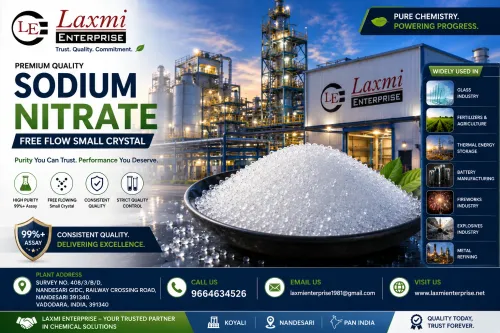
Industrial quality is achieved through a combination of consistent manufacturing, documented quality systems, appropriate packaging, complete traceability, and clear technical documentation. For Sodium Nitrate Free Flow, these elements are as important as chemical purity because they help manufacturers maintain stable operations, improve procurement confidence, and support long-term production reliability.
Keywords