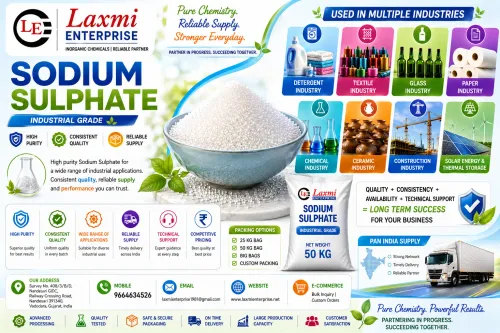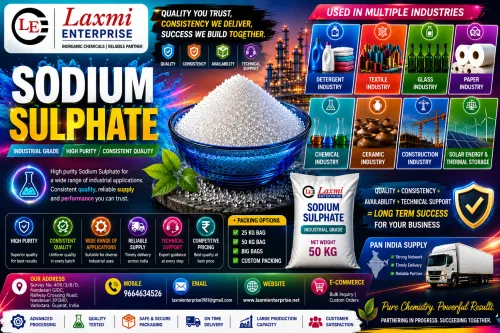


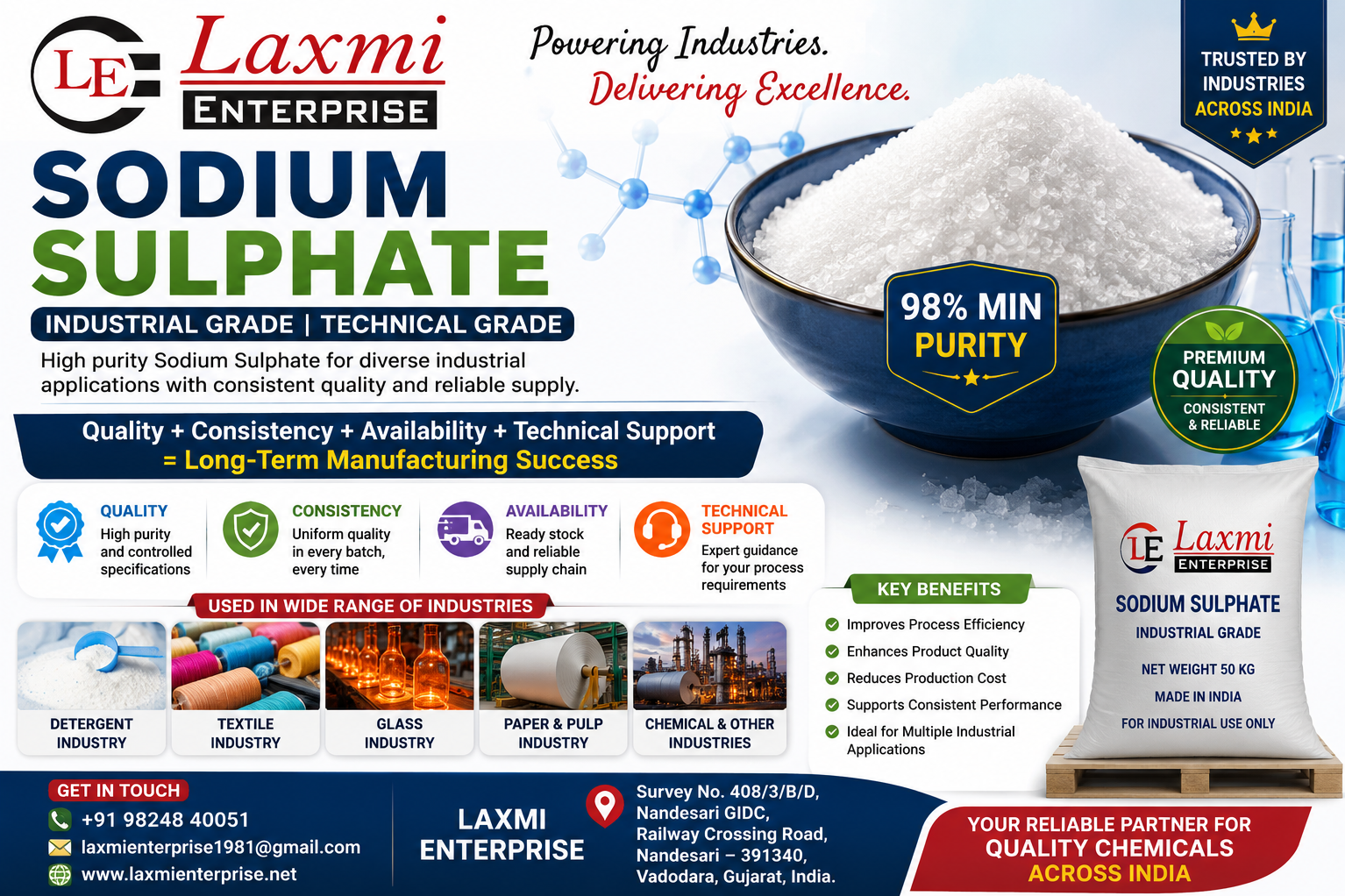
Below is a practical guide to the typical Sodium Sulphate (Na₂SO₄) requirements across major industrial sectors. These are general industry preferences; exact specifications vary by process, product quality, and customer requirements.
Below is a practical guide to the typical Sodium Sulphate (Na₂SO₄) requirements across major industrial sectors. These are general industry preferences; exact specifications vary by process, product quality, and customer requirements.
Industry / Sector Typical Na₂SO₄ Purity Moisture Insoluble Matter Chloride Preferred Form Main Purpose
Detergent Powder Manufacturing 97–99% ≤0.5% ≤0.3% ≤0.5% Free-flowing powder Filler, bulk density control, flowability
Textile Dyeing & Processing 98–99.5% ≤0.5% ≤0.2% ≤0.3% Uniform crystals Dye exhaustion, shade consistency
Glass Industry 99%+ ≤0.3% ≤0.1% Low Fine powder Fining agent, bubble removal
Kraft Paper & Pulp Mills 98–99% ≤0.5% ≤0.3% Controlled Powder Chemical recovery, pulping support
Chemical Manufacturing 99%+ ≤0.3% ≤0.1% Low Powder / Crystal Process chemical, formulation ingredient
Construction Chemicals 97–99% ≤0.5% ≤0.3% Moderate Powder Filler, formulation consistency
Ceramic & Tile Industry 98–99% ≤0.5% ≤0.3% Low Fine powder Raw material/process aid
Water Treatment & ZLD Systems 98–99.5% ≤0.5% ≤0.2% Low Crystal Salt recovery, process optimization
Mining & Metallurgy 97–99% ≤0.5% ≤0.3% Moderate Powder Process-support chemical
Feed Industry (where permitted by applicable regulations) Application-specific Low Low Controlled Food/feed suitable grade where required Mineral source/formulation component
Sodium Sulphate as a Filler in Different Industries
Detergent Industry
Sodium Sulphate is one of the most widely used fillers in detergent powder because it:
Increases bulk volume
Improves powder flowability
Controls bulk density
Supports uniform blending
Reduces formulation cost
Construction Chemicals
As a filler, Sodium Sulphate can contribute to:
Uniform dry-mix blending
Better powder handling
Consistent formulation properties
Chemical Manufacturing
It serves as an economical inorganic filler or process-support material in selected formulations where its chemical compatibility is appropriate.
Paper Industry
Sodium Sulphate is not generally used as a filler in paper. Its primary role is in the kraft pulping chemical recovery cycle, rather than filling the paper sheet. Mineral fillers in paper are more commonly materials such as calcium carbonate, kaolin clay, or talc.
Glass Industry
Sodium Sulphate is not used as a filler. Instead, it functions as a fining agent, helping remove gas bubbles from molten glass to improve clarity and quality.
Textile Industry
Sodium Sulphate is not used as a filler. It acts as an electrolyte during reactive dyeing to improve dye exhaustion, dye migration, and shade uniformity.
Why Manufacturers Prefer High-Quality Sodium Sulphate
Manufacturers across industries generally seek Sodium Sulphate with:
High Na₂SO₄ purity
Low moisture content
Low insoluble matter
Controlled chloride levels
Uniform particle size
Consistent batch-to-batch quality
These characteristics help improve production efficiency, maintain product quality, reduce downtime, and support reliable manufacturing processes.