


Sodium Acetate: Difference Between Anhydrous and Trihydrate
Introduction
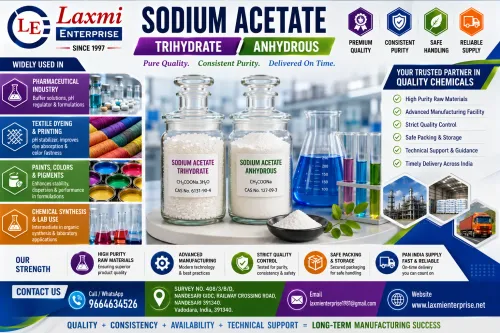
Sodium acetate is an essential chemical compound widely used across laboratories, industrial manufacturing, pharmaceuticals, and food processing. It is the sodium salt of acetic acid and is valued for its buffering capability, mild alkalinity, and chemical stability. The compound exists primarily in two forms: sodium acetate anhydrous and sodium acetate trihydrate.
Although both varieties share the same fundamental chemical structure, their physical properties, hydration levels, and industrial applications differ significantly. Understanding the distinction between these forms helps buyers select the correct material for manufacturing processes, laboratory experiments, or formulation purposes.
What is Sodium Acetate Anhydrous?
Sodium acetate anhydrous is the water-free form of the compound. In this variant, the chemical contains no water molecules within its crystalline structure. Because of the absence of bound water, the material is usually produced as a fine white crystalline powder.
Key Characteristics
Molecular formula: CH₃COONa
Appearance: White hygroscopic powder
Solubility: Highly soluble in water
Stability: Stable under normal conditions
Moisture content: Extremely low
The lack of hydration makes this grade suitable for processes requiring precise chemical composition and minimal moisture interference.
Common Applications
Sodium acetate anhydrous is frequently utilized in:
Pharmaceutical buffer preparation
Organic synthesis reactions
Industrial catalysts
Textile dyeing solutions
Chemical manufacturing intermediates
Industries often select this form when exact stoichiometric control is essential.
What is Sodium Acetate Trihydrate?
Sodium acetate trihydrate is the hydrated form containing three molecules of water integrated into its crystal lattice. The presence of water changes the compound’s physical behavior, weight, and thermal properties.
Key Characteristics
Molecular formula: CH₃COONa·3H₂O
Appearance: Transparent or white crystalline granules
Water of crystallization: 3 molecules
Melting point: Lower compared with anhydrous form
Density: Higher due to hydration
This hydrated structure allows the compound to release heat when crystallizing, making it useful in specific thermal applications.
Typical Uses
Sodium acetate trihydrate is commonly used in:
Heat packs and thermal storage systems
Textile dyeing buffers
Leather processing
Laboratory reagents
Food flavoring applications
Because of its crystalline nature and stability, this form is easier to handle in bulk industrial operations.
Major Differences Between the Two Forms
1. Water Content
The most obvious distinction is the presence of crystallization water.
Anhydrous sodium acetate contains no water molecules, whereas trihydrate incorporates three molecules of water per unit.
This difference affects molecular weight, stability, and solubility characteristics.
2. Molecular Weight
Because trihydrate contains water molecules, it has a higher molecular mass.
Approximate comparison:
Sodium acetate anhydrous: ~82 g/mol
Sodium acetate trihydrate: ~136 g/mol
For chemical reactions requiring precise calculations, this difference is crucial.
3. Physical Appearance
The two forms also vary visually:
Anhydrous: Fine powder or small crystals
Trihydrate: Larger, translucent crystalline solids
Industrial buyers often choose trihydrate when handling and storage convenience are important.
4. Heat Behavior
Trihydrate sodium acetate is known for its exothermic crystallization property, meaning it releases heat when transitioning from liquid to solid.
This phenomenon makes it valuable in:
Reusable heating pads
Thermal energy storage devices
Demonstration experiments
Anhydrous sodium acetate does not exhibit this behavior.
5. Industrial Applications
Although the compounds are chemically similar, industries often prefer different forms depending on the application.
Anhydrous sodium acetate is typically used in:
Pharmaceutical buffers
Analytical chemistry
Organic synthesis
Trihydrate sodium acetate is more common in:
Textile finishing
Leather treatment
Food additives
Heat packs
Choosing the Right Type
Selecting between anhydrous and trihydrate sodium acetate depends on several factors:
Required moisture level
Storage conditions
Application environment
Reaction sensitivity
For example, pharmaceutical laboratories generally prefer anhydrous material due to purity and accurate composition. In contrast, industrial sectors may choose trihydrate crystals for convenience and stability.