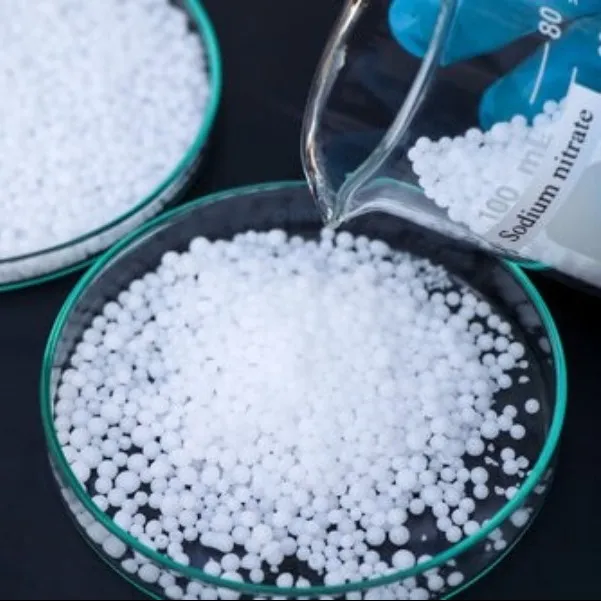
Sodium Nitrate (NaNO₃) – Storage, Handling & Safety Guidelines Sodium nitrate is a strong oxidizing inorganic salt used in fertilizers, thermal storage salts, explosives, food processing (restricted uses), and chemical manufacturing. While non-flammable, it intensifies fires and must be handled as an oxidizer.
SODIUM NITRATE STORAGE HANDLING SAFETY
UN No.: 1498
Class: 5.1 – Oxidizing Solid
GHS: Oxidizing solid (Cat. 3)
Decomposes at high temperature → oxygen + NOx
Cool, dry, well-ventilated
Away from heat, sparks, and sunlight
Separate oxidizer storage preferred
HDPE / PP bags, fiber drums with liners, or stainless steel
Keep tightly sealed (hygroscopic → caking risk)
Clearly labeled “SODIUM NITRATE – OXIDIZER”
Avoid dust formation
Use clean, non-sparking tools
Prevent contamination with combustibles
Ground equipment for bulk transfer
Safety goggles or face shield
Nitrile or PVC gloves
Dust mask / respirator for bulk handling
Protective clothing
Fire behavior
- Sodium nitrate does not burn
- Supplies oxygen → accelerates combustion of other materials
Small Spills
- Avoid raising dust
- Sweep carefully into clean container
- Reuse if uncontaminated or dispose as oxidizer waste
Large Spills
- Isolate area
- Prevent entry into drains/waterways
ExposureEffectFirst AidInhalationRespiratory irritationFresh airSkinMild irritationWash with soap & waterEyesRedness, wateringRinse ≥15 minIngestionGI upset, methemoglobinemia (high dose)Seek medical help
Highly soluble → groundwater contamination risk
Can cause eutrophication
Prevent uncontrolled release
- UN 1498, Class 5.1
- Segregate from combustibles during transport
- Follow ADR / IMDG / IATA oxidizer rules
Keep moisture <0.1%
Avoid chloride/sulfate contamination (corrosion risk)
Compatible with SS-304 / SS-316 at operating temperatures
Monitor nitrite formation in molten systems
Sodium nitrate is safe when clean, dry, and isolated from incompatible materials—but dangerous if contaminated. Fire risk comes from its oxidizing nature, not flammability.
Sodium Nitrate (NaNO₃) – Decomposition Temperature
Sodium nitrate does not boil; it thermally decomposes at elevated temperatures. The exact decomposition temperature depends on time, atmosphere, and impurities, but the behavior is well established.
TemperatureBehavior≤ 500 °CThermally stable (solid or molten)550–600 °COnset of decomposition600–650 °CSignificant nitrate → nitrite conversion> 650 °CRapid decomposition, NOx evolution> 700 °CFormation of Na₂O / Na₂CO₃ (with CO₂)
Oxygen release increases fire intensity nearby
Sodium nitrite (NaNO₂) is less thermally stable
Air / oxygen-rich → higher apparent stability
Inert or reducing → earlier decomposition
Short exposure at 600 °C → partial conversion
Long dwell → significant nitrite formation
- Recommended max continuous use: ≤ 540–550 °C
- Alarm / safety margin: ≤ 560 °C
- Above this → accelerated degradation & NOx risk
Ion chromatography: nitrate / nitrite ratio
TGA / DSC: decomposition onset
Gas analysis: O₂ / NOx evolution
Sodium nitrate begins to decompose at ~550–600 °C, converting to sodium nitrite and releasing oxygen. For safe and stable operation, systems should be designed to stay below ~550 °C.
Sodium Nitrate–Potassium Nitrate Blends (NaNO₃–KNO₃)
Blends of sodium nitrate (NaNO₃) and potassium nitrate (KNO₃) are widely used because they offer lower melting points, high thermal stability, and tunable oxidizing behavior compared to the pure salts.
Eutectic (“Solar Salt”)
- 60 wt% NaNO₃ / 40 wt% KNO₃
- Melting point: ~220–222 °C
- Global standard for thermal energy storage (TES
PropertyNaNO₃–KNO₃ BlendUsable temperature range~220 to 550 °CDecomposition onset~550–600 °CHeat capacity (molten)~1.5–1.6 kJ/kg·KThermal conductivity~0.45–0.55 W/m·KThermal cycling stabilityExcellent
Concentrated Solar Power (CSP)
Industrial heat storage
Molten salt heat-transfer fluids
Combined Na⁺ and K⁺ nutrient supply
Rapid nitrate availability
Salt baths for controlled oxidation
Stable in air and dry conditions
Hygroscopic → moisture control required
Compatible with SS 304 / SS 316
Chloride & sulfate impurities must be minimized (corrosion risk)
- Classified as oxidizers
- Store away from combustibles
- Keep dry and uncontaminated
- Use water for fire exposure (not foam/dry powder)
Typical specs:
- Total nitrate (%)
- Na⁺ / K⁺ ratio
- Chloride & sulfate impurities
- Moisture content
- Nitrite (thermal degradation indicator)
NaNO₃–KNO₃ blends provide a low-melting, thermally stable nitrate system with wide industrial use. The 60:40 “solar salt” composition remains the benchmark for high-temperature thermal storage.
Sodium nitrate is widely used in thermal energy storage, molten-salt heat transfer systems, and high-temperature oxidizing processes because it remains chemically stable over a broad temperature range. Its behavior at elevated temperatures is well characterized and critical for safe operation.
Stable Region (≤500–540 °C)
- Minimal chemical change
- Suitable for long-term molten operation
- High heat capacity and good thermal cycling stability
Transition Region (540–600 °C)
Slow nitrate → nitrite conversion
Rate increases with time at temperature
FactorEffectAtmosphereOxygen stabilizes nitrate; inert/reducing gases accelerate decompositionImpuritiesChlorides, sulfates, metals catalyze breakdownResidence timeLonger exposure near limits → faster degradationMoisturePromotes corrosion, not direct decomposition
Ion chromatography: nitrate/nitrite ratio
TGA / DSC: decomposition onset
Gas analysis: oxygen & NOx release
Sodium nitrate is thermally stable up to ~550 °C in molten systems. Beyond this range it decomposes to nitrite and oxygen, limiting safe high-temperature use.
sodium nitrate supplier in India sodium nitrate manufacturer
sodium nitrate exporter Asia Pacific buy sodium nitrate near me
sodium nitrate distributor in USA sodium nitrate supplier in Europe
Chile saltpeter
Peru saltpeter nitrate of soda
nitric acid sodium salt sodium salt of nitric acid
Keywords