

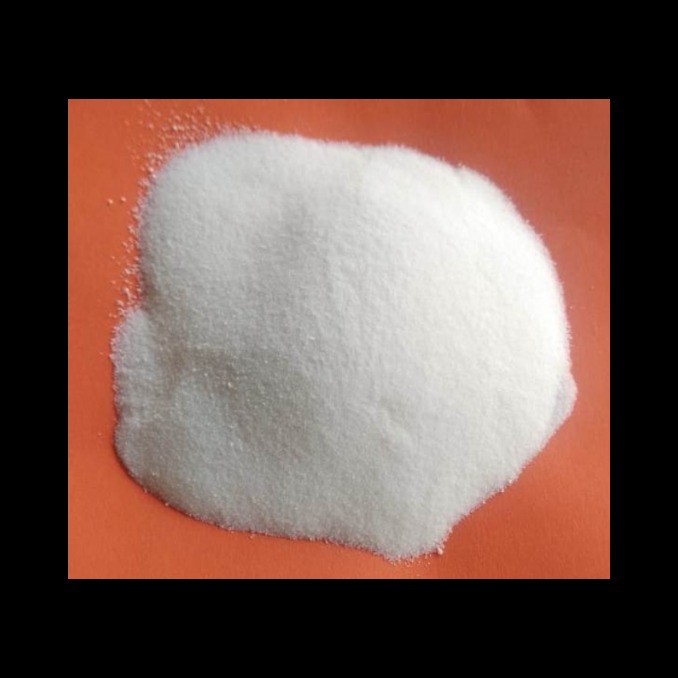
Manufacturing Process of Sodium Sulphate (Na₂SO₄)
Sodium sulphate can be produced by several methods — depending on available raw materials and industrial scale. The main commercial routes are:
From Sodium Chloride and Sulfuric Acid (Mannheim Process)
Chemical Reaction:
Process Steps:
Sodium chloride (common salt) is reacted with concentrated sulfuric acid.
The reaction is done in a Mannheim furnace at 600–700°C.
Hydrogen chloride gas (HCl) is evolved and collected.
Solid sodium sulphate remains in the furnace and is removed, cooled, and purified.
Products:
Sodium sulphate (main product)
Hydrochloric acid gas (by-product)
Advantages: Simple and continuous process.
Disadvantages: High temperature required, corrosive gases.
rom Glauber’s Salt (Decahydrate Form)
Sodium sulphate naturally occurs as Glauber’s salt (Na₂SO₄·10H₂O).
Process:
Mining or extraction of Glauber’s salt.
Heating (calcination) removes water of crystallization:
The anhydrous salt is dried and packed.
Used where natural deposits exist.
Raw Materials Required
Sodium chloride (common salt)
Sulfuric acid (H₂SO₄)
Fuel for furnace (gas/coal)
Water and cooling system
Applications
Detergent manufacturing
Glass industry
Kraft pulp process (paper)
Textile dyeing and finishing
As filler in powder detergents
As thermal storage (in decahydrate form)
Would you like me to give you a flow diagram (with steps) for the Mannheim process used in industries like Laxmi Enterprise, Vadodara?
I can also include machinery details and energy recovery setup if you want.
You said:
sodium sulphte menu fackcharing
ChatGPT said:
Okay — you want to know the Sodium Sulphate Manufacturing (Menu / Process / Factory setup) in simple language.
Let’s explain it step by step, like a factory manufacturing guide (menu)
Sodium Sulphate Manufacturing Process (Industrial Menu)
1. Raw Materials
Material Chemical Formula Purpose
Common Salt NaCl Main sodium source
Sulphuric Acid H₂SO₄ To react with NaCl
Fuel (Gas / Coal) — For heating in furnace
Water — Cooling & purification
Here, sodium chloride reacts with sulphuric acid to form sodium sulphate (solid) and hydrogen chloride gas (by-product).
3. Main Equipment (Plant Machinery)
Mannheim Furnace – Brick-lined reactor for salt + acid reaction.
Acid Feed System – Pumps and pipes for controlled flow of H₂SO₄.
HCl Gas Absorber – For converting HCl gas into liquid hydrochloric acid.
Cooler & Crystallizer – To cool down molten sodium sulphate.
Centrifuge / Filter – For separating and drying sodium sulphate crystals.
Storage Silos / Bags – For packing final product.
4. Process Flow (Step-by-Step)
Feed salt (NaCl) into the Mannheim furnace.
Add concentrated sulphuric acid slowly.
Reaction takes place at 600–700°C.
HCl gas is released → collected and absorbed in water to form liquid HCl.
Sodium sulphate remains in furnace → discharged periodically.
Product is cooled, crushed, filtered, dried, and packed.
5. By-products
Hydrochloric acid (HCl) – Can be sold commercially.
Steam heat – Can be used for drying or other plant operations.
6. Quality Parameters
Parameter Typical Value
Purity (Na₂SO₄) 98–99%
Moisture <0.5%
Appearance White crystalline powder
pH (10% soln) 6–8
7. Uses / Industries
Detergent powder and soap industry
Glass manufacturing
Textile dyeing and finishing
Paper (kraft) industry
Pharmaceuticals & thermal storage systems
Would you like me to prepare a factory layout + flow diagram (image) showing all equipment (furnace, absorber, crystallizer, etc.) — like a small manufacturing plant blueprint for sodium sulphate production?
You said:
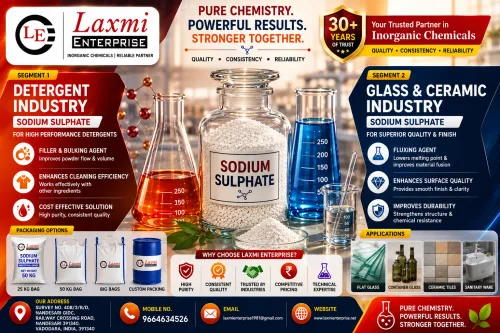
sodium sulphate Glass industry
ChatGPT said:
Excellent — you want to know how sodium sulphate (Na₂SO₄) is used in the glass industry.
Let’s explain clearly and practically
Role of Sodium Sulphate in the Glass Industry
1. Purpose
Sodium sulphate is widely used as a refining and fluxing agent in glass manufacturing.
Its main job is to remove bubbles and impurities from molten glass and help it melt evenly.
2. Chemical Action in the Furnace
During glass melting (around 1400–1500°C):
Na₂O becomes part of the glass composition — it lowers the melting temperature and improves fluidity.
SO₃ gas helps oxidize and remove air bubbles or unwanted gases (refining action).
3. Why Sodium Sulphate is Important
Function Explanation
Fluxing Agent Lowers melting point of silica and other materials, saving energy.
Refining Agent Releases SO₂ and O₂ gases, removing trapped bubbles.
De-colorizing Agent Helps oxidize iron impurities, making glass clearer.
Improves Homogeneity Promotes uniform mixing of molten glass components.
4. Typical Dosage
Usually added 0.2% to 0.5% by weight of total glass batch.
Used along with soda ash (Na₂CO₃) and limestone (CaCO₃).
5. Types of Glass Using Sodium Sulphate
Glass Type Use of Na₂SO₄
Container glass (bottles, jars) For refining and color correction
Flat glass (windows, mirrors) Improves clarity & smoothness
Fiberglass Used for smooth fiber drawing
Specialty glass Optical, borosilicate types — for refining and bubble removal
6. Reaction By-products
When Na₂SO₄ decomposes:
Produces SO₂ and O₂ gases.
These gases react with carbon and other batch materials to help in refining (bubble removal).
7. Benefits for Glass Manufacturers
. Reduces fuel consumption (lower melting temperature)
. Produces clearer, stronger glass
. Enhances color uniformity
. Improves melting efficiency in furnaces
8. Laxmi Enterprise – Industrial Supply Note
Laxmi Enterprise, Vadodara supplies high-purity sodium sulphate to glass, detergent, and textile industries across India.
• Certification Sodium Sulphate for Detergents
• Detergent Grade Sodium Sulphate
• Sodium Sulphate in Powdered Detergents
• Laundry Chemicals Supplier
• • Sodium Sulphate for Textile Processing
• • Textile Chemicals Supplier
• • Dye Fixing Agent Chemicals
• • Sodium Sulphate in Dyeing
• Sodium Sulphate for Glass Manufacturing
• Sodium Sulphate for Kraft Process
• Sodium Sulphate for Paper Industry
• Industrial Chemicals for Glass Production
• • Request Sodium Sulphate Quote
• • Bulk Sodium Sulphate Pricing
• • Sodium Sulphate MSDS Download
• • REACH-Compliant Sodium Sulphate
• • Sodium Sulphate with COA and SGS
• • “Get a Free Quote Now”
• “Download Product Specifications
[byy laxmi enterprise]