

ACETATE QUANTIFICATION IN BIOPHARMA FORMULATIONS
Low concentration levels:
- Typical formulations contain acetate at 10–50 mM (~0.6–3 g/L), sometimes even lower in diluted formulations.
Complex matrix:
- Presence of proteins, salts (Na⁺, K⁺, Cl⁻), sugars, surfactants, and other excipients can interfere with detection.
High ionic strength:
- Can affect conductivity-based detection methods in ion chromatography.
Co-elution/interference:
- Other anions (like formate, lactate, or sulfate) may co-elute with acetate in chromatography, leading to inaccurate quantification.
Suppressor IC improves sensitivity by reducing background conductivity.
Gradient or isocratic elution using hydroxide or carbonate eluents.
- Detection limit: Low μM range.
Sulfate or phosphate can interfere in high concentrations.
- Protein-rich samples require pre-treatment (e.g., ultrafiltration, protein precipitation)
Ion-pairing HPLC can separate acetate using reverse-phase columns.
Detection: UV at 210 nm or conductivity.
Advantages: Good for complex matrices; flexible detection.
- Challenges: Lower sensitivity compared to IC, potential co-elution.
Principle: Separation of anions in narrow capillaries under an electric field.
Advantages: Fast analysis, small sample volume.
- Challenges: Less commonly used in routine QC; may require derivatization for sensitivity.
Principle: Acetate kinase or acetyl-CoA synthetase-based reactions produce a measurable colorimetric or fluorometric signal.
Advantages: Simple, suitable for microplates.
- Challenges: Limited dynamic range, potential interference from other matrix components.
- Ultrafiltration (10 kDa MWCO) or protein precipitation using acetonitrile or trichloroacetic acid.
- Reduce high ionic strength to prevent conductivity suppression.
- Maintains acetate in ionized form for accurate IC detection.
- 0.2 μm filter to remove particulates before injection.
Suppressor selection: Use suppressors compatible with high-salt buffers.
Guard column: Protect main column from proteins and particulates.
Calibration: Use matrix-matched standards to account for ionic strength effects.
Limit of Detection (LOD): Typically 1–5 μM for IC; enzymatic methods around 10–50 μM.
- Interference check: Confirm that sulfate, phosphate, or citrate do not co-elute with acetate.
- Methods should be validated for:
- Accuracy, precision, linearity
- Sensitivity (LOD/LOQ)
- Specificity (no interference from matrix)
- Robustness (reproducibility across instruments)
- IC is widely accepted in pharmacopeial guidelines (USP <711>, EP) for anion quantification.
Pre-treat sample to remove proteins and high-molecular-weight excipients.
Use suppressor IC with conductivity detection for high specificity and sensitivity.
Validate method with spiked formulations to ensure recovery >95%.
- Consider enzymatic assays for rapid in-process monitoring if high throughput is needed.
- Improving acetate recovery in ion chromatography (IC), especially for biopharmaceutical formulations, is crucial because poor recovery leads to underestimation and unreliable QC results. Recovery issues typically arise from matrix effects, high ionic strength, column interactions, and sample preparation steps. Here’s a detailed guide:
Proteins, polysaccharides, surfactants, and salts can suppress or distort the acetate signal.
- High concentrations of sulfate, phosphate, or chloride can co-elute or affect suppressor efficiency.
Acetate must remain fully ionized for proper retention and detection.
- Extreme pH can lead to partial protonation or degradation.
- Filtration, precipitation, or dilution steps can adsorb acetate or alter ionic composition.
Use ultrafiltration (10 kDa cutoff) or protein precipitation with acetonitrile, methanol, or TCA.
- Avoid excessive acid which can precipitate acetate as its acid form.
Dilute high-salt or high-protein formulations to reduce ionic load.
- Ensure dilution is compatible with detection limits.
Use low-adsorption 0.2 μm or 0.22 μm filters.
- Avoid filters with cellulose or ion-exchange material that can retain acetate.
Choose suppressors optimized for high ionic strength or sulfate-rich samples.
- Self-regenerating suppressors may maintain better baseline stability.
Use hydroxide or carbonate eluents compatible with acetate retention.
- Consider gradient elution to separate acetate from interfering anions.
- Strong anion-exchange columns with high capacity reduce matrix overload effects.
Spike known acetate amounts into the actual formulation matrix.
- Target recovery: 95–105%.
- Use anion-exchange trap columns before the analytical column to remove interfering species.
- For high sulfate or phosphate matrices, dilute or use selective precipitation to reduce competition.
- Always pre-screen the formulation for high-concentration anions.
- Use matrix-matched calibration rather than aqueous standards for complex biopharma matrices.
- Consider dual detection (conductivity + UV) for confirmation.
- Monitor system suitability parameters like retention time, resolution, and peak symmetry to detect recovery issues early.
- Weak acids (like acetate, formate, citrate, lactate, succinate) are partially dissociated in solution. Their ionization depends on pH:]
Only the ionized form (A⁻) is retained on an anion-exchange column.
At low pH, weak acids may be protonated and not retained, causing poor sensitivity.
- High pH ensures full deprotonation but may affect column stability or co-elution with hydroxide-sensitive species.
Low retention / early elution
- Weak acids can elute close to the void volume.
- Separation from interfering anions (like chloride, nitrate, phosphate) can be difficult.
Proteins, buffers, and salts can:
- Suppress conductivity signals
- Alter retention times
- Cause peak broadening
- Conductivity detection may be less sensitive for low concentrations of weak acids compared to strong acids
Use strong eluents (hydroxide, carbonate, or phosphate) to promote deprotonation and consistent retention.
Gradient elution can help separate multiple weak acids in complex matrices.
- Keep eluent pH well above the pKa of the weakest acid (e.g., for acetate, pKa ≈ 4.76, use pH ≥ 7–8).
Suppressor systems reduce background conductivity of the eluent, enhancing weak acid signals.
- Helps especially with low-concentration samples or high-salt matrices.
Protein removal
- Ultrafiltration (10 kDa MWCO)
- Precipitation (acetonitrile, TCA)
High-capacity anion-exchange columns: avoid early breakthrough of weak acids.
Guard columns: protect against fouling from proteins or particulates.
- Shorter columns: faster elution for small anions but may compromise resolution.
- UV detection at 210–220 nm for organic acids.
- Conductivity detection is standard, especially with suppressor.
- Dual detection (UV + conductivity) improves confirmation.
- Always validate method with known amounts of weak acid in the actual formulation matrix.
- Helps compensate for ionic strength and viscosity effects.
- Retention time, peak symmetry, and resolution should be checked before each batch.
- Weak AcidTypical pKaEluent (mM)DetectionNotesAcetate4.7610–20 OH⁻ConductivityEasily co-elutes with formate if gradient not optimizedFormate3.7510 OH⁻ConductivityEarly elution; needs good baseline separationCitrate3.1, 4.8, 6.415 OH⁻
- gradientConductivityMultiple peaks due to multiple ionizable groupsLactate3.8610–20 OH⁻ConductivitySensitive to protein matrix
· Food grade (FCC)
· Pharma/lab grade
· Industrial grade
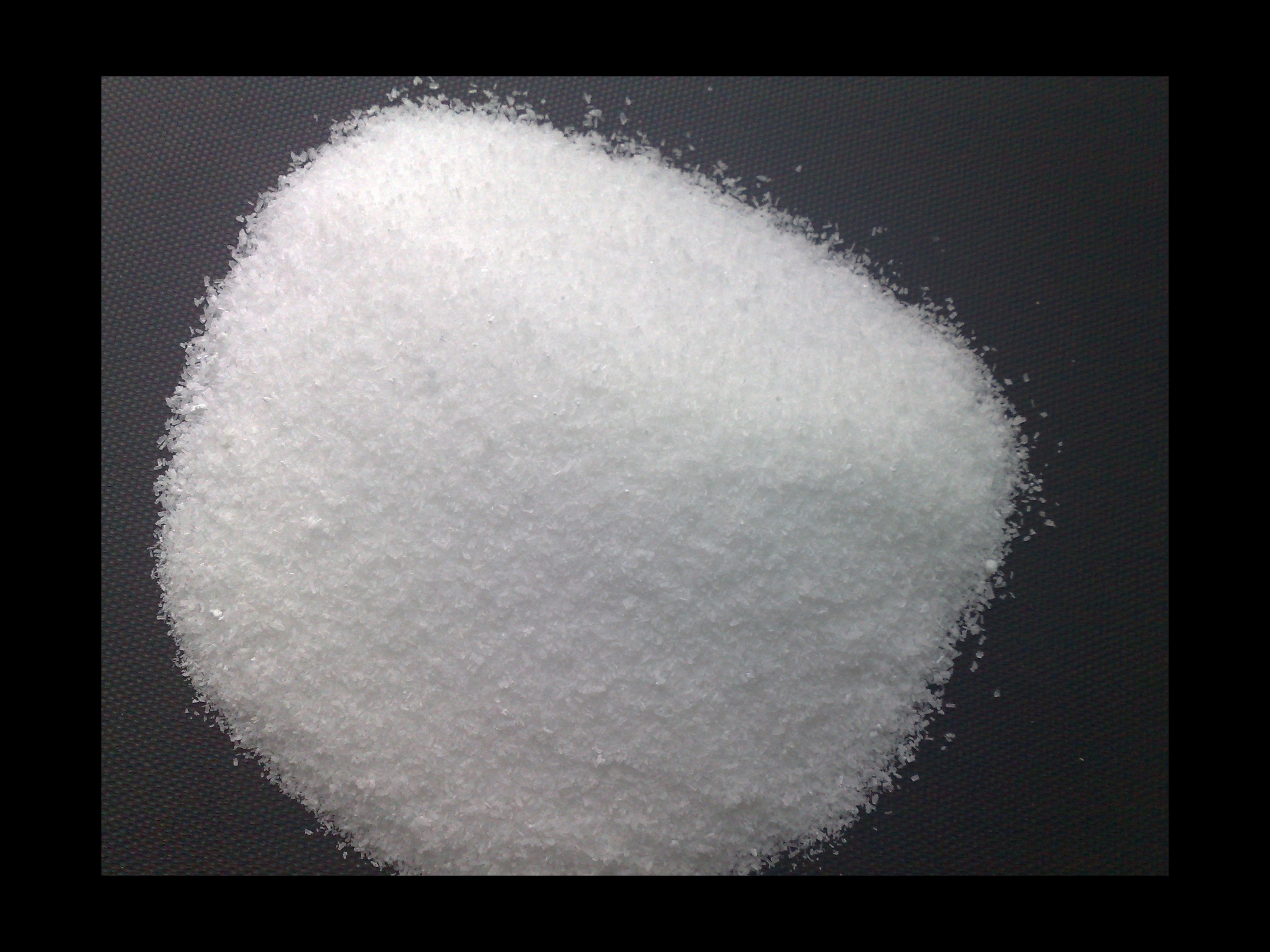
- · Forms: anhydrous; trihydrate