
Separation (Anion-Exchange)
- The stationary phase contains positively charged functional groups (e.g., quaternary ammonium).
- Analyte anions (Cl⁻, NO₃⁻, SO₄²⁻, etc.) are retained based on:
- Charge
- Ionic radius
- Hydration energy
- Elution occurs using a basic eluent (usually KOH or Na₂CO₃/NaHCO₃).
Suppressed Conductivity Detection
- The eluent itself is conductive and would mask analyte signals.
- A suppressor chemically converts the eluent to a weakly conductive form, while enhancing analyte conductivity.
Eluet generator (EGC) or prepared eluent
High-pressure IC pump
Anion-exchange analytical column
Suppressor (electrolytic or chemical)
Conductivity detector
Data acquisition software
Fluoride (F⁻)
Chloride (Cl⁻)
Nitrite (NO₂⁻)
(NO₃⁻)
(PO₄³⁻)
(SO₄²⁻)
Bromide (Br⁻)
Acetate
Formate
Oxalate
Lactate
Industrial wastewater sulfate & nitrate monitoring
Power plant effluent analysis
High-purity chemicals (sodium nitrate, sodium sulfate)
Environmental compliance testing
Process control in chemical manufacturing
- Uses semipermeable membranes with defined molecular weight cut-off (MWCO).
- Proteins (large MW) are retained, while salts, sugars, and small molecules pass through.
Pressure: 1–5 bar
Temperature: ≤ 40 °C
pH: 2–10 (membrane dependent)
Proteins are denatured and aggregated by changing solvent, pH, ionic strength, or temperature, then removed by centrifugation/filtration.
Organic Solvent Precipitation
- Solvents: Acetonitrile, Methanol, Ethanol
- Typical ratio: 1:1 to 3:1 (solvent:sample)
Pros: Fast, simple
Cons: Protein denaturation, solvent disposal
- Common salt: Ammonium sulfate
- Mechanism: Reduces protein solubility
Pros: Gentle, selective
Cons: High salt load → desalting required
- Acids: TCA, perchloric acid, HCl
- pH near protein isoelectric point
Pros: Very effective
Cons: Protein destruction, corrosive reagents
Heat Precipitation
- Temperature: 60–90 °C
Pros: No chemicals
Cons: Not selective, analyte degradation risk
Precipitation → Ultrafiltration
- Precipitation removes bulk protein
- UF polishes sample and removes residual salts/solvents
- Common in biopharma & fermentation effluent treatment
For anion analysis (sulfate, nitrate, acetate) by ion chromatography:
- Use 10 kDa ultrafiltration
- Avoid TCA or ammonium sulfate (adds interfering anions)
- If precipitation is needed → acetonitrile, followed by UF
Purpose
To ensure manufacturing processes produce products that are:
- Safe
- Pure
- Effective
- Consistent batch-to-batch
- US FDA: 21 CFR Parts 210 & 211
- ICH: Q7 (APIs), Q8–Q10 (Pharma Quality System)
- WHO GMP
- EU GMP: EudraLex Vol. 4
- India: Schedule M (Drugs & Cosmetics Act)
Quality Management System (QMS)
- Quality Manual
- SOP hierarchy
- Change control
- CAPA (Corrective & Preventive Action)
- Deviation management
Personnel & Training
- Defined roles and responsibilities
- Initial & periodic GMP training
- Training effectiveness evaluation
- Hygiene and gowning procedures
Facilities & Equipment
- Controlled layout & material flow
- Equipment qualification (IQ/OQ/PQ)
- Preventive maintenance & calibration
- Clean utilities (PW, WFI, compressed air)
Documentation & Data Integrity
- ALCOA+ principles:
- Attributable
- Legible
- Contemporaneous
- Original
- Accurate
Controlled documents
Electronic records compliance (21 CFR Part 11)
Approved suppliers
Incoming material testing
Status labeling (quarantine / approved / rejected)
Traceability & batch records
- Master Batch Records (MBR)
- In-process controls
- Process validation (Stage 1–3)
- Cleaning validation
uality Control & Release
- Validated analytical methods
- OOS / OOT investigations
- Stability studies
- Final QA release
Purpose
To ensure laboratory studies generate reliable, reproducible, and traceable data, especially for:
- Analytical testing
- Environmental & toxicology studies
- Method development & validation
Key Regulations
- OECD GLP
- US FDA: 21 CFR Part 58
- EMA / EU GLP
- India: NABL / OECD-GLP
Responsibilities
- Study Director accountability
- QA unit independence
- Defined organizational chart
Facilities & Equipment
- Suitable laboratory environment
- Equipment qualification & calibration
- Controlled access to critical areas
- Test & Reference Items
- Proper characterization
- Storage & stability records
- Chain of custody
Standard Operating Procedures (SOPs)
- Sample handling
- Instrument operation
- Method execution
- Data handling & archiving
Study Conduct & Documentation
- Study plan & amendments
- Raw data recording
- Deviations documentation
- Final study report
Data Integrity & Archiving
- Secure data storage
- Controlled access
- Defined retention periods
Gap assessment vs regulations
SOP creation & training
Equipment qualification
Method validation (ICH Q2)
Data integrity controls
Internal audits & mock inspections
Given your work in chemical products (e.g., sodium nitrate, sodium sulfate) and analytical testing (IC, sulfate/nitrate analysis):
cGMP applies to:
Chemical manufacturing & packaging
Raw material control
Batch documentation
GLP applies to:
Analytical method validation
Effluent & environmental testing
IC data integrity & reporting
Cell culture media (CHO, HEK)
Fermentation broth
Harvested cell culture fluid (HCCF)
Plasma / serum
Protein drug formulations (mAbs, enzymes)
Buffer & excipient systems
Clarification (Primary Step)
Centrifugation / Depth Filtration
3,000–10,000 g, 10–20 min
Removes cells, debris
Used before any downstream prep.
Protein Removal (Critical Step)
Ultrafiltration (Preferred)
MWCO: 10–30 kDa
Removes proteins without adding chemicals
Best for IC, HPLC, LC-MS
Minimal interference
GMP compatible
Preserves analytes (ions, excipients)
- Dialysis (large volumes)
- Solid Phase Extraction (SPE)
- Dilution with ultrapure water
- Ion-exchange cleanup (selective removal)
Essential for high-TDS samples.
- 0.22 µm or 0.45 µm syringe filters
- Materials: PES, PVDF, RC
- Removes particulates before injection
Ion Chromatography (IC)
Target analytes: sulfate, nitrate, chloride, acetate
Recommended Workflow
Centrifugation
10 kDa ultrafiltration
Dilution (if needed)
0.22 µm filtration
HPLC / UHPLC
Protein precipitation or UF
SPE for selective cleanup
Mobile phase compatibility check
LC-MS / MS-MS
- Organic solvent precipitation (ACN 3:1)
- SPE cleanup
- Volatile buffers only
Analyte Stability
- Control pH & temperature
- Minimize freeze–thaw cycles
Adsorption Loss
- Use low-binding tubes & membranes
- Pre-condition filters
Carryover Control
- Single-use filters
- System blanks
Sample preparation steps must be:
- Documented (SOPs)
- Validated / verified
- Reproducible
- Traceable
Key parameters:
- Recovery
- Precision
- Matrix effect
- Robustness
Practical Recommendation (Based on Your IC Work)
For biopharma matrices with sulfate/nitrate analysis:
- Use centrifugation + 10 kDa ultrafiltration
- Avoid ammonium sulfate, phosphate buffers
- Perform method suitability after sample prep
- Include matrix-matched standards
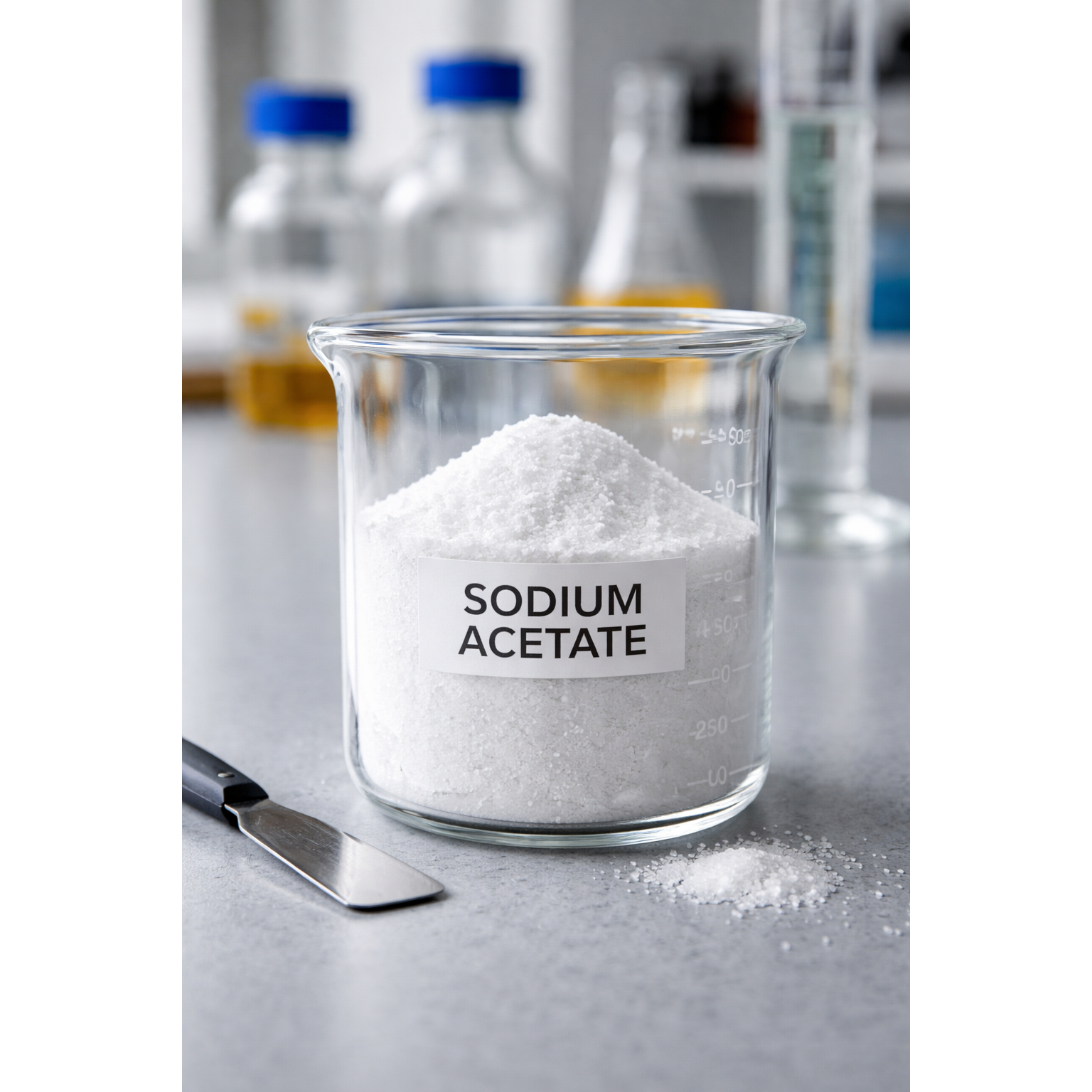
· sodium acetate
· sodium acetate anhydrous
· sodium acetate trihydrate
· sodium acetate buffer
· sodium acetate CAS 127-09-3
sodium acetate E262
· sodium acetate supplier
· sodium acetate manufacturer
· sodium acetate distributor
· buy sodium acetate online
· sodium acetate price per kg
· bulk sodium acetate