

ANION-EXCHANGE CHROMATOGRAPHY WITH SUPPRESSED CONDUCTIVITY
Anion-Exchange Separation
- The analytical column contains positively charged functional groups (quaternary ammonium).
- Analyte anions are retained based on:
- Charge (SO₄²⁻ > NO₃⁻ > Cl⁻)
- Ionic size and hydration
- Elution is achieved using a basic eluent.
Common eluents
- Potassium hydroxide (KOH) – most common
- Sodium carbonate / bicarbonate
Analyte after suppression
- Cl⁻ → HCl
- NO₃⁻ → HNO₃
- SO₄²⁻ → H₂SO₄
Result:
- Background conductivity ↓↓↓
- Analyte conductivity ↑↑↑
- Very high signal-to-noise ratio
Eluent generator (EGC) or prepared eluent
High-pressure pump
Anion-exchange column + guard column
Suppressor (cation-exchange membrane)
Conductivity detector
Chromatography data system (CDS)
Fluoride (F⁻)
Chloride (Cl⁻)
Nitrite (NO₂⁻)
Nitrate (NO₃⁻)
Sulfate (SO₄²⁻)
Phosphate (PO₄³⁻)
Bromide (Br⁻)
Acetate
Formate
Lactate
Oxalate
Biopharma: sulfate, acetate, nitrate in formulations & buffers
Chemical manufacturing: sodium nitrate / sodium sulfate purity
Wastewater: high-sulfate effluents (power plants, chemicals)
Regulatory testing: cGMP & GLP compliant analysis
Anion-exchange chromatography with suppressed conductivity offers the highest sensitivity and robustness for anion analysis and is the regulatory-preferred approach for industrial, environmental, and biopharma applications.
Protein precipitation and ultrafiltration are core, complementary techniques used across biopharmaceutical development, manufacturing, and quality control. They are applied during upstream clarification, downstream purification support, and analytical sample preparation to manage complex, protein-rich matrices while maintaining cGMP and GLP compliance.
Biopharma matrices typically contain:
- High protein concentrations (mAbs, enzymes, host cell proteins)
- Salts and buffers (phosphate, acetate, citrate)
- Cell debris, lipids, DNA/RNA
- Process additives and excipients
Without proper protein removal:
- Analytical columns foul (IC, HPLC, LC-MS)
- Detectors drift or saturate
- Ion suppression or matrix effects occur
- Data integrity and reproducibility are compromised
Protein precipitation relies on reducing protein solubility, causing proteins to denature, aggregate, and form insoluble solids that can be removed by centrifugation or filtration.
Mechanisms include:
- Disruption of hydration shells
- Charge neutralization
- Solvent polarity reduction
- Thermal denaturation
Acetonitrile (ACN) – preferred
Methanol
Ethanol
Solvent : sample = 2:1 to 3:1
Temperature: 0–10 °C (improves precipitation)
- Fast and simple
- Highly effective protein removal (>95%)
- Compatible with LC-MS
- Minimal equipment
Protein denaturation (irreversible)
Organic solvent handling & disposal
Possible loss of small polar analytes
- Bioanalysis
- Impurity profiling
- Rapid QC sample cleanup
Reagents
- Trichloroacetic acid (TCA)
- Perchloric acid
- Hydrochloric acid
- Very strong precipitation
- Effective for dilute samples
- Corrosive reagents
- Destruction of protein structure
- Acid residues interfere with IC
- Not preferred for GMP analytics
Common salt
- Ammonium sulfate
Mechanism
- High ionic strength competes for water molecules
- Reduces protein solubility
Advantages
- Gentle, selective
- Used in protein fractionation
- Introduces high salt load
- Requires desalting before analysis
- Not suitable for anion IC (adds sulfate)
Conditions
- 60–90 °C for 10–30 minutes
Advantages
- No chemical addition
- Simple process
Limitations
- Poor selectivity
- Risk of analyte degradation
- Limited analytical applicability
Ultrafiltration uses semipermeable membranes to separate components based on molecular size.
- Proteins are retained (retentate)
- Small molecules (ions, excipients) pass through (filtrate)
Operating Conditions
- Pressure: 1–5 bar (or centrifugal force)
- Temperature: ≤ 40 °C
- pH range: membrane-dependent (usually 2–10)
Protein Precipitation → Ultrafiltration
This hybrid approach is widely used in biopharma:
- Precipitation removes bulk protein rapidly
- Ultrafiltration:
- Removes residual protein
- Eliminates salts, acids, solvents
- Polishes sample for analysis
Maximizes cleanup efficiency
Protects analytical systems
Improves method robustness
Ion Chromatography (Sulfate, Nitrate, Acetate)
- Avoid sulfate or phosphate reagents
- Use 10 kDa ultrafiltration
- If precipitation needed → acetonitrile only
- Follow with dilution + 0.22 µm filtration
LC-MS Bioanalysis
- ACN precipitation (3:1)
- SPE if matrix effects persist
- Volatile buffers only
Process Development / Downstream Support
- Salt or heat precipitation (early stages)
- UF/diafiltration for polishing
Protein removal steps must be:
- Defined in SOPs
- Qualified for recovery and precision
- Shown not to alter analyte integrity
Validation parameters
- Protein removal efficiency
- Analyte recovery
- Precision (%RSD)
- Matrix effects
- Robustness
Protein precipitation is fast and effective for bulk removal.
Ultrafiltration provides clean, reproducible, regulator-friendly samples.
Combined use delivers the best balance of speed, cleanliness, and compliance in biopharma analytics.
Proteins remain soluble in water because of:
- Strong hydration shells
- Electrostatic interactions
- Hydrogen bonding
When an organic solvent is added:
- Dielectric constant of the medium decreases
- Protein hydration shells collapse
- Proteins denature and aggregate
- Aggregated proteins become insoluble and precipitate
Small molecules (ions, metabolites, excipients) typically remain in solution.
- Cool sample (0–10 °C recommended)
- Add organic solvent slowly while vortexing
- Typical solvent:sample ratio = 2:1 to 3:1
- Incubate 5–15 minutes (optional)
- Centrifuge at 10,000–15,000 g for 10–15 min
- Collect clear supernatant
- Optional: evaporate solvent or dilute before analysis
- Final filtration (0.22 µm)
Key Operating Parameter
- 1:1 → partial precipitation
- 2–3:1 → optimal protein removal (>95%)
- Lower temperatures improve precipitation efficiency
- Reduces analyte degradation
- Efficient vortexing prevents local over-precipitation
- Ensures reproducibility
5Advantages
Very fast and simple
High protein removal efficiency
Minimal equipment required
Excellent for high-throughput analysis
Compatible with LC-MS and HPLC
Limitations & Risks
Protein structure destroyed (irreversible)
Possible co-precipitation of analytes
Organic solvent disposal required
Not ideal for ion chromatography without polishing
Solvent-Specific Notes
Acetonitrile
- Strongest and cleanest precipitation
- Lowest LC-MS ion suppression
- Volatile and easy to remove
Methanol
- Less aggressive
- Higher risk of protein breakthrough
Ethanol
- Safer, greener solvent
- Requires higher volumes. Compatibility with Analytical Techniques
TechniqueCompatibilityLC-MS / MS-MSExcellentHPLC-UVExcellentIon ChromatographyLimited (needs UF/dilution)Capillary ElectrophoresisGood Best Practices in Biopharma
- Use ACN (2–3:1) for analytical cleanup
- Always validate analyte recovery
- Avoid solvent precipitation alone for sulfate/nitrate IC
- Combine with ultrafiltration when needed
- Use low-binding tubes to reduce losses
Regulatory & GMP Considerations
- Procedure must be described in SOP
- Solvent grade: LC-MS / HPLC grade
- Document
- Volumes
- Mixing time
- Precision
- Recovery
- Robustnes
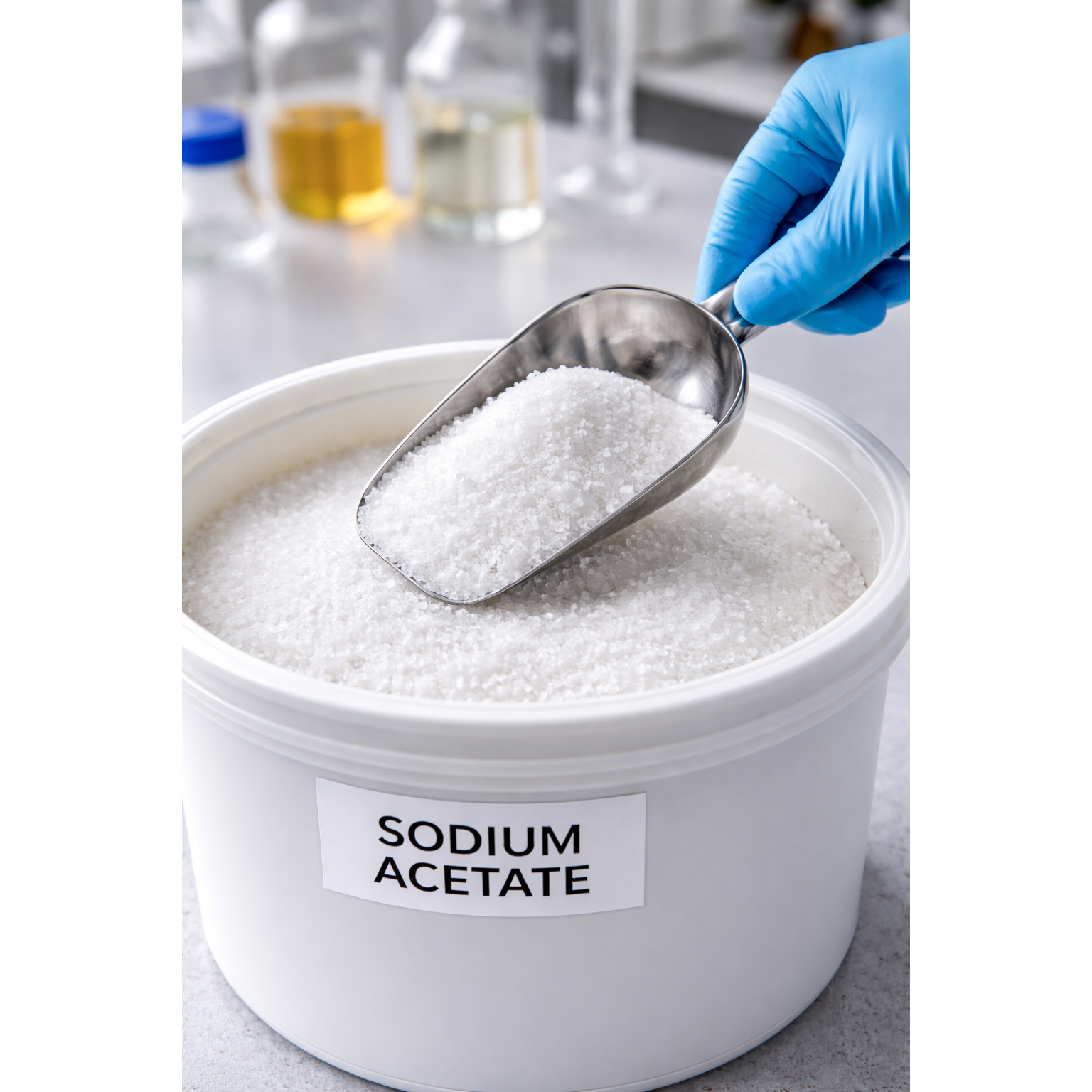
· sodium acetate for food industry
· sodium acetate for pharmaceuticals
· sodium acetate for textile dyeing
· sodium acetate for water treatment
· sodium acetate for heating pads
· sodium acetate buffer solution preparation