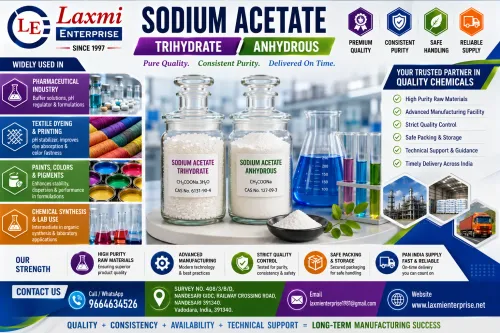


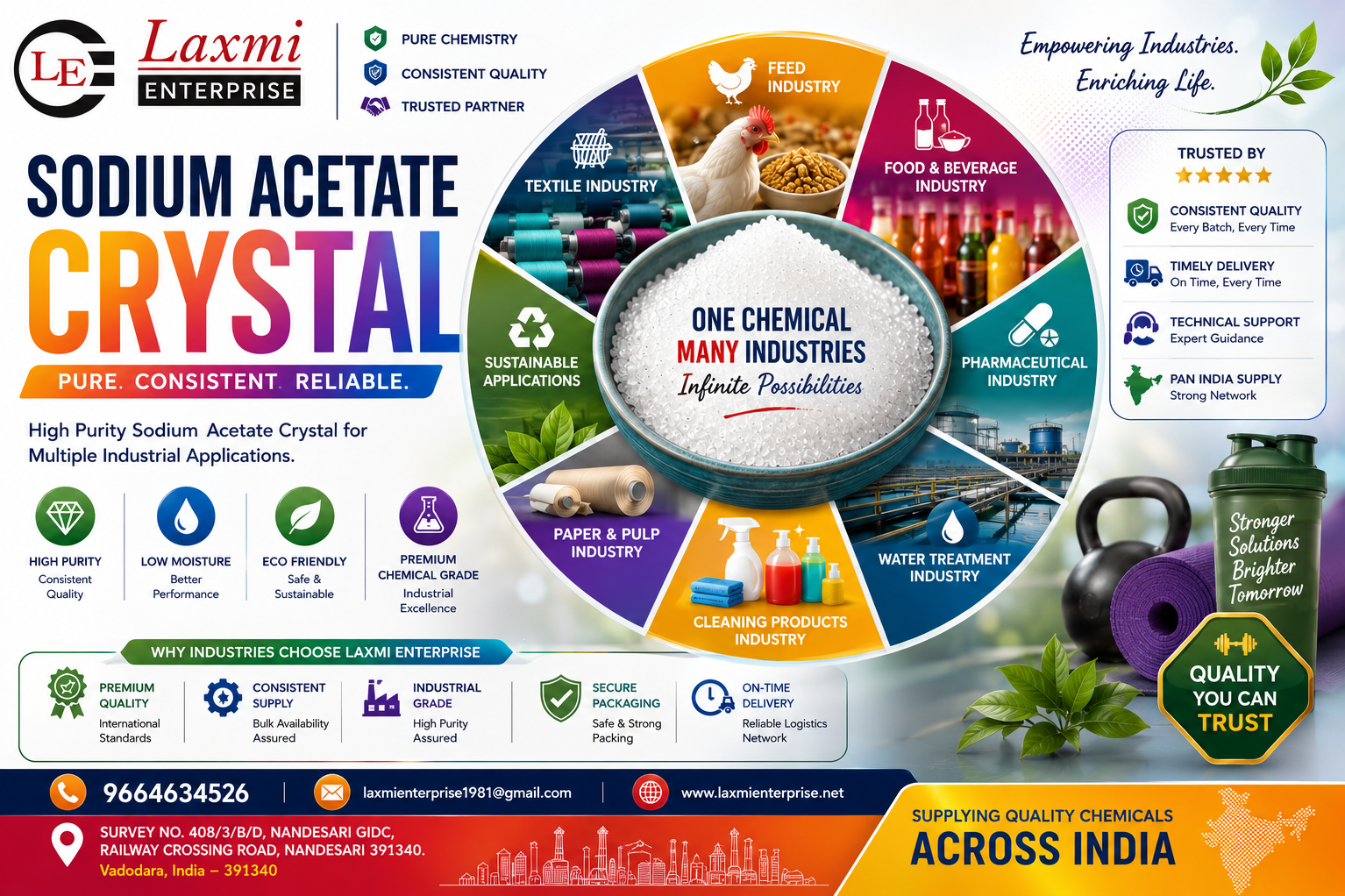
Complete Technical & Procurement Guide to Sodium Acetate (Anhydrous & Trihydrate)SEO Title: Sodium Acetate Anhydrous & Trihydrate: Technical Guide & Procurement ManualMeta Title: Sodium Acetate Supplier & Technical Guide | Laxmi EnterpriseMeta Description: Complete technical guide to Sodium Acetate Anhydrous (CAS 127-09-3) and Trihydrate (CAS 6131-90-4). Grade selection, buffer chemistry, industrial uses, and procurement standards from Laxmi Enterprise, Vadodara, Gujarat.SEO URL: laxmienterprise.net/technical-guide-sodium-acetate-anhydrous-trihydrateQuick Answer SummaryWhat is Sodium Acetate?Sodium Acetate is the sodium salt of acetic acid, produced commercially as Sodium Acetate Anhydrous ($text{CH}_3text{COONa}$, CAS 127-09-3) and Sodium Acetate Trihydrate ($text{CH}_3text{COONa}cdot 3text{H}_2text{O}$, CAS 6131-90-4). It functions primarily as a pH buffer, neutralizing agent, carbon source, and crystal seed across textiles, pharmaceuticals, food, wastewater treatment, leather processing, and chemical manufacturing. Choosing between forms depends on process moisture sensitivity, handling preference, solubility requirements, and thermal energy constraints.Table of ContentsIntroduction & Product OverviewChemical Structure & Reaction ChemistryAnhydrous vs. Trihydrate: Technical ComparisonIndustrial Applications by SectorManufacturing Overview & Quality ParametersAnalytical Testing & Laboratory Quality ControlComprehensive Grade SpecificationsPackaging, Storage, Safety & HandlingIndustrial Procurement & Supplier Evaluation GuideIndustrial Case Studies & TroubleshootingFrequently Asked Questions (25+ Detailed FAQs)Chemical & Industrial Glossary1. Introduction & Product OverviewSodium Acetate is a versatile organic salt manufactured by neutralizing acetic acid with sodium carbonate or sodium hydroxide. It is widely used in industrial processing because of its high water solubility, low toxicity, chemical stability, and strong buffering capacity in mild acid-to-neutral pH ranges.In commercial manufacturing, it is produced in two distinct forms:Sodium Acetate Anhydrous ($text{CH}_3text{COONa}$): A hygroscopic, white crystalline powder or granule with no water of crystallization. It contains a minimum of 99.0% active material by weight and is ideal for moisture-sensitive formulations, anhydrous reactions, and compact storage.Sodium Acetate Trihydrate ($text{CH}_3text{COONa}cdot 3text{H}_2text{O}$): A stable, white monoclinic crystalline solid containing three water molecules per formula unit (approximately 39.7% bound water by weight). It dissolves rapidly, melts easily at moderate temperatures ($58^circtext{C}$), and is used where hydration improves process compatibility or thermal energy storage.As a leading supplier, stockist, and distributor based in Nandesari GIDC, Vadodara, Gujarat, Laxmi Enterprise supplies high-purity Sodium Acetate Anhydrous and Trihydrate for industrial operations across India and international markets. Operating from the chemical hub of Gujarat—near major industrial centers including Ahmedabad, Surat, Vapi, Ankleshwar, and Dahej—Laxmi Enterprise provides reliable material availability, technical support, and strict batch-to-batch quality control.2. Chemical Structure & Reaction Chemistry2.1 Chemical Formulas and IdentifiersParameterSodium Acetate AnhydrousSodium Acetate TrihydrateIUPAC NameSodium acetateSodium acetate trihydrateChemical Formula$text{CH}_3text{COONa}$$text{CH}_3text{COONa}cdot 3text{H}_2text{O}$Molar Mass$82.03text{ g/mol}$$136.08text{ g/mol}$CAS Number127-09-36131-90-4EC / EINECS Number204-823-8204-823-8 (Parent)PubChem CID51704523665404HSN Code2915.29.202915.29.20Physical AppearanceWhite free-flowing powder/granulesWhite monoclinic crystals2.2 Reaction Chemistry & SynthesisCommercial Sodium Acetate is synthesized by reacting acetic acid with sodium carbonate ($text{Na}_2text{CO}_3$) or liquid caustic soda ($text{NaOH}$):$$text{CH}_3text{COOH} + text{NaOH} rightarrow text{CH}_3text{COONa} + text{H}_2text{O}$$$$text{2 CH}_3text{COOH} + text{Na}_2text{CO}_3 rightarrow text{2 CH}_3text{COONa} + text{H}_2text{O} + text{CO}_2uparrow$$Trihydrate Formation: Evaporating the aqueous solution below $58^circtext{C}$ causes Sodium Acetate Trihydrate to crystallize out with three bound water molecules per unit cell.Anhydrous Conversion: Heating the trihydrate solid above its melting point ($58^circtext{C}$) drives off the hydration water. Continued thermal drying at $120^circtext{C}$ to $130^circtext{C}$ yields the anhydrous form:$$text{CH}_3text{COONa}cdot 3text{H}_2text{O} xrightarrow{Delta ge 120^circtext{C}} text{CH}_3text{COONa} + 3text{H}_2text{O}uparrow$$2.3 Buffer Mechanism and EquilibriumSodium Acetate acts as a classic conjugate base buffer when combined with acetic acid ($text{CH}_3text{COOH}$). In aqueous solutions, it dissociates completely:$$text{CH}_3text{COONa (aq)} rightarrow text{CH}_3text{COO}^- text{(aq)} + text{Na}^+ text{(aq)}$$The acetate anion ($text{CH}_3text{COO}^-$) reacts with added strong acids ($text{H}^+$) to form weakly dissociated acetic acid, preventing sudden drops in pH:$$text{CH}_3text{COO}^- + text{H}^+ rightleftharpoons text{CH}_3text{COOH}$$Conversely, when a strong base ($text{OH}^-$) is added, the undissociated acetic acid neutralizes it:$$text{CH}_3text{COOH} + text{OH}^- rightleftharpoons text{CH}_3text{COO}^- + text{H}_2text{O}$$The buffer operational range is governed by the Henderson-Hasselbalch equation:$$text{pH} = text{p}K_a + logleft(frac{[text{CH}_3text{COO}^-]}{[text{CH}_3text{COOH}]}right)$$With a $text{p}K_a$ of 4.76 at $25^circtext{C}$, a Sodium Acetate / Acetic Acid buffer system operates reliably between pH 3.75 and 5.75, making it essential for dyeing, leather tanning, pharmaceutical formulations, and biochemical assays.3. Anhydrous vs. Trihydrate: Technical ComparisonChoosing between anhydrous and trihydrate forms impacts operational costs, material handling, storage conditions, and process chemistry.Technical ParameterSodium Acetate AnhydrousSodium Acetate TrihydrateChemical Formula$text{CH}_3text{COONa}$$text{CH}_3text{COONa}cdot 3text{H}_2text{O}$Active Salt Content$ge 99.0%$$approx 60.3%$ (Remainder is $text{H}_2text{O}$)Bound Water Content$le 1.0%$ (Hygroscopic moisture)$39.0% - 40.5%$ (Water of crystallization)Melting Point$324^circtext{C}$ (Decomposes $>400^circtext{C}$)$58^circtext{C}$ (Loses water to become anhydrous)Solubility in Water ($20^circtext{C}$)$1190text{ g/L}$ ($46.4text{ w/w}%$)$1250text{ g/L}$ (Calculated as hydrated material)Dissolution HeatExothermic ($Delta H_{soln} < 0$)Endothermic ($Delta H_{soln} > 0$)Bulk Density$0.50 - 0.70text{ g/cm}^3$$0.75 - 0.95text{ g/cm}^3$Hygroscopic NatureVery high (Absorbs water from humid air)Low (Stable under ambient conditions)Freight EfficiencyHigh ($1.00text{ kg}$ provides $1.00text{ kg}$ active salt)Standard ($1.66text{ kg}$ yields $1.00text{ kg}$ active salt)Key ApplicationsAnhydrous reactions, dry blends, desiccant usesAqueous solutions, dyeing, buffer prep, thermal packs4. Industrial Applications by Sector ┌─────────────────────────────────────────┐
│ SODIUM ACETATE USES │
└────────────────────┬────────────────────┘
│
┌───────────────────┬────────────────────┼────────────────────┬───────────────────┐
│ │ │ │ │
┌────┴─────────┐ ┌──────┴───────┐ ┌─────────┴────────┐ ┌────────┴────────┐ ┌────────┴────────┐
│ Textiles │ │ Pharma & Lab │ │ Water Treatment │ │ Food & Leather │ │ Construction │
├──────────────┤ ├──────────────┤ ├──────────────────┤ ├─────────────────┤ ├─────────────────┤
│• pH Buffering│ │• Dialysis │ │• Carbon Source │ │• Preservative │ │• Concrete Retard│
│• Dye Fixation│ │• Electrolytes│ │• Denitrification │ │• Tanning Neutral│ │• Sealant Agent │
│• Acid Neutral│ │• DNA Isolation│ │• Biological Nutrient││• Flavor Control │ │• Anti-Efflorescence│
└──────────────┘ └──────────────┘ └──────────────────┘ └─────────────────┘ └─────────────────┘
4.1 Textile, Dyeing, and Garment ProcessingAcid Neutralization: Neutralizes residual sulfuric acid after wool carbonization and cotton processing.Reactive Dye Buffering: Maintains a stable pH range (4.5–5.5) in dyebaths, ensuring even dye uptake, high color yield, and level dyeing across cotton, silk, and synthetic fabrics.Aniline Black Dyeing: Prevents fiber degradation during oxidation by buffering acidic byproducts.Denim Finishing: Used as a buffer during ozone and enzyme washing processes to stabilize target pH levels.4.2 Pharmaceuticals, Medical, and BiotechnologyIntravenous Solutions: Used as an electrolyte replenisher in parenteral solutions to manage metabolic acidosis.Hemodialysis Formulations: Functions as a base precursor in dialysate solutions to stabilize blood pH during treatment.Molecular Biology: High-purity AR/LR grade Sodium Acetate (3.0 M, pH 5.2) precipitates nucleic acids (DNA/RNA) in ethanol solutions.Protein Crystallization: Serves as a buffer to stabilize protein structures during isolation and purification.4.3 Water Treatment & Biological DenitrificationCarbon Source for Bacteria: Acts as an easily biodegradable carbon source for heterotrophic denitrifying bacteria in municipal and industrial wastewater systems.Biological Nutrient Removal (BNR): Accelerates nitrate ($text{NO}_3^-$) conversion to nitrogen gas ($text{N}_2$) without leaving toxic byproducts.COD/BOD Adjustment: Provides precise Chemical Oxygen Demand (COD) tuning for biological reactors, operating faster than methanol or acetic acid without safety or flashpoint hazards.4.4 Food, Feed, and AgricultureFood Additive (E262): Used as a acidity regulator, flavor enhancer, and preservative in bakery products, snacks, processed meats, and sauces.Animal & Livestock Feed: Functions as a buffering additive in cattle, poultry, pig, and aquaculture feeds, supporting rumen health and nutrient absorption.Mold Control: Inhibits fungal growth in stored grain and animal feeds.4.5 Leather Tanning & ProcessingPickling & Neutralization: Neutralizes strong mineral acids used in chrome tanning, ensuring even chromium penetration into hides without damage.Uniform Pickling: Prevents surface-only tanning by controlling pH shifts throughout the cross-section of the leather.4.6 Construction, Concrete, and SealantsConcrete Setting Retarder: Slows initial cement hydration, extending workability during hot-weather pours.Waterproofing Barrier: Reduces concrete porosity and surface efflorescence by forming insoluble crystal networks within micro-voids.4.7 Phase Change Materials (PCM) & Thermal Energy StorageLatent Heat Thermal Storage: Sodium Acetate Trihydrate melts at $58^circtext{C}$ with a high latent heat of fusion ($approx 264text{ J/g}$).Reusable Heating Pads: Supercooled liquid trihydrate crystallizes rapidly upon activation (e.g., via a metal trigger disc), releasing stored heat for therapeutic and consumer heat packs.5. Manufacturing Overview & Quality ParametersRaw Materials (Acetic Acid + Caustic Soda / Soda Ash)
│
▼
Neutralization Reactor (pH 7.0 - 8.5)
│
▼
Filtration & Carbon Treatment
│
▼
Evaporation & Crystallization
│
┌───────────────┴───────────────┐
▼ ▼
Trihydrate Centrifugation Thermal Dehydration (>120°C)
│ │
▼ ▼
Cooling & Fluid Bed Drying Fluid Bed Anhydrous Dryer
│ │
▼ ▼
Screening & Sifting Cooling & Anti-Caking Addition
│ │
▼ ▼
Packaging: Trihydrate (PE Bags) Packaging: Moisture-Proof HDPE
5.1 Synthesis and NeutralizationIndustrial acetic acid ($text{CH}_3text{COOH}, 99.8%$) is reacted with purified sodium hydroxide ($text{NaOH}, 48%-50%$) or sodium carbonate ($text{Na}_2text{CO}_3$) in stainless steel ($316text{L}$) reactor vessels. Temperature and dosing rate are controlled to keep the pH between 7.0 and 8.5.5.2 Purification and FiltrationThe crude solution passes through activated carbon filters to remove trace organic impurities, color-forming bodies, and insoluble matter, producing a water-white feed liquid.5.3 Crystallization vs. Thermal DehydrationTrihydrate Route: The purified liquid is concentrated under vacuum and cooled below $55^circtext{C}$ to crystallize Sodium Acetate Trihydrate. The slurry is centrifuged and dried under controlled low-temperature air flow to preserve the water of crystallization.Anhydrous Route: Concentrated solution or trihydrate crystals enter a high-temperature thermal dehydrator operating between $120^circtext{C}$ and $140^circtext{C}$. Moisture is removed, yielding anhydrous material which is ground, sifted, and cooled in a dry atmosphere.5.4 Key Quality ParametersParameterImpact on Process PerformanceRisk of Non-CompliancePurity Assayed (%)Direct measure of active salt available for buffering/reaction.Inconsistent dosing, under-buffering.Moisture ContentCritical for Anhydrous grades; prevents clumping and unwanted water addition.Caking in hoppers, reduced active weight.Iron (Fe) ContentImportant in textiles and pharma to avoid staining or catalysis side reactions.Fabric discoloration, batch degradation.Heavy Metals (Pb, As)Required for Food (E262) and Pharma grades to ensure safety compliance.Health hazards, regulatory non-compliance.Water InsolublesPrevents filter plugging and sediment buildup in automated liquid dosing.Filter blinding, nozzle clogging.pH (5% Solution)Ensures predictable buffer performance upon dissolution.Drift in dyebath or formulation pH.6. Analytical Testing & Laboratory Quality ControlLaxmi Enterprise verifies batch consistency using standard, traceable analytical methods: ┌────────────────────────────────────────┐
│ INCOMING & BATCH QC TESTING │
└───────────────────┬────────────────────┘
│
┌───────────────────┬──────────────────┼───────────────────┬───────────────────┐
│ │ │ │ │
┌────────┴────────┐ ┌────────┴────────┐ ┌───────┴────────┐ ┌────────┴────────┐ ┌────────┴────────┐
│ Nonaqueous Titr.│ │ Karl Fischer │ │ ICP-OES / AAS │ │ pH & Turbidity │ │ Sieving Analysis│
├─────────────────┤ ├─────────────────┤ ├─────────────────┤ ├─────────────────┤ ├─────────────────┤
│• Assay % │ │• Water Content │ │• Iron (Fe) │ │• pH (5% sol) │ │• Particle Size │
│• Purity Check │ │• Anhydrous Spec │ │• Heavy Metals │ │• Insoluble matter││• Flowability │
└─────────────────┘ └─────────────────┘ └─────────────────┘ └─────────────────┘ └─────────────────┘
6.1 Assay Titration (Nonaqueous)Principle: Anhydrous Sodium Acetate behaves as a weak base in glacial acetic acid and is titrated against perchloric acid ($text{HClO}_4$) standard volumetric solution.Reagents: Glacial acetic acid, $0.1text{ M}$ Perchloric acid in acetic acid, Crystal Violet indicator (or potentiometric endpoint electrode).Procedure:Weigh accurately $approx 0.2text{ g}$ of dried sample into a clean, dry titration flask.Dissolve in $50text{ mL}$ of glacial acetic acid.Titrate with $0.1text{ M HClO}_4$ until the color changes from violet to emerald-green.Calculate purity using:$$text{Assay (%)} = frac{V times M times 82.03}{W times 1000} times 100$$Where $V = text{volume of }text{HClO}_4text{ in mL}$, $M = text{molarity of }text{HClO}_4$, and $W = text{sample weight in grams}$.6.2 Moisture Determination (Karl Fischer & Loss on Drying)Loss on Drying (LOD) for Trihydrate: Heat $2.0text{ g}$ of sample at $120^circtext{C}$ for 4 hours. Target weight loss: $39.0% - 40.5%$.Karl Fischer Titration for Anhydrous: Volumetric or coulometric KF titration determines residual moisture. Standard target: $le 0.5% - 1.0%$.6.3 Trace Metal Analysis (Iron & Heavy Metals)Iron (Fe): Determined colorimetrically using 1, 10-phenanthroline or via ICP-OES. Target: $< 10text{ ppm}$ (Industrial) or $< 5text{ ppm}$ (Pharma/AR).Heavy Metals (as Pb): Analyzed by Atomic Absorption Spectroscopy (AAS) or ICP-MS to ensure compliance with pharmacopeial limits ($< 5text{ ppm}$).7. Comprehensive Grade Specifications7.1 Technical Specifications: Sodium Acetate AnhydrousParameterIndustrial GradeTechnical GradeAR / LR GradeFood / Pharma GradeAssay (Dry Basis)$ge 98.5%$$ge 99.0%$$ge 99.5%$$99.0% - 101.0%$AppearanceOff-white powderWhite powderWhite crystallineFine white powderpH (5% at $25^circtext{C}$)7.5 – 9.57.5 – 9.07.5 – 8.57.5 – 9.0Loss on Drying$le 1.5%$$le 1.0%$$le 0.5%$$le 1.0%$Water Insolubles$le 0.05%$$le 0.02%$$le 0.005%$$le 0.01%$Chloride ($text{Cl}^-$)$le 0.15%$$le 0.05%$$le 0.002%$$le 0.01%$Sulfate ($text{SO}_4^{2-}$)$le 0.10%$$le 0.03%$$le 0.003%$$le 0.005%$Iron ($text{Fe}$)$le 20text{ ppm}$$le 10text{ ppm}$$le 3text{ ppm}$$le 5text{ ppm}$Heavy Metals ($text{Pb}$)$le 10text{ ppm}$$le 5text{ ppm}$$le 2text{ ppm}$$le 2text{ ppm}$7.2 Technical Specifications: Sodium Acetate TrihydrateParameterIndustrial GradeTechnical GradeAR / LR GradeFood / Pharma GradeAssay (Hydrated)$ge 98.5%$$ge 99.0%$$ge 99.5%$$99.0% - 101.0%$AppearanceWhite crystalsWhite crystalsClear crystalsClean white crystalspH (5% at $25^circtext{C}$)7.5 – 9.27.5 – 9.07.5 – 8.57.5 – 9.0Water of Crystallization$38.0% - 41.0%$$39.0% - 40.5%$$39.0% - 40.0%$$39.0% - 40.5%$Water Insolubles$le 0.05%$$le 0.02%$$le 0.005%$$le 0.01%$Chloride ($text{Cl}^-$)$le 0.10%$$le 0.03%$$le 0.001%$$le 0.005%$Sulfate ($text{SO}_4^{2-}$)$le 0.08%$$le 0.02%$$le 0.002%$$le 0.003%$Iron ($text{Fe}$)$le 15text{ ppm}$$le 10text{ ppm}$$le 2text{ ppm}$$le 3text{ ppm}$Heavy Metals ($text{Pb}$)$le 10text{ ppm}$$le 5text{ ppm}$$le 2text{ ppm}$$le 2text{ ppm}$8. Packaging, Storage, Safety & Handling8.1 Commercial Packaging OptionsLaxmi Enterprise supplies Sodium Acetate in secure, moisture-barrier industrial packaging:25 kg / 50 kg HDPE Bags: High-Density Polyethylene woven bags with a heavy-duty inner LDPE liner to protect against moisture absorption.500 kg / 1000 kg FIBC Jumbo Bags: Flexible Intermediate Bulk Containers equipped with moisture barrier liners and bottom discharge spouts for automated plants.Customized Drums: Fiber or plastic drums with tamper-evident seals for pharma and laboratory grades.+-------------------------------------------------------------------+
| HDPE OUTER WOVEN BAG |
| +-------------------------------------------------------------+ |
| | INNER LDPE LINER (100 MICRON) | |
| | +-------------------------------------------------------+ | |
| | | | | |
| | | SODIUM ACETATE PRODUCT | | |
| | | (ANHYDROUS / TRIHYDRATE) | | |
| | | | | |
| | +-------------------------------------------------------+ | |
| +-------------------------------------------------------------+ |
+-------------------------------------------------------------------+
8.2 Storage and Warehouse ConditionsAnhydrous Storage: Highly hygroscopic. Store in a cool, dry, well-ventilated warehouse below $30^circtext{C}$ and under $60%$ relative humidity. Ensure bags remain sealed until used.Trihydrate Storage: Keep away from direct sunlight and heat sources. Temperatures above $50^circtext{C}$ can cause the material to dissolve in its own water of crystallization, leading to caking upon cooling.Palletization: Store on clean wooden or plastic pallets elevated off the floor. Stack no more than 2 pallets high to prevent caking in lower bags.8.3 Safety, Hazards & Transport Classification NFPA 704 DIAMOND
[ 1 ]
[ 1 ] [ 0 ]
[ ]
GHS Classification: Non-hazardous substance under standard industrial handling. Not classified as dangerous goods for transport (ADR, RID, IMDG, IATA).NFPA 704 Rating: Health: 1 (Slight), Flammability: 1 (Slight), Reactivity: 0 (Stable).Personal Protective Equipment (PPE): Safety goggles, dust mask (N95/FFP2), nitrile gloves, and industrial work overalls during bulk handling.Spill Response: Sweep up dry material into clean, labeled containers for reuse or disposal. Flush residual spill areas with clean water.9. Industrial Procurement & Supplier Evaluation Guide┌────────────────────────────────────────────────────────────────────────┐
│ SUPPLIER EVALUATION CHECKLIST │
├────────────────────────────────────────────────────────────────────────┤
│ [ ] Certificate of Analysis (COA) supplied per batch │
│ [ ] Technical Data Sheet (TDS) and SDS available │
│ [ ] ISO 9001:2015 Quality Management System Certification │
│ [ ] Moisture-barrier packaging with inner LDPE liner │
│ [ ] Batch traceability from raw material to dispatch │
│ [ ] Verified plant capacity and stockholding at Nandesari GIDC │
│ [ ] Clear logistics routes to major ports (Hazira, Mundra, Nhava Sheva)│
└────────────────────────────────────────────────────────────────────────┘
9.1 Procurement Checklist for Purchase ManagersWhen sourcing Sodium Acetate for industrial facilities, evaluate suppliers using these criteria:Form Accuracy: Confirm whether the process requires Anhydrous ($ge 99%$) or Trihydrate ($approx 60%$ active salt) to avoid dosage and cost errors.Batch-to-Batch Consistency: Verify that the supplier maintains tight control over assay, moisture, and iron limits.Traceability & Documentation: Ensure every shipment includes a manufacturer Certificate of Analysis (COA), Technical Data Sheet (TDS), and Safety Data Sheet (SDS).Packaging Integrity: Check that inner liners are thick enough ($ge 80 - 100text{ microns}$) to prevent moisture ingress and caking during transport.Location & Logistics: Sourcing from industrial hubs like Nandesari GIDC, Vadodara ensures shorter lead times, lower freight costs, and reliable supply to industrial zones across Gujarat and India.9.2 Questions to Ask Chemical SuppliersWhat is the guaranteed maximum moisture content for your Sodium Acetate Anhydrous?What packaging measures are used to prevent caking during transport?Can you supply custom particle sizes or bulk jumbo bag configurations?Are your pharma and food grades produced under cGMP / FSSAI compliant conditions?10. Industrial Case Studies & TroubleshootingCase Study 1: Dyebath Optimization in a Gujarat Textile PlantIssue: A textile processing unit in Surat experienced uneven color shades and fabric weakening during reactive dyeing.Root Cause Analysis: The mill was using basic alkali additions without proper buffer control, causing pH spikes above 8.5 during heating.Solution: Laxmi Enterprise introduced Sodium Acetate Trihydrate (Technical Grade) combined with acetic acid to maintain a stable pH buffer at 5.2–5.5 throughout the dyeing cycle.Results: Shade variance dropped by $92%$, acid damage was eliminated, and overall dye consumption fell by $8%$ due to improved exhaustion efficiency.Case Study 2: Wastewater Denitrification EfficiencyIssue: A chemical plant in Dahej struggled to lower effluent nitrate levels below local environmental discharge limits ($< 10text{ mg/L }text{NO}_3text{-N}$).Root Cause Analysis: Methanol was used as a carbon source, but low ambient temperatures slowed bacterial uptake and created safety concerns around flashpoint handling.Solution: The plant transitioned to Sodium Acetate Anhydrous solution (30% w/w) supplied by Laxmi Enterprise.Results: Denitrification rates increased within 48 hours, nitrate compliance reached $100%$, and chemical handling hazards were resolved.11. Frequently Asked Questions (25+ Detailed FAQs)Q1: What is the main difference between Sodium Acetate Anhydrous and Trihydrate?Sodium Acetate Anhydrous ($text{CH}_3text{COONa}$) contains no water of crystallization and has an active purity of $ge 99.0%$. Sodium Acetate Trihydrate ($text{CH}_3text{COONa}cdot 3text{H}_2text{O}$) contains three bound water molecules per unit, resulting in $approx 60.3%$ active salt and $approx 39.7%$ water weight.Q2: Can I substitute Sodium Acetate Trihydrate for Anhydrous in my process?Yes, provided you adjust for the weight difference and water content. To replace $1.0text{ kg}$ of Sodium Acetate Anhydrous, use $1.66text{ kg}$ of Sodium Acetate Trihydrate. You must also account for the $0.66text{ kg}$ of added water in moisture-sensitive processes.Q3: What is the CAS number for Sodium Acetate?The CAS number for Sodium Acetate Anhydrous is 127-09-3. The CAS number for Sodium Acetate Trihydrate is 6131-90-4.Q4: Why is Sodium Acetate used in textile dyeing?It acts as a conjugate base buffer with acetic acid, maintaining dyebath pH between 4.5 and 5.5. This prevents fiber degradation, stabilizes dye molecules, and ensures level, reproducible shade yields.Q5: Is Sodium Acetate hazardous or toxic?Sodium Acetate is generally considered non-hazardous, non-toxic, and biodegradable under normal industrial conditions. Standard industrial hygiene (dust mask, safety glasses, gloves) is recommended during handling.Q6: How should Sodium Acetate Anhydrous be stored to prevent caking?Store in sealed moisture-proof bags with inner LDPE liners in a climate-controlled warehouse below $30^circtext{C}$ and $<60%$ relative humidity. Avoid double-stacking pallets for long periods.Q7: What is the solubility of Sodium Acetate in water?Sodium Acetate is highly soluble. Anhydrous dissolves up to $1190text{ g/L}$ at $20^circtext{C}$, while Trihydrate dissolves up to $1250text{ g/L}$. Solubility increases with temperature.Q8: Why is Sodium Acetate used in wastewater treatment plants?It provides an easily bioavailable carbon source for heterotrophic denitrifying bacteria, converting nitrate ($text{NO}_3^-$) to atmospheric nitrogen gas ($text{N}_2$) without flashpoint hazards or toxic residues.Q9: What is the HSN code for Sodium Acetate in India?The primary HSN code for Sodium Acetate (both Anhydrous and Trihydrate) is 2915.29.20.Q10: What role does Sodium Acetate play in heating pads and PCMs?Sodium Acetate Trihydrate melts at $58^circtext{C}$ and can be supercooled down to room temperature without solidifying. Bending an internal metal disk triggers rapid crystallization, releasing stored latent heat ($approx 264text{ J/g}$).Q11: How does Sodium Acetate function in leather tanning?It acts as a neutralizing agent for chrome-tanned hides, preventing rapid surface binding of chromium salts and ensuring deep, uniform leather tanning.Q12: What grades of Sodium Acetate does Laxmi Enterprise supply?Laxmi Enterprise supplies Industrial, Technical, Laboratory (LR/AR), Food (E262), and Pharmacopeia-aligned grades in both Anhydrous and Trihydrate forms.Q13: What is the pH of a Sodium Acetate solution?A $5%$ aqueous solution of Sodium Acetate typically has a pH between 7.5 and 9.0, as the acetate ion undergoes mild hydrolysis in water.Q14: Does Sodium Acetate act as a food preservative?Yes. Classified as food additive E262, it acts as an acidity regulator and preservative, inhibiting bacterial growth in baked goods, processed meats, and sauces.Q15: Why is Iron (Fe) content critical in Sodium Acetate specifications?Iron impurities cause fabric discoloration in textiles, catalyze oxidation in pharmaceutical formulas, and cause unwanted side reactions in fine chemical synthesis.Q16: How is Sodium Acetate used in molecular biology?A $3.0text{ M}$ Sodium Acetate solution (pH 5.2) is used alongside ethanol or isopropanol to precipitate DNA and RNA out of aqueous solution during extraction protocols.Q17: What is the melting point of Sodium Acetate Trihydrate?Sodium Acetate Trihydrate melts at $58^circtext{C}$ ($136.4^circtext{F}$), dissolving into its own water of crystallization.Q18: What is the shelf life of Sodium Acetate?When stored in its original, unopened moisture-barrier packaging under dry warehouse conditions, Sodium Acetate has a shelf life of 2 to 3 years.Q19: Where is Laxmi Enterprise located?Laxmi Enterprise is based in Nandesari GIDC, Vadodara, Gujarat, India, a prime hub for industrial chemical manufacturing and distribution.Q20: Can Laxmi Enterprise supply Sodium Acetate across India and for export?Yes. Laxmi Enterprise supplies customer facilities across India (including industrial centers in Gujarat, Maharashtra, South India, and North India) and provides export-ready material through major ports like Hazira, Mundra, and Nhava Sheva.Q21: What testing documents accompany a shipment from Laxmi Enterprise?Every shipment includes a batch-specific Certificate of Analysis (COA), Technical Data Sheet (TDS), and Safety Data Sheet (SDS).Q22: How does Sodium Acetate compare to Methanol in biological denitrification?Sodium Acetate is non-flammable, safe to store, acts faster at low temperatures, and poses no chemical toxicity to treatment plant biomass compared to methanol.Q23: Is Sodium Acetate Anhydrous exothermic upon dissolution?Yes. Dissolving Anhydrous Sodium Acetate in water releases heat (exothermic reaction), whereas dissolving Trihydrate absorbs heat (endothermic reaction).Q24: What bulk packaging options are available for industrial purchase?Options include 25 kg HDPE bags, 50 kg HDPE bags, and 500 kg or 1000 kg Jumbo FIBC bags with inner liners.Q25: How do I select between Industrial Grade and AR Grade Sodium Acetate?Use Industrial Grade for large-scale applications like wastewater treatment, concrete admixtures, and basic dyeing. Choose AR/LR Grade for analytical research, medical formulations, and high-purity laboratory assays.Q26: How can I request a technical quote from Laxmi Enterprise?Contact Laxmi Enterprise directly via their official website at www.laxmienterprise.net or through their supply desk in Nandesari GIDC, Vadodara, Gujarat.12. Chemical & Industrial GlossaryAnhydrous: A substance containing no water molecules in its crystalline structure.AEO (Answer Engine Optimization): Structuring technical content so AI search tools (ChatGPT, Gemini, Perplexity) can directly read and provide factual answers to user queries.Buffer Capacity: The ability of a solution to resist changes in pH when an acid or base is added.CAS Number: A unique numerical identifier assigned by the Chemical Abstracts Service to every chemical substance described in scientific literature.Conjugate Base: The species formed when an acid loses a proton ($text{H}^+$); acetate ($text{CH}_3text{COO}^-$) is the conjugate base of acetic acid.Denitrification: The biological process where bacteria convert nitrate ($text{NO}_3^-$) into atmospheric nitrogen gas ($text{N}_2$).Exothermic: A chemical or physical process that releases heat energy to its surroundings.FIBC: Flexible Intermediate Bulk Container; also known as a jumbo bag or bulk bag for shipping powders.GEO (Generative Engine Optimization): Optimizing technical content for inclusion in generative AI knowledge bases and search engine direct answers.Hygroscopic: The tendency of a substance to readily absorb moisture from the surrounding atmosphere.Latent Heat of Fusion: The thermal energy absorbed or released when a material changes state between solid and liquid without a change in temperature.Mother Liquor: The residual liquid remaining after crystallization and separation of solid crystals.Pickling: An industrial leather tanning step where hides are treated with acid and salt solutions to prepare them for chrome tanning.Supercooling: Cooling a liquid below its freezing temperature without it becoming a solid, creating a metastable liquid state.Trihydrate: A crystalline hydrate containing three water molecules per chemical formula unit.Schema-Ready FAQ (JSON-LD)JSON{
'@context': 'https://schema.org',
'@type': 'FAQPage',
'mainEntity': [
{
'@type': 'Question',
'name': 'What is the main difference between Sodium Acetate Anhydrous and Trihydrate?',
'acceptedAnswer': {
'@type': 'Answer',
'text': 'Sodium Acetate Anhydrous (CH3COONa) contains no water of crystallization and has an active purity of at least 99.0%. Sodium Acetate Trihydrate (CH3COONa·3H2O) contains three bound water molecules per unit, resulting in approximately 60.3% active salt and 39.7% water weight.'
}
},
{
'@type': 'Question',
'name': 'Can I substitute Sodium Acetate Trihydrate for Anhydrous in my process?',
'acceptedAnswer': {
'@type': 'Answer',
'text': 'Yes, provided you adjust for the weight difference and water content. To replace 1.0 kg of Sodium Acetate Anhydrous, use 1.66 kg of Sodium Acetate Trihydrate. You must also account for the 0.66 kg of added water in moisture-sensitive processes.'
}
},
{
'@type': 'Question',
'name': 'What is the CAS number for Sodium Acetate?',
'acceptedAnswer': {
'@type': 'Answer',
'text': 'The CAS number for Sodium Acetate Anhydrous is 127-09-3. The CAS number for Sodium Acetate Trihydrate is 6131-90-4.'
}
},
{
'@type': 'Question',
'name': 'Why is Sodium Acetate used in textile dyeing?',
'acceptedAnswer': {
'@type': 'Answer',
'text': 'It acts as a conjugate base buffer with acetic acid, maintaining dyebath pH between 4.5 and 5.5. This prevents fiber degradation, stabilizes dye molecules, and ensures level, reproducible shade yields.'
}
},
{
'@type': 'Question',
'name': 'Where is Laxmi Enterprise located?',
'acceptedAnswer': {
'@type': 'Answer',
'text': 'Laxmi Enterprise is headquartered in Nandesari GIDC, Vadodara, Gujarat, India, a prime industrial chemical manufacturing and distribution hub.'
}
}
]
}
Contact Information & Commercial InquiriesFor technical documentation, bulk procurement pricing, sample requests, or Certificate of Analysis (COA) verification, contact the chemical distribution team at Laxmi Enterprise:Company Name: Laxmi EnterpriseOperating Location: Nandesari GIDC, Vadodara, Gujarat, IndiaOfficial Website: www.laxmienterprise.netProduct Portfolio: Sodium Acetate Anhydrous, Sodium Acetate Trihydrate, and Fine Industrial Inorganic Salts.