
High-Purity Sodium Nitrate – Product Specifications
Chemical Identity
Parameter Specification
Chemical Name Sodium Nitrate
Synonyms Chile Saltpeter, Nitratum Natricum
Chemical Formula NaNO₃
Molecular Weight 85.00 g/mol
CAS Number 7631-99-4
UN Number 1498
Hazard Class Oxidizer (Class 5.1)
EC Number 231-554-3
Physical & Chemical Properties
Property Typical Value
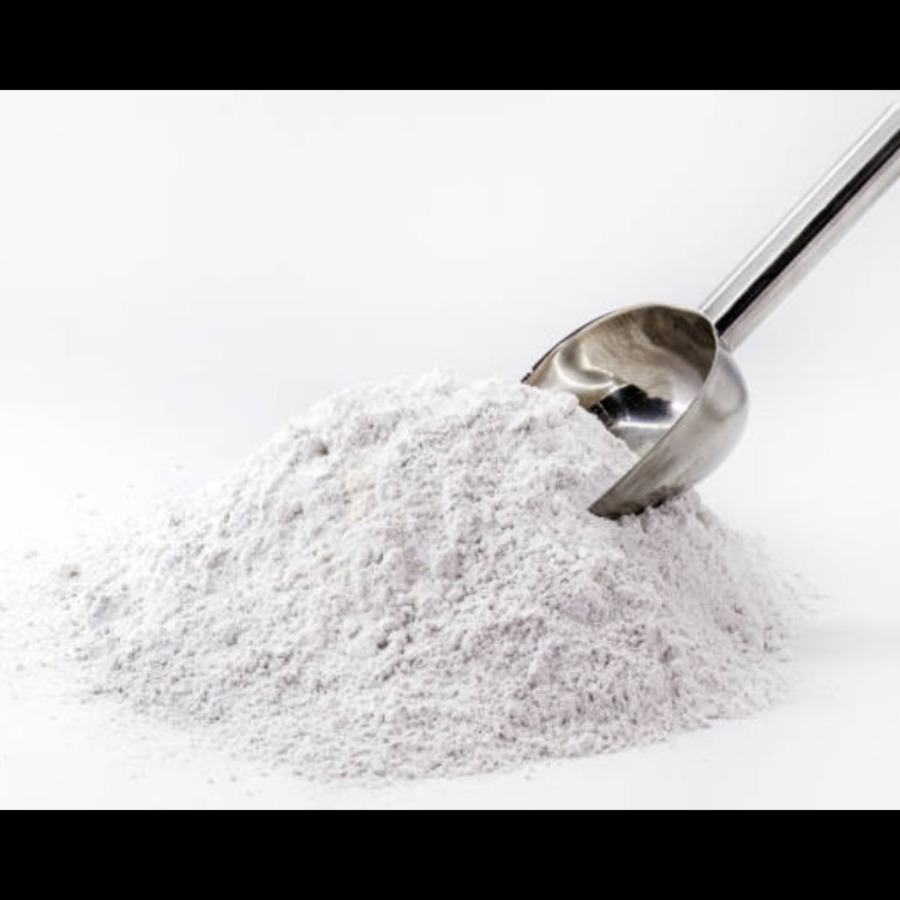
Appearance White to transparent crystalline solid
Odor Odorless
Solubility in Water (20 °C) ~92 g/100 mL
Melting Point 308 °C
Boiling Point / Decomposition ~380 °C (decomposes)
Density (bulk) 2.26 g/cm³
pH (5% solution, 25 °C) 6.5 – 8.5
Hygroscopicity Slightly hygroscopic
Stability Stable under normal conditions; strong oxidizer
High-Purity Grade Specifications
Parameter Unit Specification
Assay (NaNO₃) % (w/w) ≥ 99.5 %
Moisture (H₂O) % ≤ 0.20 %
Chlorides (as Cl⁻) % ≤ 0.01 %
Sulphates (as SO₄²⁻) % ≤ 0.02 %
Nitrites (as NO₂⁻) % ≤ 0.01 %
Insoluble Matter in Water % ≤ 0.02 %
Iron (as Fe) ppm ≤ 10
Heavy Metals (as Pb) ppm ≤ 5
pH (5% solution) – 6.5 – 8.5
Particle Size – Free-flowing crystals or fine granules
Applications
Oxidizing agent in glass, ceramics, and metallurgical industries
Raw material for fertilizers and chemical intermediates
Used in heat treatment salts and metal finishing
Additive in wastewater & odor control processes
Laboratory reagent and analytical applications
Controlled use in pyrotechnic compositions under regulation (non-procedural)
Packaging Options
Type Description
25 kg / 50 kg HDPE bags Standard industrial packaging with inner liner
1000 kg jumbo bags Bulk packaging for large users
Custom packing As per client requirements
Storage & Handling
Store in a cool, dry, ventilated area away from heat and moisture.
Keep separate from organics, reducing agents, and combustibles.
Avoid contamination and minimize dust formation.
Follow oxidizer handling regulations (Class 5.1).
Quality Assurance
Manufactured under ISO-compliant process controls
Each batch tested for purity, moisture, and soluble impurities
COA (Certificate of Analysis) and SDS available upon request
Product Highlights for Catalog
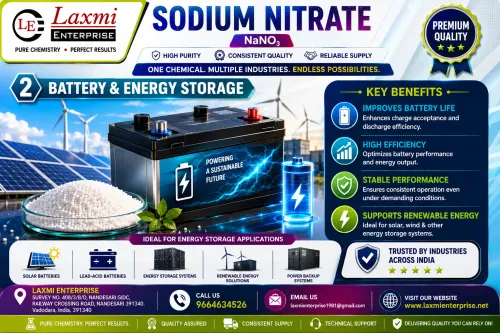
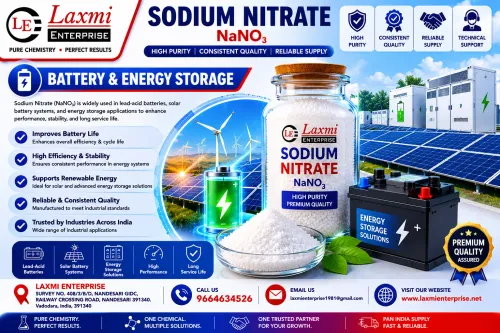
High-Purity Sodium Nitrate (≥99.5%) – Laxmi Enterprise, Vadodara
Reliable supply of fine crystalline oxidizer for industrial, metallurgical, and environmental applications. Consistent quality, tested batches, and flexible packaging options for bulk users across India.
SODIUM NITRATE — INDUSTRIAL OVERVIEW AS AN OXIDIZING AGENT
Below is a concise, industry-ready, non-procedural summary you can use in product literature, technical pages, or a catalog for Laxmi Enterprise. It focuses on chemistry, legitimate industrial uses, specifications, safety and regulatory considerations. I avoid any step-by-step or weaponizable details.
Quick facts
Name: Sodium nitrate
Formula: NaNO₃
CAS: 7631-99-4
Appearance: White crystalline or granular solid
Primary role: Strong oxidizing agent — supplies oxygen equivalents in thermal and chemical oxidation processes, and can act as an oxidation promoter or oxygen carrier in molten-salt systems.
How it acts as an oxidizing agent (high level)
The nitrate anion (NO₃⁻) can accept electrons and oxidize reducing species; under process conditions it is often reduced to nitrite (NO₂⁻), nitrogen oxides or other nitrogen species while oxidizing the substrate.
In many industrial uses NaNO₃ functions as a consumable oxidant rather than a classical cycling catalyst — i.e., it participates chemically and is transformed in the process.
At elevated temperatures NaNO₃ (alone or in eutectic mixtures) forms molten-salt media that facilitate homogeneous oxidation, heat transfer and mass transport — useful for salt-bath processing, thermal regeneration and selective oxidative roasting.
Key industrial applications (descriptive, non-operational)
Metallurgy & oxidative roasting: desulfurization, oxidation of sulfides and conversion processes where an oxidizer or molten-salt medium is useful.
Glass & ceramics: as an oxidizing additive in certain thermal processes and formulations.
Heat-transfer molten salts / thermal storage: component of nitrate salt mixtures used in high-temperature heat transfer and thermal energy storage.
Chemical manufacture: reagent or promoter in controlled oxidation steps and specialty chemical syntheses.
Wastewater & odor control: used to manage redox balance and reduce sulfide (H₂S) formation in sewers and tanks (as part of engineered treatment strategies).
Catalyst promotion: as a promoter or co-component in supported catalyst systems where it modifies oxygen availability or redox characteristics (used by catalyst formulators, not as an isolated catalytic recipe).
Laboratory & analytical reagent: where a reliable oxygen donor or nitrate source is required.
Note: Uses that could enable pyrotechnics or explosives are excluded from operational guidance. Sodium nitrate is a legitimate industrial chemical but subject to controls in certain applications.
Typical grades & product specs (industrial/high-purity)
Industrial/technical grade: ~95–99% NaNO₃ (crystalline/granular)
High-purity/reagent grade: ≥99.5% NaNO₃ for analytical or specialty uses
Typical QC parameters: assay (% NaNO₃), moisture, chlorides, sulphates, nitrites, insolubles, Fe/heavy metals, particle size.
Form factors & packaging: 25 kg / 50 kg HDPE bags with liners; 1 MT jumbo bags; loose bulk shipments for large users.
Advantages & limitations (overview)
Advantages: stable, easy to store/handle as a solid; dependable oxygen content; useful in molten-salt media and as a process promoter; cost-effective for many oxidation needs.
Limitations: consumable oxidant (is chemically consumed); can produce nitrite/NOx and other by-products that require off-gas treatment and effluent control; oxidizer hazards require segregation from organics and reducing agents.
Safety, handling & storage (concise)
Hazard class: Oxidizer — avoid contact with combustible materials and organics.
Storage: cool, dry, ventilated area; store separate from fuels, acids (where incompatible), and reducing agents.
Handling: minimize dust, use appropriate PPE (gloves, eye protection, respirator if dusty).
Spill response & disposal: treat spills as oxidizer hazards; avoid organic sorbents that could react; dispose per local hazardous-waste regulations and SDS instructions.
Emissions & environment: processes may generate nitrite or NOx — provide off-gas treatment and wastewater controls as required by regulation.
Regulatory & transport notes
Subject to oxidizer classification (e.g., UN1498 in many jurisdictions) and to local regulations for storage, transport and environmental discharge. Always consult SDS and local transport/regulatory requirements before shipment or large-scale use.
Comparison (high level)
vs KNO₃ (potassium nitrate): similar oxidizing power; selection often depends on melting point, solubility, ionic effects in molten salts and cost.
vs NaNO₂ (sodium nitrite): nitrite is a different redox intermediate and more reactive in some contexts; nitrite behavior and regulatory constraints differ.
Mixed nitrate systems: combining Na⁺ and K⁺ nitrates lets formulators tailor melting points and thermal stability for molten-salt applications.
HIGH-PURITY SODIUM NITRATE SPECIFICATIONS, LAXMI ENTERPRISE.
Quality assurance & supply (for procurement copy)
Available in industrial and high-purity grades with batch COA (assay, moisture, halides, insolubles).
Flexible packaging and reliable bulk supply from Vadodara, Gujarat (or specify your logistics).
Technical support available to discuss grade selection, QC specs, and logistics (non-operational process advice).
If you’d like, I can now:
Draft an SEO-optimized product page (meta title, meta description, keywords) for “Sodium Nitrate — Industrial Oxidizing Agent”.
Create a technical datasheet (PDF) with the specs above, hazard icons and packaging table ready for client use.
Produce a short comparison whitepaper (NaNO₃ vs KNO₃ vs NaNO₂) focused on molten-salt and oxidizing properties (non-procedural).
Which of those should I prepare for you next?