How Sodium Sulphate Is Manufactured: Natural & Synthetic Production Methods Explained (2026)
Primary Keyword: Sodium Sulphate Manufacturing Process
Secondary Keywords: Sodium Sulphate Production, Na₂SO₄ Manufacturing, Natural Sodium Sulphate, Synthetic Sodium Sulphate, Industrial Sodium Sulphate
Technical Product Identity
Property Details
Product Name Sodium Sulphate
Chemical Formula Na₂SO₄
CAS Number 7757-82-6
HSN Code (India) 2833 11 00
Molecular Weight 142.04 g/mol
EINECS Number 231-820-9
Appearance White crystalline powder or granules
Industrial Forms Anhydrous Sodium Sulphate and Hydrated Sodium Sulphate (application dependent)
Quick Answer
Sodium Sulphate is produced by natural and synthetic methods. Natural production typically involves recovery from mineral deposits or saline lakes, while synthetic production often occurs as a co-product or by-product of certain industrial chemical processes. After production, the material is purified, dried (where required), tested, packaged, and supplied according to customer specifications.
Why Manufacturing Knowledge Matters
Understanding how Sodium Sulphate is produced helps buyers:
Understand differences in supply sources.
Evaluate quality documentation.
Communicate technical requirements.
Review procurement specifications.
Better interpret supplier information.
For many industrial users, the most important consideration is whether the supplied material consistently meets the agreed specification.
Two Main Production Routes
Quick Answer
Commercial Sodium Sulphate generally comes from one of two broad sources:
Natural recovery from mineral deposits or saline brines.
Synthetic production associated with industrial chemical manufacturing.
The downstream processing, purification, and quality control steps are important regardless of the production route.
Route 1 – Natural Production
Natural Sodium Sulphate is obtained from naturally occurring sources such as:
Saline lakes.
Evaporite deposits.
Mineral resources containing sodium sulfate.
A simplified process may include:
Resource extraction.
Concentration or evaporation.
Crystallization.
Separation.
Drying (where applicable).
Screening.
Quality testing.
Packaging.
The exact process varies according to the geology and production technology.
Route 2 – Synthetic Production
Quick Answer
Synthetic Sodium Sulphate is commonly generated during certain industrial chemical manufacturing processes. The resulting material is recovered, purified where necessary, tested, and prepared for industrial use.
Depending on the manufacturing route, the process may include:
Recovery of Sodium Sulphate-containing streams.
Purification.
Crystallization.
Drying.
Screening.
Quality control.
Packaging.
The specific chemistry depends on the originating industrial process.
Simplified Manufacturing Flow
A generalized production sequence can be represented as:
Raw Material Source
↓
Recovery or Reaction
↓
Purification
↓
Crystallization
↓
Solid–Liquid Separation
↓
Drying (if required)
↓
Screening / Size Classification
↓
Laboratory Testing
↓
Packaging
↓
Dispatch
Individual plants may use additional or alternative processing steps.
Purification
Quick Answer
Purification removes or reduces unwanted impurities so the final product is suitable for its intended application. The required level of purification depends on the target market and customer specification.
Typical objectives include:
Consistent purity.
Controlled impurity levels.
Uniform appearance.
Reliable batch quality.
Drying
Some manufacturing routes require drying to achieve the desired product form.
Drying helps:
Improve handling.
Reduce moisture content.
Support storage stability.
Prepare material for packaging.
The drying method depends on the manufacturing process.
Particle Size Classification
After drying, manufacturers may classify the product according to particle size.
Particle size can influence:
Handling.
Dissolution.
Blending.
Packaging.
End-use performance.
The target size distribution depends on customer requirements.
Quality Control During Manufacturing
Quick Answer
Quality control is integrated throughout production. Manufacturers generally monitor raw materials, in-process conditions, and finished products to support consistent quality.
Typical quality activities include:
Raw material checks.
Process monitoring.
Finished product testing.
Batch identification.
Documentation.
Acceptance criteria are based on internal quality systems and customer specifications.
Finished Product Testing
Common quality parameters may include:
Parameter Purpose
Appearance Visual assessment
Purity Product specification
Moisture Handling and storage
Water-Insoluble Matter Process suitability
Particle Size Handling and application
Iron (where specified) Application-specific requirement
Chloride (where specified) Process-specific requirement
The required tests depend on the intended application.
Packaging After Production
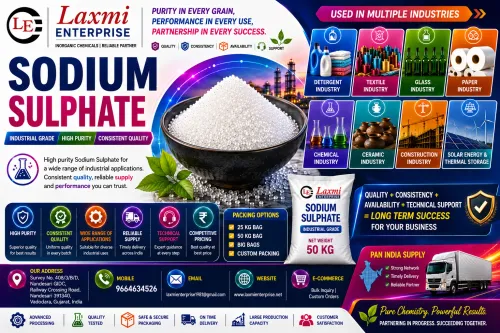
Once approved, Sodium Sulphate may be packed in:
25 kg bags.
50 kg bags.
500 kg FIBC.
1000 kg FIBC.
Packaging selection depends on customer requirements and logistics planning.
Industry Applications
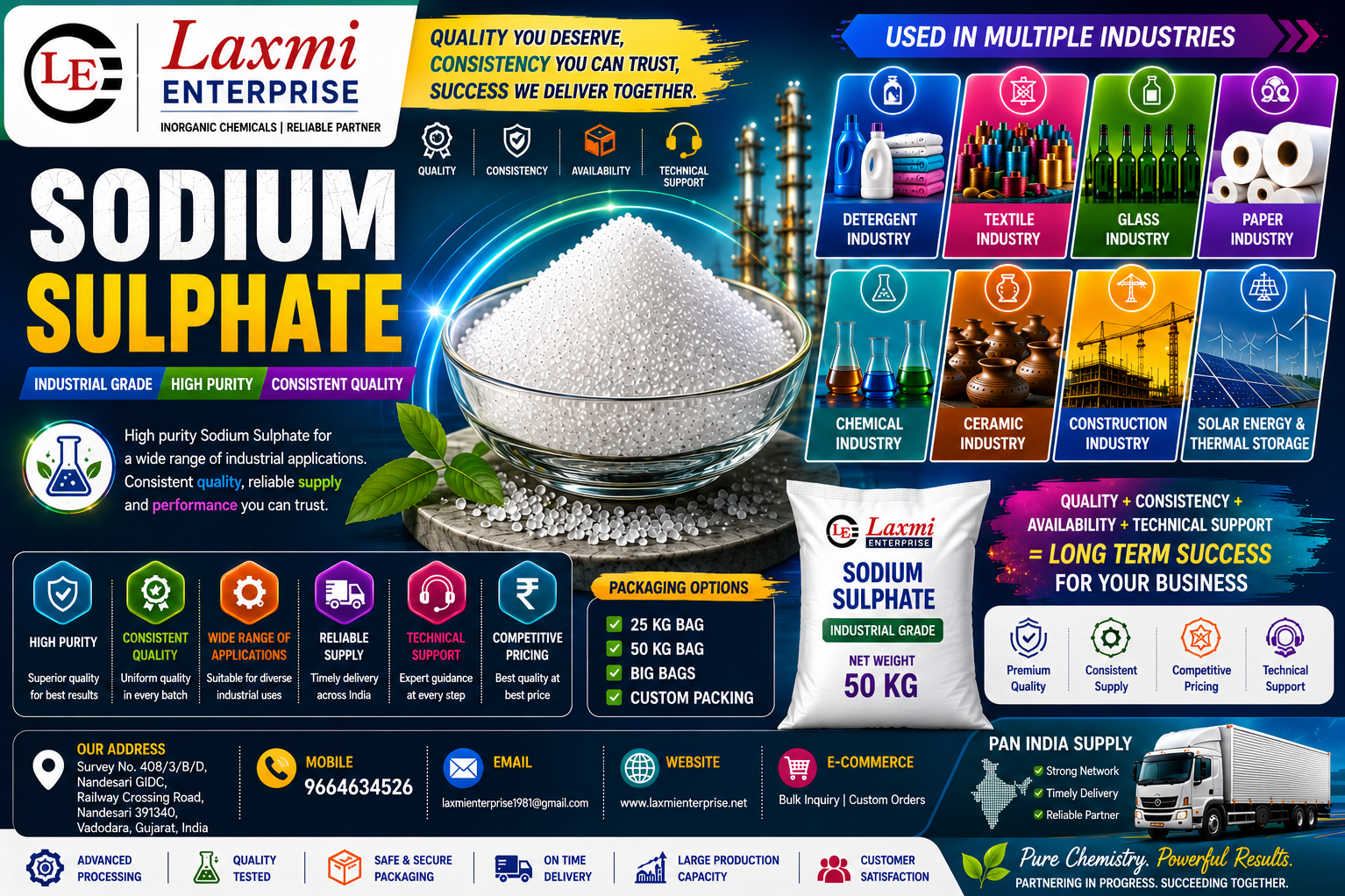
Manufactured Sodium Sulphate is supplied to a range of industries, including:
Detergent Manufacturing
Used in many powdered detergent formulations according to formulation requirements.
Glass Manufacturing
Used in many glass formulations as part of the batch design.
Textile Dyeing
Used as an electrolyte in many reactive dyeing processes for cellulosic fibres.
Kraft Pulping
Used as a makeup chemical in the kraft chemical recovery cycle.
Chemical Manufacturing
Used in selected chemical processes where appropriate.
Sustainability Considerations
Many producers focus on:
Efficient resource use.
Process optimization.
Waste minimization.
Energy management.
Product quality consistency.
Specific sustainability practices vary by manufacturing facility and production method.
Pan-India Supply
Industrial users across Gujarat, Maharashtra, Rajasthan, Delhi NCR, Uttar Pradesh, Punjab, Haryana, Madhya Pradesh, Chhattisgarh, Odisha, West Bengal, Karnataka, Telangana, Andhra Pradesh, Tamil Nadu, Kerala, Jharkhand, and Assam source Sodium Sulphate for manufacturing applications.
Laxmi Enterprise, based in Nandesari GIDC, Vadodara, Gujarat, supplies Sodium Sulphate (CAS No. 7757-82-6, HSN Code 2833 11 00) across Pan India. As an industrial chemical supplier and distributor, the company provides technical documentation, packaging options, and dependable logistics to support detergent, glass, textile, kraft pulp, and chemical manufacturing industries.
Buyer Checklist
Before approving a supplier:
✔ Confirm the required grade.
✔ Verify CAS Number: 7757-82-6.
✔ Verify HSN Code: 2833 11 00.
✔ Review the COA.
✔ Review the TDS and SDS/MSDS.
✔ Confirm packaging.
✔ Evaluate batch consistency.
✔ Review logistics capability.
Frequently Asked Questions
Is all Sodium Sulphate manufactured the same way?
No. Commercial Sodium Sulphate can originate from natural sources or synthetic industrial processes, followed by purification and quality control appropriate for the intended application.
Does the manufacturing route determine quality?
The production route is one factor, but the finished product should ultimately be evaluated against the agreed technical specification and supporting documentation.
Why is quality testing important after production?
Testing helps verify that the finished product meets customer requirements before packaging and dispatch.
Why include the CAS Number and HSN Code?
The CAS Number (7757-82-6) confirms the chemical identity of Sodium Sulphate, while the HSN Code (2833 11 00) supports commercial documentation, taxation, and logistics in India.
Conclusion
Sodium Sulphate is produced through both natural and synthetic routes, followed by purification, quality control, and packaging tailored to industrial requirements. Understanding these production methods helps buyers evaluate product specifications and supplier documentation with greater confidence.
For manufacturers throughout Pan India, Laxmi Enterprise, located in Nandesari GIDC, Vadodara, Gujarat, supplies Sodium Sulphate (CAS No. 7757-82-6, HSN Code 2833 11 00) with technical documentation, flexible packaging, and reliable logistics for detergent, glass, textile, kraft pulp, and selected chemical manufacturing applications.
Keywords