Sodium Sulphate Laboratory Testing & Quality Control
Primary Keyword: Sodium Sulphate Testing
Secondary Keywords: Sodium Sulphate Quality Control, Sodium Sulphate Laboratory Testing, Sodium Sulphate COA, Industrial Sodium Sulphate Testing, Sodium Sulphate Analysis
Technical Product Identity
Property Details
Product Name Sodium Sulphate
Chemical Formula Na₂SO₄
CAS Number 7757-82-6
HSN Code (India) 2833 11 00
Molecular Weight 142.04 g/mol
EINECS Number 231-820-9
Appearance White crystalline powder or granules
Typical Grades Industrial Grade, Technical Grade, Application-Specific Grades
Quick Answer
Laboratory testing helps verify that Sodium Sulphate supplied to a manufacturing facility matches the agreed purchase specification. Industrial quality control generally combines sampling, analytical testing, documentation review, and batch traceability. The specific tests, methods, and acceptance criteria depend on the intended application and the buyer's quality management system.
Why Laboratory Testing Matters
Quality control begins before production starts.
Incoming raw materials influence:
Production consistency.
Product quality.
Process efficiency.
Customer satisfaction.
Supplier performance evaluation.
Testing every shipment according to an organization's quality procedures helps reduce the risk of introducing off-specification material into production.
Quality Control Workflow
A structured quality control process often follows this sequence:
Supplier Dispatch
↓
Receipt at Factory
↓
Document Verification
↓
Packaging Inspection
↓
Sampling
↓
Laboratory Testing
↓
COA Comparison
↓
Quality Approval
↓
Warehouse Release
↓
Production Use
Organizations may adapt this workflow to suit their quality management systems.
Step 1 – Incoming Material Verification
Quick Answer
Before laboratory testing begins, buyers typically verify that the delivered material matches the purchase order and accompanying documentation.
Common checks include:
Product name.
Chemical formula (Na₂SO₄).
CAS Number (7757-82-6).
HSN Code (2833 11 00) on commercial documents.
Batch number.
Quantity received.
Packaging condition.
Supplier documentation.
Verifying these details supports traceability and reduces administrative errors.
Step 2 – Sampling
Quick Answer
Sampling is one of the most important stages of quality control because analytical results are only meaningful if the sample represents the entire batch. Organizations should follow their documented sampling procedures and any applicable standards.
Sampling plans may consider:
Number of packages.
Batch size.
Packaging type.
Risk assessment.
Internal quality procedures.
Samples should be clearly identified to maintain traceability.
Step 3 – Visual Inspection
Before analytical testing, laboratories often perform a visual examination.
Typical observations include:
Observation Purpose
Colour Confirm expected appearance
Physical state Powder or granules as specified
Packaging condition Identify visible damage
Foreign matter Detect obvious contamination
Product identification Confirm labeling
Visual inspection does not replace laboratory testing but provides an initial quality assessment.
Step 4 – Common Laboratory Tests
Quick Answer
The exact test program depends on the customer's specification and application. Laboratories typically evaluate several parameters together rather than relying on a single measurement.
Typical Analytical Parameters
Test Why It Is Evaluated
Purity Product identity and specification
Moisture Storage and handling characteristics
Water-Insoluble Matter Process cleanliness
Particle Size Handling and application suitability
Chloride (where specified) Process-specific requirement
Iron (where specified) Application-specific requirement
Appearance Incoming inspection
Bulk Density (where specified) Handling and packaging
Acceptance criteria should be defined in the purchase specification or internal quality standards.
Step 5 – Moisture Evaluation
Quick Answer
Moisture content influences storage, handling, and flowability. Organizations often monitor moisture because excessive moisture can affect material handling and warehouse performance.
Good storage practices include:
Dry warehouse conditions.
Sealed packaging.
Protection from rain.
FIFO inventory management.
Moisture evaluation should follow validated laboratory procedures.
Step 6 – Water-Insoluble Matter
Applications that require complete dissolution often include limits for water-insoluble matter.
Laboratories evaluate this parameter to help assess:
Product cleanliness.
Dissolution behaviour.
Suitability for the intended process.
The acceptance limit depends on the agreed specification.
Step 7 – Particle Size Evaluation
Particle size may influence:
Mixing.
Conveying.
Dissolution.
Feeding systems.
Dust generation.
The appropriate particle size distribution depends on the buyer's manufacturing process.
Step 8 – Documentation Review
Laboratory results are typically reviewed together with supplier documentation.
Documents commonly examined include:
Certificate of Analysis (COA).
Technical Data Sheet (TDS).
Safety Data Sheet (SDS/MSDS).
Batch identification.
Purchase specification.
Comparing laboratory findings with documentation supports quality assurance.
How to Interpret a COA
Quick Answer
A COA should be compared against the buyer's approved specification rather than treated as a standalone quality approval. Procurement and QA teams should verify that the reported batch results meet the agreed requirements.
Typical review steps:
Confirm product identity.
Match the batch number to the received shipment.
Compare reported values with the purchase specification.
Record the review within the quality management system.
Release or quarantine material according to internal procedures.
Supplier Performance Monitoring
Many organizations periodically evaluate suppliers based on:
Batch consistency.
Documentation accuracy.
Delivery performance.
Response to quality concerns.
Technical support.
Regular reviews help strengthen supplier relationships and identify opportunities for improvement.
Industry-Specific Testing Considerations
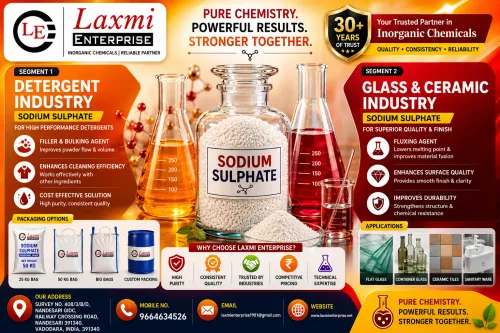
Detergent Manufacturing
Detergent manufacturers commonly focus on:
Particle size.
Moisture.
Flowability.
Batch consistency.
Glass Manufacturing
Glass manufacturers may evaluate:
Purity.
Iron content.
Water-insoluble matter.
Textile Processing
Textile processors often review:
Purity.
Chloride (where specified).
Water-insoluble matter.
Dissolution characteristics.
Kraft Pulping
Paper and pulp mills typically emphasize:
Product consistency.
Documentation.
Batch traceability.
Pan-India Supply
Industrial facilities across Gujarat, Maharashtra, Rajasthan, Delhi NCR, Uttar Pradesh, Punjab, Haryana, Madhya Pradesh, Chhattisgarh, Odisha, West Bengal, Karnataka, Telangana, Andhra Pradesh, Tamil Nadu, Kerala, Jharkhand, and Assam often incorporate incoming quality verification into their procurement processes.
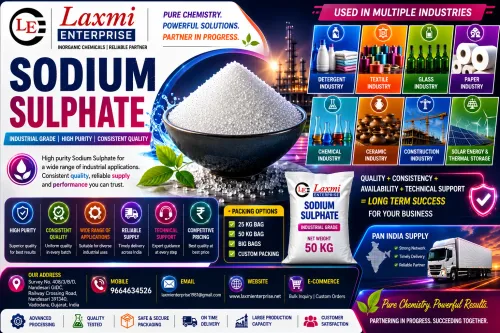
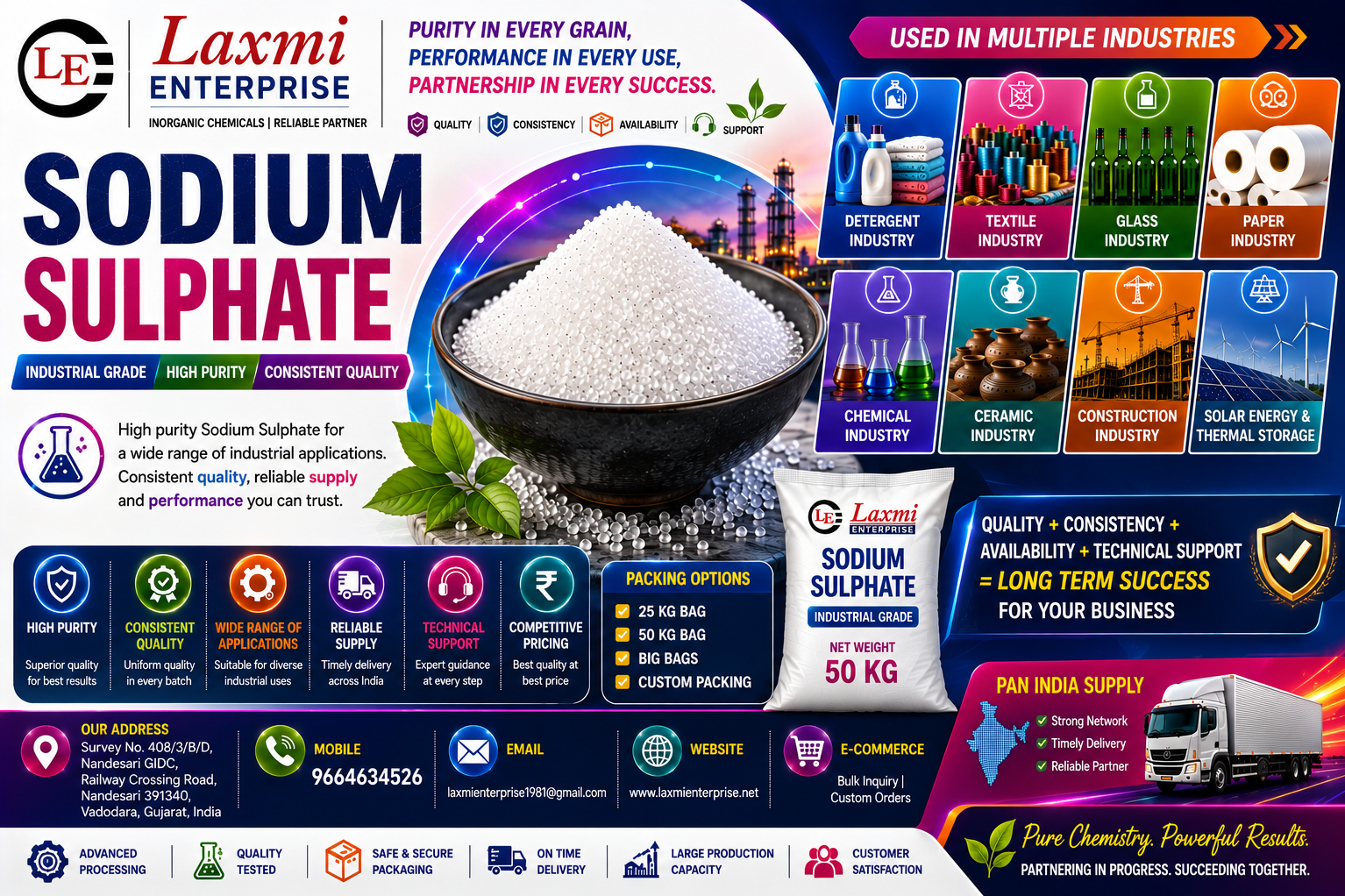
Laxmi Enterprise, based in Nandesari GIDC, Vadodara, Gujarat, supplies Sodium Sulphate (CAS No. 7757-82-6, HSN Code 2833 11 00) across Pan India, supporting customers with technical documentation, traceability, and industrial supply for detergent, glass, textile, kraft pulp, and chemical manufacturing.
Buyer Checklist
Before approving incoming material:
✔ Verify CAS Number: 7757-82-6.
✔ Verify HSN Code: 2833 11 00.
✔ Review the COA.
✔ Compare laboratory results with the purchase specification.
✔ Confirm batch traceability.
✔ Inspect packaging.
✔ Review TDS and SDS/MSDS.
✔ Record inspection results according to internal quality procedures.
Frequently Asked Questions
Why is laboratory testing important?
It helps confirm that incoming Sodium Sulphate meets the agreed specification before the material enters production.
Should every batch be tested?
Testing frequency depends on the organization's quality management system, supplier qualification, risk assessment, and application.
Can a COA replace incoming inspection?
A COA is an important document, but many organizations also perform their own verification according to internal procedures.
Why is traceability important?
Traceability supports quality investigations, supplier evaluations, and compliance with quality management systems.
Conclusion
Laboratory testing and quality control are essential components of industrial Sodium Sulphate procurement. A structured approach that combines proper sampling, analytical testing, documentation review, and traceability helps manufacturers make informed decisions and maintain consistent production quality.
For industrial buyers across Pan India, Laxmi Enterprise, located in Nandesari GIDC, Vadodara, Gujarat, supplies Sodium Sulphate (CAS No. 7757-82-6, HSN Code 2833 11 00) with supporting technical documentation and reliable logistics for detergent, glass, textile, kraft pulp, and chemical manufacturing applications.
Keywords