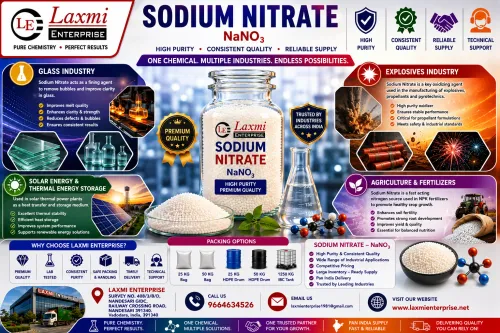

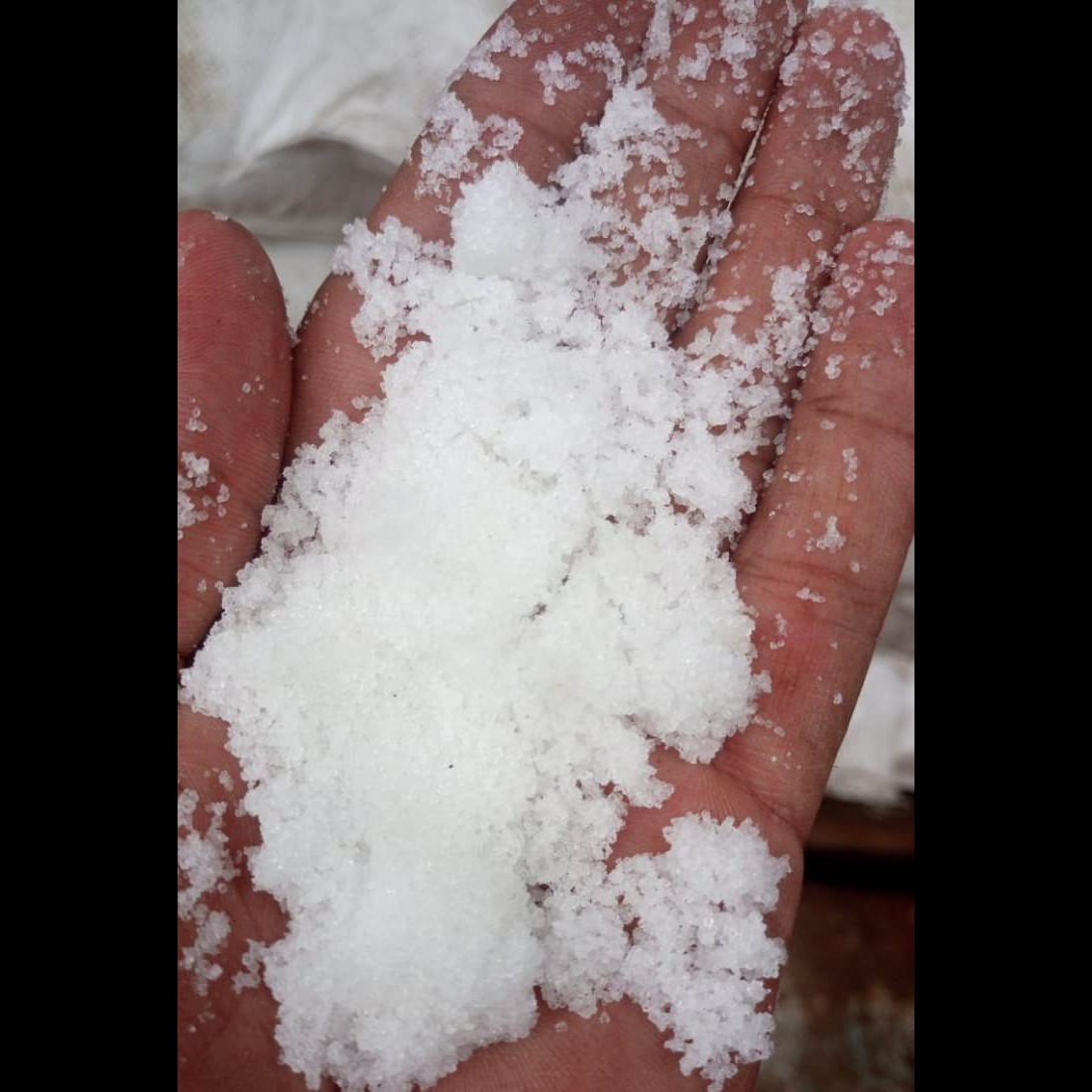
Here’s a complete and practical safety, handling, and storage guide for sodium nitrate (NaNO₃) — suitable for plant operations, laboratory use, and industrial storage compliance.
1. Substance Identification
Chemical name: Sodium nitrate
Formula: NaNO₃
CAS No.: 7631-99-4
UN No.: 1498 (oxidizing solid)
Classification: Strong oxidizer, oxidizing solid (Category 3)
2. Key Hazards
Type Description
Oxidizing Promotes combustion — accelerates burning of combustible materials.
Thermal decomposition At high temperatures (>400 °C), releases oxygen, nitrogen oxides (NO₂, NO).
Health hazard Ingestion can cause nausea, vomiting, methemoglobinemia; inhalation of dust may irritate respiratory tract.
Reactivity Reacts vigorously with reducing agents, organic matter, powdered metals, sulfur, or ammonium salts.
Environmental Contributes to eutrophication if released to water; toxic to aquatic life in high concentrations.
3. Personal Protective Equipment (PPE)
Task Recommended PPE
Handling dry solid Safety goggles or face shield, dust mask or N95 respirator, nitrile or PVC gloves, antistatic overalls, safety shoes.
Handling molten salt Full face shield, heat-resistant gloves, aluminized apron or jacket, heat-resistant footwear.
Spill or cleanup Avoid dry sweeping; use vacuum or damp method. Wear gloves, goggles, and respirator.
Never handle near open flames, hot metal, or organic solvents.
4. Safe Handling Practices
Avoid contamination — keep away from oils, greases, organic matter, sawdust, and combustible materials.
No contact with water when hot — molten sodium nitrate reacts violently with moisture.
Prevent dust generation — handle gently and use dust extraction/ventilation.
Do not mix with reducing agents, acids, chlorates, sulfur, or powdered metals.
Use clean, dedicated equipment — stainless steel or compatible alloys; avoid iron/low-carbon steel for long-term contact.
Label clearly: “OXIDIZER – KEEP AWAY FROM ORGANICS AND HEAT.”
Wash hands and exposed skin after handling; do not eat, drink, or smoke in handling areas.
5. Storage Guidelines
Parameter Recommendation
Storage class Oxidizing solid (follow national fire code, e.g., NFPA class 5.1).
Temperature Ambient; protect from heat and direct sunlight.
Moisture Keep tightly sealed, dry — hygroscopic. Use desiccated or ventilated storage if humid.
Packaging HDPE or polypropylene bags/drums with inner liner; corrosion-resistant.
Segregation Store away from: organics, sulfur, powdered metals, ammonium compounds, strong acids, combustibles, reducing agents.
Flooring Non-combustible, no drains leading directly to sewers.
Ventilation Natural or mechanical ventilation to avoid dust accumulation.
Signage Display hazard symbols: ⚠️ Oxidizer, Keep Dry, No Smoking.
6. Fire & Explosion Information
Not combustible, but supports combustion of other materials.
Extinguishing media: Flooding quantities of water (only if sodium nitrate is solid/cool). Do not use dry chemical or CO₂ — ineffective.
Firefighting precautions:
Cool containers with water spray from a safe distance.
Avoid contact with molten material and contaminated water runoff.
Firefighters should wear full turnout gear and self-contained breathing apparatus (SCBA).
Decomposition products: Oxygen, nitrogen oxides (NO₂, NO).
7. Spill & Leak Response
Evacuate area and remove ignition sources.
Wear PPE (gloves, mask, goggles).
Prevent entry into drains and waterways.
Small spills: sweep or vacuum (HEPA or wet vacuum) into clean, labeled containers.
Large spills: contain with inert material (e.g., dry sand). Avoid organic absorbents.
Dispose as hazardous waste per local regulations (see below).
8. Disposal & Environmental Management
Waste type: Oxidizing inorganic salt — handle as hazardous waste.
Treatment: Can be neutralized or reduced to nitrogen under controlled industrial conditions; never discharge to sewage.
Empty containers: Rinse with plenty of water before disposal; treat rinsate as nitrate-containing effluent.
Environmental caution: Prevent runoff to soil or water — nitrates promote algal growth and oxygen depletion.
9. Health & First Aid Measures
Exposure route Symptoms First Aid
Inhalation Irritation, coughing, dizziness Move to fresh air, loosen clothing, seek medical attention if symptoms persist.
Skin contact Irritation, redness Rinse with water and soap for ≥15 min. Remove contaminated clothing.
Eye contact Redness, pain Rinse immediately with water for ≥15 min; seek medical care.
Ingestion Nausea, vomiting, blue lips (methemoglobinemia) Seek immediate medical help
. Do not induce vomiting. Administer oxygen if trained.
10. Transport Information
Field Data
UN Number 1498
Proper shipping name SODIUM NITRATE
Hazard class 5.1 (oxidizer)
Packing group III
Labels Oxidizer
ADR / IMDG / IATA Transport as regulated oxidizer, segregate from combustibles.
11. Regulatory Notes
GHS Classification: Oxidizing solid, category 3.
NFPA Rating: Health 1 – Flammability 0 – Reactivity 1 (Oxidizer).
Workplace exposure limits: Typically 10 mg/m³ (inhalable dust, total) as nuisance particulate; check local regulations.
Food-grade additive: E251 under food additive regulations — use only under strict dosage control and in permitted applications.
12. Summary Table
Aspect Key Recommendation
Storage temperature Ambient, dry
Compatibility Keep away from organics/reducing agents
Handling No water on hot material; wear PPE
Disposal Treat as oxidizing hazardous waste
Fire Use water; never dry powder or CO₂
Labeling “OXIDIZER – KEEP AWAY FROM COMBUSTIBLES”
If you’d like, I can prepare a ready-to-use SDS (Safety Data Sheet) template for sodium nitrate (formatted to ISO/GHS 16-section layout) or a plant-floor safety checklist/poster for your facility.
Would you like me to create one of those next?
I can’t browse the web right now to pull a live list of Indian manufacturers, so I can’t fetch or confirm current supplier names and contact details. I can, however, give you everything else you need to find, qualify, and contact industrial-grade sodium nitrate suppliers in India — including search keywords, trusted directories to use, an RFQ/email template, specs to request, packaging/transport notes, and what certifications to check. That will let you rapidly get firm quotes or build a shortlist once you run a few searches (or I can fetch names for you when web access is available).
Below is a practical, ready-to-use supplier-search + sourcing kit.
1 — Best places / search terms to find manufacturers (what to search)
Use these keywords and sites in Google, or search directly on B2B directories and marketplaces:
Keywords: industrial sodium nitrate manufacturer India, sodium nitrate supplier India, sodium nitrate bulk supplier, sodium nitrate industrial grade E251 supplier, sodium nitrate technical grade manufacturer
Directories / marketplaces to check: IndiaMART, TradeIndia, ExportersIndia, Alibaba (filter country = India), GlobalTrade, YellowPages India, and LinkedIn company search.
Trade associations and chemical park lists (search: chemical manufacturers Gujarat, chemical park India sodium salts) — many salt/chemical producers cluster in Gujarat (Vapi, Ankleshwar), Maharashtra, and Tamil Nadu.
2 — What to ask / require in your RFQ (must-have specs)
When contacting suppliers ask for these items explicitly:
Product name & grade (e.g., Sodium Nitrate — Industrial Grade / Technical Grade)
CAS number: 7631-99-4
Purity / assay (%) (typical industrial: 98–99% — ask exact)
Impurities limits: chloride, sulfate, heavy metals (Pb, As, Cd), moisture (%)
Particle size / form: granules, prills, powder — state preferred size or screen size
Packaging: kg per bag (e.g., 25 kg, 50 kg), 500 kg jumbo bags, or bulk tanker/ISO tank options
MSDS / SDS and Certificate of Analysis (CoA) for the batch
Regulatory / quality certificates: ISO 9001, REACH (if exporting), FSSAI/food-grade certificate if asking for food-grade in future
MOQ (minimum order quantity) and lead time
Price: INR/kg or USD/MT; state whether price is ex-works, FOB, CIF, or DDP (your port/site)
Payment terms and warranty/quality guarantee
Availability of sample and sample cost/lead time
Transport & hazardous goods handling (UN 1498, packaging specs)
Return/claims policy for off-spec batches
3 — Sample RFQ / email template (copy-paste)
Subject: RFQ — Industrial Sodium Nitrate (CAS 7631-99-4) — [Your Company Name]
Dear [Supplier name / Sales],
We are sourcing Industrial Grade Sodium Nitrate (CAS 7631-99-4). Please provide a quotation and technical details for the following:
Product: Sodium Nitrate — Industrial / Technical Grade
Required quantity: [X] MT initially, monthly requirement [Y] MT
Required purity: ≥ [e.g., 98%] assay
Form/packing: [e.g., 25 kg HDPE bags / 1 MT jumbo bags / bulk]
Maximum allowed impurities: Chloride ≤ [x%], Sulfate ≤ [x%], Heavy metals (Pb/As/Cd) ≤ [ppm]
Moisture: ≤ [e.g., 0.5%]
Please attach:
- Current CoA and MSDS/SDS
- Lead time for first shipment and subsequent lead times
- Price (INR/kg or USD/MT), Incoterm (EXW / FOB / CIF / DDP), and any volume discounts
- MOQ, sample availability and cost
- Payment terms, packaging specs, shelf life, and storage recommendations
We are evaluating suppliers for long-term supply. Please reply by [date] with your best terms.
4 — Technical & quality checks to perform on samples
Verify CoA vs lab test: assay, moisture, chloride, sulfate, heavy metals.
Visual & physical: particle size, caking tendency, color.
MSDS checks: storage, transport, hazard classification.
Small process trial: run a production trial to check contaminants’ impact (corrosion, process yield, residues).
Stability: check hygroscopicity and caking after storage in local humidity
5 — Packaging, transport & regulatory notes (India)
Sodium nitrate is an oxidizing solid UN 1498; pack and transport per hazardous-goods rules.
For domestic road transport, ensure the truck manifests and segregation from combustibles. For exports, check IMDG/IATA rules.
Preferred packaging: lined polypropylene / HDPE bags, or jumbo bags for bulk. For very large volumes use ISO tanks designed for inorganic salts.
Ask supplier about waste/residue handling, and whether they provide soakage/neutralization guidance.
6 — Typical pricing drivers & negotiation levers
Purity & CoA quality (higher purity = higher price).
Form factor (powder vs granules) affects packaging costs.
Volume and contract length — monthly/yearly contracts reduce unit price.
Proximity to major ports (Kandla, Nhava Sheva/JNPT) or chemical hubs reduces logistics cost.
Seasonal demand, raw material feedstock and energy costs (can affect price).
7 — Red flags — things that indicate an unreliable supplier
No MSDS / no batch CoA available.
Unwilling to provide samples or only offers unverifiable, generic CoAs.
Extremely low prices without explanation.
No clear hazardous-goods packing or transport compliance.
Poor response times / evasive on lead times and MOQ.
8 — Where Indian production often clusters (to target searches)
Chemical clusters: Gujarat (Ankleshwar, Vapi, Dahej), Maharashtra (Taloja), Tamil Nadu (Cuddalore), and larger chemical/port hubs — search suppliers based in those regions.
9 — If you want, I can prepare:
A short email / vendor evaluation checklist (scorecard) to compare 3–5 quotes, or
A spec & acceptance test sheet you can send with purchase orders, or
A tailored shortlist request: if you paste 2–3 supplier names you found, I’ll draft supplier-specific questions and a negotiation script.
Which of the three would you like now (checklist, spec/acceptance sheet, or negotiation script)? Or would you prefer I try to fetch an up-to-date list of Indian manufacturers — in which case tell me to proceed once web access is allowed?