
Sodium Nitrate in Wastewater Treatment Systems
Chemical formula: NaNO₃
Molecular weight: 85.00 g/mol
1. Overview
Sodium nitrate is a highly soluble inorganic salt commonly used as an external carbon and nitrogen source in wastewater treatment systems.
1. Overview
Sodium nitrate is an inorganic oxidizing salt widely used in the detergent and cleaning product industry. In detergent manufacturing, it primarily serves as a builder salt, oxidizing agent, and process aid that improves product performance, stability, and appearance.
2. Role of Sodium Nitrate in Detergent Manufacturing
A. As a Processing Aid / Filler
Sodium nitrate is used as a filler or bulk agent in detergent powders to:
Adjust product density and flowability.
Provide a uniform texture and consistent appearance.
Help maintain the free-flowing nature of powder detergents.
It is compatible with other detergent ingredients like sodium sulfate, soda ash (Na₂CO₃), STPP, and surfactants.
B. As an Oxidizing Agent
In formulations containing enzymes or bleaching agents, sodium nitrate can:
Stabilize active ingredients by controlling oxidation-reduction reactions.
Prevent the degradation of organic components during storage.
Acts as a mild oxidizer that improves the detergent’s cleaning efficiency for oily and greasy soils.
C. As an Anti-Caking and Brightening Agent
Reduces moisture absorption and helps prevent clumping or caking in detergent powders.
Improves the whiteness and brightness of detergent granules due to its crystalline nature.
D. For Environmental and Quality Control
Sodium nitrate contributes to controlled alkalinity in the formulation, maintaining an optimal pH for surfactant performance.
Enhances the oxidative cleaning properties without generating chlorine-based residues.
It provides nitrate (NO₃⁻) ions that serve as an electron acceptor for denitrifying bacteria during the biological denitrification process,
where nitrate is reduced to nitrogen gas (N₂), which is harmlessly released into the atmosphere.
Environmental and Safety Considerations
Biodegradability: Sodium nitrate itself is not biodegradable but promotes biological activity.
Safety: Avoid mixing with organic matter or reducing agents to prevent heat release or decomposition.
Storage: Keep in a cool, dry, well-ventilated area; use corrosion-resistant tanks (plastic, fiberglass, or lined steel).
Thermal and Chemical Stability
Stable below 300°C, but decomposes slowly to sodium nitrite (NaNO₂) and oxygen above 380°C.
Acts as a heat transfer medium in molten salt systems (mixed with sodium nitrite and potassium nitrate).
Non-flammable but supports combustion — should not be stored with combustible materials.
Typical Grade Name & Target Assay
Grade name (example): High-Purity / Reagent / Electronic Grade Sodium Nitrate
Target assay (NaNO₃, wt%): ≥ 99.5% (typical)
Other typical grades:
Key Analytical Methods (recommended)
Ion Chromatography (IC): NO₃⁻, NO₂⁻, Cl⁻, SO₄²⁻ and other anions.
ICP-MS / ICP-OES: Trace metals (Pb, Cd, As, Fe, Cu, etc.) — use ICP-MS for sub-ppb/ppb sensitivity.
Karl Fischer titration / Loss on Drying: Moisture content.
TOC Analyzer: Organic contamination.
FTIR / XRD / DSC: Identity and crystallinity.
Laser diffraction / sieving: Particle size distribution.
Microbiological assays: If required for pharma or cosmetic uses.
4) Typical Applications for High-Purity Grade
Reference standards and analytical reagents
Electronic / semiconductor processes where ionic impurities must be minimized
Optical & specialty glass manufacturing (minimized coloring ions)
Laboratory and pharmaceutical manufacturing (raw material for formulations, reagents)
Heat-transfer salts and thermal storage (when mixed into nitrate eutectics; low impurity extends life)
High-value detergents, specialty chemical synthesis where impurities cause side-reactions
Manufacturing / Purification Notes (how producers achieve high purity)
Multiple recrystallizations from deionized water and filtration to remove insolubles.
Conversion/oxidation steps (if starting from sodium nitrite) followed by removal of residual nitrite by catalytic reduction or ion-exchange.
Use of ion-exchange resins and activated carbon for trace organic and ionic impurity removal.
Final drying under controlled temperature and humidity to meet moisture spec.
Sodium Nitrate for Sewage Odor Control
Chemical formula: NaNO₃
Molecular weight: 85.00 g/mol
CAS Number: 7631-99-4
Overview
Sodium nitrate is widely used in municipal and industrial wastewater systems as an odor control chemical.
It effectively prevents the generation of hydrogen sulfide (H₂S) and other malodorous gases in sewers,
pumping stations, and sludge-handling facilities.
It works by promoting biological denitrification — providing oxygen (in the form of nitrate)
to bacteria that outcompete sulfate-reducing bacteria (SRB),
thereby stopping the formation of hydrogen sulfide
TYPICAL APPLICATIONS
Odor and Corrosion Control in sewage and wastewater systems
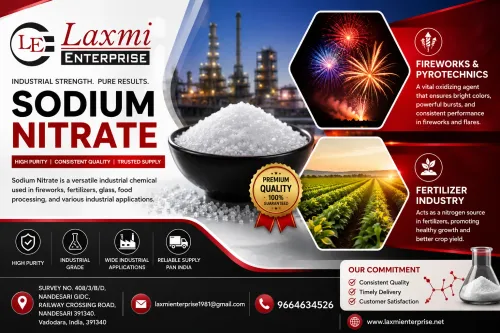
Fertilizer as a nitrogen source
Detergent manufacturing as filler, oxidizer, stabilizer
Glass and ceramics for clarity and brightness
Heat treatment salts (metal industry)
Pyrotechnics & chemical synthesis (oxidizer)
Section 5: Firefighting Measures
Suitable Extinguishing Media: Water spray, flooding quantities of water (do NOT use dry chemical or foam).
Hazardous Decomposition: Nitrogen oxides (NOx), sodium oxides.
Special PPE: Firefighters should wear full protective gear and self-contained breathing apparatus.
Specific Hazard: Strong oxidizer; may intensify fire if in contact with combustible materials.
Section 10: Stability and Reactivity
Stable under normal storage and use.
Incompatible with: Reducing agents, organic materials, sulfur, ammonium salts, and combustible substances.
Decomposition products: Nitrogen oxides (NO₂, N₂O), sodium oxide.
Regulatory Information
GHS Classification: Oxidizing Solid (Category 3)
REACH / OSHA / WHMIS: Listed and compliant
Indian Regulations: Covered under Schedule VI, Rule 13 of the MSIHC Rules (as an oxidizing agent)