

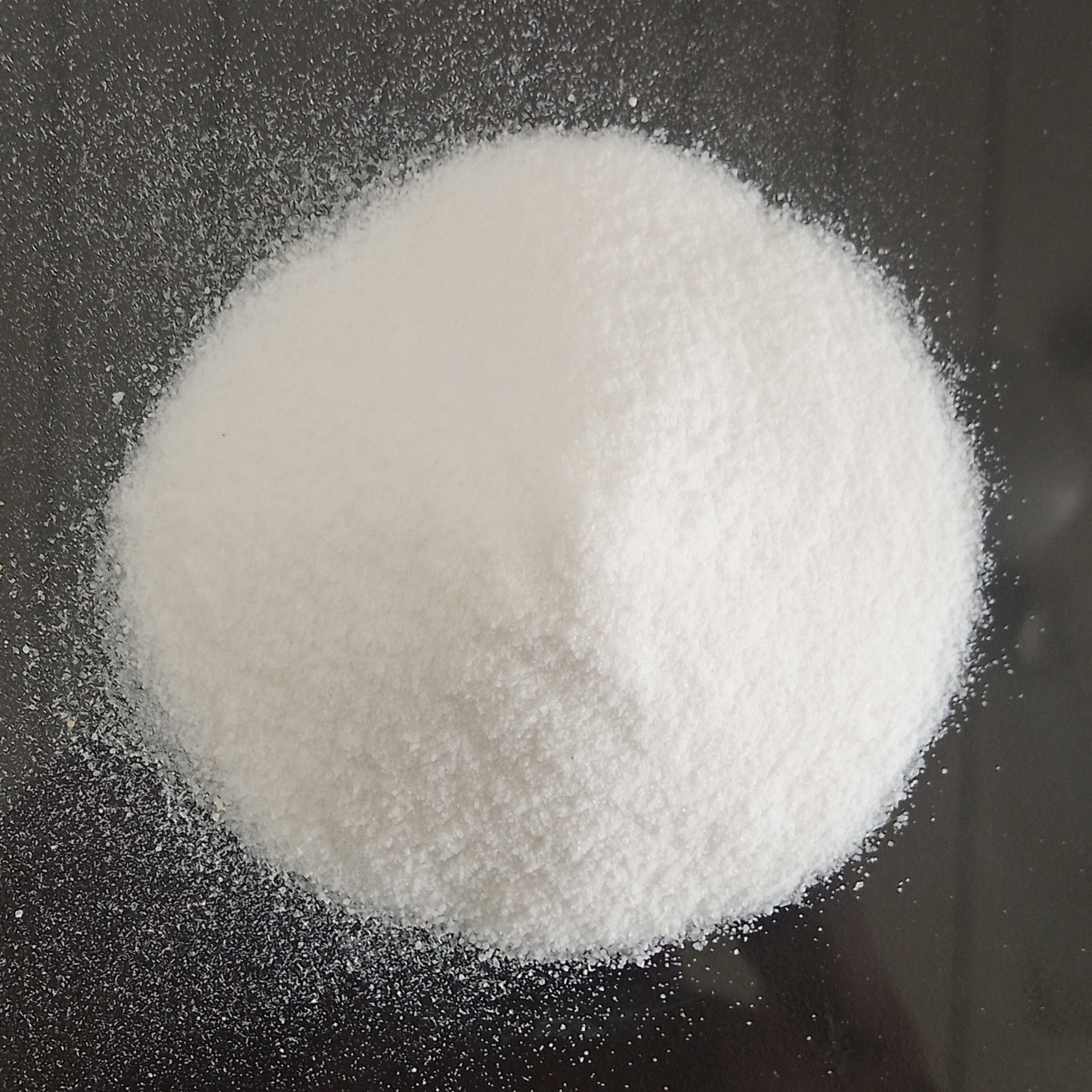
ndustrial Sodium Sulphate (Na₂SO₄) Production Methods
Overview
Sodium Sulphate (Na₂SO₄) is an important inorganic chemical widely used in detergents, glass manufacturing, pulp & paper, textiles, and chemical industries.
Its industrial production is carried out via both natural and synthetic processes, depending on required purity, scale, and application.
1. Natural Sources (Mining)
Sodium sulphate occurs naturally as mirabilite (Na₂SO₄·10H₂O) or thenardite (Na₂SO₄) in arid regions and salt lakes.
Process
Mining or collecting naturally occurring deposits.
Crushing and washing to remove impurities.
Drying to obtain anhydrous or crystalline sodium sulphate.
Advantages:
Economical for large-scale production.
Suitable for detergent and glass-grade applications.
Limitations:
Purity depends on natural deposits; may require additional refining.
2. Mannheim Process (Chemical Synthesis)
The Mannheim process produces sodium sulphate by reacting sodium chloride (NaCl) with sulfuric acid (H₂SO₄)).
:Reaction:
Mix sodium chloride with concentrated sulfuric acid in a reactor.
Heat at high temperature (around 600°C) to drive the reaction.
Collect solid sodium sulphate.
HCl gas is captured and optionally processed as a by-product.
Advantages:
Produces high-purity sodium sulphate.
Continuous and controlled process suitable for industrial scale.
Applications: Glass, detergents, and chemical intermediates.
3. Salt Cake Process
Also known as soda ash by-product process, where sodium sulphate is obtained as a by-product from sodium carbonate (soda ash) production via Solvay process.
Reaction
Involves reaction of sulfuric acid with sodium chloride or sodium carbonate solutions.
Produces sodium sulphate along with other by-products such as HCl or gypsum.
Advantages:
Efficient use of industrial waste streams.
Cost-effective for large-scale production.
4. Chemical Reaction with Sodium Bicarbonate
Sodium sulphate can be prepared by neutralization reactions in chemical plants.
Applications: Laboratory and specialty industrial production.
5. Recovery from Industrial Waste Streams
Sodium sulphate is often recovered from chemical effluents (e.g., hydrochloric acid or sodium hydroxide waste streams) in industries.
Involves precipitation, crystallization, and drying.
Advantages:
.Eco-friendly and sustainable approach.
.Reduces chemical disposal costs.
.Industrial Considerations
.Purity Requirements:
.Detergent-grade: 99%+ Na₂SO₄
.Glass-grade: 98–99% Na₂SO₄
.Technical grade: ~95% Na₂SO₄
.Forms Produced:
.Anhydrous sodium sulphate (Na₂SO₄)
.Decahydrate (Glauber’s salt, Na₂SO₄·10H₂O)
.Quality Control Tests:
.Moisture content
.Solubility
.pH of saturated solution
.Heavy metal content
.SEO Keywords
.Industrial sodium sulphate production | Sodium sulphate manufacturing process | Sodium sulphate chemical synthesis | Sodium sulphate for glass | Sodium sulphate for detergents | Laxmi Enterprise Na₂SO₄ supplier Gujarat | Sodium sulphate anhydrous production
If you want, I can prepare a visual flowchart showing all major Sodium Sulphate production methods including Mannheim, Natural, Salt Cake, and Waste Recovery, which will be ideal for technical presentations and catalogs.
Sodium Chloride (NaCl) and Sulfuric Acid (H₂SO₄) Reactions
Overview
The reaction of sodium chloride with concentrated sulfuric acid is a fundamental industrial process used to produce hydrogen chloride gas (HCl) and sodium sulfate (Na₂SO₄).
It is widely applied in chemical manufacturing, including Mannheim process for sodium sulfate production, HCl generation, and as a key step in various chemical industries.
1. Primary Reaction
When solid sodium chloride reacts with concentrated sulfuric acid at elevated temperatures:
:Process Details
Reactants: Sodium chloride (NaCl), concentrated sulfuric acid (H₂SO₄)
Conditions: Heated to around 150–250°C in a dry, controlled environment
Products:
Sodium sulfate (Na₂SO₄): Solid, remains in reactor
Hydrogen chloride (HCl): Gaseous, collected for industrial use
2. Industrial Applications of the Reaction
Mannheim Process (Sodium Sulfate Production)
Sodium chloride and sulfuric acid react to produce detergent-grade sodium sulfate.
By-product HCl gas is captured and sold for use in chemical, fertilizer, and hydrochloric acid industries.
Hydrogen Chloride Production
Gaseous HCl can be dissolved in water to produce hydrochloric acid for industrial use.
Intermediate in Chemical Synthesis
HCl and Na₂SO₄ serve as intermediates for dyes, pharmaceuticals, and inorganic chemicals.
3. Reaction Variations
Temperature-Dependent Products:
At room temperature, HCl evolves slowly; reaction is incomplete.
At high temperatures (>150°C), the reaction is faster and yields solid sodium sulfate.
Moisture Control:
Reaction must be anhydrous, as water reduces HCl efficiency and dissolves NaCl.
4. Advantages of This Reaction
Produces high-purity sodium sulfate and industrial HCl simultaneously.
Continuous process suitable for large-scale chemical manufacturing.
Enables economical utilization of sodium chloride and sulfuric acid in industrial settings.
5. Safety and Handling
Corrosive Reactants: Both H₂SO₄ and NaCl can cause burns in concentrated form.
HCl Gas: Must be captured and handled with proper ventilation and gas scrubbing.
Temperature Control: Essential to prevent side reactions or equipment damage.
SEO Keywords
Sodium chloride sulfuric acid reaction | NaCl H₂SO₄ industrial process | Sodium sulfate production Mannheim process | Hydrogen chloride generation | Sodium chloride chemical reactions | Laxmi Enterprise chemical supplier Vadodara
If you want, I can create a step-by-step process diagram of NaCl + H₂SO₄ reaction showing both HCl gas evolution and sodium sulfate formation, which will be ideal for a technical catalog or industrial presentation.
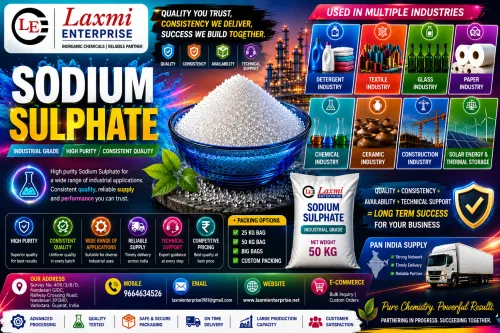
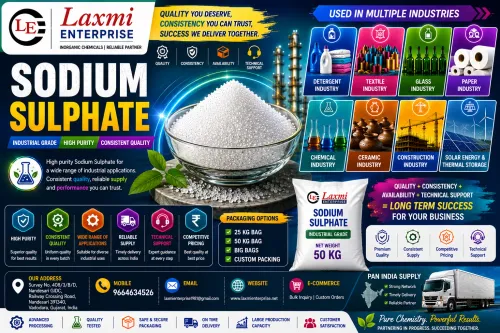
Why Choose Our High-Purity Sodium Sulphate?
Industrial Grade Quality:
Manufactured under strict quality control standards.
Ensures low impurities for critical industrial processes.
Consistent Chemical Composition:
Guaranteed Na₂SO₄ content ≥ 99% for high-performance applications.
Stable granular or powdered form for easy handling.
Wide Industrial Applications:
Detergent Industry: Filler and builder in powder detergents.
Glass Manufacturing: Fluxing agent for high-quality glass.
Textiles: Dyeing, printing, and finishing applications.
Chemicals & Pharmaceuticals: Intermediate for inorganic chemical reactions.
Pulp & Paper: Used in Kraft process for paper production.
Reliable Supply & Packaging:
Available in 25 kg, 50 kg HDPE bags or bulk jumbo bags.
Custom packaging and bulk orders available.
Specifications
Property Typical Value
Sodium Sulphate (Na₂SO₄) ≥ 99%
Moisture ≤ 0.5%
Appearance White crystalline / powder
Solubility in Water Highly soluble
Particle Size Granular / Fine Powder
Industries We Serve
.Detergent & Soap Manufacturing
.Glass & Ceramics Industry
.Textile Dyeing & Printing
.Chemical Manufacturing
.Pulp & Paper Industry
.Food & Pharmaceuticals (if required, subject to grade)
Advantages of Our Product
High chemical purity for critical industrial processes
Low impurity levels ensuring consistent performance
Bulk availability for large-scale industrial use
Competitive pricing with timely delivery
SEO Keywords
High purity sodium sulphate supplier | Sodium sulphate manufacturer Vadodara | Industrial sodium sulphate for detergents | Bulk Na₂SO₄ supplier Gujarat | Laxmi Enterprise sodium sulphate | Sodium sulphate powder & granular | Sodium sulphate for glass and textile
If you want, I can also prepare a detailed product page content with applications, benefits, and industrial uses specifically for Laxmi Enterprise Sodium Sulphate, optimized for Google search and lead generation.
- sodium sulphate
- sodium sulfate
- Na2SO4
- CAS 7757-82-6 (anhydrous)
- CAS 7727-73-3 (decahydrate)
- E514
- EC 231-820-9
- sodium sulphate SDS
- sodium sulphate MSDS
Glauber's salt
- mirabilite
- thenardite
- sulfate of soda
- salt cake
- disodium sulfate
-sodium sulphate supplier
- sodium sulphate manufacturer
- sodium sulphate exporter
[[Industrial Sodium Sulphate, Production Methods, LAXMI ENTRPRISE, VADODRA, GUJARAT, INDIA.]]