

Select Column & Eluent:
- Anion-exchange column, carbonate/bicarbonate or hydroxide eluent.
- Suppressed conductivity detection preferred.
Prepare Calibration Standards:
- At least 5–7 points over the expected concentration range.
Perform Specificity Check:
- Include possible interfering ions in sample matrix.
- Verify no co-elution with acetate peak.
Assess Accuracy & Recovery:
- Spike known concentrations in blank matrix.
- Calculate %Recovery: (Me
Precision Testing:
- Inject same standard multiple times → calculate RSD%.
- Repeat on different days / instruments for intermediate precision.
Determine LOD & LOQ:
- LOD: S/N ≈ 3:1
- LOQ: S/N ≈ 10:1
Robustness Testing:
- Minor changes in flow, temperature, eluent concentration → check for consistency in retention time, area, and resolution.
Stability Studies:
- Store sample at ambient, refrigerated, or frozen conditions.
- Re-analyze after 24–72 h to ensure no significant degradation.
Protein-rich samples (biopharma): Pre-treatment by filtration or ultrafiltration to remove macromolecules.
High salt buffers: Consider matrix-matched standards or sample dilution to minimize suppression or conductivity artifacts.
Low acetate levels (<10 μM): Use pre-concentration or sensitive detectors
Include method development rationale, chromatograms, calibration curves, precision/accuracy tables.
System suitability parameters must be recorded daily.
All deviations and corrective actions documented per cGMP / GLP standards.
- IC with suppressed conductivity is gold standard for ionic acetate in complex matrices.
- Validation must cover specificity, linearity, accuracy, precision, robustness, and stability.
- Matrix effects must be evaluated to ensure true quantification.
- Proper documentation ensures regulatory compliance and method reproducibility.
- High protein content: Can interfere with detection or clog columns.
- Complex buffer systems: May contain chloride, phosphate, citrate, or other anions.
- Low acetate concentrations: Requires sensitive detection.
- Regulatory requirement: Accurate documentation under cGMP.
- Protein removal:
- Ultrafiltration (10–30 kDa cutoff)
- Precipitation (e.g., TCA, acetone) followed by filtration
- Dilution:
- Reduce matrix ionic strength and minimize detector interference.
- pH adjustment (if needed):
- Ensure consistent eluent behavior and peak resolution.
- Matrix-matched calibration standards: Ensure linearity accounts for protein or salt effects.
- Suppressed conductivity: Reduces background noise and improves signal-to-noise for low-level acetate.
- System suitability tests: Monitor retention time, theoretical plates, peak symmetry, and resolution for QC compliance.
- Documentation: Maintain chromatograms, calibration curves, and validation data for regulatory submission.
- Prepare standards and matrix blanks.
- Filter or centrifuge samples to remove protein.
- Inject standards & samples into ion chromatograph.
- Record retention time and peak area for acetate.
- Calculate concentration using calibration curve.
- Perform QC checks: System suitability, recovery, and precision.
- Document results in batch records.
- High sensitivity for trace acetate.
- Compatible with complex protein-based matrices.
- Well-established and accepted in regulatory filings (FDA, EMA).
- Reproducible and suitable for routine QC.
- Ion Chromatography is the preferred method for acetate quantification in biopharma formulations.
- Proper sample preparation (protein removal, dilution) is critical.
- Method validation must address specificity, accuracy, precision, robustness, and stability.
- Ensures formulation quality, process control, and regulatory compliance.
- Specificity / Selectivity: Ensure acetate is quantified without interference from chloride, phosphate, citrate, lactate, or proteins.
- Linearity: Calibration curve must cover the expected concentration range; correlation coefficient (R²) ≥ 0.999.
- Accuracy / Recovery: Spike-and-recovery experiments, typical acceptable range 95–105%.
- Precision: Repeatability (intra-day) and intermediate precision (inter-day, multiple analysts); RSD ≤ 2–5%.
- LOD / LOQ: Established based on signal-to-noise or statistical methods.
- Robustness: Method performance under slight changes in conditions (flow rate, temperature, eluent).
- Stability: Assess sample and standard stability under normal storage and handling.
- Complete SOPs for sample prep, instrument setup, and analysis
- Validation reports with all results and chromatograms
- Batch records for every tested sample
- Corrective and preventive actions (CAPA) if deviations occur
Protein-rich matrices (biopharma) must use validated filtration or precipitation protocols.
Environmental samples require filtration, pH adjustment, and storage conditions documented.
All preparation steps must be reproducible and traceable.
Instruments (IC, HPLC, CE) must be calibrated and qualified (IQ/OQ/PQ) according to GMP/GLP.
Calibration standards must be traceable to certified reference materials.
Regular performance checks required for suppressed conductivity, columns, and detectors.
- Results must be expressed in mg/mL, mM, or μM with proper units.
- Any out-of-specification (OOS) results must follow investigation procedures.
- Data integrity is critical: ALCOA+ principles (Attributable, Legible, Contemporaneous, Original, Accurate, Complete, Consistent, Enduring, Available).
- Matrix interference: Must be accounted for in method validation.
- Low-level detection: LOD/LOQ must comply with regulatory expectations for safety and QC.
- Stability-indicating: Methods must demonstrate acetate remains stable in the formulation over shelf life.
Regulatory compliance for acetate analysis ensures analytical accuracy, reproducibility, and traceability.
Validated IC or HPLC methods are preferred in biopharma and pharmaceutical formulations.
Documentation, system suitability, and adherence to ICH/FDA/USP/EMA guidelines are mandatory.
Proper method validation, sample preparation, and reporting ensure regulatory acceptance and product quality assurance.
Column type: Anion-exchange (e.g., quaternary ammonium functional groups)
Eluent: Sodium carbonate, sodium hydroxide, or potassium hydroxide (typical 1–5 mM)
Suppression: Conductivity suppression reduces eluent background and increases sensitivity
Operating temperature: Ambient or 25–35°C; some systems allow elevated temperature for faster analysis
- Protein removal:
- Ultrafiltration (10–30 kDa cutoff)
- Protein precipitation (TCA, acetone) followed by filtration
- Dilution:
- Dilute samples to fall within calibration range and minimize matrix effects
- pH adjustment:
- Ensure sample pH compatible with column and eluent
Proper sample prep avoids column clogging and peak interference.
- Calibration standards: Prepare at least 5–7 points covering expected sample concentration
- Linear regression: Plot peak area vs. concentration; R² ≥ 0.999
- System suitability: Check retention time, resolution, theoretical plates, and peak symmetry
- Quantification: Compare sample peak area to calibration curve or use internal standard if required
High specificity and sensitivity for low-concentration acetate
Capable of resolving multiple anions in complex matrices
Compatible with protein-containing biopharma samples after pre-treatment
Regulatory accepted for QC and process monitoring
- Avoid contamination: Use high-purity water and degassed eluent
- Suppressor maintenance: Regular regeneration or replacement ensures low background
- Column care: Flush with water or weak eluent to prevent fouling
- Temperature control: Maintain constant temp to ensure reproducibility
- Sample handling: Prevent microbial growth in stored samples, which can alter acetate content
IC with suppressed conductivity is the gold standard for acetate measurement.
Accurate sample preparation, calibration, and validation ensure reproducible, regulatory-compliant results.
Applicable for biopharma formulations, buffer solutions, environmental water, and process monitoring.
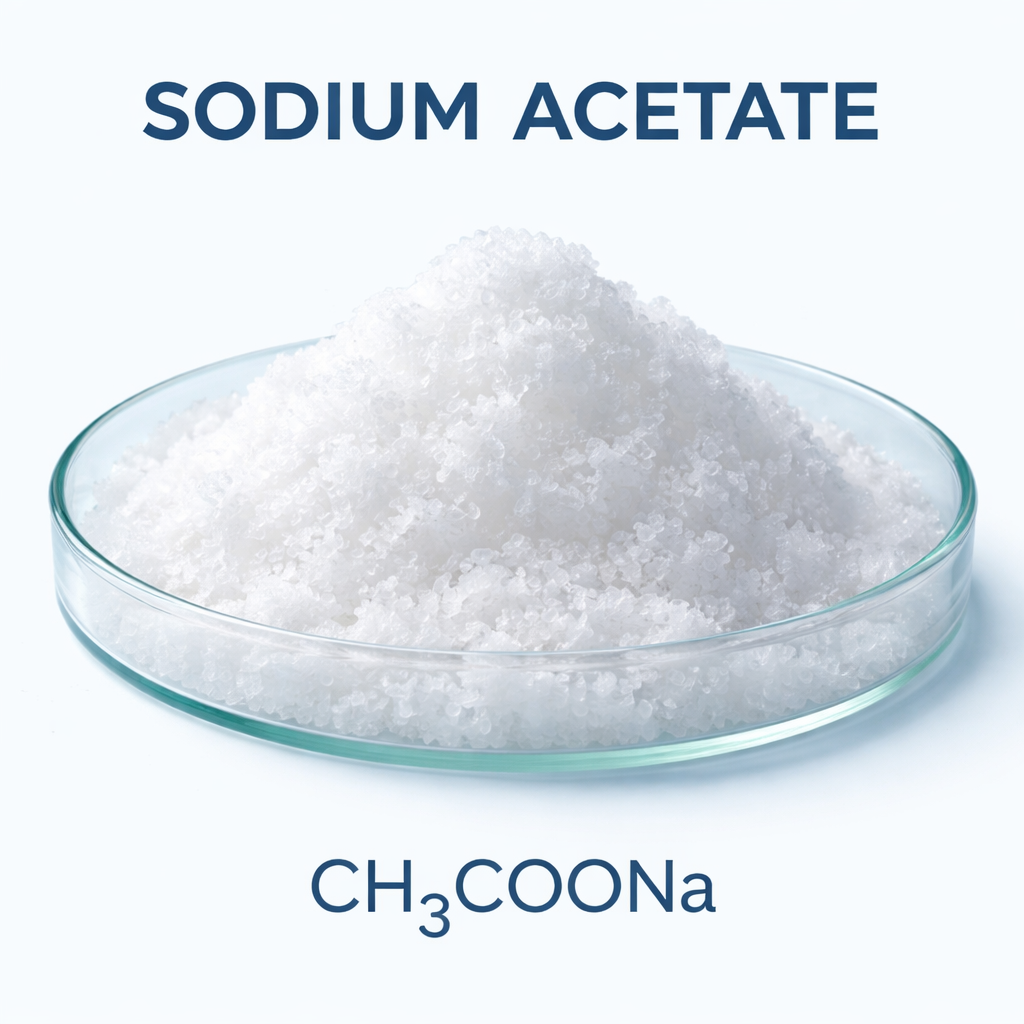
· sodium acetate
· sodium acetate anhydrous
· sodium acetate trihydrate
· sodium acetate buffer
· sodium acetate CAS 127-09-3
· sodium acetate E262
· sodium ethanoate
· sodium salt of acetic acid
· sodium acetic acid
· sodium CH3COO
· natrii acetas
· hot ice (trihydrate)
· sodium acetate hydrate