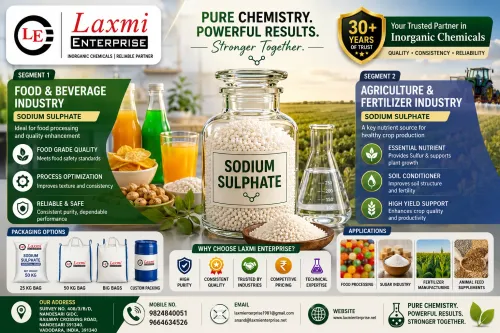


Food-Grade Sodium Sulfate (Na₂SO₄) Applications
1. Drying and Dehydration Agent
Used in powdered or granulated food products to control moisture content.
Helps prevent caking and prolongs shelf life in food powders like spices, milk powder, or powdered soups.
2. Processing Aid in Baking
Acts as a flow agent in baking powders or mixes.
Regulates moisture during dough preparation and prevents clumping in instant mixes.
3. Fermentation Support
Provides sulfate ions which may help in fermentation processes for certain foods and beverages.
Can improve the growth and metabolism of specific microorganisms used in yeast or bacterial fermentation.
4. Industrial Food Applications
Used indirectly in sugar refining to remove impurities.
Helps in clarification processes in the production of beverages or liquid foods.
5. Nutrient/Trace Mineral Source (Rare)
In some niche applications, it can act as a sodium or sulfate supplement in fortified foods.
Typically only in trace amounts, as excessive sodium sulfate can have a laxative effect.
Safety and Regulatory Notes
Must meet food-grade purity standards, usually ≥99% Na₂SO₄.
Classified as a processing aid rather than a flavoring or preservative.
Safe under regulated usage; not used for direct flavoring.
Key Point: Its main function in food processing is moisture control, flow enhancement, and fermentation support, not taste or preservation.
Role in Food Processing
Sodium sulfate is sometimes used in the following capacities:
Processing Aid in Baking: It can act as a flow agent in powdered ingredients or to control moisture in certain food powders.
Fermentation: In some fermentation processes, small amounts can regulate ionic balance or influence microbial growth.
Food-grade Drying Agent: It may help in removing residual moisture from certain food powders, though more common agents like calcium sulfate are preferred.
2. Safety and Regulatory Status
Sodium sulfate is generally recognized as safe (GRAS) for certain industrial food applications but not as a typical food additive.
European Food Safety Authority (EFSA) and FDA mostly regulate its use as a processing aid rather than a direct additive.
Excessive consumption can lead to laxative effects, as it draws water into the intestines.
3. Applications Compared to Other Salts
It is less commonly used than sodium chloride, sodium bicarbonate, or sulfates like calcium sulfate in food. Its primary role is industrial or as a processing aid, not for taste or preservation.
4. Summary
Function: Processing aid, moisture regulator, fermentation aid.
Not for direct consumption: Limited to trace amounts in food processing.
Safety: Considered safe in regulated amounts; excessive intake can cause laxative effects.
If you want, I can also make a table of all common food-related sulfates, including sodium sulfate, with their uses and regulatory limits, which is very handy for food formulation or compliance.
Natural Sources of Sodium Sulfate
Minerals
Glauber’s salt (Na₂SO₄·10H₂O): Historically mined from evaporite deposits.
Mirabilite (Na₂SO₄·10H₂O): The hydrated form of sodium sulfate.
Thenardite (Na₂SO₄): Anhydrous form found in arid regions.
Saline Lakes / Salt Lakes
Sodium sulfate is often harvested from evaporation of saline or soda lakes where the salt crystallizes naturally.
Major Extraction Regions Worldwide
Region / Country Source Type Notes
China Lake deposits (e.g., Qinghai, Inner Mongolia) Major global producer; uses both natural lake salts and synthetic recovery.
United States Lake deposits (e.g., Searles Lake, California) Large-scale extraction of sodium sulfate decahydrate and anhydrous.
Russia Mineral deposits (e.g., Volgograd, Lake Baskunchak) Mainly for industrial use, including glass and detergent production.
Canada Natural brine lakes (e.g., Alberta) Mainly for industrial applications.
Germany Mineral deposits (Evaporites in Saxony) Historically mined; now less significant.
Turkey Lake and mineral deposits Production mostly for detergent and industrial use.
India Salt lakes in Rajasthan & Gujarat Small-scale production; mostly for industrial applications.
Extraction Methods
Evaporation of Lake Brines – Crystallization from natural soda lakes.
Mining of Mineral Deposits – Glauber’s salt or mirabilite extraction from sedimentary evaporite layers.
Synthetic Recovery – From chemical processes (like sodium carbonate production) in regions lacking natural deposits.
Role in Food Processing
Sodium sulfate is mainly used as a processing aid, not as a direct food additive. Its functions include:
Moisture Control & Drying Agent:
Helps reduce moisture in powdered foods like milk powder, spices, or instant mixes, preventing caking and extending shelf life.
Flow Agent / Anti-caking Agent:
Keeps powdered ingredients free-flowing during mixing, packaging, and transport.
Fermentation Support:
Provides sulfate ions that can aid the growth of specific microorganisms in fermented foods or beverages.
Industrial Applications in Food:
Used indirectly in sugar refining and beverage clarification to remove impurities.
2. Food-Grade Sodium Sulfate
Purity: Typically ≥99% Na₂SO₄.
Usage: Classified as a processing aid; not for flavoring or preservation.
Safety: Considered GRAS (Generally Recognized As Safe) when used appropriately. Overuse can have laxative effects.
3. Examples of Application
Food Product Function of Sodium Sulfate
Powdered milk, soups Moisture control, prevent caking
Baking mixes Flow agent
Fermented foods/beverages Sulfate source for microbial activity
Sugar/beverage refining Clarification, impurity removal
. Key Point: Sodium sulfate’s main role in food processing is technological—controlling moisture, improving flow, supporting fermentation—not enhancing taste or preservation.
Natural Extraction
Source: Natural mineral deposits and saline lakes.
Minerals: Glauber’s salt (Na₂SO₄·10H₂O), mirabilite, thenardite.
Process:
Mining of evaporite deposits.
Crushing and purification.
Drying to obtain anhydrous sodium sulfate.
Regions: China, USA (California), Russia, Turkey, India.
Pros: Low energy requirement if deposits are rich.
Cons: Location-dependent; may require purification due to impurities.
2. Synthetic (Chemical) Production
Industrial production mainly uses chemical processes involving other sodium and sulfur compounds.
a) Mannheim Process
Reaction: Sodium chloride (NaCl) reacts with sulfuric acid (H₂SO₄) at high temperatures.
Products: Sodium sulfate + hydrochloric acid (HCl, can be recovered).
Applications: Mainly in dry process industries.
b) From Sodium Carbonate and Sulfuric Acid
Reaction
Notes: Often a byproduct of soda ash processing.
Advantage: Uses inexpensive raw materials; widely applied in glass and detergent industries.
c) Recovery from Other Industrial Processes
Sodium sulfate is sometimes recovered as a byproduct from:
Chlor-alkali processes
Acid neutralization in chemical plants
Detergent and paper manufacturing effluents
3. Industrial Production Flow
Raw material (NaCl, Na₂CO₃, or natural deposits) → reaction/evaporation
Crystallization of sodium sulfate
Filtration and washing
Drying (to get anhydrous or decahydrate form)
Grading for industrial or food-grade applications
4. Forms Produced
Anhydrous Na₂SO₄: Mainly for glass, detergents, and industrial chemicals.
Decahydrate (Glauber’s salt): Used in some specialty applications, including pharmaceuticals and food processing.
What Is Circular Economy in Chemical Production?
A circular economy focuses on:
Reducing waste
Reusing by-products
Recycling raw materials
Closing the loop in industrial processes
For sodium sulfate, this means minimizing environmental impact and maximizing resource efficiency by recovering and reusing chemicals instead of disposing of them.
2. Sources of Sodium Sulfate in Industry
Sodium sulfate is produced via:
Natural mineral extraction
Chemical synthesis (e.g., Mannheim process, soda ash reactions)
Byproduct recovery from other industrial processes
The circular economy approach emphasizes byproduct recovery and reuse rather than starting from virgin raw materials.
3. Circular Economy Strategies in Sodium Sulfate Production
A. Byproduct Recovery
Chlor-alkali Industry: Sodium sulfate is a byproduct when producing HCl or during brine treatment.
Detergent & Paper Industry: Sodium sulfate is formed as a residual product; instead of disposal, it is recovered, purified, and reused in glass or detergent production.
B. Recycling and Reuse
Glass Industry: Sodium sulfate recovered from other processes can be reused as a fining agent in glass making.
Detergent Industry: Recovered Na₂SO₄ can replace virgin sodium sulfate in detergent powders.
Food Industry: Food-grade sodium sulfate can sometimes be produced from purified industrial byproducts, reducing raw material extraction.
C. Waste Minimization
Converting effluent streams containing sulfates into usable sodium sulfate, reducing environmental discharge.
Utilizing crystallization and filtration technologies to recover salts from waste streams.
4. Benefits of Circular Economy in Na₂SO₄ Production
Benefit Description
Resource Efficiency Less dependence on mined or synthetic raw materials
Cost Savings Reduced raw material and waste disposal costs
Environmental Protection Less discharge of sulfate-rich effluents into water bodies
Regulatory Compliance Meets stricter environmental regulations on industrial waste
5. Examples of Circular Practices
Mannheim Process: HCl byproduct is recovered and sold instead of released.
Detergent Plants: Sodium sulfate byproduct is crystallized, dried, and reused in new detergent production.
Glass Manufacturing: Waste sodium sulfate is recovered from molten glass flues and reused as a fining agent.
Key Point: A circular economy in sodium sulfate production focuses on recovering byproducts, recycling effluents, and reducing raw material extraction, turning what would be waste into valuable resources.