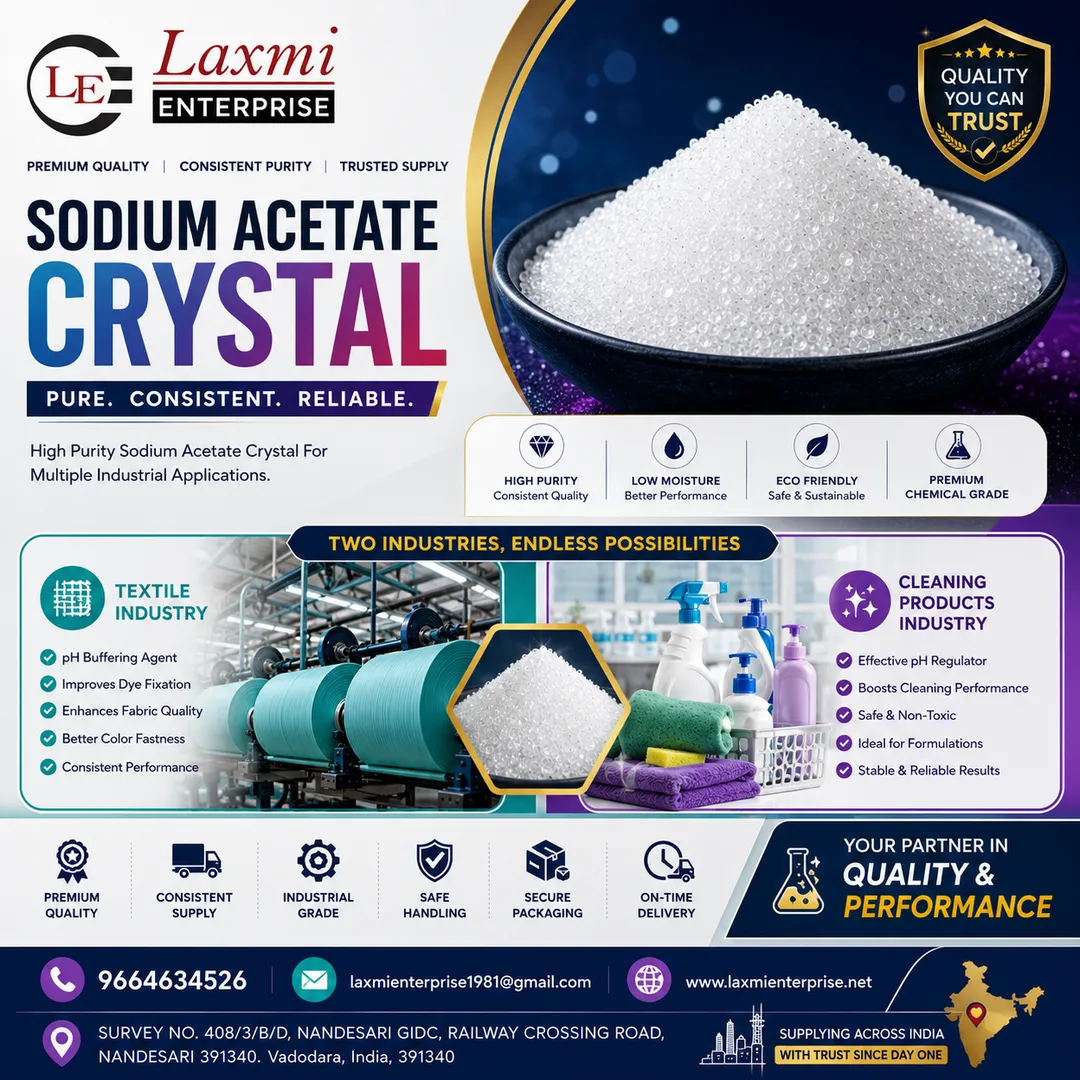
Reaction Kinetics and Crystallization Engineering of Sodium Acetate – Nucleation, Crystal Growth, Supersaturation Control, Crystal Morphology & Industrial Process Optimization
In industrial Sodium Acetate manufacturing, crystallization is the heart of the production process.
Even when the chemical reaction is complete and laboratory analysis confirms the desired composition, the product's commercial value is still determined by how the crystals are formed. Crystal size, crystal shape, purity, moisture retention, filtration efficiency, drying time, bulk density, and flowability are all strongly influenced by crystallization engineering.
Poor crystallization may result in:
Fine powder generation
High moisture retention
Difficult filtration
Longer drying cycles
Product caking
Lower flowability
Inconsistent particle size
Increased energy consumption
Well-designed crystallization, on the other hand, produces uniform crystals that are easier to filter, dry, package, transport, and use in downstream industrial applications.
This article explores the chemical engineering principles behind Sodium Acetate crystallization, including reaction kinetics, supersaturation control, nucleation, crystal growth, crystal habit, and industrial optimization strategies.
Understanding Reaction Kinetics
Reaction kinetics studies how quickly chemical reactions proceed and which factors influence the reaction rate.
For Sodium Acetate production, engineers monitor process variables such as:
Reactant concentration
Temperature
Mixing intensity
Residence time
Heat transfer
Reaction completion
A stable reaction provides a consistent starting point for downstream crystallization.
From Reaction to Crystallization
Once the reaction reaches the desired endpoint, the solution contains dissolved Sodium Acetate.
Crystals begin to form when the solution becomes supersaturated.
The transition generally follows this sequence:
Chemical reaction
Formation of a clear solution
Development of supersaturation
Nucleation
Crystal growth
Crystal maturation
Solid-liquid separation
Drying
Packaging
Each stage influences final product quality.
What Is Supersaturation?
Supersaturation occurs when a solution contains more dissolved Sodium Acetate than can remain dissolved under the prevailing conditions.
It is the driving force for crystallization.
Without sufficient supersaturation:
Crystals may not form.
Excessive supersaturation may result in:
Numerous very fine crystals
Increased dust formation
Filtration challenges
Broader particle size distribution
Maintaining an appropriate supersaturation profile is therefore critical.
The Metastable Zone
Between the fully dissolved state and spontaneous crystal formation lies the metastable zone.
Within this region:
Existing crystals can grow.
Uncontrolled spontaneous nucleation is less likely.
Operating within an appropriate metastable zone helps manufacturers encourage crystal growth while reducing the formation of excessive fines.
Nucleation
Nucleation is the process by which the first stable crystals form within a supersaturated solution.
It represents the starting point of crystallization.
Two principal mechanisms are commonly considered.
Primary Nucleation
Primary nucleation occurs when crystals form in a solution without the presence of existing crystals.
It generally requires a higher degree of supersaturation.
Secondary Nucleation
Secondary nucleation occurs when existing crystals promote the formation of additional crystals.
It is commonly observed in industrial crystallizers where crystal suspension and agitation are present.
Crystal Growth
Once stable nuclei have formed, dissolved Sodium Acetate molecules continue depositing onto crystal surfaces.
Crystal growth determines:
Final crystal size
Crystal uniformity
Surface characteristics
Filtration behaviour
Drying efficiency
Controlled crystal growth generally produces larger and more uniform particles.
Crystal Habit
Crystal habit refers to the external shape and appearance of individual crystals.
Crystal habit influences:
Bulk density
Packing behaviour
Flowability
Filtration
Drying
Dust generation
Manufacturers seek crystal habits appropriate for the intended application and downstream processing.
Crystal Morphology
Crystal morphology describes the overall physical characteristics of the crystal population.
Typical considerations include:
Particle size distribution
Shape consistency
Surface texture
Aspect ratio
Agglomeration tendency
These properties directly affect handling and product performance.
Factors Affecting Crystallization
Temperature
Temperature strongly influences:
Solubility
Supersaturation development
Crystal growth rate
Controlled temperature profiles improve reproducibility.
Cooling Rate
Cooling is one of the most important crystallization variables.
Rapid cooling may produce:
Smaller crystals
Increased fines
Higher surface area
Gradual cooling generally encourages larger crystal growth.
Mixing
Mixing promotes:
Uniform temperature
Homogeneous concentration
Improved heat transfer
Consistent crystal suspension
However, excessive agitation may increase crystal breakage.
Residence Time
Residence time determines how long crystals remain within the crystallizer.
Longer residence times often allow:
Additional crystal growth
Improved crystal maturity
Narrower particle size distribution
The optimal duration depends on process objectives.
Impurities
Trace impurities may influence:
Nucleation behaviour
Crystal growth
Crystal morphology
Filtration performance
Raw material quality therefore contributes to crystallization consistency.
Seeding
Industrial crystallization frequently uses seed crystals.
Seed crystals provide:
Controlled nucleation
Improved batch reproducibility
Better particle size control
Reduced spontaneous crystal formation
Proper seed quality and quantity are important for consistent crystal development.
Crystal Size Distribution (CSD)
Crystal Size Distribution describes the range of particle sizes present within a batch.
A controlled CSD contributes to:
Better flowability
Easier filtration
Faster drying
Reduced dust
Improved packaging consistency
Monitoring CSD is an important part of process optimization.
Filtration Performance
Crystallization strongly affects filtration efficiency.
Large, well-formed crystals generally produce:
Faster filtration
Lower moisture retention
Improved washing efficiency
Poor crystal formation can slow filtration and increase production time.
Drying Performance
Crystal characteristics influence:
Drying rate
Final moisture content
Energy consumption
Product stability
Uniform crystals often dry more consistently than irregular particles.
Process Analytical Technology (PAT)
Modern manufacturing increasingly incorporates Process Analytical Technology (PAT) to monitor crystallization in real time.
Examples include:
Temperature sensors
Concentration monitoring
Particle size analyzers
Turbidity sensors
In-line spectroscopy
Image analysis systems
PAT supports proactive process control and early detection of deviations.
Computational Process Modeling
Advanced manufacturers may use mathematical models to simulate:
Heat transfer
Crystal growth
Supersaturation profiles
Mixing behaviour
Scale-up performance
Modeling helps reduce development time and supports process optimization.
Scale-Up Challenges
Crystallization developed in laboratory equipment may behave differently at commercial scale.
Important considerations include:
Mixing efficiency
Heat removal
Equipment geometry
Cooling uniformity
Residence time distribution
Scale-up studies help ensure consistent product quality during commercial production.
Documentation Requirements
Crystallization development records may include:
Process flow diagrams
Temperature profiles
Cooling schedules
Seeding procedures
Crystal size measurements
Filtration performance
Drying results
Batch observations
Optimization studies
Well-organized documentation supports continuous improvement.
Common Crystallization Challenges
Manufacturers may encounter:
Excessive fine crystals
Wide particle size distribution
Crystal breakage
Agglomeration
Slow filtration
High moisture retention
Product caking
Inconsistent crystal morphology
Systematic process optimization helps reduce these issues.
Best Practices for Manufacturers
An effective crystallization program includes:
Controlled supersaturation
Optimized cooling profiles
Appropriate seeding strategy
Consistent mixing
Routine crystal size monitoring
Statistical process evaluation
Process validation
Continuous optimization
Best Practices for Industrial Buyers
When evaluating a Sodium Acetate supplier, buyers may ask:
How is crystallization controlled during manufacturing?
Are seed crystals used?
How is crystal size distribution monitored?
What controls are in place for cooling and temperature?
How is filtration performance optimized?
Are crystallization parameters validated?
These questions provide insight into the supplier's process engineering capability.
Frequently Asked Questions (FAQ)
Why is crystallization important in Sodium Acetate manufacturing?
Crystallization determines many physical properties of the final product, including particle size, moisture retention, filtration behaviour, flowability, and drying efficiency.
What is supersaturation?
Supersaturation is the condition where a solution contains more dissolved Sodium Acetate than can remain dissolved under the existing conditions, providing the driving force for crystal formation.
What is nucleation?
Nucleation is the formation of the first stable crystals within a supersaturated solution and marks the beginning of crystallization.
What is the difference between primary and secondary nucleation?
Primary nucleation occurs without existing crystals, whereas secondary nucleation is promoted by the presence of existing crystals in the system.
Why are seed crystals used?
Seed crystals encourage controlled crystal growth, improve batch reproducibility, and help achieve a more consistent particle size distribution.
How does cooling rate affect crystal size?
Cooling rate influences the balance between nucleation and crystal growth. Process optimization aims to achieve the desired crystal size distribution while maintaining product quality.
What is crystal habit?
Crystal habit describes the external shape of individual crystals and influences handling, filtration, flowability, and bulk density.
Why is crystal size distribution important?
A controlled crystal size distribution improves filtration, drying, packaging, flowability, and downstream processing performance.
What is Process Analytical Technology (PAT)?
PAT refers to analytical tools and monitoring systems that provide real-time information about manufacturing processes, supporting better process control and consistency.
How does crystallization engineering improve manufacturing efficiency?
By optimizing crystal formation, manufacturers can reduce drying time, improve filtration, minimize dust, lower energy consumption, and produce more consistent product quality.
Expert Insight: Crystallization Is Where Product Quality Takes Shape
The chemical reaction produces Sodium Acetate, but crystallization determines how that Sodium Acetate behaves in the real world. Control of supersaturation, nucleation, crystal growth, and cooling transforms dissolved material into a product that is easier to filter, dry, package, transport, and use. Manufacturers who understand crystallization engineering gain significant advantages in process efficiency, consistency, and customer satisfaction.
Original Assets to Build
Technical Diagrams
Sodium Acetate Crystallization Process Flow
Solubility Curve and Supersaturation Zones
Metastable Zone Width Illustration
Primary vs Secondary Nucleation Mechanisms
Crystal Growth Stages
Cooling Rate vs Crystal Size Distribution
Crystal Habit Comparison
Filtration Performance vs Crystal Size
PAT Monitoring During Crystallization
Laboratory-to-Commercial Scale-Up Model
Downloadable Resources
Crystallization SOP Template
Seeding Strategy Worksheet
Cooling Profile Record Sheet
Crystal Size Distribution Log
Crystallization Risk Assessment Checklist
Process Optimization Worksheet
Scale-Up Evaluation Report
Crystallization Troubleshooting Guide
Original Photography
Industrial crystallizer with agitator
Sodium Acetate crystal formation inside a reactor
QC laboratory measuring crystal size
Microscope images of crystal morphology
Filtration unit with crystal slurry
Tray or fluid-bed dryer processing crystals
Process engineer monitoring crystallization parameters
Control room displaying crystallization trends
Internal Linking Strategy
Link this article with:
Design of Experiments (DOE)
Measurement System Analysis (MSA)
Statistical Process Control (SPC)
Process Validation
Moisture Testing
Particle Size Analysis
Flowability Testing
Bulk Density
Equipment Qualification & Calibration
Solid–Liquid Separation and Filtration Engineering for Sodium Acetate
In industrial Sodium Acetate manufacturing, crystallization is the heart of the production process.
Even when the chemical reaction is complete and laboratory analysis confirms the desired composition, the product's commercial value is still determined by how the crystals are formed. Crystal size, crystal shape, purity, moisture retention, filtration efficiency, drying time, bulk density, and flowability are all strongly influenced by crystallization engineering.
Poor crystallization may result in:
Fine powder generation
High moisture retention
Difficult filtration
Longer drying cycles
Product caking
Lower flowability
Inconsistent particle size
Increased energy consumption
Well-designed crystallization, on the other hand, produces uniform crystals that are easier to filter, dry, package, transport, and use in downstream industrial applications.
This article explores the chemical engineering principles behind Sodium Acetate crystallization, including reaction kinetics, supersaturation control, nucleation, crystal growth, crystal habit, and industrial optimization strategies.
Understanding Reaction Kinetics
Reaction kinetics studies how quickly chemical reactions proceed and which factors influence the reaction rate.
For Sodium Acetate production, engineers monitor process variables such as:
Reactant concentration
Temperature
Mixing intensity
Residence time
Heat transfer
Reaction completion
A stable reaction provides a consistent starting point for downstream crystallization.
From Reaction to Crystallization
Once the reaction reaches the desired endpoint, the solution contains dissolved Sodium Acetate.
Crystals begin to form when the solution becomes supersaturated.
The transition generally follows this sequence:
Chemical reaction
Formation of a clear solution
Development of supersaturation
Nucleation
Crystal growth
Crystal maturation
Solid-liquid separation
Drying
Packaging
Each stage influences final product quality.
What Is Supersaturation?
Supersaturation occurs when a solution contains more dissolved Sodium Acetate than can remain dissolved under the prevailing conditions.
It is the driving force for crystallization.
Without sufficient supersaturation:
Crystals may not form.
Excessive supersaturation may result in:
Numerous very fine crystals
Increased dust formation
Filtration challenges
Broader particle size distribution
Maintaining an appropriate supersaturation profile is therefore critical.
The Metastable Zone
Between the fully dissolved state and spontaneous crystal formation lies the metastable zone.
Within this region:
Existing crystals can grow.
Uncontrolled spontaneous nucleation is less likely.
Operating within an appropriate metastable zone helps manufacturers encourage crystal growth while reducing the formation of excessive fines.
Nucleation
Nucleation is the process by which the first stable crystals form within a supersaturated solution.
It represents the starting point of crystallization.
Two principal mechanisms are commonly considered.
Primary Nucleation
Primary nucleation occurs when crystals form in a solution without the presence of existing crystals.
It generally requires a higher degree of supersaturation.
Secondary Nucleation
Secondary nucleation occurs when existing crystals promote the formation of additional crystals.
It is commonly observed in industrial crystallizers where crystal suspension and agitation are present.
Crystal Growth
Once stable nuclei have formed, dissolved Sodium Acetate molecules continue depositing onto crystal surfaces.
Crystal growth determines:
Final crystal size
Crystal uniformity
Surface characteristics
Filtration behaviour
Drying efficiency
Controlled crystal growth generally produces larger and more uniform particles.
Crystal Habit
Crystal habit refers to the external shape and appearance of individual crystals.
Crystal habit influences:
Bulk density
Packing behaviour
Flowability
Filtration
Drying
Dust generation
Manufacturers seek crystal habits appropriate for the intended application and downstream processing.
Crystal Morphology
Crystal morphology describes the overall physical characteristics of the crystal population.
Typical considerations include:
Particle size distribution
Shape consistency
Surface texture
Aspect ratio
Agglomeration tendency
These properties directly affect handling and product performance.
Factors Affecting Crystallization
Temperature
Temperature strongly influences:
Solubility
Supersaturation development
Crystal growth rate
Controlled temperature profiles improve reproducibility.
Cooling Rate
Cooling is one of the most important crystallization variables.
Rapid cooling may produce:
Smaller crystals
Increased fines
Higher surface area
Gradual cooling generally encourages larger crystal growth.
Mixing
Mixing promotes:
Uniform temperature
Homogeneous concentration
Improved heat transfer
Consistent crystal suspension
However, excessive agitation may increase crystal breakage.
Residence Time
Residence time determines how long crystals remain within the crystallizer.
Longer residence times often allow:
Additional crystal growth
Improved crystal maturity
Narrower particle size distribution
The optimal duration depends on process objectives.
Impurities
Trace impurities may influence:
Nucleation behaviour
Crystal growth
Crystal morphology
Filtration performance
Raw material quality therefore contributes to crystallization consistency.
Seeding
Industrial crystallization frequently uses seed crystals.
Seed crystals provide:
Controlled nucleation
Improved batch reproducibility
Better particle size control
Reduced spontaneous crystal formation
Proper seed quality and quantity are important for consistent crystal development.
Crystal Size Distribution (CSD)
Crystal Size Distribution describes the range of particle sizes present within a batch.
A controlled CSD contributes to:
Better flowability
Easier filtration
Faster drying
Reduced dust
Improved packaging consistency
Monitoring CSD is an important part of process optimization.
Filtration Performance
Crystallization strongly affects filtration efficiency.
Large, well-formed crystals generally produce:
Faster filtration
Lower moisture retention
Improved washing efficiency
Poor crystal formation can slow filtration and increase production time.
Drying Performance
Crystal characteristics influence:
Drying rate
Final moisture content
Energy consumption
Product stability
Uniform crystals often dry more consistently than irregular particles.
Process Analytical Technology (PAT)
Modern manufacturing increasingly incorporates Process Analytical Technology (PAT) to monitor crystallization in real time.
Examples include:
Temperature sensors
Concentration monitoring
Particle size analyzers
Turbidity sensors
In-line spectroscopy
Image analysis systems
PAT supports proactive process control and early detection of deviations.
Computational Process Modeling
Advanced manufacturers may use mathematical models to simulate:
Heat transfer
Crystal growth
Supersaturation profiles
Mixing behaviour
Scale-up performance
Modeling helps reduce development time and supports process optimization.
Scale-Up Challenges
Crystallization developed in laboratory equipment may behave differently at commercial scale.
Important considerations include:
Mixing efficiency
Heat removal
Equipment geometry
Cooling uniformity
Residence time distribution
Scale-up studies help ensure consistent product quality during commercial production.
Documentation Requirements
Crystallization development records may include:
Process flow diagrams
Temperature profiles
Cooling schedules
Seeding procedures
Crystal size measurements
Filtration performance
Drying results
Batch observations
Optimization studies
Well-organized documentation supports continuous improvement.
Common Crystallization Challenges
Manufacturers may encounter:
Excessive fine crystals
Wide particle size distribution
Crystal breakage
Agglomeration
Slow filtration
High moisture retention
Product caking
Inconsistent crystal morphology
Systematic process optimization helps reduce these issues.
Best Practices for Manufacturers
An effective crystallization program includes:
Controlled supersaturation
Optimized cooling profiles
Appropriate seeding strategy
Consistent mixing
Routine crystal size monitoring
Statistical process evaluation
Process validation
Continuous optimization
Best Practices for Industrial Buyers
When evaluating a Sodium Acetate supplier, buyers may ask:
How is crystallization controlled during manufacturing?
Are seed crystals used?
How is crystal size distribution monitored?
What controls are in place for cooling and temperature?
How is filtration performance optimized?
Are crystallization parameters validated?
These questions provide insight into the supplier's process engineering capability.
Frequently Asked Questions (FAQ)
Why is crystallization important in Sodium Acetate manufacturing?
Crystallization determines many physical properties of the final product, including particle size, moisture retention, filtration behaviour, flowability, and drying efficiency.
What is supersaturation?
Supersaturation is the condition where a solution contains more dissolved Sodium Acetate than can remain dissolved under the existing conditions, providing the driving force for crystal formation.
What is nucleation?
Nucleation is the formation of the first stable crystals within a supersaturated solution and marks the beginning of crystallization.
What is the difference between primary and secondary nucleation?
Primary nucleation occurs without existing crystals, whereas secondary nucleation is promoted by the presence of existing crystals in the system.
Why are seed crystals used?
Seed crystals encourage controlled crystal growth, improve batch reproducibility, and help achieve a more consistent particle size distribution.
How does cooling rate affect crystal size?
Cooling rate influences the balance between nucleation and crystal growth. Process optimization aims to achieve the desired crystal size distribution while maintaining product quality.
What is crystal habit?
Crystal habit describes the external shape of individual crystals and influences handling, filtration, flowability, and bulk density.
Why is crystal size distribution important?
A controlled crystal size distribution improves filtration, drying, packaging, flowability, and downstream processing performance.
What is Process Analytical Technology (PAT)?
PAT refers to analytical tools and monitoring systems that provide real-time information about manufacturing processes, supporting better process control and consistency.
How does crystallization engineering improve manufacturing efficiency?
By optimizing crystal formation, manufacturers can reduce drying time, improve filtration, minimize dust, lower energy consumption, and produce more consistent product quality.
Expert Insight: Crystallization Is Where Product Quality Takes Shape
The chemical reaction produces Sodium Acetate, but crystallization determines how that Sodium Acetate behaves in the real world. Control of supersaturation, nucleation, crystal growth, and cooling transforms dissolved material into a product that is easier to filter, dry, package, transport, and use. Manufacturers who understand crystallization engineering gain significant advantages in process efficiency, consistency, and customer satisfaction.
Original Assets to Build
Technical Diagrams
Sodium Acetate Crystallization Process Flow
Solubility Curve and Supersaturation Zones
Metastable Zone Width Illustration
Primary vs Secondary Nucleation Mechanisms
Crystal Growth Stages
Cooling Rate vs Crystal Size Distribution
Crystal Habit Comparison
Filtration Performance vs Crystal Size
PAT Monitoring During Crystallization
Laboratory-to-Commercial Scale-Up Model
Downloadable Resources
Crystallization SOP Template
Seeding Strategy Worksheet
Cooling Profile Record Sheet
Crystal Size Distribution Log
Crystallization Risk Assessment Checklist
Process Optimization Worksheet
Scale-Up Evaluation Report
Crystallization Troubleshooting Guide
Original Photography
Industrial crystallizer with agitator
Sodium Acetate crystal formation inside a reactor
QC laboratory measuring crystal size
Microscope images of crystal morphology
Filtration unit with crystal slurry
Tray or fluid-bed dryer processing crystals
Process engineer monitoring crystallization parameters
Control room displaying crystallization trends
Internal Linking Strategy
Link this article with:
Design of Experiments (DOE)
Measurement System Analysis (MSA)
Statistical Process Control (SPC)
Process Validation
Moisture Testing
Particle Size Analysis
Flowability Testing
Bulk Density
Equipment Qualification & Calibration
Solid–Liquid Separation and Filtration Engineering for Sodium Acetate
Keywords