
Sodium Sulphate in Glass Fiber Manufacturing: A Complete Technical Guide for Industrial Manufacturers
Introduction
Glass fiber has transformed modern manufacturing by enabling the production of lightweight, high-strength, corrosion-resistant, and thermally stable composite materials. Today, glass fiber reinforced products are found in construction, wind energy, automotive components, electrical insulation, marine equipment, aerospace structures, chemical processing plants, water storage tanks, pipelines, and numerous industrial applications. As industries demand stronger yet lighter materials, global consumption of glass fiber continues to grow steadily.
Behind every high-quality glass fiber product lies a carefully engineered manufacturing process that depends on precise control of raw materials. Every ingredient added to the glass batch influences melting behavior, furnace efficiency, glass quality, fiber formation, and long-term product performance. Even slight variations in raw material quality can affect production consistency, energy consumption, fiber strength, and manufacturing costs.
Among the various industrial chemicals used during glass manufacturing, Sodium Sulphate (Na₂SO₄) plays an important supporting role. Although it represents only a small proportion of the total glass batch, its contribution to furnace operation and glass refining is significant. High-purity sodium sulphate helps manufacturers achieve stable melting conditions, improve refining efficiency, reduce unwanted gas inclusions, and produce clearer, more homogeneous molten glass suitable for continuous fiber production.
For manufacturers operating large glass furnaces around the clock, consistency is more valuable than occasional peak performance. A stable supply of high-quality sodium sulphate enables predictable furnace behavior, smoother production cycles, lower process variability, and improved product quality. This is why leading glass manufacturers place considerable emphasis on sourcing sodium sulphate from reliable suppliers capable of delivering consistent chemical composition and physical properties with every shipment.
This comprehensive guide explains the technical role of sodium sulphate in glass fiber manufacturing, its chemical characteristics, production advantages, quality requirements, purchasing considerations, and best practices for industrial users.
Understanding Glass Fiber Manufacturing
Glass fiber is produced by melting selected mineral raw materials at temperatures typically ranging between 1, 400°C and 1, 600°C. The molten glass is then drawn through precision bushings containing hundreds or thousands of tiny openings, forming continuous glass filaments with highly controlled diameters.
These filaments are cooled, coated with specialized sizing formulations, gathered into strands, and wound onto packages for further processing into woven fabrics, chopped strands, mats, roving, insulation products, reinforced plastics, and engineered composites.
Unlike ordinary glass manufacturing, glass fiber production demands exceptional consistency because the molten glass must remain chemically uniform throughout continuous operation. Variations in viscosity, composition, or refining efficiency can lead to production instability, fiber breakage, or defects in the finished product.
Major Raw Materials Used in Glass Fiber Production
A typical glass batch contains carefully proportioned mineral raw materials, each contributing specific properties to the finished glass.
Common raw materials include:
Silica Sand (SiO₂)
Limestone (Calcium Carbonate)
Dolomite
Alumina Sources
Boron Compounds (for E-glass)
Feldspar
Kaolin
Sodium Carbonate (Soda Ash)
Sodium Sulphate
Recycled Glass (Cullet)
Each ingredient performs a unique function. The final glass composition depends on maintaining strict control over the quality and proportion of every raw material entering the furnace.
What Is Sodium Sulphate?
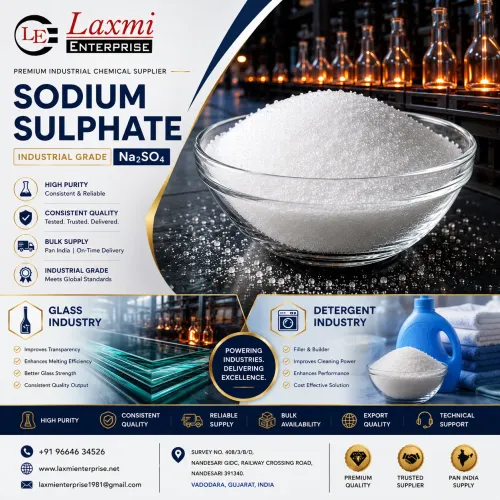
Sodium sulphate is an inorganic salt with the chemical formula Na₂SO₄. It is widely used across numerous industrial sectors, including glass manufacturing, detergents, pulp and paper, textiles, chemicals, pharmaceuticals, and laboratory applications.
Commercially, sodium sulphate is available in two primary forms:
Anhydrous Sodium Sulphate
Sodium Sulphate Decahydrate (Glauber's Salt)
For glass manufacturing, high-purity anhydrous sodium sulphate is generally preferred because of its low moisture content, stable composition, and predictable behavior under high-temperature furnace conditions.
Its white crystalline appearance, excellent storage stability, and ease of handling make it suitable for automated bulk material handling systems commonly used in modern glass plants.
Technical Profile of Sodium Sulphate
Understanding the physical and chemical characteristics of sodium sulphate helps explain why it remains an important raw material in industrial glass manufacturing.
Property Typical Value
Chemical Formula Na₂SO₄
Molecular Weight 142.04 g/mol
CAS Number 7757-82-6
Appearance White Crystalline Powder or Granules
Odor Odorless
Solubility in Water Highly Soluble
pH (Aqueous Solution) Neutral to Slightly Alkaline
Crystal Structure Orthorhombic (Anhydrous Form)
Stability Excellent under Normal Storage
Flammability Non-Flammable
The exact specification may vary depending on the manufacturing process and purity grade supplied by the producer.
Why Sodium Sulphate Is Important in Glass Fiber Manufacturing
Glass manufacturing involves far more than simply melting minerals together. The objective is to create a homogeneous molten glass free from excessive bubbles, unmelted particles, chemical inconsistencies, and structural defects.
During furnace operation, gases generated from raw material decomposition become trapped within the molten glass. If these gases remain, they may create bubbles, reduce optical quality, interfere with fiber formation, and negatively affect product consistency.
Sodium sulphate serves as a glass refining agent, helping to promote the removal of entrapped gases from the molten glass. Under high-temperature conditions, it participates in reactions that assist the refining process, supporting the production of a more homogeneous melt suitable for continuous glass fiber formation.
A more uniformly refined melt contributes to smoother downstream processing and improved manufacturing stability.
Role During Glass Batch Preparation
The quality of molten glass begins long before the raw materials enter the furnace.
Glass manufacturers invest significant effort in preparing a consistent and homogeneous batch mixture. Every component must be accurately weighed, thoroughly mixed, and uniformly distributed.
High-quality sodium sulphate contributes to this stage by offering:
Uniform particle size
Excellent flow characteristics
Consistent bulk density
Good compatibility with other batch materials
Stable storage properties
Low moisture content
These characteristics help automated batching systems maintain accurate dosing and reduce the likelihood of material segregation during handling.
Contribution to Furnace Performance
Modern glass furnaces operate continuously for several years without shutdown.
Maintaining stable furnace conditions is essential because temperature fluctuations, inconsistent raw materials, or changes in melt behavior can significantly affect production efficiency.
Consistent sodium sulphate quality helps support:
Stable furnace operation
Predictable melting behavior
Uniform glass composition
Improved refining efficiency
Reduced process variability
Reliable long-term production
Although sodium sulphate is only one component of the glass batch, maintaining its consistency contributes to overall process stability.
Importance of High Purity
Industrial glass manufacturers generally specify high-purity sodium sulphate because impurities can influence furnace chemistry and glass quality.
Quality control laboratories commonly evaluate parameters such as:
Na₂SO₄ content
Moisture content
Water-insoluble matter
Chloride content
Iron content
Particle size distribution
Bulk density
Whiteness
Loss on drying
Maintaining consistent values across production batches helps manufacturers reduce process variability and improve production planning.
Glass Fiber Quality Depends on Raw Material Consistency
Glass fiber is produced continuously, often at high speeds, through precision platinum alloy bushings.
Small variations in glass composition can influence:
Melt viscosity
Fiber attenuation
Filament diameter consistency
Break frequency
Production efficiency
Product quality
For this reason, manufacturers carefully qualify suppliers capable of maintaining long-term consistency rather than simply offering the lowest price.
Reliable sodium sulphate quality supports repeatable manufacturing performance and contributes to efficient furnace operation over extended production campaigns.
Introduction
Glass fiber has transformed modern manufacturing by enabling the production of lightweight, high-strength, corrosion-resistant, and thermally stable composite materials. Today, glass fiber reinforced products are found in construction, wind energy, automotive components, electrical insulation, marine equipment, aerospace structures, chemical processing plants, water storage tanks, pipelines, and numerous industrial applications. As industries demand stronger yet lighter materials, global consumption of glass fiber continues to grow steadily.
Behind every high-quality glass fiber product lies a carefully engineered manufacturing process that depends on precise control of raw materials. Every ingredient added to the glass batch influences melting behavior, furnace efficiency, glass quality, fiber formation, and long-term product performance. Even slight variations in raw material quality can affect production consistency, energy consumption, fiber strength, and manufacturing costs.
Among the various industrial chemicals used during glass manufacturing, Sodium Sulphate (Na₂SO₄) plays an important supporting role. Although it represents only a small proportion of the total glass batch, its contribution to furnace operation and glass refining is significant. High-purity sodium sulphate helps manufacturers achieve stable melting conditions, improve refining efficiency, reduce unwanted gas inclusions, and produce clearer, more homogeneous molten glass suitable for continuous fiber production.
For manufacturers operating large glass furnaces around the clock, consistency is more valuable than occasional peak performance. A stable supply of high-quality sodium sulphate enables predictable furnace behavior, smoother production cycles, lower process variability, and improved product quality. This is why leading glass manufacturers place considerable emphasis on sourcing sodium sulphate from reliable suppliers capable of delivering consistent chemical composition and physical properties with every shipment.
This comprehensive guide explains the technical role of sodium sulphate in glass fiber manufacturing, its chemical characteristics, production advantages, quality requirements, purchasing considerations, and best practices for industrial users.
Understanding Glass Fiber Manufacturing
Glass fiber is produced by melting selected mineral raw materials at temperatures typically ranging between 1, 400°C and 1, 600°C. The molten glass is then drawn through precision bushings containing hundreds or thousands of tiny openings, forming continuous glass filaments with highly controlled diameters.
These filaments are cooled, coated with specialized sizing formulations, gathered into strands, and wound onto packages for further processing into woven fabrics, chopped strands, mats, roving, insulation products, reinforced plastics, and engineered composites.
Unlike ordinary glass manufacturing, glass fiber production demands exceptional consistency because the molten glass must remain chemically uniform throughout continuous operation. Variations in viscosity, composition, or refining efficiency can lead to production instability, fiber breakage, or defects in the finished product.
Major Raw Materials Used in Glass Fiber Production
A typical glass batch contains carefully proportioned mineral raw materials, each contributing specific properties to the finished glass.
Common raw materials include:
Silica Sand (SiO₂)
Limestone (Calcium Carbonate)
Dolomite
Alumina Sources
Boron Compounds (for E-glass)
Feldspar
Kaolin
Sodium Carbonate (Soda Ash)
Sodium Sulphate
Recycled Glass (Cullet)
Each ingredient performs a unique function. The final glass composition depends on maintaining strict control over the quality and proportion of every raw material entering the furnace.
What Is Sodium Sulphate?
Sodium sulphate is an inorganic salt with the chemical formula Na₂SO₄. It is widely used across numerous industrial sectors, including glass manufacturing, detergents, pulp and paper, textiles, chemicals, pharmaceuticals, and laboratory applications.
Commercially, sodium sulphate is available in two primary forms:
Anhydrous Sodium Sulphate
Sodium Sulphate Decahydrate (Glauber's Salt)
For glass manufacturing, high-purity anhydrous sodium sulphate is generally preferred because of its low moisture content, stable composition, and predictable behavior under high-temperature furnace conditions.
Its white crystalline appearance, excellent storage stability, and ease of handling make it suitable for automated bulk material handling systems commonly used in modern glass plants.
Technical Profile of Sodium Sulphate
Understanding the physical and chemical characteristics of sodium sulphate helps explain why it remains an important raw material in industrial glass manufacturing.
Property Typical Value
Chemical Formula Na₂SO₄
Molecular Weight 142.04 g/mol
CAS Number 7757-82-6
Appearance White Crystalline Powder or Granules
Odor Odorless
Solubility in Water Highly Soluble
pH (Aqueous Solution) Neutral to Slightly Alkaline
Crystal Structure Orthorhombic (Anhydrous Form)
Stability Excellent under Normal Storage
Flammability Non-Flammable
The exact specification may vary depending on the manufacturing process and purity grade supplied by the producer.
Why Sodium Sulphate Is Important in Glass Fiber Manufacturing
Glass manufacturing involves far more than simply melting minerals together. The objective is to create a homogeneous molten glass free from excessive bubbles, unmelted particles, chemical inconsistencies, and structural defects.
During furnace operation, gases generated from raw material decomposition become trapped within the molten glass. If these gases remain, they may create bubbles, reduce optical quality, interfere with fiber formation, and negatively affect product consistency.
Sodium sulphate serves as a glass refining agent, helping to promote the removal of entrapped gases from the molten glass. Under high-temperature conditions, it participates in reactions that assist the refining process, supporting the production of a more homogeneous melt suitable for continuous glass fiber formation.
A more uniformly refined melt contributes to smoother downstream processing and improved manufacturing stability.
Role During Glass Batch Preparation
The quality of molten glass begins long before the raw materials enter the furnace.
Glass manufacturers invest significant effort in preparing a consistent and homogeneous batch mixture. Every component must be accurately weighed, thoroughly mixed, and uniformly distributed.
High-quality sodium sulphate contributes to this stage by offering:
Uniform particle size
Excellent flow characteristics
Consistent bulk density
Good compatibility with other batch materials
Stable storage properties
Low moisture content
These characteristics help automated batching systems maintain accurate dosing and reduce the likelihood of material segregation during handling.
Contribution to Furnace Performance
Modern glass furnaces operate continuously for several years without shutdown.
Maintaining stable furnace conditions is essential because temperature fluctuations, inconsistent raw materials, or changes in melt behavior can significantly affect production efficiency.
Consistent sodium sulphate quality helps support:
Stable furnace operation
Predictable melting behavior
Uniform glass composition
Improved refining efficiency
Reduced process variability
Reliable long-term production
Although sodium sulphate is only one component of the glass batch, maintaining its consistency contributes to overall process stability.
Importance of High Purity
Industrial glass manufacturers generally specify high-purity sodium sulphate because impurities can influence furnace chemistry and glass quality.
Quality control laboratories commonly evaluate parameters such as:
Na₂SO₄ content
Moisture content
Water-insoluble matter
Chloride content
Iron content
Particle size distribution
Bulk density
Whiteness
Loss on drying
Maintaining consistent values across production batches helps manufacturers reduce process variability and improve production planning.
Glass Fiber Quality Depends on Raw Material Consistency
Glass fiber is produced continuously, often at high speeds, through precision platinum alloy bushings.
Small variations in glass composition can influence:
Melt viscosity
Fiber attenuation
Filament diameter consistency
Break frequency
Production efficiency
Product quality
For this reason, manufacturers carefully qualify suppliers capable of maintaining long-term consistency rather than simply offering the lowest price.
Reliable sodium sulphate quality supports repeatable manufacturing performance and contributes to efficient furnace operation over extended production campaigns.
Keywords