Sodium Acetate (Anhydrous & Trihydrate) Specifications, Quality Parameters, Laboratory Testing, COA, TDS & Industrial Quality Standards (2026)
Description
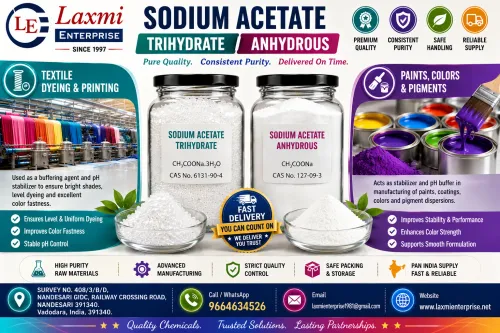
Discover the complete quality and laboratory guide for Sodium Acetate Anhydrous (CAS No. 127-09-3) and Sodium Acetate Trihydrate (CAS No. 6131-90-4). Learn about product specifications, laboratory testing methods, quality control procedures, Certificates of Analysis (COA), Technical Data Sheets (TDS), Safety Data Sheets (SDS), quality assurance systems, supplier qualification, procurement guidelines, and industrial quality standards. This guide is intended for laboratories, quality managers, procurement teams, manufacturers, exporters, and industrial buyers.
SEO URL
/sodium-acetate-specifications-quality-testing-coa-tds-guide
Primary Keyword
Sodium Acetate Specifications
Opening Answer
Industrial buyers rely on Sodium Acetate specifications to ensure consistent manufacturing performance and product quality. Before a batch is approved for production, manufacturers and customers typically verify its identity, physical characteristics, documentation, and compliance with agreed specifications. Reliable laboratory testing, Certificates of Analysis (COA), Technical Data Sheets (TDS), Safety Data Sheets (SDS), and batch traceability form the foundation of an effective quality assurance system for both Sodium Acetate Anhydrous (CAS No. 127-09-3) and Sodium Acetate Trihydrate (CAS No. 6131-90-4).
Table of Contents
Why Specifications Matter
Product Specifications
Quality Parameters
Laboratory Testing
Certificate of Analysis (COA)
Technical Data Sheet (TDS)
Safety Data Sheet (SDS)
Quality Assurance
Supplier Qualification
Buyer FAQs
Why Are Specifications Important?
Product specifications define the agreed quality requirements between the supplier and the buyer. They provide a common technical reference that helps ensure the supplied material is suitable for its intended application.
Specifications help manufacturers:
Maintain consistent production.
Reduce quality-related risks.
Improve supplier evaluation.
Support laboratory verification.
Simplify procurement decisions.
Meet customer requirements.
Without clearly defined specifications, product consistency and quality assurance become more difficult to maintain.
Technical Insight
Specifications should be developed according to the intended application. A laboratory-grade product may require different acceptance criteria than a product intended for general industrial processing. Buyers should therefore ensure that the specification aligns with the manufacturing process and regulatory requirements.
Chemical Identification
Accurate product identification is the first step in any quality system.
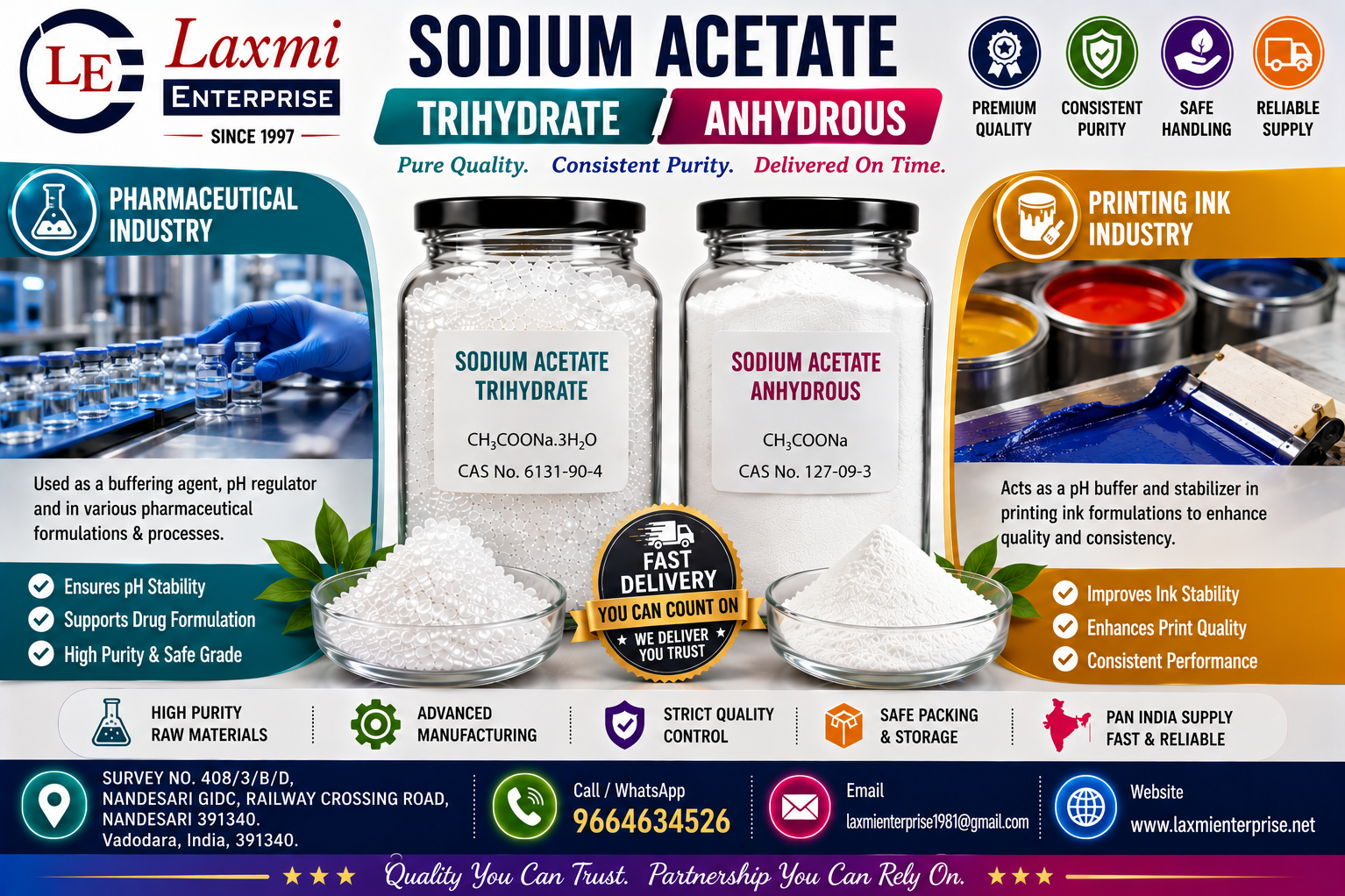
Property Sodium Acetate Anhydrous Sodium Acetate Trihydrate
Chemical Name Sodium Acetate Anhydrous Sodium Acetate Trihydrate
Chemical Formula CH₃COONa CH₃COONa·3H₂O
CAS Number 127-09-3 6131-90-4
HSN Code 2915 2915
Chemical Family Sodium Salt of Acetic Acid Sodium Salt of Acetic Acid
Appearance White crystalline powder White crystalline crystals
Correct identification reduces the risk of receiving or using the wrong raw material.
Typical Product Specifications
The exact specification varies according to grade, manufacturer, and customer agreement. Buyers should always refer to the supplier's approved specification and Certificate of Analysis.
Quality Parameter Why It Is Evaluated Importance to Buyers
Product Identity Confirms correct chemical Prevents material mix-ups
Appearance Visual quality verification Detects abnormalities
Solubility Confirms expected performance Supports manufacturing
Purity Verifies specification compliance Improves product consistency
Moisture Characteristics Supports storage stability Improves handling
Particle Characteristics Influences process performance Supports automated handling
Batch Traceability Enables investigation Strengthens quality systems
Packaging Integrity Protects product quality Reduces transport damage
Quality Parameters
Professional manufacturers evaluate several quality characteristics before approving a production batch.
Major Quality Parameters
Parameter Typical Purpose
Appearance Product identification
Chemical Identity Product verification
Solubility Performance evaluation
Purity Specification compliance
Moisture Storage suitability
Particle Characteristics Process consistency
Packaging Product protection
Documentation Regulatory and customer support
Each parameter contributes to overall product quality and customer confidence.
Laboratory Insight
Quality should be viewed as a combination of product performance, process consistency, documentation, and traceability. Laboratory testing confirms technical characteristics, but a complete quality system extends well beyond analytical measurements.
Understanding Product Purity
Purity is one of the most frequently discussed quality characteristics.
From an industrial perspective, purity should always be interpreted together with:
Product grade
Manufacturing process
Customer specification
Intended application
Supporting documentation
A purity value alone does not determine whether a product is suitable for a specific manufacturing process.
Why Batch Consistency Matters
Manufacturers prefer raw materials that perform consistently from one delivery to the next.
Consistent batches help:
Reduce process adjustments
Improve product quality
Minimize production downtime
Support laboratory reproducibility
Strengthen supplier relationships
Engineering Insight
A highly consistent product often delivers greater manufacturing value than one with a marginally higher specification but greater batch-to-batch variation. Production stability is a key objective for most industrial users.
Laboratory Sampling
Before laboratory testing begins, a representative sample should be collected according to documented sampling procedures.
A good sampling program helps ensure that laboratory results accurately represent the production batch.
Sampling generally includes:
Clean sampling equipment
Representative sample selection
Proper sample labeling
Traceable documentation
Controlled storage before testing
Typical Laboratory Workflow
Laboratory Stage Purpose
Sample Receipt Register incoming sample
Identification Verify sample details
Visual Examination Check appearance
Laboratory Testing Evaluate quality characteristics
Documentation Review Compare with specification
Report Preparation Record results
Batch Approval Support release decision
Frequently Asked Questions (FAQ)
1. Why are product specifications important?
Specifications establish the agreed quality requirements between supplier and buyer and help ensure the material is suitable for its intended application.
2. What information should buyers verify first?
Buyers should confirm the product name, grade, CAS Number, HSN Code, specification, and supporting documentation before approving a shipment.
3. Does every manufacturer use the same specification?
No. Specifications may vary depending on grade, manufacturing process, customer requirements, and intended application.
4. Why is representative sampling important?
Reliable laboratory results depend on samples that accurately represent the production batch.
5. Is purity the only quality parameter that matters?
No. Product identity, consistency, moisture characteristics, particle properties, documentation, packaging, and traceability are also important considerations.
About Laxmi Enterprise
Laxmi Enterprise, based in Nandesari GIDC, Vadodara, Gujarat, supplies Sodium Acetate Anhydrous (CAS No. 127-09-3) and Sodium Acetate Trihydrate (CAS No. 6131-90-4) with HSN Code 2915 to industrial customers across Ahmedabad, Surat, Bharuch, Ankleshwar, Dahej, Vapi, Mumbai, Pune, Hyderabad, Chennai, Bengaluru, Coimbatore, Tiruppur, Kanpur, Ludhiana, Kolkata, Indore, Jaipur, and other major manufacturing centers. The company supports customers by providing technical documentation, consistent product availability, and responsive service for diverse industrial applications.
Key Takeaways
Clear product specifications, disciplined laboratory practices, and complete technical documentation form the basis of a reliable Sodium Acetate quality system. Industrial buyers who evaluate product identity, quality parameters, documentation, and supplier capability are better positioned to achieve consistent manufacturing performance and long-term supply reliability.
Keywords