

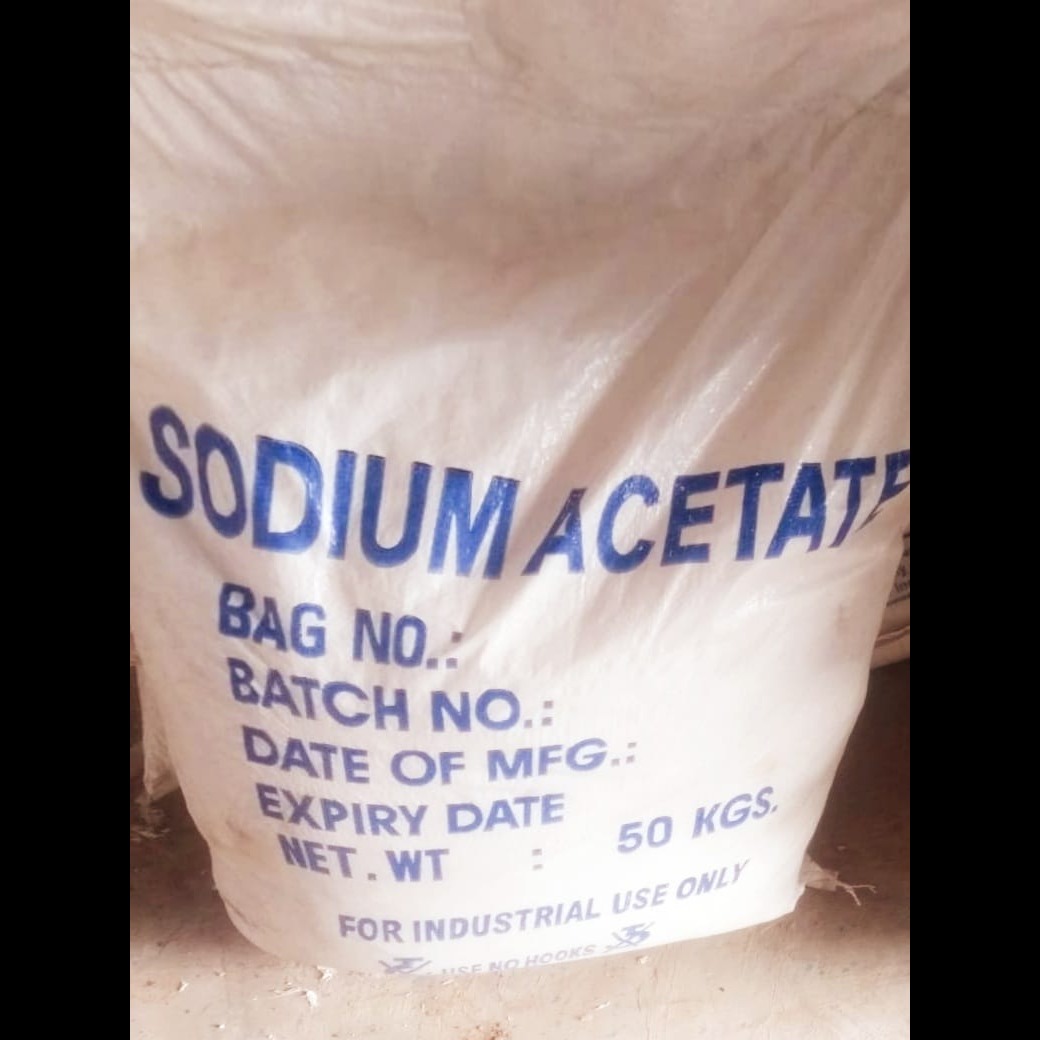
Overview
Role of Sodium Acetate in Electroplating
In electroplating baths (especially copper, nickel, or zinc baths), sodium acetate (CH₃COONa) is often used as a buffer or stabilizer. Its main functions include:
pH Buffering
Electroplating reactions are sensitive to pH.
Sodium acetate, often in combination with acetic acid, maintains the bath pH within an optimal range.
Stable pH prevents precipitation of metal hydroxides and ensures uniform deposition.
Bath Stabilization
Some plating baths (like copper or zinc-acetate baths) are prone to decomposition or side reactions.
Sodium acetate helps reduce free metal ion hydrolysis, stabilizing the metal ions in solution.
Complexation
Sodium acetate can weakly complex certain metal ions (e.g., copper ions), reducing aggressive reactions and improving deposit smoothness and brightness.
Control of Throwing Power
By stabilizing the bath, it allows more uniform metal deposition even on complex geometries.
2. Typical Use
Concentration depends on the bath composition:
Usually 1–5 g/L in plating solutions.
Works best in baths where the metal is not strongly acidic.
Often combined with acetic acid to form an acetate buffer system.
3. Key Notes
• sodium acetate
• sodium acetate anhydrous
• sodium acetate trihydrate
• sodium acetate buffer
• sodium acetate CAS 127-09-3
• sodium acetate E262
Sodium acetate is not a primary plating metal source; it’s a supporting additive.
It can help reduce pitting and roughness in deposits.
It is compatible with aqueous baths, but care must be taken if using organic solvents.
Sodium acetate (CH₃COONa) is a sodium salt of acetic acid. It is widely used in:
Textile printing
Heat packs (as supercooled solution)
Food industry (as a preservative)
Buffer solutions in laboratories
Crystallization is the main method for purifying and producing solid sodium acetate from solutions.
2. Principle of Crystallization
Sodium acetate is highly soluble in water (~119 g/100 mL at 20°C).
Crystallization involves supersaturating the solution (by cooling, evaporating, or seeding), so sodium acetate precipitates as crystals.
The process relies on temperature control, concentration, seeding, and sometimes pH adjustment.
3. Laboratory / Small Scale Crystallization
Step-by-step procedure:
Dissolve crude sodium acetate in hot water (near boiling) to form a saturated solution.
Filter to remove insoluble impurities (e.g., CaCO₃, dust).
Cool solution gradually to room temperature or below; sodium acetate crystals begin to form.
Seeding can be used to initiate crystallization and control crystal size.
Collect crystals by filtration (Buchner funnel or vacuum filter).
Wash crystals with a small amount of cold water to remove mother liquor impurities.
Dry crystals at 60–80°C in an oven or under vacuum to remove residual water.
4. Industrial / Large-Scale Process
Process flow:
Feed preparation
Dissolve crude sodium acetate in water.
Remove insoluble impurities via filtration or centrifugation.
Concentration
Evaporate water to achieve a supersaturated solution.
Techniques: forced-circulation evaporators, multiple-effect evaporators, or simple pan evaporation.
Crystallization
Cooling crystallization: cool the concentrated solution to induce crystal formation.
Seeding: control nucleation and crystal size.
Crystallizers used: batch stirred tank, continuous forced-circulation, or draft tube crystallizers.
Solid–liquid separation
Centrifuge or vacuum filters separate crystals from mother liquor.
Washing
Wash crystals with cold, saturated sodium acetate solution to reduce mother liquor contamination.
Drying
Dry crystals in a fluid bed dryer, rotary dryer, or tray dryer at 60–80°C.
Recycle mother liquor
Concentrate or reuse for the next batch to maximize yield.
5. Process Considerations
Temperature control: Crucial to prevent rapid nucleation and formation of fine crystals (sludge).
Seeding: Ensures uniform crystal size and avoids fines.
Purity: Wash with saturated solution to avoid loss by dissolution.
Solubility: Sodium acetate solubility increases with temperature, so hot saturation followed by controlled cooling is standard.
6. Common Problems
Problem Cause Solution
Fine sludge crystals Rapid cooling, uncontrolled nucleation Slow cooling, proper seeding
Low yield Loss in mother liquor Recycle mother liquor, optimize supersaturation
Impurities in crystals Incomplete washing Wash with cold saturated solution
Caking during drying Overheating or high humidity Dry at controlled temperature, gentle agitation
7. Optional Steps for High Purity
Decolorization: Use activated carbon if colored impurities are present.
Ion removal: If heavy metals or Ca²⁺/Mg²⁺ are present, precipitation (carbonate or hydroxide) before crystallization is used.
Background
Sodium acetate (CH₃COONa) is the sodium salt of acetic acid. If you have a saline solution (NaCl-rich water), extracting sodium acetate requires either:
Formation of sodium acetate from a source in the saline or
Separation of sodium acetate from other salts (like NaCl).
Sodium acetate is highly soluble in water, which makes its separation from saline a challenge.
2. Principle
The process relies on:
Reaction of acetic acid with sodium hydroxide (or carbonate) if you are starting from NaOH in saline:
Crystallization: Sodium acetate trihydrate can be crystallized from hot aqueous solution because its solubility decreases on cooling.
Separation from NaCl: Using differential solubility—NaCl is less soluble at low temperatures compared to sodium acetate trihydrate.
3. Laboratory Method
Materials:
Saline solution (contains Na⁺, Cl⁻)
Acetic acid (glacial)
Water
Heat source
Filtration setup
Ice bath
Steps:
React Sodium Source with Acetic Acid
If the saline contains NaOH: Add acetic acid slowly until the solution is neutral (pH ~7).
Reaction forms sodium acetate in solution.
Concentration
Evaporate some water under reduced pressure or gentle heating to concentrate sodium acetate solution.
Crystallization
Cool the solution in an ice bath.
Sodium acetate trihydrate crystallizes out because its solubility decreases with temperature.
Filtration
Filter the crystals from the mother liquor (mostly NaCl solution).
Drying
Dry sodium acetate trihydrate at room temperature or slightly above (60°C).
Avoid overheating; otherwise, you’ll get anhydrous sodium acetate, which is very hygroscopic.
4. Industrial Process
Starting Material: Acetic acid + sodium hydroxide or sodium carbonate.
React in water to produce sodium acetate solution.
Evaporate water in a crystallizer.
Cool to crystallize sodium acetate trihydrate.
Separate NaCl if present by fractional crystallization or by using membrane separation techniques.
Note: Direct extraction of sodium acetate from seawater or salt brine is not common, because NaCl dominates and sodium acetate is not naturally abundant there. Typically, sodium acetate is manufactured chemically from acetic acid and a sodium source.
5. Key Points
Solubility of sodium acetate trihydrate at 0°C: ~119 g/100 mL
Solubility of NaCl at 0°C: ~35.7 g/100 mL
This solubility difference allows crystallization separation.
If you want, I can draw a simple flow diagram showing “sodium acetate extraction from saline” for better clarity—it makes this process much easier to understand visually.
Do you want me to do that?
Sodium Acetate Overview
Chemical formula: CH₃COONa
Common forms: anhydrous or trihydrate (CH₃COONa·3H₂O)
Solubility: Very soluble in water.
Uses: Buffer solutions, food additive, and in some cases as a drying salt for specific applications.
2. Drying Agent Properties
A drying agent (desiccant) usually has the ability to:
Absorb water from the environment or from other chemicals.
Remain stable after water absorption.
Not react undesirably with the material being dried.
Some common drying agents include calcium chloride, silica gel, molecular sieves, phosphorus pentoxide (P₂O₅), and anhydrous magnesium sulfate.
3. Sodium Acetate as a Drying Agent
Anhydrous sodium acetate is mildly hygroscopic, but it is not very efficient at absorbing water compared to standard desiccants.
Its trihydrate form (CH₃COONa·3H₂O) contains water of crystallization, so it can release water upon heating, but this is not typically used to dry other chemicals.
It may be used in some lab settings to store in a slightly dry environment or in mixtures where mild water absorption is acceptable, but it is not a primary dehydrating agent.
4. Conclusion
If your goal is drying or dehydration, sodium acetate is not the best choice. You should use:
Calcium chloride (CaCl₂) – very strong drying agent for inorganic liquids.
Silica gel – general-purpose desiccant.
Molecular sieves (3Å or 4Å) – excellent for rigorous drying.
If you want, I can also explain how sodium acetate trihydrate can be dehydrated to anhydrous form safely and under what conditions it can act as a mild drying agent. This is a common lab procedure.
Overview
Sodium acetate is a white crystalline salt, available as anhydrous or trihydrate.
It is water-soluble, mildly alkaline, and often used in buffering and stabilizing solutions.
In metal finishing, its role is supportive, not as a primary metal source.
2. Key Applications in Metal Finishing
A. Electroplating Baths
Role: Stabilizer and pH buffer.
How it works:
Maintains optimal pH for metal deposition.
Reduces hydrolysis of metal ions (like copper, nickel, or zinc), preventing precipitation.
Improves deposit uniformity, brightness, and smoothness.
Typical concentration: 1–5 g/L, often combined with acetic acid (acetate buffer).
B. Metal Surface Treatment
As a buffer in cleaning or etching solutions:
Helps maintain mild alkalinity in water-based cleaners.
Reduces aggressive attack on base metals while allowing effective cleaning.
• sodium acetate supplier
• sodium acetate manufacturer
• sodium acetate distributor
• buy sodium acetate online
• sodium acetate price per kg
• bulk sodium acetate
C. Pickling and Passivation
Can act as a supporting additive in mild pickling solutions to control pH and prevent over-etching.
D. Industrial Coatings and Finishing
Used in chemical polishing baths to stabilize the solution.
Supports consistent surface finish, reducing defects like streaking or roughness.
3. Advantages for Metal Finishing
Economical and easy to handle.
Improves bath stability and prolongs solution life.
Enhances quality and uniformity of metal deposition.
Compatible with water-based systems.
4. Limitations
Not a primary metal source—only a supporting additive.
• sodium ethanoate
• sodium salt of acetic acid
• sodium acetic acid
• sodium CH3COO
• natrii acetas
• hot ice (trihydrate)
• sodium acetate hydrate
Excessive amounts can increase solution conductivity too much, affecting plating quality.
Requires combination with other stabilizers or buffers in aggressive plating baths.