Sodium Acetate in the Animal Feed Industry
Applications, Functional Benefits, Feed Manufacturing, Quality Standards, Regulatory Considerations, Procurement & Best Practices
The global animal feed industry is one of the largest consumers of specialty feed ingredients. Modern livestock production depends on scientifically formulated feed that delivers consistent nutrition, supports efficient feed manufacturing, and helps producers achieve reliable animal performance while complying with feed safety regulations.
Feed manufacturers no longer evaluate ingredients only by price or nutritional value. Today's formulations consider ingredient quality, manufacturing consistency, traceability, physical characteristics, storage stability, and supply reliability.
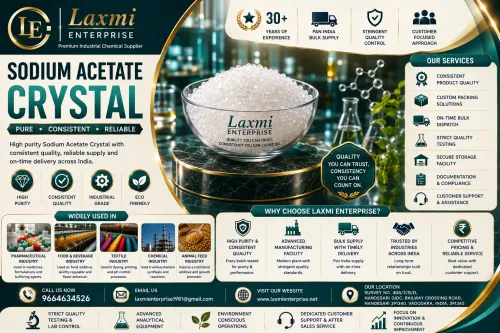
Feed-grade Sodium Acetate is used in selected animal feed applications because of its functional properties. Depending on the formulation, target species, and applicable feed regulations, it may contribute to buffering systems, feed formulation, palatability strategies, acidity management in specific applications, and overall manufacturing consistency. Its inclusion should always be determined by qualified animal nutritionists and comply with local feed regulations.
It is important to understand that Sodium Acetate is not a universal feed additive and should never be viewed as a substitute for balanced nutrition, proper farm management, veterinary guidance, or good feed manufacturing practices (GFMP).
This comprehensive guide explains where Sodium Acetate is used in the feed industry, how manufacturers evaluate suppliers, what quality standards matter, and how procurement teams can identify reliable feed ingredient partners.
The Modern Animal Feed Industry
The feed industry has evolved from simple grain mixing into a highly scientific manufacturing sector.
Today's feed manufacturers produce formulations for:
Poultry
Dairy cattle
Beef cattle
Buffalo
Swine
Sheep
Goats
Aquaculture
Companion animals
Specialty livestock
Each feed category requires different nutritional objectives, ingredient specifications, and manufacturing processes.
Why Feed Quality Matters
Feed represents one of the largest operating costs in livestock production.
Consistent feed quality helps support:
Uniform feed manufacturing
Predictable formulation performance
Efficient feed processing
Reliable ingredient handling
Stable storage characteristics
Consistent pellet production (where applicable)
High-quality feed ingredients also simplify quality control and reduce manufacturing variability.
Animal Nutrition Insight
A successful feed formulation is built on the combined performance of all ingredients. No single ingredient can compensate for poor formulation, low-quality raw materials, or inadequate manufacturing practices.
What Is Feed-Grade Sodium Acetate?
Feed-grade Sodium Acetate is manufactured for use in approved animal feed applications and must meet the quality requirements applicable to feed ingredients.
Depending on the intended application and regulations, manufacturers evaluate:
Product identity
Purity
Moisture content
Physical appearance
Batch consistency
Traceability
Packaging quality
Feed-grade material should not be confused with industrial-grade Sodium Acetate.
Why Is Sodium Acetate Used in Animal Feed?
In selected formulations, Sodium Acetate may contribute to:
Buffering systems
Acidity management in specific feed formulations
Feed manufacturing consistency
Ingredient compatibility
Palatability strategies in certain applications
Stable feed processing
Its inclusion depends on the complete formulation developed by qualified nutritionists.
Common Animal Feed Applications
Poultry Feed
Commercial poultry feed manufacturers emphasize:
Ingredient consistency
Uniform mixing
Reliable pellet quality
Manufacturing efficiency
Feed ingredients are selected after technical evaluation and formulation trials.
Dairy Cattle Feed
High-performance dairy operations require carefully balanced feed formulations.
Feed manufacturers evaluate ingredients for:
Manufacturing consistency
Storage performance
Reliable formulation characteristics
Beef Cattle Feed
Feed consistency supports standardized production and efficient large-scale manufacturing.
Procurement teams prioritize suppliers capable of maintaining batch-to-batch consistency.
Aquaculture Feed
Aquaculture feeds require precise manufacturing because water stability and pellet quality are important performance factors.
Ingredient quality contributes to consistent production.
Specialty Feed Products
Custom feed formulations for young animals or specialty livestock often require tighter ingredient specifications and enhanced quality verification.
Feed Manufacturing Process
Modern feed production generally involves:
Raw material receiving
Ingredient inspection
Quality verification
Grinding (where required)
Mixing
Conditioning
Pelletizing or extrusion (depending on product)
Cooling
Packaging
Warehouse storage
Distribution
Ingredient consistency influences every stage of production.
Engineering Insight
The best feed manufacturing process cannot consistently produce high-quality feed if raw material quality varies significantly. Stable ingredients reduce process adjustments and improve manufacturing efficiency.
Quality Standards for Feed Ingredients
Professional feed manufacturers typically establish specifications covering:
Product identity
Physical appearance
Moisture
Purity
Packaging
Batch traceability
Documentation
Storage recommendations
Quality verification helps ensure incoming materials meet approved standards before use.
Supplier Qualification
Feed manufacturers commonly evaluate suppliers based on:
Manufacturing capability
Product consistency
Technical documentation
Batch reliability
Quality management systems
Delivery performance
Technical support
Long-term supply stability
Reliable suppliers reduce production risk and support consistent feed quality.
Procurement Insight
The lowest-priced ingredient is not always the lowest-cost option. Variability in raw material quality can increase manufacturing adjustments, quality investigations, production delays, and customer complaints.
Incoming Quality Control
Before ingredients enter production, quality teams commonly perform:
Documentation Review
Review of:
Certificate of Analysis (COA)
Product specification
Batch identification
Supplier documentation
Packaging Inspection
Checking:
Package integrity
Correct labeling
Moisture protection
Physical condition
Identity Verification
Confirming that the received material matches the approved purchase specification.
Warehouse Inspection
Ensuring proper storage before production.
Storage Recommendations
Feed-grade Sodium Acetate should generally be:
Stored in a clean and dry warehouse.
Protected from moisture.
Kept in original sealed packaging until use.
Stored according to the manufacturer's recommendations.
Rotated using established inventory management procedures.
Good storage practices help preserve product quality.
Traceability
Effective traceability links:
Supplier
Batch number
Manufacturing records
Warehouse inventory
Customer deliveries
Traceability supports quality investigations and feed safety programs.
Feed Safety & Regulatory Considerations
Feed ingredients should always comply with the regulations applicable in the country where they are manufactured and used.
Manufacturers should:
Verify approval for intended feed applications.
Follow applicable feed regulations.
Maintain complete documentation.
Work with qualified nutritionists when developing formulations.
Regulatory requirements differ across jurisdictions.
Compliance Insight
Manufacturers exporting feed ingredients should verify the feed additive regulations of each destination market before commercial supply.
Sustainability in Feed Manufacturing
Feed companies increasingly evaluate suppliers based on:
Responsible sourcing
Manufacturing consistency
Packaging quality
Efficient logistics
Supply continuity
Environmental responsibility
Reducing manufacturing waste also supports sustainability goals.
Illustrative Industrial Example
A poultry feed manufacturer notices that pellet quality varies between production batches even though equipment settings remain unchanged.
A review finds that one raw material supplier exhibits greater batch-to-batch variability in physical properties.
After strengthening supplier qualification and introducing tighter incoming quality inspections, pellet quality becomes more consistent, manufacturing efficiency improves, and production adjustments decrease.
This example highlights the importance of raw material consistency in feed manufacturing.
Common Manufacturing Challenges
Challenge Possible Cause Business Impact Recommended Action
Ingredient variability Supplier inconsistency Feed quality variation Strengthen supplier qualification
Moisture exposure Poor warehouse conditions Product handling problems Improve storage management
Documentation gaps Incomplete supplier records Audit observations Standardize documentation review
Production adjustments Variable raw materials Reduced efficiency Improve incoming quality verification
Supply interruptions Procurement planning Manufacturing delays Develop multiple qualified suppliers
Best Practices for Feed Manufacturers
Leading manufacturers typically:
Purchase ingredients from approved suppliers.
Review Certificates of Analysis before production.
Verify incoming ingredients through documented inspection procedures.
Maintain complete traceability.
Monitor supplier performance using measurable quality indicators.
Store ingredients according to manufacturer recommendations.
Periodically review feed safety and quality systems.
Best Practices for Procurement Teams
When evaluating a Sodium Acetate supplier, ask:
Is the product manufactured as feed-grade Sodium Acetate?
Is a batch-specific Certificate of Analysis provided?
How is batch consistency monitored?
What traceability systems are implemented?
How is the product packaged to protect quality?
Can the supplier provide long-term supply reliability?
What technical support is available for feed manufacturers?
Key Takeaways
Feed-grade Sodium Acetate is used in selected animal feed formulations because of its functional properties and manufacturing consistency. Successful use depends on much more than selecting the ingredient itself. Manufacturers should combine qualified suppliers, scientifically developed formulations, effective quality control, complete traceability, and robust feed safety systems to achieve reliable production and consistent feed quality.
Frequently Asked Questions (FAQ)
1. What is feed-grade Sodium Acetate?
Feed-grade Sodium Acetate is material manufactured to meet quality requirements for approved animal feed applications. It should only be used in accordance with applicable feed regulations and professional formulation guidance.
2. Is industrial-grade Sodium Acetate suitable for animal feed?
No. Industrial-grade Sodium Acetate is not intended for animal feed applications. Feed manufacturers should source only feed-grade material that meets applicable quality and regulatory requirements.
3. Which animal feeds may include Sodium Acetate?
Depending on formulation objectives and local regulations, Sodium Acetate may be considered in selected poultry, dairy cattle, beef cattle, aquaculture, and specialty feed formulations. Decisions should be made by qualified animal nutritionists.
4. Does Sodium Acetate replace a balanced feed formulation?
No. It is only one possible component of a complete feed formulation. Balanced nutrition requires scientifically formulated diets that meet the nutritional needs of the target species.
5. Why is batch consistency important?
Consistent raw materials support repeatable feed manufacturing, reduce production adjustments, improve quality control, and enhance operational efficiency.
6. What documents should accompany each shipment?
Manufacturers typically review the Certificate of Analysis (COA), product specification, batch identification, and other quality documentation required by their feed quality management system.
7. Why is supplier qualification important?
Supplier qualification helps ensure consistent product quality, reliable documentation, dependable deliveries, and reduced manufacturing risk.
8. How should feed-grade Sodium Acetate be stored?
It should generally be stored in a clean, dry environment, protected from moisture, kept in sealed packaging, and managed according to the manufacturer's storage recommendations.
9. What should procurement teams evaluate besides price?
Procurement teams should consider product quality, batch consistency, traceability, technical documentation, packaging quality, delivery reliability, quality management systems, and long-term supply capability.
10. Can changing suppliers affect feed manufacturing?
Yes. Differences in physical properties or batch consistency may influence manufacturing performance. New suppliers are often evaluated through laboratory testing and production trials before approval.
11. Why is traceability important in feed manufacturing?
Traceability links raw materials with production batches and customer deliveries, supporting quality investigations, audits, and feed safety management.
12. What makes a reliable feed ingredient supplier?
A reliable supplier consistently delivers feed-grade material meeting agreed specifications, provides complete documentation, maintains effective traceability, offers dependable deliveries, and supports customers with technical expertise.
Expert Conclusion
The animal feed industry relies on science, consistency, and disciplined quality management. Feed-grade Sodium Acetate can play a role in selected formulations when used appropriately within regulatory requirements and professionally developed nutritional programs. Manufacturers that combine high-quality raw materials, qualified suppliers, robust feed safety systems, complete traceability, and continuous process improvement are better positioned to produce reliable feed products that support modern livestock production.
Applications, Functional Benefits, Feed Manufacturing, Quality Standards, Regulatory Considerations, Procurement & Best Practices
The global animal feed industry is one of the largest consumers of specialty feed ingredients. Modern livestock production depends on scientifically formulated feed that delivers consistent nutrition, supports efficient feed manufacturing, and helps producers achieve reliable animal performance while complying with feed safety regulations.
Feed manufacturers no longer evaluate ingredients only by price or nutritional value. Today's formulations consider ingredient quality, manufacturing consistency, traceability, physical characteristics, storage stability, and supply reliability.
Feed-grade Sodium Acetate is used in selected animal feed applications because of its functional properties. Depending on the formulation, target species, and applicable feed regulations, it may contribute to buffering systems, feed formulation, palatability strategies, acidity management in specific applications, and overall manufacturing consistency. Its inclusion should always be determined by qualified animal nutritionists and comply with local feed regulations.
It is important to understand that Sodium Acetate is not a universal feed additive and should never be viewed as a substitute for balanced nutrition, proper farm management, veterinary guidance, or good feed manufacturing practices (GFMP).
This comprehensive guide explains where Sodium Acetate is used in the feed industry, how manufacturers evaluate suppliers, what quality standards matter, and how procurement teams can identify reliable feed ingredient partners.
The Modern Animal Feed Industry
The feed industry has evolved from simple grain mixing into a highly scientific manufacturing sector.
Today's feed manufacturers produce formulations for:
Poultry
Dairy cattle
Beef cattle
Buffalo
Swine
Sheep
Goats
Aquaculture
Companion animals
Specialty livestock
Each feed category requires different nutritional objectives, ingredient specifications, and manufacturing processes.
Why Feed Quality Matters
Feed represents one of the largest operating costs in livestock production.
Consistent feed quality helps support:
Uniform feed manufacturing
Predictable formulation performance
Efficient feed processing
Reliable ingredient handling
Stable storage characteristics
Consistent pellet production (where applicable)
High-quality feed ingredients also simplify quality control and reduce manufacturing variability.
Animal Nutrition Insight
A successful feed formulation is built on the combined performance of all ingredients. No single ingredient can compensate for poor formulation, low-quality raw materials, or inadequate manufacturing practices.
What Is Feed-Grade Sodium Acetate?
Feed-grade Sodium Acetate is manufactured for use in approved animal feed applications and must meet the quality requirements applicable to feed ingredients.
Depending on the intended application and regulations, manufacturers evaluate:
Product identity
Purity
Moisture content
Physical appearance
Batch consistency
Traceability
Packaging quality
Feed-grade material should not be confused with industrial-grade Sodium Acetate.
Why Is Sodium Acetate Used in Animal Feed?
In selected formulations, Sodium Acetate may contribute to:
Buffering systems
Acidity management in specific feed formulations
Feed manufacturing consistency
Ingredient compatibility
Palatability strategies in certain applications
Stable feed processing
Its inclusion depends on the complete formulation developed by qualified nutritionists.
Common Animal Feed Applications
Poultry Feed
Commercial poultry feed manufacturers emphasize:
Ingredient consistency
Uniform mixing
Reliable pellet quality
Manufacturing efficiency
Feed ingredients are selected after technical evaluation and formulation trials.
Dairy Cattle Feed
High-performance dairy operations require carefully balanced feed formulations.
Feed manufacturers evaluate ingredients for:
Manufacturing consistency
Storage performance
Reliable formulation characteristics
Beef Cattle Feed
Feed consistency supports standardized production and efficient large-scale manufacturing.
Procurement teams prioritize suppliers capable of maintaining batch-to-batch consistency.
Aquaculture Feed
Aquaculture feeds require precise manufacturing because water stability and pellet quality are important performance factors.
Ingredient quality contributes to consistent production.
Specialty Feed Products
Custom feed formulations for young animals or specialty livestock often require tighter ingredient specifications and enhanced quality verification.
Feed Manufacturing Process
Modern feed production generally involves:
Raw material receiving
Ingredient inspection
Quality verification
Grinding (where required)
Mixing
Conditioning
Pelletizing or extrusion (depending on product)
Cooling
Packaging
Warehouse storage
Distribution
Ingredient consistency influences every stage of production.
Engineering Insight
The best feed manufacturing process cannot consistently produce high-quality feed if raw material quality varies significantly. Stable ingredients reduce process adjustments and improve manufacturing efficiency.
Quality Standards for Feed Ingredients
Professional feed manufacturers typically establish specifications covering:
Product identity
Physical appearance
Moisture
Purity
Packaging
Batch traceability
Documentation
Storage recommendations
Quality verification helps ensure incoming materials meet approved standards before use.
Supplier Qualification
Feed manufacturers commonly evaluate suppliers based on:
Manufacturing capability
Product consistency
Technical documentation
Batch reliability
Quality management systems
Delivery performance
Technical support
Long-term supply stability
Reliable suppliers reduce production risk and support consistent feed quality.
Procurement Insight
The lowest-priced ingredient is not always the lowest-cost option. Variability in raw material quality can increase manufacturing adjustments, quality investigations, production delays, and customer complaints.
Incoming Quality Control
Before ingredients enter production, quality teams commonly perform:
Documentation Review
Review of:
Certificate of Analysis (COA)
Product specification
Batch identification
Supplier documentation
Packaging Inspection
Checking:
Package integrity
Correct labeling
Moisture protection
Physical condition
Identity Verification
Confirming that the received material matches the approved purchase specification.
Warehouse Inspection
Ensuring proper storage before production.
Storage Recommendations
Feed-grade Sodium Acetate should generally be:
Stored in a clean and dry warehouse.
Protected from moisture.
Kept in original sealed packaging until use.
Stored according to the manufacturer's recommendations.
Rotated using established inventory management procedures.
Good storage practices help preserve product quality.
Traceability
Effective traceability links:
Supplier
Batch number
Manufacturing records
Warehouse inventory
Customer deliveries
Traceability supports quality investigations and feed safety programs.
Feed Safety & Regulatory Considerations
Feed ingredients should always comply with the regulations applicable in the country where they are manufactured and used.
Manufacturers should:
Verify approval for intended feed applications.
Follow applicable feed regulations.
Maintain complete documentation.
Work with qualified nutritionists when developing formulations.
Regulatory requirements differ across jurisdictions.
Compliance Insight
Manufacturers exporting feed ingredients should verify the feed additive regulations of each destination market before commercial supply.
Sustainability in Feed Manufacturing
Feed companies increasingly evaluate suppliers based on:
Responsible sourcing
Manufacturing consistency
Packaging quality
Efficient logistics
Supply continuity
Environmental responsibility
Reducing manufacturing waste also supports sustainability goals.
Illustrative Industrial Example
A poultry feed manufacturer notices that pellet quality varies between production batches even though equipment settings remain unchanged.
A review finds that one raw material supplier exhibits greater batch-to-batch variability in physical properties.
After strengthening supplier qualification and introducing tighter incoming quality inspections, pellet quality becomes more consistent, manufacturing efficiency improves, and production adjustments decrease.
This example highlights the importance of raw material consistency in feed manufacturing.
Common Manufacturing Challenges
Challenge Possible Cause Business Impact Recommended Action
Ingredient variability Supplier inconsistency Feed quality variation Strengthen supplier qualification
Moisture exposure Poor warehouse conditions Product handling problems Improve storage management
Documentation gaps Incomplete supplier records Audit observations Standardize documentation review
Production adjustments Variable raw materials Reduced efficiency Improve incoming quality verification
Supply interruptions Procurement planning Manufacturing delays Develop multiple qualified suppliers
Best Practices for Feed Manufacturers
Leading manufacturers typically:
Purchase ingredients from approved suppliers.
Review Certificates of Analysis before production.
Verify incoming ingredients through documented inspection procedures.
Maintain complete traceability.
Monitor supplier performance using measurable quality indicators.
Store ingredients according to manufacturer recommendations.
Periodically review feed safety and quality systems.
Best Practices for Procurement Teams
When evaluating a Sodium Acetate supplier, ask:
Is the product manufactured as feed-grade Sodium Acetate?
Is a batch-specific Certificate of Analysis provided?
How is batch consistency monitored?
What traceability systems are implemented?
How is the product packaged to protect quality?
Can the supplier provide long-term supply reliability?
What technical support is available for feed manufacturers?
Key Takeaways
Feed-grade Sodium Acetate is used in selected animal feed formulations because of its functional properties and manufacturing consistency. Successful use depends on much more than selecting the ingredient itself. Manufacturers should combine qualified suppliers, scientifically developed formulations, effective quality control, complete traceability, and robust feed safety systems to achieve reliable production and consistent feed quality.
Frequently Asked Questions (FAQ)
1. What is feed-grade Sodium Acetate?
Feed-grade Sodium Acetate is material manufactured to meet quality requirements for approved animal feed applications. It should only be used in accordance with applicable feed regulations and professional formulation guidance.
2. Is industrial-grade Sodium Acetate suitable for animal feed?
No. Industrial-grade Sodium Acetate is not intended for animal feed applications. Feed manufacturers should source only feed-grade material that meets applicable quality and regulatory requirements.
3. Which animal feeds may include Sodium Acetate?
Depending on formulation objectives and local regulations, Sodium Acetate may be considered in selected poultry, dairy cattle, beef cattle, aquaculture, and specialty feed formulations. Decisions should be made by qualified animal nutritionists.
4. Does Sodium Acetate replace a balanced feed formulation?
No. It is only one possible component of a complete feed formulation. Balanced nutrition requires scientifically formulated diets that meet the nutritional needs of the target species.
5. Why is batch consistency important?
Consistent raw materials support repeatable feed manufacturing, reduce production adjustments, improve quality control, and enhance operational efficiency.
6. What documents should accompany each shipment?
Manufacturers typically review the Certificate of Analysis (COA), product specification, batch identification, and other quality documentation required by their feed quality management system.
7. Why is supplier qualification important?
Supplier qualification helps ensure consistent product quality, reliable documentation, dependable deliveries, and reduced manufacturing risk.
8. How should feed-grade Sodium Acetate be stored?
It should generally be stored in a clean, dry environment, protected from moisture, kept in sealed packaging, and managed according to the manufacturer's storage recommendations.
9. What should procurement teams evaluate besides price?
Procurement teams should consider product quality, batch consistency, traceability, technical documentation, packaging quality, delivery reliability, quality management systems, and long-term supply capability.
10. Can changing suppliers affect feed manufacturing?
Yes. Differences in physical properties or batch consistency may influence manufacturing performance. New suppliers are often evaluated through laboratory testing and production trials before approval.
11. Why is traceability important in feed manufacturing?
Traceability links raw materials with production batches and customer deliveries, supporting quality investigations, audits, and feed safety management.
12. What makes a reliable feed ingredient supplier?
A reliable supplier consistently delivers feed-grade material meeting agreed specifications, provides complete documentation, maintains effective traceability, offers dependable deliveries, and supports customers with technical expertise.
Expert Conclusion
The animal feed industry relies on science, consistency, and disciplined quality management. Feed-grade Sodium Acetate can play a role in selected formulations when used appropriately within regulatory requirements and professionally developed nutritional programs. Manufacturers that combine high-quality raw materials, qualified suppliers, robust feed safety systems, complete traceability, and continuous process improvement are better positioned to produce reliable feed products that support modern livestock production.
Keywords