Sodium Acetate in the Textile Industry
Applications in Dyeing, Printing, pH Control, Reactive Dyeing, Quality Assurance, Process Optimization & Commercial Textile Manufacturing
The textile industry is one of the world's largest manufacturing sectors, transforming natural and synthetic fibers into fabrics used in apparel, home furnishings, technical textiles, automotive interiors, medical textiles, and industrial products.
Modern textile manufacturing depends on precision chemical processing. From pretreatment and bleaching to dyeing, printing, washing, and finishing, every stage requires carefully controlled chemical reactions. Among the most important process parameters is pH control, because even small variations can influence dye fixation, color reproducibility, fabric appearance, chemical consumption, and production efficiency.
Industrial-grade Sodium Acetate is widely recognized as a buffering agent in selected textile wet-processing applications, particularly in reactive dyeing and certain dyeing processes where controlled pH conditions are required. When used appropriately within validated process parameters, it helps textile processors maintain stable processing conditions and improve batch-to-batch consistency.
This article explains the science behind Sodium Acetate in textile manufacturing, how textile engineers use buffering systems, quality parameters that buyers should evaluate, and how selecting the right supplier contributes to consistent dyeing performance and operational efficiency.
The Modern Textile Industry
Textile manufacturing includes multiple production stages:
Fiber production
Yarn manufacturing
Fabric weaving
Knitting
Pretreatment
Dyeing
Printing
Washing
Finishing
Garment manufacturing
Each stage depends on carefully controlled process conditions.
Chemical consistency directly influences production quality.
Why Chemical Quality Matters
A textile dye house may process 20–500 tons of fabric every day.
A small variation in chemical quality can result in:
Shade variation
Reprocessing
Increased water consumption
Higher steam usage
Additional chemical consumption
Customer complaints
Export quality rejection
For this reason, textile manufacturers evaluate chemicals not only on price but also on consistency and technical performance.
Textile Engineering Insight
In textile dyeing, consistency is more valuable than speed. A perfectly reproducible dyeing process reduces production losses, minimizes re-dyeing, and improves customer satisfaction.
What Is Sodium Acetate?
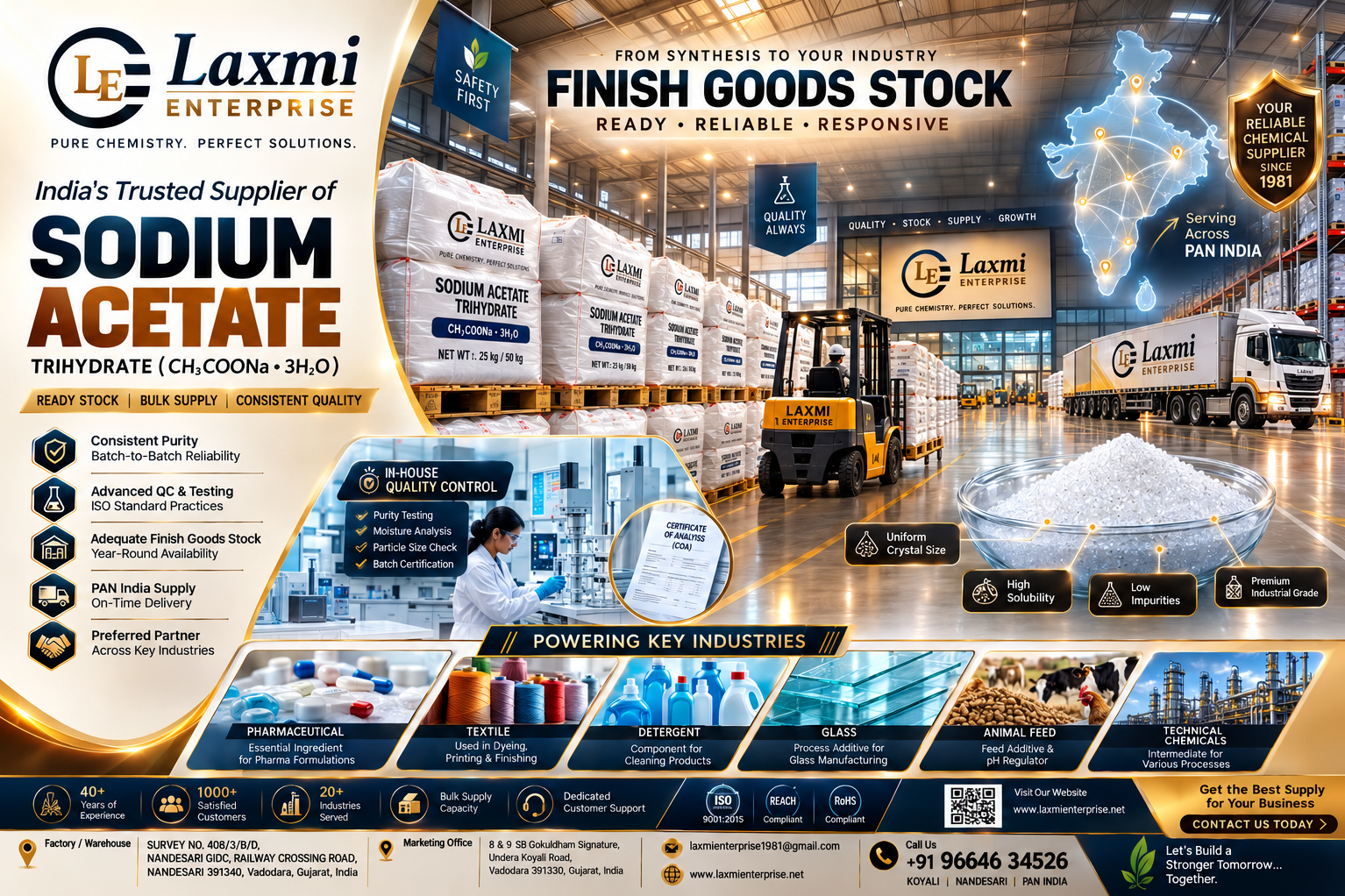
Sodium Acetate (CH₃COONa) is the sodium salt of acetic acid.
Industrial-grade Sodium Acetate is commonly supplied as:
Sodium Acetate Anhydrous
Sodium Acetate Trihydrate
For textile applications, the selected grade depends on the specific process requirements and plant operating procedures.
Why Sodium Acetate Is Used in Textile Processing
The primary role of Sodium Acetate in textile processing is buffering.
A buffering system helps reduce sudden changes in pH during processing.
Stable pH contributes to:
Improved dyeing consistency
Better reproducibility
Controlled dye reactions
Uniform processing conditions
Reduced batch variation
Its function should always be evaluated within the complete dyeing recipe.
The Science of Buffering
Many textile dyes perform best within a controlled pH range.
If pH changes rapidly during dyeing:
Dye uptake may become uneven.
Shade variation may occur.
Dye fixation efficiency may decrease.
Reprocessing costs may increase.
Buffering systems help moderate these fluctuations, supporting more predictable processing.
Technical Insight
A buffer does not keep the pH perfectly constant under all conditions. Instead, it helps resist rapid pH changes within the operating range of the dyeing process, allowing textile technologists to maintain greater process stability.
Applications in Textile Manufacturing
1. Reactive Dyeing of Cotton
Reactive dyeing is one of the most common applications for Sodium Acetate.
Textile processors value:
Controlled pH
Repeatable dye fixation
Uniform color development
Reduced shade variation
Consistent chemical quality contributes to reproducible dyeing.
2. Yarn Dyeing
Yarn dyeing requires excellent process consistency because color variation becomes highly visible after weaving or knitting.
Buffer systems help support controlled dyeing conditions.
3. Fabric Dyeing
Continuous and batch dyeing operations rely on:
Controlled chemical dosing
Stable process conditions
Uniform liquor composition
Reliable chemical quality
4. Textile Printing
Some textile printing systems require carefully controlled chemical environments.
Formulators evaluate buffering systems according to printing chemistry and production requirements.
5. Laboratory Color Matching
Textile laboratories perform numerous shade development trials before commercial production.
Consistent laboratory chemicals help improve correlation between laboratory and bulk production.
Reactive Dyeing Process
Although dye recipes vary between mills, a typical reactive dyeing sequence includes:
Fabric preparation
Dye bath preparation
Controlled chemical addition
Temperature control
Dye fixation
Washing
Soaping
Final rinsing
Drying
Each stage must be carefully controlled.
Importance of pH Control
pH influences:
Dye reaction rate
Dye fixation
Hydrolysis
Fabric appearance
Washing efficiency
Reproducibility
Stable pH improves process reliability.
Engineering Insight
Many dye houses monitor pH continuously throughout production because maintaining stable chemical conditions is often easier than correcting shade variation after dyeing.
Chemical Quality Parameters
Textile manufacturers commonly evaluate:
Purity
Appearance
Moisture
Solubility
Batch consistency
Particle size
Packaging quality
Storage stability
Consistent quality supports predictable manufacturing.
Supplier Qualification
Professional textile companies typically evaluate suppliers based on:
Manufacturing capability
Batch consistency
Technical documentation
Product specifications
Delivery reliability
Packaging quality
Technical support
Long-term supply stability
Reliable suppliers reduce manufacturing risks.
Procurement Insight
A low-cost chemical that causes even one production re-dye may ultimately cost far more than purchasing a consistently performing product from a qualified supplier.
Incoming Quality Control
Before approving Sodium Acetate for production, textile mills commonly perform:
Documentation Review
Including:
Certificate of Analysis (COA)
Technical Data Sheet (TDS)
Product specification
Batch number
Visual Inspection
Checking:
Packaging condition
Product appearance
Correct labeling
Batch identification
Laboratory Verification
Depending on internal quality procedures, mills may verify selected physical or chemical properties before releasing the material for production.
Storage Recommendations
Industrial-grade Sodium Acetate should generally be:
Stored in a dry warehouse.
Protected from moisture.
Kept in sealed original packaging.
Protected from contamination.
Rotated using FIFO inventory practices.
Proper storage helps maintain consistent product quality.
Packaging
Industrial suppliers commonly offer:
25 kg HDPE bags with liner
50 kg bags
Jumbo bags (500–1000 kg)
Customized industrial packaging
Packaging should protect the product during storage and transportation.
Traceability
Complete traceability allows manufacturers to identify:
Supplier
Batch number
Production records
Customer deliveries
Traceability supports ISO quality systems and customer audits.
Sustainability in Textile Processing
Modern textile mills increasingly focus on:
Reduced water consumption
Lower energy usage
Efficient chemical utilization
Reduced reprocessing
Sustainable manufacturing
Environmental compliance
Consistent chemicals contribute to more efficient production and lower waste.
Sustainability Insight
Reducing re-dyeing not only lowers manufacturing costs but also saves water, steam, electricity, dyes, and processing chemicals, making textile production more resource-efficient.
Illustrative Industrial Example
A cotton dyeing mill experiences recurring shade variation between production batches despite using the same dye formulation.
After reviewing equipment calibration, dye quality, and operating procedures, engineers identify inconsistent buffering chemical quality from different suppliers.
The mill standardizes procurement with one qualified supplier and strengthens incoming quality verification.
Within several weeks:
Shade reproducibility improves.
Re-dye frequency decreases.
Chemical consumption becomes more predictable.
Customer complaints decline.
The case demonstrates how consistent Sodium Acetate quality can contribute to stable textile processing.
Common Textile Manufacturing Challenges
Challenge Possible Cause Business Impact Recommended Action
Shade variation Poor pH control or inconsistent chemicals Reprocessing and customer complaints Improve buffering control and supplier qualification
Batch inconsistency Variable raw material quality Production delays Standardize approved suppliers
Moisture absorption Poor warehouse storage Reduced handling quality Improve storage practices
Documentation gaps Missing COA or TDS Audit observations Strengthen documentation review
Supply interruptions Weak procurement planning Production downtime Develop multiple qualified suppliers
Best Practices for Textile Mills
Leading textile manufacturers typically:
Purchase chemicals from qualified suppliers.
Review Certificates of Analysis before production.
Verify incoming materials according to internal quality procedures.
Maintain complete batch traceability.
Monitor pH during dyeing.
Store chemicals under recommended conditions.
Review supplier performance regularly.
Best Practices for Procurement Teams
Before selecting a Sodium Acetate supplier, ask:
Is the product manufactured specifically for industrial applications?
Is a Certificate of Analysis supplied with every batch?
How is batch consistency maintained?
What purity specification is guaranteed?
Is a Technical Data Sheet available?
What packaging options are offered?
Can the supplier provide long-term technical and commercial support?
Key Takeaways
Industrial-grade Sodium Acetate is an important processing chemical in many textile dyeing and wet-processing operations because of its buffering properties and contribution to process stability. Successful textile manufacturing depends on much more than selecting a chemical—it requires qualified suppliers, consistent product quality, controlled process parameters, disciplined quality management, and skilled technical personnel. Textile companies that integrate these principles achieve better reproducibility, lower production losses, and higher customer satisfaction.
Frequently Asked Questions (FAQ)
1. Why is Sodium Acetate used in textile dyeing?
Industrial-grade Sodium Acetate is primarily used as a buffering agent in selected textile dyeing processes. It helps maintain more stable pH conditions during processing, supporting consistent dyeing performance.
2. Which textile processes commonly use Sodium Acetate?
Depending on the process, it may be used in reactive dyeing, yarn dyeing, fabric dyeing, textile printing, and laboratory color matching.
3. Why is pH control important in textile dyeing?
pH influences dye fixation, reaction rate, color reproducibility, and overall process consistency. Stable pH helps reduce shade variation and improves production reliability.
4. Is Sodium Acetate the same as Acetic Acid?
No. Sodium Acetate is the sodium salt of acetic acid. Although related chemically, they have different properties and functions within textile processing.
5. What quality documents should accompany each shipment?
Manufacturers commonly review the Certificate of Analysis (COA), Technical Data Sheet (TDS), product specification, and batch identification before approving material for production.
6. How should Sodium Acetate be stored?
Store it in a clean, dry warehouse, protected from moisture, in sealed original packaging, and according to the supplier's storage recommendations.
7. Why is supplier consistency important?
Consistent suppliers help maintain reproducible dyeing, reduce production variability, minimize reprocessing, and improve manufacturing efficiency.
8. What should procurement teams evaluate besides price?
Evaluate purity, batch consistency, documentation, technical support, packaging quality, delivery reliability, and long-term supply capability.
9. Can changing suppliers affect dyeing performance?
Yes. Differences in chemical purity, physical characteristics, or manufacturing consistency may influence process stability. New suppliers should be technically evaluated before routine production use.
10. Why is traceability important?
Traceability links incoming chemicals to production batches, supporting quality investigations, ISO systems, customer audits, and process improvement.
11. What packaging is commonly available?
Industrial Sodium Acetate is commonly supplied in 25 kg bags, 50 kg bags, jumbo bags, and customized industrial packaging, depending on customer requirements.
12. What defines a reliable Sodium Acetate supplier for textile mills?
A reliable supplier consistently delivers product meeting agreed specifications, provides complete technical documentation, maintains effective traceability, offers dependable deliveries, and supports customers with technical expertise.
Expert Conclusion
Textile dyeing is a precision chemical process where consistency determines product quality, production efficiency, and customer satisfaction. Industrial-grade Sodium Acetate plays an important role in selected dyeing operations by contributing to buffering systems and process stability. However, long-term manufacturing excellence depends on integrating high-quality chemicals with qualified suppliers, disciplined process control, laboratory verification, and continuous quality improvement. Textile mills that adopt this systems-based approach are better positioned to achieve reproducible color, reduce waste, improve sustainability, and strengthen their competitive position in global textile markets.
Keywords