

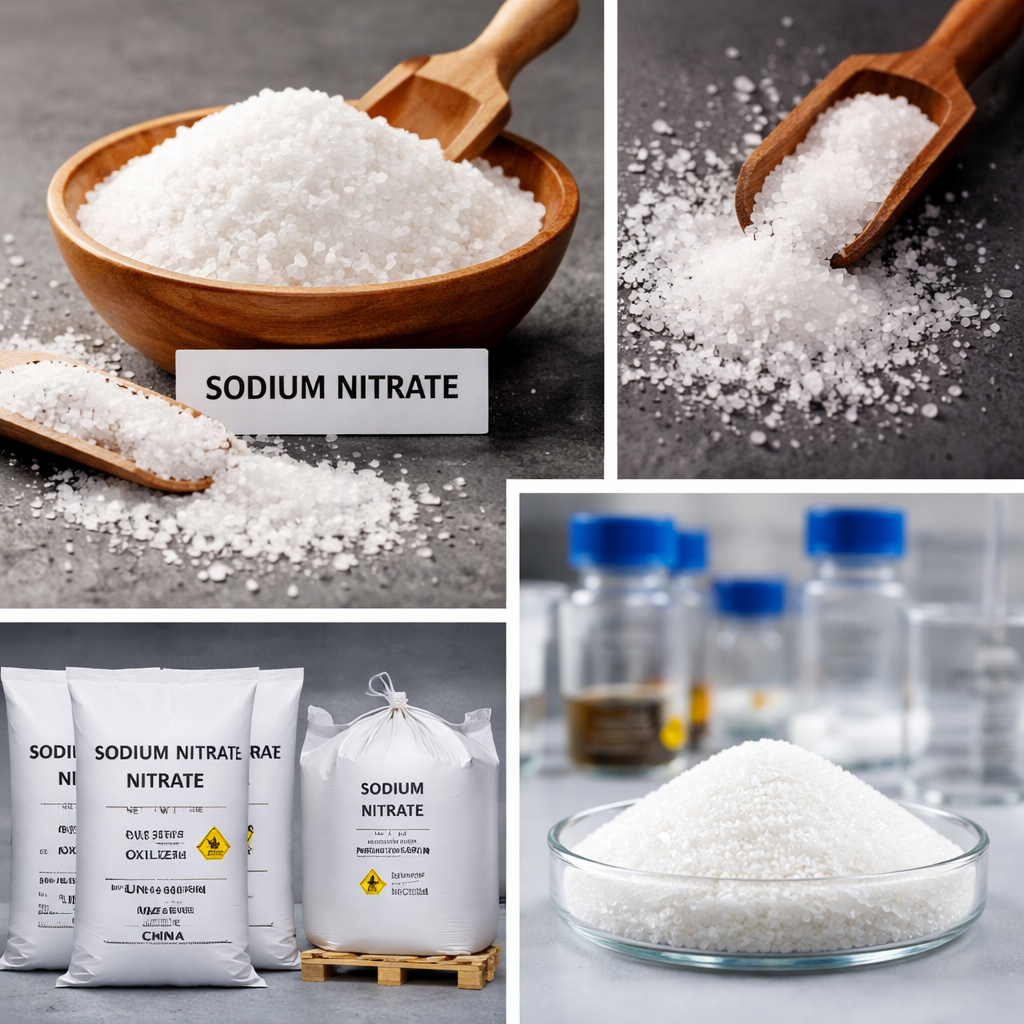
SODIUM NITRATE DECOMPOSITION TEMPERATURE CONTROL
Temperature Monitoring
- Use high-accuracy thermocouples (K-type or N-type).
- Multi-point monitoring in large reactors to avoid local overheating.
- PID controller integrated with furnace/heater systems.
Heating Rate Control
- Ramp temperature slowly near 300–350°C.
- Maintain isothermal holds (20–60 min) to stabilize melt before higher temperature exposure.
- Avoid direct flame heating; use uniform electric heating when possible.
Atmosphere Control
- Decomposition accelerates in reducing environments.
- Use air/oxygen presence for stability; inert gases (N₂/Ar) increase nitrite formation.
- Avoid contamination with organics, metals (Co, Mn, Cu), or chlorides—these can catalyze decomposition.
Mixture/Impurity Management
- Keep moisture < 0.1% (pre-dry at 120°C).
- Use high-purity sodium nitrate grades for thermal storage systems.
- Avoid mixing with combustible materials.
- Use corrosion-resistant vessels (SS316, high-nickel alloys).
- Provide venting for oxygen/NOx release.
- Implement over-temperature shutdown & alarm interlocks.
Solar molten salt thermal storage
Heat treatment salt baths (nitrate/nitrite mixtures)
Metal nitration/oxidation processes
Fertilizer granulation
Pyrotechnics & propellant formulations
- Store in a cool, dry, well-ventilated area.
- Use non-combustible shelves/containers—preferably HDPE or compatible metal.
- Keep away from sunlight, heat sources, sparks, flames.
- Maintain moisture-free environment to prevent clumping/reaction.
Storing near reducing agents, organics, sulfur, metal powders, charcoal, glycerin, acids.
Contact with combustible materials (wood, paper, sawdust).
Closed/unvented containers at high temperature
At least 3–5 meters from combustibles and flammables.
Dedicated oxidizer storage room is ideal.
Maintain process temperatures below 380°C when possible.
(Decomposition accelerates → oxygen release)
If used molten:
- Use PIDs and overtemperature interlocks.
- Vent systems to safely release gas.
- Avoid adding wet or contaminated material into molten nitrate.
If involved with combustibles:
- Expect intense flames
- Use copious water from safe distance
- Isolate area & evacuate personnel
No sealed containers in high heat → pressure buildup → rupture.
Install pressure relief vents in molten salt systems.
Avoid rapid heating or thermal shock.
Monitor for NOx fumes (toxic) → install scrubbers/exhaust fans.
Avoid mixing with fuels or chemicals unless process-designed.
Sodium nitrate (NaNO₃) is widely used in fertilizers, wastewater treatment, metal finishing, explosives, and heat-transfer systems.
The main environmental concern is nitrate pollution in soil and water, leading to eutrophication, groundwater contamination, and potential human/animal health effects such as methemoglobinemia (blue-baby syndrome) and nitrate/nitrite toxicity.
- Store with secondary containment to prevent runoff.
- Keep in closed, moisture-proof containers.
- Maintain safe distances from drains, water bodies, soil exposure.
Use closed transfer systems to reduce dust and spillage.
Install leak detection & monitoring sensors in molten salt systems.
Perform routine inspections of pipelines, valves, and tanks.
- Use controlled-release nitrogen fertilizers to reduce leaching.
- Adopt precision dosing technologies in agriculture.
- Stop source, isolate area.
- Avoid water for cleanup initially (prevents dissolving & spreading).
- Sweep solid into sealed containers.
- Dispose as per hazardous waste rules.
Contain with dykes/earth bunds.
Pump liquid into storage tanks for treatment.
Use absorbents (clay, vermiculite) around perimeters.
Use split dosing rather than single heavy application.
Apply during crop uptake period to minimize leaching.
Use drip irrigation + fertigation to control delivery.
Add nitrification inhibitors (DCD, DMPP) to slow conversion.
Install scrubbers to remove NOx emissions.
Maintain operating temperature below 450°C when possible.
Ensure ventilation & regular stack monitoring.
- Routine groundwater testing near storage/use areas.
- Continuous nitrate monitoring in effluent streams.
- Maintain logbooks for chemical usage & waste disposal.
- Annual environmental audit (mandatory in many jurisdictions).
Alert personnel in the area.
Wear PPE:
- Gloves (nitrile/PVC)
- Goggles/face shield
- Dust mask/respirator (N95/half-mask if dusty)
- Coveralls, chemical apron, safety shoes
Stop the spill source if safe to do so.
Restrict access; isolate area with barricades or caution tape.
Ensure no ignition sources near spill (avoid organics contact).
- Avoid water contact initially (prevents spreading).
- Use non-sparking tools (plastic/aluminum shovel).
- Sweep gently to avoid dust generation.
- Transfer material into clean, labeled containers.
- Vacuum remaining residue using HEPA industrial vacuum.
- Wash the area only after solid removal using plenty of water.
- Collect wash water for disposal/treatment—do not release to drains.
Note: Contaminated sodium nitrate must not be reused.
- Prevent spill from entering drains, storm channels, soil, waterways.
- Build containment using:
- Sand/soil berms
- Clay/vermiculite absorbent barriers
- Commercial chemical booms
- Pump collected liquid into tanks or drums for treatment.
- For remaining thin layers:
- Use absorbents (clay, diatomaceous earth)
- Scoop and bag the material
- Neutralize surfaces by flushing with excess water and directing effluent to a treatment system.
- Activate facility Emergency Response Team.
- Notify environment officer.
- Use earth dykes to form temporary containment pond.
- Deploy portable bund walls/absorbent socks around perimeter.
- Arrange wastewater tanker suction if required.
Report to local authorities as per regulatory requirements.
Check surrounding soil and collect samples if spill was large.
Ventilate area to remove dust and NOx if heated.
File incident report including:
- Date/time
- Cause of spill
- Quantity released
- Cleanup method
- Disposal record
- Preventive corrective actions
Use spill containment pallets for storage drums.
Keep floor dry; avoid storing near drains.
Maintain SDS availability and spill kits nearby.
Conduct periodic emergency response drills.
Ensure all staff trained for oxidizer handling.
- Nitric oxide (NO)
- Nitrogen dioxide (NO₂)
- Oxides of nitrogen (NOx mixture)
- Trace N₂O & N₂ may form depending on conditions
Mild–Moderate Exposure:
- Sore throat, irritation of eyes/nose
- Coughing, chest tightness
- Dizziness, headache
Shortness of breath
Pulmonary edema (fluid in lungs)
Potential delayed symptoms (4–24 hours)
Risk of respiratory failure or death
Engineering Controls
- Use local exhaust ventilation (LEV) around heating processes.
- Install NOx scrubbers or catalytic converters.
- Continuous gas monitoring sensors for NO/NO₂.
- Maintain vented systems for molten nitrate tanks.
Safe Operating Temperatures
- Operate preferably below 450°C to minimize decomposition.
- Avoid localized hotspots using PID controllers.
- Prevent contamination with organics or catalytic metals.
- Respiratory Protection:
- Half/full face respirator with acid gas/NOx cartridges
- SCBA for emergency entry (confined spaces)
- Eye & Skin Protection:
- Goggles/face shield, nitrile gloves, flame-resistant clothing
- Evacuate area immediately.
- Ventilate — open windows, start exhaust fans.
- If large release → activate emergency gas alarms.
- Use SCBA-equipped responders only.
- Move exposed person to fresh air.
- Seek medical care even if symptoms appear mild (delayed edema risk).
NOx contributes to acid rain, smog, air oxidation stress.
Aquatic ecosystems sensitive to nitrate deposition.
Emissions must be treated before atmospheric release.
Sodium nitrate (NaNO₃) is regulated as an oxidizing solid under international and national chemical safety frameworks. Compliance ensures safe storage, transport, and workplace handling while preventing fire, contamination, and environmental hazards.
Below is a comprehensive regulatory overview with global standards + India-specific guidelines.
- Workers must be trained on oxidizer handling & spill response
- SDS availability on-site is mandatory
- Avoid contamination — no organic residue or fuel in transfer tools
- Use PPE: gloves, goggles, dust mask, apron, safety shoes
- Implement static grounding for large volumes to prevent ignition
- No eating/drinking in handling zones (food contamination risk)
- Workers must be trained on oxidizer handling & spill response
- SDS availability on-site is mandatory
- Avoid contamination — no organic residue or fuel in transfer tools
- Use PPE: gloves, goggles, dust mask, apron, safety shoes
- Implement static grounding for large volumes to prevent ignition
- No eating/drinking in handling zones (food contamination risk)
Documentation on-site
- SDS (latest version)
- Incoming material log
- Consumption and disposal records
- Spill/emergency response SOP
Discharge limits (typical):
- Drinking water: NO₃-N < 10 mg/L
- Industrial effluent: typically < 50 mg/L (region-specific)
- Water hydrants + extinguishers must be available
- Dedicated oxidizer storage zone
- NO combustible building materials (wood, paper)
- Periodic fire drill for handling oxidizers
- Spill kits containing: absorbents, plastic shovels, PPE
Emergency Plan Must Include:
- Evacuation protocol
- Spill containment steps
- NOx gas release response
- Waste handling procedure
ADR (Road, EU)
IMDG (Sea)
ICAO/IATA (Air freight)
DOT/49 CFR (USA)
Approved packaging types:
- HDPE bags with inner lining
- Fiberboard or plastic drums
- UN-approved FIBC jumbo bags
- Steel/plastic bins with corrosion resistance
Standards:
- Containers must be tightly sealed & moisture protected
- Use tamper-proof labeling
- Avoid wooden crates or combustible packing materials
For bulk transport:
- Prefer silos or lined tankers
- Use dedicated oxidizer transport vehicles (no organic cargo mixing)
SDS (latest revision)
Consignment note & invoice
Emergency handling instructions
Spill/fire response card
- Use non-sparking handling tools.
- Keep away from heat, sparks, open flames.
- Stack bags/drums to prevent collapse during transit.
- Use palletizing to minimize friction & tearing.
- Never load with:
- fuels, oils, organic chemicals
- metal powders, sulfur, phosphorous
- reducing agents, acids, flammable cargo
- Display Oxidizer 5.1 placards on all sides.
- Driver trained in hazardous chemical transport.
- GPS & route planning recommended for bulk.
- No smoking during transit.
- Carry spill kit containing:
- PPE
- Plastic shovel
- Absorbents (vermiculite/sand)
- Poly bags or sealed drum for recovered material
Fire suppression: water only
Avoid CO₂, dry chemical, or foam extinguishers for sodium nitrate fires.
Spill Scenario
- Stop vehicle safely; prevent public access.
- Use barriers/soil to contain material.
- Sweep & collect solid carefully.
- Do not wash with water at accident spot — may spread.
- Inform local authorities for large spills.
Cool containers with large amounts of water.
Do not use CO₂ or foam.
Evacuate area if NOx fumes present.
- Firefighters must use SCBA respiratory protection.
- Avoid routes near rivers/lakes during heavy rainy seasons.
- In event of spill to waterway:
- Notify environmental agency immediately
- Deploy booms & start recovery pumping
Gases released:
- Oxygen (O₂) – increases combustion risk
- Nitric oxide (NO) – toxic
- Nitrogen dioxide (NO₂) – highly toxic
Recommended working temperature range for molten salt systems:
300–450°C
- Below 350°C: highly stable
- Near 400°C: monitor for decomposition onset
- Above 450°C: require gas venting and monitoring
Use PID-controlled heaters with dual thermocouples.
Install over-temperature automatic cutoffs (trip ~480–500°C).
Provide vented lids to avoid pressure buildup.
Maintain constant agitation to prevent hotspots.
- Use NOx detectors & scrubbers for high-temperature setups.
Monitoring nitrite formation helps estimate nitrate breakdown.
General trend:
Higher temperature → Higher NaNO₂ fraction → Lower long-term salt stability
- Periodic testing using ion chromatography or titration recommended.
- Sodium nitrate is thermally stable up to ~350–380°C.
- Decomposition begins slowly above 380°C, increases rapidly >450°C.
- 500°C is often considered an upper safety limit.
- Decomposition releases toxic NOx gases and oxygen, raising fire risk.
- Proper ventilation, monitoring, and contamination control are essential
· Chile saltpeter
· Peru saltpeter nitrate of soda
· nitric acid sodium salt sodium salt of nitric acid
· sodium nitrate supplier in India
· sodium nitrate manufacturer in Gujarat
· sodium nitrate exporter Asia Pacific
· buy sodium nitrate near me
· sodium nitrate distributor in USA
· sodium nitrate supplier in Europe