

SODIUM NITRATE — fertilizer & agricultural use (practical guide)
Nice — below is a concise, practical reference on using sodium nitrate (NaNO₃) as a fertilizer: what it supplies, how to dose and apply, benefits, risks (especially soil sodicity), handling, and quick worked examples so you can translate N-requirements into kg of product.
1) What sodium nitrate supplies
Primary nutrient: Nitrogen as nitrate (NO₃⁻) — immediately plant-available and mobile in the soil.
Secondary effect: adds sodium (Na⁺) to the soil (no useful cation for crops — can be harmful in excess).
Typical N content (by weight): ~16.48% N.
(Calculation shown below.)
Why growers use it: fast N availability (good for leafy vegetables, fruit trees, fertigation, foliar nitrate feeding), highly soluble so works well in fertigation systems.
2) Arithmetic — how %N and dosing are computed (step-by-step)
Molecular masses (rounded):
Na ≈ 22.99
N ≈ 14.01
O ≈ 15.999 → 3×O = 47.997
Total molar mass NaNO₃ ≈ 22.99 + 14.01 + 47.997 = ≈84.997 ≈ 85.00 g·mol⁻¹
Percent nitrogen = (mass of N / molar mass)
= 14.01 / 84.997 ≈ 0.16478 → 16.478% N ≈ 16.48% N
So to supply 1 kg of elemental N you need:
1
kg N
0.16478
≈
6.07
kg NaNO
3
0.16478
1 kg N
≈6.07 kg NaNO
3
Examples:
To supply 50 kg N/ha → 50 × 6.07 ≈ 303.5 kg NaNO₃ / ha
To supply 100 kg N/ha → 100 × 6.07 ≈ 607 kg NaNO₃ / ha
(You can scale these by your target N rate.)
3) Solubility & formulation
Highly soluble (commonly used as a soluble feed for fertigation and foliar sprays).
Available as granular/crystalline fertilizer and as technical-grade industrial salt. For crop use buy agricultural-grade product (labelled for fertilizer use).
4) Application methods & timing
Soil broadcast / incorporation: supplies nitrate quickly — risk of leaching in light/sandy soils, so split applications are preferred.
Fertigation (drip / sprinkler): excellent because of high solubility; apply in small doses through the season for continuous supply.
Foliar spray: low-rate nitrate sprays can rapidly correct deficiencies; follow crop-specific spray concentrations and avoid phytotoxicity.
Top dressing / sidedressing: common for vegetables and shallow-rooted crops to boost N during growth flushes.
5) Agronomic advantages
Immediate availability (nitrate is directly taken up by roots).
No soil acidification (unlike ammonium-based fertilizers) — can be an advantage for neutral/alkaline soils.
Quick correction of nitrate deficiency and rapid response in leaf color/growth.
6) Key disadvantages & risks (important)
Sodium load (soil sodicity): repeated use increases soil Na⁺ → degrades soil structure, reduces infiltration and aeration, causes dispersion of clay (higher ESP/SAR), and damages sensitive crops.
Problem soils: light-textured, low-ESP soils can tolerate some use, but soils already saline/sodic or crops sensitive to Na (e.g., many fruit trees, legumes) are at risk.
Leaching risk: nitrate is highly mobile — potential groundwater contamination and loss of fertilizer efficiency.
Compatibility: Not recommended where sodium accumulation is unacceptable; consider alternatives.
Cost & availability: frequently more expensive or less available than other N sources in many markets.
7) When to choose alternatives
If you are concerned about sodium buildup or need calcium to improve soil structure, prefer:
Calcium nitrate (Ca(NO₃)₂) — supplies nitrate-N and Ca²⁺ (helps mitigate sodicity).
Urea / ammonium nitrate — different N forms; consider acidifying effect and nitrification.
Choose based on soil test, crop tolerance, and irrigation quality.
8) Practical management recommendations
Soil test first — check texture, baseline sodium, ESP/SAR, and salinity (EC).
Limit cumulative NaNO₃ use on light soils or irrigated systems — use only when nitrate form is specifically needed.
Prefer split applications or fertigation to reduce leaching losses.
Use calcium amendments (lime or gypsum) or switch to calcium nitrate if sodium buildup is suspected. Gypsum (calcium sulfate) helps displace Na⁺ and restore structure.
Monitor irrigation water (EC & SAR) — if irrigation water also brings Na⁺, avoid using sodium nitrate.
Monitor plant & soil: leaf tissue nitrate tests, and periodic soil Na/ESP checks.
Avoid pre-plant heavy single applications in coarse soils — the nitrate will leach before crops use it.
Storage & handling: keep dry, sealed, away from organics/flammable material (oxidizer), and prevent moisture ingress.
9) Typical crop guidance (general — always confirm with local recommendations)
Leafy vegetables / horticulture: commonly used because of rapid uptake — small, frequent fertigation doses.
Field crops (maize, wheat): less common as sole N source due to sodium risk and cost; producers usually choose urea, ammonium nitrate, or calcium nitrate.
High-value crops (tomato, pepper, leafy greens): fertigation with nitrate feeds is common — but sodium content and water quality must be managed.
Salt-sensitive crops: avoid repeated NaNO₃ use.
10) Environmental & regulatory notes
Groundwater risk: nitrate leaching risks contamination — follow best management practices and legal limits for groundwater protection.
Disposal & runoff: avoid runoff to water bodies (eutrophication).
Label & grade: use agricultural-grade fertilizer that meets local regulation (not industrial-technical grade unless specified).
11) Quick calculators — useful conversions
%N in NaNO₃ ≈ 16.48%
NaNO₃ required (kg) = required elemental N (kg) ÷ 0.1648
Example: For 80 kg N/ha → 80 ÷ 0.1648 ≈ 485.6 kg NaNO₃/ha
If you want, I can now:
Make a printable one-page datasheet (PDF) summarizing this with the conversion calculator and a prefilled table (kg NaNO₃/ha for common N rates 10–200 kg N/ha), or
Run specific calculations for your crop, soil type, and target N rate (tell me target N kg/ha and whether you want fertigation or single-application figures), or
Compare NaNO₃ vs calcium nitrate vs urea for your specific farm (soil EC, SAR, crop) and recommend a strategy.
Role in Agriculture
✅ Main Use
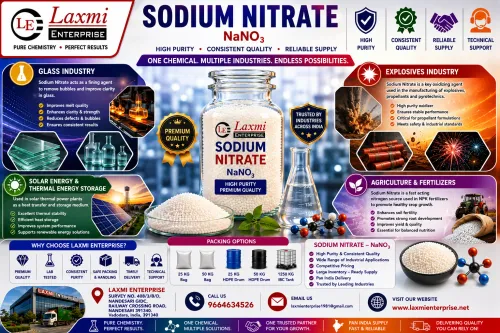
Sodium nitrate is a nitrogen fertilizer, providing readily available nitrate nitrogen for crops.
It is absorbed directly by roots without conversion, leading to rapid plant response.
🌱 Advantages
Supplies instant nitrate-N — useful when quick greening or growth is needed.
Does not acidify soil (unlike ammonium-based fertilizers).
Excellent solubility — ideal for fertigation and hydroponics (when sodium tolerance allows).
Useful for cool soils where nitrification of ammonium is slow.
Best Management Practices (BMPs)
Base on soil test – check soil sodium (Na⁺), EC, and pH.
Split applications – apply multiple small doses rather than one heavy dose.
Irrigate properly – prevent salt accumulation in the root zone.
Rotate nitrogen sources – alternate with calcium nitrate or urea to limit sodium build-up.
Leaching management – flush excess salts periodically with good-quality irrigation water.
Avoid water contamination – prevent runoff or drainage into open water bodies.
Storage safety – keep dry and away from organic materials or combustibles (oxidizer)
• Chile saltpeter
• Peru saltpeter
• nitrate of soda
• nitric acid sodium salt
• sodium salt of nitric acid
Crop Nutrition Solutions
Agricultural Chemicals Supplier
Sodium Nitrate Food Additive
Curing Salt Additive
Food-Grade Nitrate Preservative
Meat Curing Ingredients
Preservatives for Processed Meat
Sodium Nitrate for Explosives
Oxidizer Chemicals Supplier
Pyrotechnic Grade Sodium Nitrate
Blasting Compound Ingredients
Mining Chemicals Supplier
What is Sodium Nitrate Used For?
Sodium Nitrate vs Sodium Nitrite
Is Sodium Nitrate Safe?