

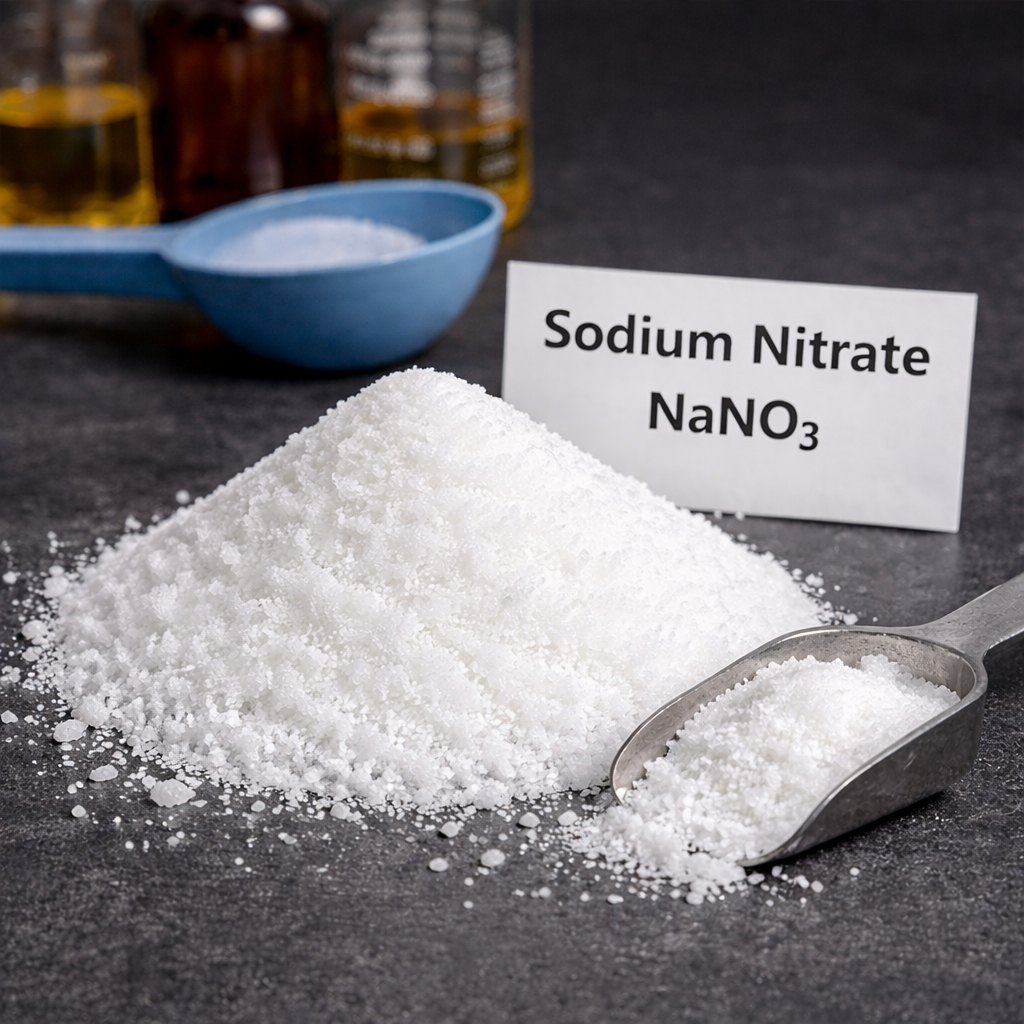
SODIUM NITRATE FIRE EMERGENCY RESPONSE
Sodium nitrate is not combustible, but it is a strong oxidizer. In a fire, it releases oxygen, which can intensify combustion of nearby flammable materials. Fire emergency response focuses on preventing ignition, isolating material, and safe extinguishing.
- Type of hazard: Oxidizer
- Decomposition on heating:
- 2 NaNO3→2 NaNO2+O2↑2,NaNO_3 rightarrow 2,NaNO_2 + O_2 uparrow2NaNO3→2NaNO2+O2↑Secondary decomposition: Produces toxic NO, NO₂ gases at higher temperatures (>600 °C).
- Main danger: Accelerates fire of combustible materials nearby.
- Raise alarm and evacuate non-essential personnel.
- Call fire response team immediately.
- Identify source of fire and separate containers if safe.
- Keep all flammables away from the area.
- Approach from upwind to avoid smoke and gases.
- Keep ventilation on to disperse NOₓ gases.
- Prevent runoff from contaminating drains – may require containment.
- Do not attempt to remove burning material if it puts personnel at risk.
Respiratory protection: SCBA or appropriate respirator
Eye/skin protection: Chemical goggles, gloves, fire-resistant suit
Footwear: Chemical-resistant boots
Maintain a safe perimeter: at least 10–15 meters for small-scale fires; more for bulk storage.
Evacuate all non-essential personnel.
Alert local authorities if fire is spreading.
Allow NaNO₃ to cool completely before handling.
Collect contaminated water/runoff and neutralize if necessary.
Inspect containers for damage or leaks.
Investigate cause and update fire prevention protocols.
- Initial decomposition:
- 2 NaNO3→2 NaNO2+O2↑2,NaNO_3 rightarrow 2,NaNO_2 + O_2 uparrow2NaNO3→2NaNO2+O2↑Further decomposition at higher temperatures (>600 °C):
2 NaNO2→Na2O+NO+NO2↑2,NaNO_2 rightarrow Na_2O + NO + NO_2 uparrow2NaNO2→Na2O+NO+NO2↑
Continuous operation: ≤ 380 °C
Short-term exposure: up to 400 °C, with monitoring
Avoid prolonged heating: >400–450 °C
Moisture: Accelerates corrosion and impurities formation
Impurities (chlorides, metals): Lower decomposition threshold
Mixing with organics or reducing agents: Can trigger rapid reactions
SODIUM NITRATE – CHEMICAL COMPATIBILITY GUIDE
Sodium nitrate is a strong oxidizer. It reacts dangerously with reducing agents, combustible materials, and certain acids. Compatibility evaluation is critical in storage, transfer, and processing.
Reducing Agents
Highly hazardous — risk of violent reaction/explosion.
- Sulfur, phosphorus, charcoal, powdered metals (Al, Mg, Fe)
- Hydrazine, sodium borohydride, lithium aluminum hydride
Combustible/Organic Materials
Risk of ignition & fire intensification.
- Oils, greases, solvents (ethanol, methanol, toluene)
- Sugars, sawdust, paper, cotton, wood
Especially strong acids → release toxic nitrogen oxides.
- HCl, H₂SO₄, HNO₃ (concentrated), HBr
- Reaction may generate NO, NO₂, corrosive fumes
Example reaction with sulfuric acid:
- 2NaNO3+H2SO4→2HNO3+Na2SO42NaNO_3 + H_2SO_4 rightarrow 2HNO_3 + Na_2SO_42NaNO3+H2SO4→2HNO3+Na2SO4
Risk of explosive ammonium nitrate formation.
- NH₄Cl, NH₄NO₃, ammonium sulfate
E. Halides & Cyanides
- May form shock‑sensitive or unstable salts.
Sodium Nitrate is chemically compatible with most inorganic salts, stainless steel, and plastics.
Keep away from organics, acids, ammonium compounds, reducing agents, and combustibles.
- It is an oxidizer, so storage and handling require segregation and moisture control.
- ParameterRecommendation
- TemperatureStore at
- room temperature, away from heat sources.
- HumidityKeep
- dry & well-ventilated; hygroscopic nature can cause caking.
- LightNo special restriction, but avoid prolonged direct sunlight.
- ContainersUse
- airtight, corrosion-resistant containers (HDPE drums, plastic-lined fiber drums, glass jars, stainless steel)
- .SegregationKeep away from
- flammables, organics, acids, ammonium salts, and reducing agents.LabelingClearly mark with:
- “Sodium Nitrate – Oxidizer, UN 1498.”PalletizationKeep containers
- off the floor on pallets; use secondary containment trays if needed.
Sodium nitrate is non-flammable, but can intensify fires of nearby combustible materials.
Keep water fire extinguishing equipment nearby.
- Avoid using CO₂ or dry chemical extinguishers directly on oxidizer fires.
Follow UN 1498, Class 5.1 (Oxidizer) regulations.
Transport upright in sealed containers.
- Avoid mixing with flammables, acids, or reducing agents during transport.
Spill: Isolate area, avoid dust clouds, sweep up carefully, then wash.
Fire: Evacuate personnel, flood area with water, cool containers, and wear SCBA.
- Exposure: For dust, wash skin with water, flush eyes, and seek medical attention if inhaled or ingested.
Below 308 °C → Stable solid
At 308 °C → Melts, still stable
Around 380–400 °C → Decomposition begins slowly, releasing oxygen
400–600 °C → Formation of sodium nitrite (NaNO₂) increases progressively
Above 600 °C → Further decomposition into oxides & nitrogen oxides
- Near 800+ °C → Extensive breakdown, residue mainly Na₂O
- Stable operational limit for molten salt use: ≤ 380 °C
- Avoid extended operation above ~400 °C
- Sodium nitrate decomposes starting around 380–400 °C, producing oxygen gas and sodium nitrite, with decomposition accelerating at higher temperatures.
· sodium nitrate supplier
· sodium nitrate manufacturer
· sodium nitrate exporter
· sodium nitrate distributor
· sodium nitrate price
· buy sodium nitrate online
· bulk sodium nitrate for sale
· industrial grade sodium nitrate
· food grade sodium nitrate
pharmaceutical grade sodium nitrate