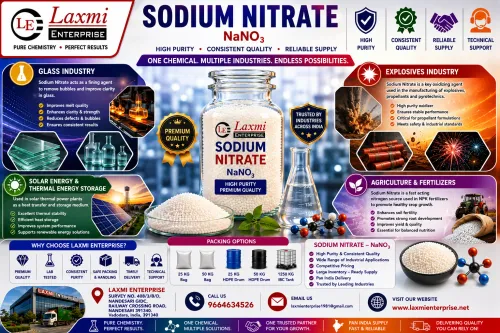


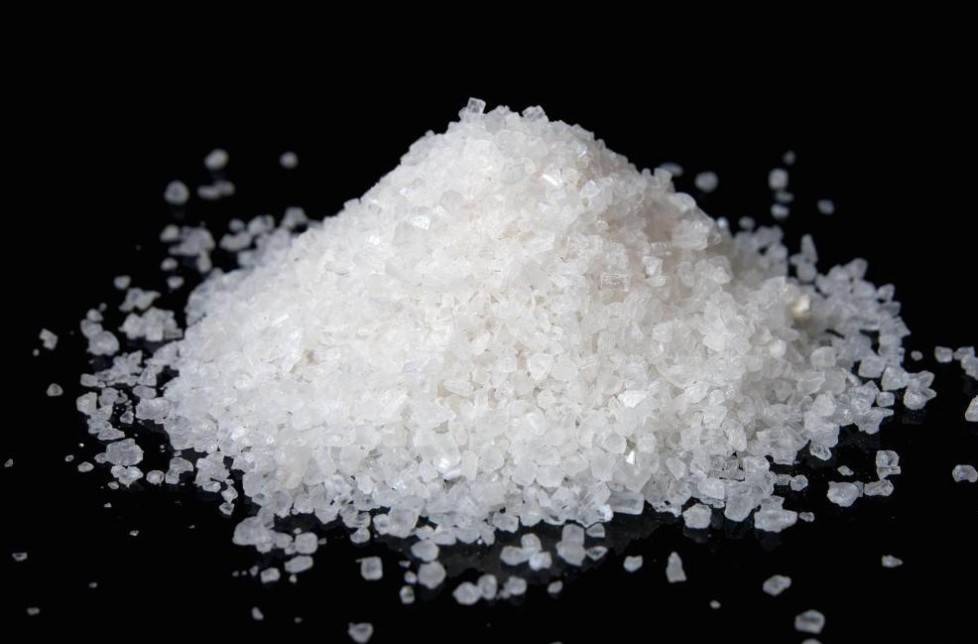
Sodium Nitrate — Chemical Synthesis Applications
Chemical Formula: NaNO₃ CAS No.: 7631-99-4
Molecular Weight: 85.00 g/mol Appearance: White crystalline solid
Overview:
Sodium Nitrate is a strong oxidizing agent and an essential raw material in numerous chemical synthesis processes. Its stable nitrate ion (NO₃⁻) participates in oxidation, nitration, and redox reactions, making it a valuable chemical intermediate for both organic and inorganic production.
Key Applications in Chemical Synthesis:
Production of Nitric Acid through reaction with sulfuric acid.
Intermediate for Sodium Nitrite and other nitrogen compounds.
Oxidizing agent in the manufacture of dyes, pharmaceuticals, and fine chemicals.
Used in metal surface treatment and catalyst preparation.
Reactant in glass, enamel, and ceramic formulations for color stabilization.
Component of molten salt mixtures in high-temperature chemical processes.
Advantages:
High purity and reactivity ensure consistent synthesis results.
Fully water-soluble and easy to handle in industrial systems.
Stable oxidizer for controlled reaction environments.
Packaging:
25 kg / 50 kg HDPE bags or jumbo bags.
Supplier: Laxmi Enterprise, Vadodara — Supplying dependable Sodium Nitrate for industrial and chemical synthesis applications.
Quick summary
Main use in heat treating: component of molten salt baths and heat-transfer salts for annealing, tempering, bright-annealing and some quenching operations (usually as part of nitrate/nitrite mixtures).
Why used: good thermal stability, high heat capacity, stable molten-salt heat transfer across moderate industrial temperature ranges, and strong oxidizing characteristics useful in some bright/cleaning fluxes.
Key risk: strong oxidizer — avoid contamination with organics, reducing agents or combustibles; can decompose at high temperature producing nitrites/NOx.
Technical / physical info (practical values)
Chemical name / formula: Sodium nitrate, NaNO₃
Appearance: white crystalline powder / granules
Melting point: ≈ 308 °C
Density: ≈ 2.26 g·cm⁻³ (solid)
Solubility: highly soluble in water
Typical industrial grade assay: 98%–99% NaNO₃ (other grades available)
(These are general values — ask and I’ll make a formal spec with exact tolerances.)
How it’s used in metal heat-treating
Molten salt baths / heat-transfer salts: Sodium nitrate is commonly blended with potassium nitrate and/or sodium nitrite to produce a stable molten bath used for uniform heating, annealing, tempering and some quenching operations. Mixtures lower melting point vs pure NaNO₃ and change heat-transfer and stability characteristics.
Bright annealing / cleaning fluxes: The oxidizing nature helps remove scale and can support bright finishes when properly controlled.
Temperature range (typical): salt baths containing nitrates are typically used from just above their melt point up to several hundred °C (common industrial ranges are roughly 250–600 °C depending on exact salt mix). Pure NaNO₃ melts ≈308 °C so mixtures are often used to reach lower working temperatures.
Control & maintenance: baths require strict control of composition, water/moisture content and contamination (chlorides, organics). Contaminants reduce bath life and increase corrosion or NOx formation.
Advantages and limitations
Advantages
Good thermal storage and heat-transfer properties as a molten salt component.
Stable at moderate temperatures for long runs (with correct maintenance).
Relatively low cost and widely available.
Limitations / concerns
Oxidizer hazard — contact with organics or combustibles can cause fire.
Corrosivity — molten nitrates/nitrites can corrode some steels and alloys; compatibility testing and alloy selection (or protective linings) are essential.
Decomposition / NOx — at high T or when contaminated, nitrite formation and NOx emissions can occur — requires ventilation and emissions controls.
Moisture sensitivity — water ingress can cause violent reactions when salt is molten.
Typical specification fields customers request (for a sales sheet)
Assay (NaNO₃ %), moisture (%), sodium nitrite (ppm), chlorides (ppm), insolubles (%), iron (ppm), particle size / granulation, bulk density, CAS number (7631-99-4), packaging (25 kg bags / 500 kg bags / bulk), shelf life & storage, recommended application temperature, SDS link.
Safety, handling & storage (practical guidance)
Storage: cool, dry, well-ventilated warehouse; keep away from reducing agents, organic materials, fuels and combustibles. Store off the ground on pallets. Keep containers closed and dry.
PPE: safety glasses, chemical-resistant gloves, dust mask or respirator for dust, protective clothing. For molten work use heat-resistant PPE and face protection.
Fire / incompatible materials: oxidizer — avoid contact with organic material, reducing agents, metal powders, sulfur, etc. In a fire use water spray; do not use dry chemical agents that could be contaminated by organic residues.
Spill response: sweep up dry if safe (avoid dusting), or use inert absorbent; avoid mixing with combustibles. Dispose per local hazardous waste rules.
Environmental: nitrate is a water pollutant — avoid release to drains or waterways; treat/recover per regulations.
Waste, disposal & regulatory notes
Spent or contaminated salt baths and rinse waters must be treated as hazardous or controlled industrial waste in many jurisdictions because of nitrite/nitrate content and possible heavy metals/contamination. Follow local environmental regs for discharge limits and disposal. Consider salt recycling/regeneration where practical.
Packaging & grades (what to offer customers)
Technical / industrial grade — typical for heat-treat baths (assay 98%+).
Packaging: 25 kg paper/single-polylined bags, 500 kg FIBCs (big bags), bulk tanker (for liquid solutions).
Services to offer: SDS, Certificate of Analysis (CoA), sample packs, technical support for bath formulation and bath lifecycle management.
Quick checklist for a buyer (use this when sourcing)
Required grade / purity and max moisture.
Intended bath composition & working temperature (so supplier recommends NaNO₃ vs mixture).
Packaging size and storage capability.
Need for CoA and SDS.
Local regulations for transport and disposal (oxidizer classification).
Do you want supplier to supply recycle/regeneration service?
If you want, I can immediately (choose one):
Draft a 1-page product spec & sales description for sodium nitrate (ready for catalog/website).
Create a technical SDS-style safety summary for shopfloor use.
Propose salt-bath formulations (example nitrate/nitrite/potassium blends) for specific operating temperature ranges and the pros/cons of each.
Prepare a supplier quote template including typical packaging, CoA fields and handling notes.
SODIUM NITRATE — SAFETY AND STORAGE GUIDELINES
Chemical Name: Sodium Nitrate
Chemical Formula: NaNO₃
CAS Number: 7631-99-4
UN Number: 1498
Hazard Class: 5.1 (Oxidizer)
Common Uses: Metal heat-treating salt baths, fluxes, fertilizers, heat transfer media, pyrotechnics.
1. HAZARD IDENTIFICATION
Hazard Type Description
Physical Hazard Strong oxidizer – intensifies fire and may cause combustion of other materials.
Health Hazards Irritant to skin, eyes, and respiratory tract. Ingestion can cause nausea, vomiting, and methemoglobinemia (blood oxygen interference).
Environmental Hazards Toxic to aquatic life in large quantities; contributes to eutrophication (nitrate contamination).
GHS Classification & Labeling
Pictograms: (Oxidizer) (Health Hazard, in some cases)
Signal Word: Danger
Hazard Statements:
H272: May intensify fire; oxidizer.
H319: Causes serious eye irritation.
H335: May cause respiratory irritation.
Precautionary Statements:
Keep away from heat, combustible materials, and reducing agents.
Avoid breathing dust or fumes.
Store in a cool, dry, well-ventilated area.
2. SAFE HANDLING PRACTICES
Avoid contact with combustible, organic, or easily oxidizable materials (wood dust, paper, oil, etc.).
Do not smoke, weld, or create sparks near sodium nitrate storage or handling areas.
Use clean, dedicated tools (non-contaminated with oils or grease).
Minimize dust formation during transfer or mixing.
Provide adequate ventilation or local exhaust in work areas to prevent inhalation of dust or decomposition gases (NOx).
Avoid overheating — decomposition above ~380 °C produces toxic fumes.
Wash hands and exposed skin thoroughly after handling.
3. FIRE AND EXPLOSION HAZARDS
Not combustible itself, but supports and intensifies combustion of other materials.
Decomposition products: nitrogen oxides (NO₂, NO), oxygen.
Suitable extinguishing media: Water spray, flooding quantities only.
Do NOT use: dry chemical, CO₂, or foam on nitrate fires.
Firefighting instructions:
Keep containers cool with water spray.
Wear full protective clothing and self-contained breathing apparatus (SCBA).
Evacuate area if large quantities involved.
4. STORAGE GUIDELINES
Parameter Recommended Practice
Storage area Cool, dry, well-ventilated, non-combustible structure.
Temperature Ambient (< 30 °C ideal); avoid high heat or direct sunlight.
Humidity Keep dry; moisture causes caking and corrosion.
Segregation Store away from organics, acids, reducing agents, sulfur, metal powders, ammonium salts, and flammable materials.
Flooring Concrete or coated surface; no wooden pallets or cardboard near material.
Containers Use sealed HDPE bags, lined drums, or steel containers with corrosion-resistant lining.
Stacking Avoid high stacking; ensure stability and ventilation.
Signage Mark storage area with “OXIDIZER – NO SMOKING – KEEP DRY”.
Spill control Have neutral absorbents (inert sand, vermiculite) available.
5. SPILL AND LEAK PROCEDURE
Evacuate area and eliminate ignition sources.
Avoid dust; use mechanical means (shovel/scoop) to collect spilled material.
Do not use combustible absorbents (like sawdust).
Contain and prevent entry into drains or waterways.
Clean area with copious water once solid removed.
Dispose of waste per local hazardous waste regulations.
6. FIRST AID MEASURES
Exposure Route Action
Inhalation Move to fresh air. Seek medical attention if symptoms (coughing, breathing difficulty) persist.
Skin Contact Wash immediately with soap and water. Remove contaminated clothing.
Eye Contact Rinse cautiously with water for at least 15 minutes. Get medical help if irritation continues.
Ingestion Rinse mouth. Do NOT induce vomiting. Seek immediate medical help.
7. DISPOSAL CONSIDERATIONS
Dispose of contaminated salts and residues in accordance with local environmental regulations.
Do not discharge nitrates into sewage or natural water systems.
Rinse waters from cleaning operations should be treated for nitrate removal (biological denitrification or ion exchange).
8. TRANSPORT INFORMATION
Parameter Details
UN Number: 1498
Proper Shipping Name: Sodium Nitrate
Hazard Class: 5.1 (Oxidizer)
Packing Group: III
Label: Oxidizer (Yellow, Flame Over Circle)
9. STORAGE SUMMARY CHECKLIST
.Keep containers tightly closed and dry
.Separate from combustibles and organics
.Use corrosion-resistant containers
.Store below 30 °C
.Maintain clear aisle space and ventilation
.Label storage area “OXIDIZER – KEEP DRY”
.Train staff on nitrate hazards and emergency response
Would you like me to convert this into a printable one-page PDF safety sheet or warehouse display poster (A4 format) for your team or storage area?
It would include hazard pictograms and a clean layout for quick on-site refereng.