

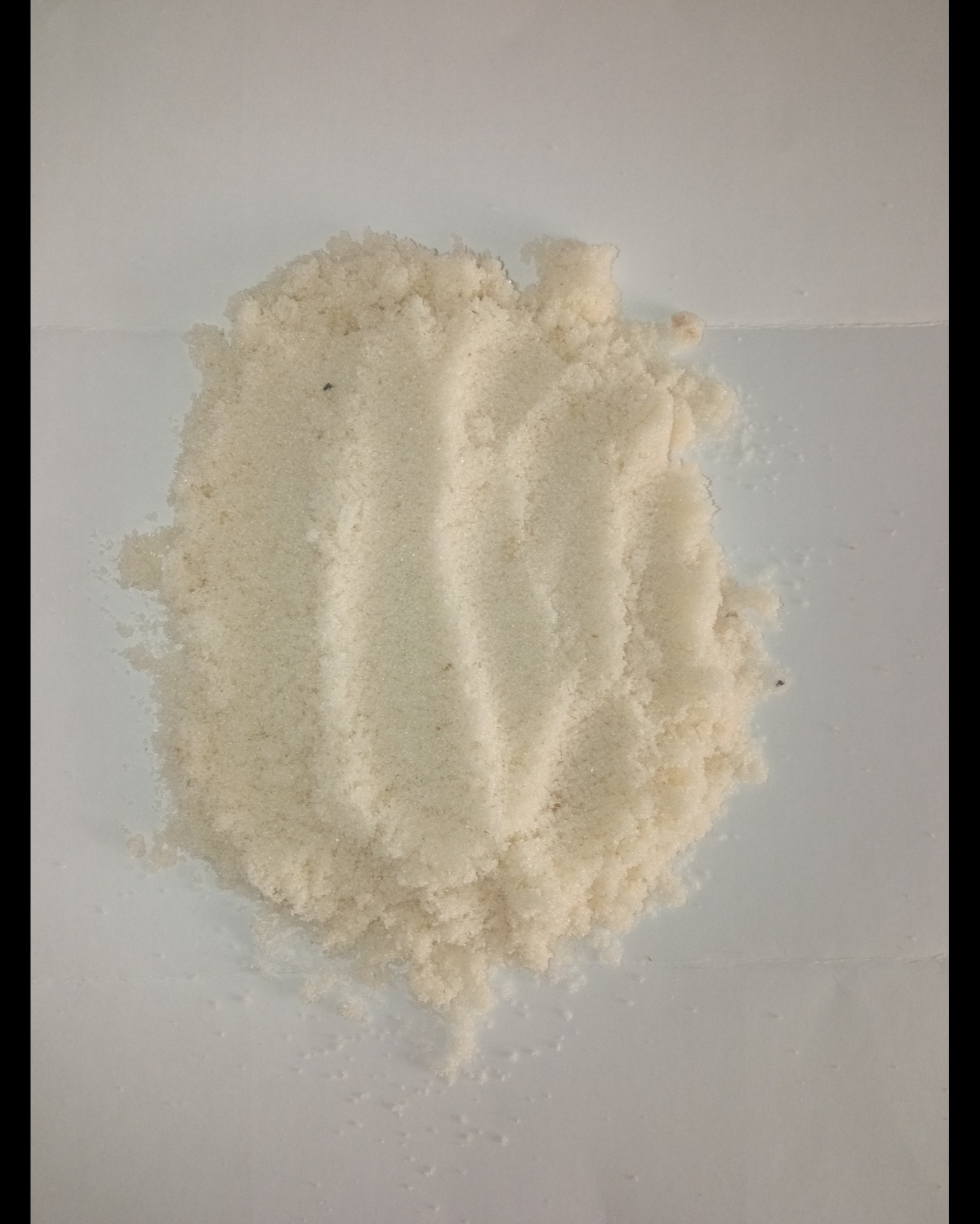
Here’s a complete technical and commercial overview of Sodium Nitrate (CAS No. 7631-99-4) — including chemical properties, industrial uses,
Chemical Overview – Sodium Nitrate
Parameter Details
Chemical Name Sodium Nitrate
Molecular Formula NaNO₃
Molecular Weight 84.99 g/mol
CAS Number 7631-99-4
EINECS / EC Number 231-554-3
HSN Code (India) 2834 21 00
Appearance White crystalline solid or powder
Odor Odorless
Solubility Highly soluble in water
Melting Point 306 °C
Boiling Point (decomposes) ~380 °C
pH (5% soln) 6.5 – 8.5
Density 2.26 g/cm³
Stability Stable; strong oxidizer — avoid contact with reducing agents, organics, or combustibles
Industrial Applications
Industry Application
Heat Treatment / Metallurgy As a neutral salt bath chemical (in mix with NaNO₂) for quenching, tempering, annealing
Glass & Ceramics Fluxing agent and fining agent
Fertilizer Source of nitrogen for crops (Chile saltpeter)
Pharmaceuticals Used in synthesis of nitro compounds
Explosives / Pyrotechnics Oxidizer component
Laboratories Analytical reagent and oxidizing agent
Typical Heat Treatment Salt Bath Mix
Component Proportion Function
Sodium Nitrite (NaNO₂) 60% Reducing / neutralizing
Sodium Nitrate (NaNO₃) 40% Oxidizing balance
Temperature Range: 220 – 550 °C Used for tempering, quenching, and austempering steels
🇮🇳 Major Sodium Nitrate Suppliers in India
Company Location Contact / Website Remarks
Deepak Nitrite Ltd. Vadodara, Gujarat deepaknitrite.com
Leading Indian producer; technical & industrial grade
Tata Chemicals Ltd. Mithapur, Gujarat tatachemicals.com
Large-scale producer; high purity
Gujarat Narmada Valley Fertilizers (GNFC) Bharuch, Gujarat gnfc.in
Fertilizer and industrial chemical manufacturer
Parth Chemicals Ankleshwar, Gujarat parthchemicals@yahoo.com
Custom nitrate/nitrite blends
Shree Chemicals Vadodara, Gujarat info@shreechemicals.in
Industrial and heat-treatment salt supplier
HOC (Hindustan Organic Chemicals Ltd.) Kochi, Kerala hocindia.com
Public sector chemical manufacturer
Metkore Alloys & Industries Ltd. Visakhapatnam, AP metkore.com
Alloy & salt bath formulations
Available Grades
Buy Sodium Nitrate
Sodium Nitrate for Sale
Sodium Nitrate Supplier
Sodium Nitrate Manufacturers
Sodium Nitrate Wholesale
Industrial Grade Sodium Nitrate
Food Grade Sodium Nitrate
High Purity Sodium Nitrate
Sodium Nitrate Fertilizer
Nitrogen Fertilizer Supplier
Nitrate-Based Fertilizers
Crop Nutrition Solutions
Agricultural Chemicals Supplier
Sodium Nitrate Food Additive
Curing Salt Additive
Food-Grade Nitrate Preservative
Meat Curing Ingredients
Preservatives for Processed Meat
Sodium Nitrate for Explosives
Grade Purity Applications
Industrial / Technical ≥99% Heat treatment, glass, explosives
Fertilizer Grade 98–99% Agriculture
Laboratory / Reagent ≥99.5% Analytical use
Would you like me to create an Excel sheet with supplier names, emails, phone numbers, and product grades (specific to Sodium Nitrate CAS 7631-99-4) for procurement or quotation requests?
It will include direct sourcing contacts across Gujarat and India.
Top Nitrate Salt Bath Mixture Suppliers – Vadodara Region
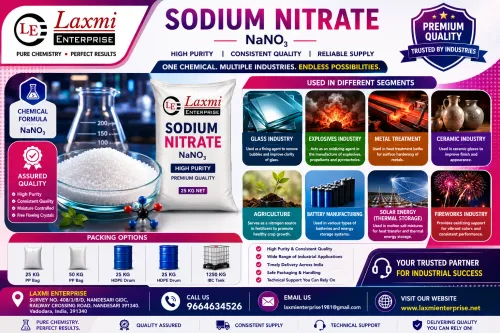
1. Laxmi Enterprise (Vadodara)
(You may already be connected to this market.)
Products:
Sodium Nitrate (NaNO₃) – 99%
Sodium Nitrite (NaNO₂) – 99%
Nitrate–Nitrite Salt Bath Mix (60/40 or custom ratios)
Applications: Heat treatment, tempering, annealing, neutral salt baths
Custom Services: Bulk blending, packaging in 25–50 kg bags, and private labeling
Contact: You can distribute or locally blend under your brand for local workshops and foundries.
Short answer: yes — when heated strongly, sodium nitrate (NaNO₃, CAS 7631-99-4) can decompose and release oxygen. That released oxygen (and other oxidizing decomposition products) is why NaNO₃ is an oxidizer and must be handled carefully in salt-bath and high-temperature applications.
Below is a clear, practical summary with the chemistry, temperatures, safety implications, and a worked example (how much O₂ is released if a given mass decomposes).
1) Key decomposition chemistry
The main primary thermal decomposition reaction commonly written is:
2 NaNO3 → 2 NaNO2 + O2↑;2;text{NaNO}_3 ;rightarrow; 2;text{NaNO}_2 ;+; text{O}_2 uparrow2NaNO3→2NaNO2+O2↑
So two moles of sodium nitrate produce one mole of oxygen gas and two moles of sodium nitrite.
At higher temperatures or under different conditions nitrite (NaNO₂) and nitrate can further break down to nitrogen oxides (NO, NO₂) and oxide residues — so expect a mixture of gaseous products if decomposition is severe (overheating, long exposure).
2) Typical temperatures / behavior
Melting point: ~306 °C (molten baths operate above this).
Decomposition onset (typical data): decomposition begins at elevated temperatures (often cited around ~350–400 °C; earlier decomposition signs occur with impurities or catalytic surfaces).
In normal eutectic NaNO₂/NaNO₃ salt baths (designed for 220–550 °C) oxygen release is not instantaneous — but overheating, long residence time, or contamination accelerates decomposition and O₂ (and NOₓ) evolution.
Molten nitrate salts are oxidizing molten media by nature — they supply an oxidizing environment even without appreciable free O₂ evolution.
3) Practical and safety implications
Oxidizing hazard: NaNO₃ can intensify fires; contact with organics, reducing agents, oil/grease when hot can cause ignition.
For molten salt baths: oxygen evolution + oxidizing environment can:
cause oxidation/scale of metal parts,
change surface finish (bright vs oxidized),
accelerate corrosion of some containment materials,
produce NOx if decomposition is severe (health hazard + corrosion).
Storage: Keep in a cool, dry area away from combustible materials and reducing agents. Use sealed containers if possible.
Handling PPE & controls: gloves, eye protection, face/respiratory protection when fumes likely, local exhaust ventilation, gas monitoring if overheating suspected.
Emegency: extinguishers appropriate for oxidizers and no combustible extinguishers placed against oxidizer fires without training.
4) Monitoring & prevention in salt-bath practice
aintain bath at recommended temperatures; avoid overheating.
Regularly analyse bath composition (NaNO₃ / NaNO₂ ratio) and top up or replace as needed.
Use corrosion-resistant crucibles and fittings (consult supplier for compatible alloys).
Avoid organic contamination (oils, greases) around the bath.
Vent or scrub any off-gases; monitor for NOx and oxygen spikes if you suspect decomposition.
If you need an inert or reducing atmosphere, consider alternate salt chemistries (or inert gas blankets) — but consult a metallurgist / supplier.
5) Worked example — oxygen volume from decomposition
If you want to estimate how much oxygen would be released if a certain mass of sodium nitrate fully decomposed by the reaction above, here’s the arithmetic using a 2 NaNO₃ → 2 NaNO₂ + O₂ stoichiometry.
Example: 100.000 kg of NaNO₃ fully decomposes.
Step-by-step:
Molar mass NaNO₃ ≈ 84.9947 g·mol⁻¹.
Convert mass to grams: 100.000 kg = 100000 g.
Moles of NaNO₃ = mass / molar mass
= 100000 g ÷ 84.9947 g·mol⁻¹ = 1, 176.543949... mol.
Reaction gives 1 mole O₂ per 2 moles NaNO₃, so moles O₂ = moles NaNO₃ ÷ 2
= 1, 176.543949 ÷ 2 = 588.2719746 mol O₂.
At STP (approx 22.414 L per mole), volume O₂ = moles × 22.414 L·mol⁻¹
= 588.2719746 × 22.414 ≈ 13, 185.528 L ≈ 13.19 m³ of O₂ (STP).
So 100 kg of NaNO₃ → ~588.3 mol O₂ → ≈13, 186 L (≈13.19 m³) of oxygen at STP, if it all decomposed by that simple stoichiometry.
(Partial / gradual decomposition will produce smaller flows but still can be hazardous locally.)
6) Short checklist for safe operation of nitrate salt baths
Keep operating temperature below decomposition risk for your formulation.
Avoid organic contamination and reducing materials near the bath.
Provide good ventilation and NOx / O₂ monitoring if overheating is a possibility.
Store bulk NaNO₃ away from combustibles and reducing agents.
Train staff on oxidizer hazards and emergency procedures.
Consider routine bath analysis and scheduled bath replacement to avoid progressive decomposition.
If you want I can:
calculate O₂ for any other mass/weight (tell me the figure) — I’ll show the same step-by-step math, or
draft a short MSDS-style hazard summary or a one-page safety checklist tailored for a Vadodara heat-treatment shop. Which would you prefer?