

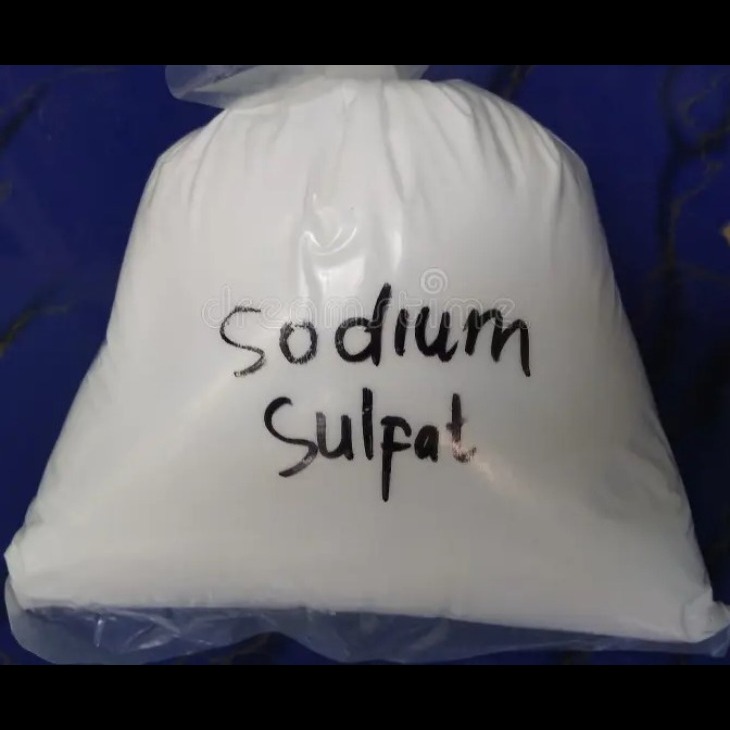
Sodium sulfate — crystallization process
Below is a practical, end-to-end guide to crystallizing sodium sulfate from solution (brine or purified liquor). It covers the physical chemistry you need to control, common crystallization strategies, recommended equipment and operating targets, step-by-step lab and pilot SOPs, washing/drying, product quality control, and troubleshooting. If you want, I can now (a) draw a simple PFD/SOP, (b) run a mass balance for a feed composition and production rate you give, or (c) size a crystallizer — tell me which.
1 — Key principles you must control
Thermodynamics (solubility & hydrate form): Sodium sulfate commonly crystallizes as Na₂SO₄·10H₂O (decahydrate, “Glauber’s salt”) at temperatures below ~32.4°C. Above that temperature the anhydrous form (thenardite) is stable. Use this temperature dependence to your advantage for selective crystallization.
Supersaturation: Driving force for nucleation/growth. Control cooling rate or evaporation to produce the desired nucleation vs growth balance. Too high → fines; too low → low yield/slow production.
Seeding: Provides controlled nucleation, improves crystal size distribution and filterability.
Impurities (Ca²⁺, Mg²⁺, organics, Cl⁻): They affect crystal quality, habit, yield and scaling. Pretreatment (softening, filtration, organics removal) is often required.
Hydrodynamics & residence time: Affect mixing, secondary nucleation, and growth. Proper agitation prevents localized supersaturation or agglomeration.
2 — Two commonly used crystallization routes
A. Cooling crystallization
Concentrate brine to a point close to saturation at an elevated temperature, then cool to induce crystallization of Na₂SO₄·10H₂O.
Best when feed has moderate sulfate concentration and cooling is energy-efficient.
Control tips: slow cooling (e.g., 0.2–2 °C/hr for industrial scale depending on plant) to favor growth over nucleation; seed at small supersaturation (5–20% over saturation) to get large, filterable crystals.
B. Evaporative crystallization
Evaporate water (solar ponds, single/multiple-effect evaporators, MVR) to reach supersaturation and induce crystallization.
Good for hot/dry climates (solar) or where steam/electricity and reliable equipment are available.
Often combined with fractional crystallization stages to separate NaCl and other salts.
You can combine both (evaporate to concentrate and then cool) to get better control.
3 — Practical operating targets & parameters (guidance)
Seeding dose: 0.1–1.0% (w/w) of expected crystal mass for controlled crystallization; adjust per vessel volume and target CSD.
Supersaturation control (industrial): Keep supersaturation moderate. For many inorganic salts, target supersaturation ratio S = C/C* around 1.05–1.2 during growth-dominant operation. (C* = solubility concentration at that temperature.)
Cooling rate (batch): Slow is better — usually 0.2–2 °C/h for large plants. Lab scale can be faster (e.g., 1–5 °C/h) but expect smaller crystals.
Agitation: Gentle to moderate shear; avoid intense shear that causes secondary nucleation unless you want fines.
Residence time: Depends on crystallizer type and kinetics — can be hours (batch) to tens of hours (continuous forced-circulation) for target crystal sizes.
Washing: Use cold (near wash temp) saturated Na₂SO₄ solution to reduce product dissolution and remove surface NaCl. Typical wash uses 1–3 wash stages or a single thorough wash — temperature control is key.
Drying: To convert Na₂SO₄·10H₂O → anhydrous, dry at elevated temperature (commonly 100–150 °C) while avoiding cake hardening or sintering. Use fluid bed or rotary dryer for industrial scale.
Note: exact numeric solubilities vary with temperature and ionic strength of the mother liquor. Use your measured saturation concentration curve for precise control.
4 — Crystallizer choices & brief pros/cons
Batch stirred tank (cooling crystallizer) — simple, flexible, good for R& D and small scale; variable product.
Draft-tube/forced-circulation (circulation cooling crystallizer) — excellent control of supersaturation, uniform crystals, good for scale-up.
Swenson-Walker / MSMPR (mixed suspension mixed product removal) — continuous operation (steady-state CSD), simpler internals, needs careful residence time control.
Vacuum crystallizer / vacuum pans — used with evaporative crystallization at lower temperatures.
Solar evaporation ponds — cheapest energy, but land extensive & slow.
5 — Step-by-step lab SOP (bench scale — example)
This is a general, safe bench procedure. Adapt volumes & times to your lab and feed composition.
Sample prep & pretreatment
Filter feed brine (0.45 μm or coarse filter) to remove suspended solids.
If Ca/Mg present, dose lime or soda ash stoichiometrically, stir 30–60 min, allow precipitate to settle, filter.
Concentration
Heat to evaporate some water (e.g., on hotplate) until the solution is close to saturation at your intended seeding temp. Avoid overheating.
Seeding & crystallization
Cool slowly to target crystallization temperature (e.g., 20–25°C if you want decahydrate). Typical lab cooling: 0.5–3 °C/hr, or place in a controlled-temperature bath set to target temp and allow solution to equilibrate.
Add seed crystals (0.5% w/w of expected product) with gentle stirring (200–400 rpm depending on vessel).
Hold at target temp for several hours to overnight to allow growth.
Solid–liquid separation
Vacuum filter (Buchner) using a filter aid if necessary.
Keep filtrate cold to avoid product loss.
Washing
Wash cake with cold, saturated Na₂SO₄ solution (at wash temp) — small volumes, repeat 1–2 times.
Drying
Dry in oven at 100–120 °C (lab) to convert decahydrate to anhydrous. Check for cake hardening; mix if necessary.
QC
Test assay (wt% Na₂SO₄), moisture, NaCl impurity, insolubles.
6 — Industrial sequence (concise)
Pretreatment (filtering, softening, organics removal).
Concentration (evaporation: MVR, multi-effect, or solar).
Cooling/evaporative crystallization in continuous or batch crystallizers with seeding.
Solid–liquid separation (centrifuge, vacuum belt, drum filter).
Washing with saturated cold liquor.
Drying & milling/classification.
Recycle mother liquor or treat for secondary salt recovery.
7 — Washing & drying best practices
Wash with cold saturated liquor to reduce dissolution. If wash is too warm, product dissolves and yield drops.
Minimize wash volume while ensuring removal of surface NaCl.
Drying to anhydrous will remove water of crystallization; control heat ramp to avoid sintering which reduces downstream milling efficiency.
8 — Monitoring & control strategy
Measure solution concentration (density, TDS, or conductivity calibrated to composition) in real time for supersaturation control.
Monitor temperature precisely in crystallizer and wash stages.
Use on-line particle-sizing (FBRM/particle counters) for continuous processes to detect nucleation bursts/fines.
Automate feed/concentration/cooling to maintain target supersaturation window.
9 — Common problems & fixes
Fines / slurry difficult to filter → reduce supersaturation, add more seed, slower cooling, or use flocculant for fine removal.
High NaCl content in crystals → lower wash temperature, use additional wash stages, or perform fractional crystallization upstream.
Scaling on heat exchangers / evaporators → improve pretreatment (remove Ca/Mg), use anti-scaling chemicals, periodic cleaning.
Sintered/overheated product → reduce drying temperature or use staged drying with fluid bed to maintain porosity.
Low yield/loss to mother liquor → concentrate mother liquor further, or evaluate recovery of salts via additional crystallizer stages.
10 — Quality control parameters (examples)
Assay (Na₂SO₄ % w/w) — target depends on application (technical, detergent grade, reagent grade).
Moisture content (for anhydrous product typically <0.5–1.5%).
NaCl % — lower is better for many uses.
Insolubles / Ash — (<0.1–0.5% typical targets).
Particle size distribution — target D50 depending on number (e.g., 100–500 µm for good filterability).
11 — Simple mass-balance / design template (you can copy & fill)
Feed: volume flow (m³/h) and concentrations (g/L of Na⁺, SO₄²⁻, Cl⁻, Ca²⁺, Mg²⁺).
Target product production: kg/day anhydrous Na₂SO₄.
Steps:
Convert feed sulfate to Na₂SO₄ equivalent (mol or kg).
Apply recovery (tight: 90–98% typical achievable with good washing/recycle; conservative 85–92% for new process).
Calculate required evaporation/cooling duty based on water removed (kJ/kg water) and latent heat (if evaporative).
Size crystallizer based on residence time and expected crystal mass (e.g., for continuous, Volume = (kg product/day)/(kg crystals/m³ per day)).
If you paste a feed composition and target output, I’ll do the numbers now.
12 — Quick pilot-scale checklist
Lab solubility curve for your exact brine (measure saturation concentration vs temperature).
Bench crystallization tests to determine nucleation/growth kinetics and seed effectiveness.
Test different cooling profiles and seeding doses — measure resulting CSD and filtration rates.
Pilot continuous run (MSMPR or forced circulation) to confirm steady-state yields, mother liquor composition and wash efficiency.
Pilot drying & handling tests to check for caking and dust issues.
If you want, I can:
Draw a concise PFD / SOP for a batch or continuous crystallization (I can produce a diagram or step list).
Run a mass balance and evaporation duty estimate — paste your brine composition (g/L) and target production (kg/day) and I’ll calculate yields, water removed, and suggest crystallizer volume and dryer throughput.
Provide a short operator checklist or a QC certificate template for product release.
Which of these would you like me to do now?
Forms of Sodium Sulfate
Decahydrate (Na₂SO₄·10H₂O, Glauber’s salt) – commonly obtained from crystallization at temperatures <32 °C.
Anhydrous (Na₂SO₄, thenardite) – required for industrial uses (detergents, glass, chemicals).
Drying is mainly the process of removing water of crystallization from decahydrate to produce anhydrous sodium sulfate.
2. Drying Principles
Temperature control is critical:
Na₂SO₄·10H₂O loses water gradually between 32 °C–300 °C, depending on the desired hydration level.
Rapid heating can cause cake hardening, sintering, or dusting.
Moisture content measurement ensures proper anhydrous conversion.
Airflow and agitation improve drying rate and prevent lumps.
3. Laboratory Drying Methods
Method Temperature / Conditions Pros Cons
Hot air oven 100–120 °C Simple, low cost, easy to control Slow, batch process, uneven heating for large amounts
Vacuum oven 60–80 °C under reduced pressure Gentle drying, reduces risk of sintering Expensive, small capacity
Infrared (IR) drying Surface heating Fast for small samples Uneven heating for bulk
Desiccator over drying agent Room temperature, desiccant (e.g., silica gel, P₂O₅) Very gentle, prevents decomposition Very slow, only small quantities
Lab tip: For accurate mass balance, weigh the sample before and after drying and check for constant weight.
4. Industrial Drying Methods
Method Operating Principle Typical Conditions Pros Cons
Rotary dryer / drum dryer Continuous tumbling with hot air 150–300 °C (depends on water content) Continuous operation, high capacity Initial investment, energy use
Fluidized bed dryer Crystals suspended in hot air stream 120–200 °C Fast, uniform drying, good for fines Requires controlled airflow, careful to avoid dust
Spray dryer Feed slurry atomized into hot air 200–300 °C Produces fine, uniform particles, can convert decahydrate to anhydrous directly High energy, more complex
Vacuum tray dryer Batch trays under vacuum 60–100 °C Low-temperature drying, minimizes thermal stress Limited capacity, batch operation
Flash dryer Powder exposed to high-velocity hot air 150–250 °C Very fast, suitable for large-scale Risk of dust explosion, requires cyclone or filter for recovery
5. Drying Tips & Best Practices
Prevention of caking:
Avoid high local temperatures; keep crystals moving (fluidized or tumbled).
Pre-screen or pre-mill large lumps to improve surface area.
Energy efficiency:
Use multi-stage drying or waste heat from evaporators.
Recycle hot air if possible.
Product quality:
Moisture content for anhydrous product: typically ≤0.5–1%.
Maintain low NaCl contamination by washing crystals before drying.
Safety:
Minimize dust accumulation (respirable silica hazard).
Avoid overheat to prevent decomposition or dust explosion in industrial dryers.
6. Typical Industrial Sequence
Crystallization → produces Na₂SO₄·10H₂O crystals.
Solid-liquid separation → remove mother liquor.
Washing → remove NaCl and impurities.
Drying → convert decahydrate → anhydrous Na₂SO₄ (choose rotary, fluidized bed, or vacuum drying depending on scale).
Screening / milling → adjust particle size for end-use.
Overview of Sodium Sulfate in Asia-Pacific
Sodium sulfate (Na₂SO₄) is a white crystalline inorganic salt widely used in detergents, glass manufacturing, pulp and paper, textiles, and chemicals.
The Asia-Pacific region is a major producer and consumer, with large-scale production in countries like China, India, Japan, South Korea, and Thailand.
2. Major Producers
Country Key Details
China Largest global producer; abundant natural deposits and synthetic production (from chemical byproducts). Exports mainly to Southeast Asia, India, and Europe.
India Produces from natural deposits (e.g., Gujarat) and as a byproduct of chemical industries. Exports to Middle East, Africa, and Asia-Pacific.
Japan & South Korea Mainly synthetic Na₂SO₄ from chemical processes; domestic consumption for detergents and glass is high; exports limited but consistent.
Thailand & Vietnam Smaller-scale producers; mainly serve domestic and neighboring countries.
3. Key Export Markets in Asia-Pacific
Southeast Asia: Indonesia, Malaysia, Philippines, Vietnam — demand for detergents and industrial chemicals.
Oceania: Australia and New Zealand — industrial and laboratory applications.
South Asia: Sri Lanka, Bangladesh, Nepal — primarily detergents and textile processing.
Observation: Export volumes are often linked to local industrial demand, raw material availability, and price competitiveness compared to local production.
4. Types of Sodium Sulfate Exported
Anhydrous sodium sulfate (Na₂SO₄) – high-grade, used in detergents, glass, and chemical industries.
Decahydrate (Na₂SO₄·10H₂O, Glauber’s salt) – used in pulp/paper, textile, and chemical processes.
Industrial grade / technical grade – used for bulk manufacturing applications; usually lower purity (~95–98%).
Reagent grade – high-purity (~99%+) for laboratory or specialty chemical applications.
5. Export Regulations & Standards
Packaging: Usually in 25–50 kg HDPE bags, jumbo bags, or bulk containerized shipments.
Quality parameters: Moisture content, NaCl contamination, particle size, insoluble matter, and assay.
Documentation: Commercial invoice, packing list, certificate of origin, quality certificate (optional for buyers), and MSDS.
Customs & import duty: Varies by country; many Asia-Pacific countries have low to moderate import tariffs on industrial chemicals.
6. Logistics & Shipping
Transport modes: Bulk cargo by sea (containerized or in bulk), some land transport for neighboring countries.
Storage: Dry, moisture-free storage is critical to prevent caking and maintain product quality.
Lead time: 2–6 weeks typical for sea shipments depending on origin and destination ports.
7. Market Trends
Growing detergent and textile industry in Asia-Pacific drives demand.
China dominates exports, but India is emerging as a cost-competitive supplier for regional markets.
Synthetic sodium sulfate from chemical byproducts (e.g., HCl neutralization, sodium carbonate production) is increasing, supplementing natural deposits.
Sustainability trends: Buyers prefer suppliers with reliable quality and responsible environmental practices.
8. Pricing
Prices fluctuate based on feedstock availability, global chemical demand, energy costs, and shipping costs.
Approximate export price range (2025 estimate):
Industrial grade: $150–250/ton FOB (China/India origin)
High-purity / anhydrous: $300–400/ton FOB
Prices vary by packaging, quantity, and market conditions.
9. Key Export Strategies for Suppliers
Target regional hubs: Southeast Asia, Oceania, South Asia.
Highlight technical specifications, moisture control, and low NaCl content.
Offer bulk shipment options and flexible packaging.
Comply with international chemical shipping regulations (IMDG code for solids, MSDS).
Chemical Overview
Chemical formula: Na₂SO₄
Molar mass: 142.04 g/mol
Forms:
Anhydrous (thenardite) – white crystalline powder
Decahydrate (Glauber’s salt, Na₂SO₄·10H₂O) – colorless crystals
Solubility: Highly soluble in water; insoluble in most organic solvents.
Odor: Odorless, chemically inert in most organic reactions.
2. Role as a Drying Agent
Sodium sulfate is widely used to remove water from organic solvents and solutions. It works primarily by absorbing water physically, forming hydrates rather than reacting chemically.
Mechanism
Anhydrous Na₂SO₄ can take up water from an organic solution, forming partially or fully hydrated crystals.
It continues to remove water until equilibrium is reached or until fully hydrated (Na₂SO₄·10H₂O).
Does not introduce acidity or basicity, so it is inert in most organic reactions.
3. Applications
a. Laboratory
Drying organic solvents after extraction, washing, or reaction (ethers, alcohols, hydrocarbons).
Suitable for general-purpose drying where fast drying is not critical.
Often used after MgSO₄ if a slower, thorough drying step is desired.
b. Industrial
Detergent and soap manufacturing: Keeps powders free-flowing by absorbing moisture.
Glass industry: Acts as a flux and dehydration agent in some glass formulations.
Chemical manufacturing: Helps remove residual water in reactions or processing steps.
Textile and pulp industry: Removes water in dyeing or bleaching processes.
4. Advantages
Inert, non-toxic, and inexpensive.
High capacity for water absorption (~25% of its own weight).
Easy to handle and regenerate by heating to remove water.
Does not react with most organic solvents or compounds.
5. Comparison with Other Drying Agents
Drying Agent Speed Capacity Typical Use
Na₂SO₄ Slow High General organic solvent drying
MgSO₄ Fast Moderate Quick lab drying, small volumes
CaCl₂ Moderate High Hydrocarbons, amines
P₂O₅ Very fast Very high Strong dehydrating agent for chemical reactions
6. Handling & Safety
Store in a dry, moisture-free environment.
Avoid inhaling dust; wear gloves and goggles.
Non-corrosive, non-flammable, and generally safe.
Build long-term relationships with detergent manufacturers, glass plants, and textile companies.
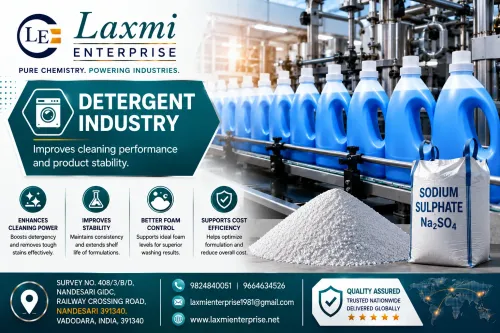
• Detergent Industry: As a filler in powdered laundry detergents
• Textile Industry: Dyeing and finishing agent
• Glass Manufacturing: Used in refining molten glass
• Paper Industry: For kraft pulping processes
• Other Uses: Ceramics, pharmaceuticals, and lab reagents
• Certification Sodium Sulphate for Detergents
• Detergent Grade Sodium Sulphate
• Sodium Sulphate in Powdered Detergents
• Laundry Chemicals Supplier
• • Sodium Sulphate for Textile Processing
• • Textile Chemicals Supplier
• • Dye Fixing Agent Chemicals
• • Sodium Sulphate in Dyeing
• Sodium Sulphate for Glass Manufacturing
• Sodium Sulphate for Kraft Process
• Sodium Sulphate for Paper Industry
• Industrial Chemicals for Glass Production
• • Request Sodium Sulphate Quote
• • Bulk Sodium Sulphate Pricing
• • Sodium Sulphate MSDS Download
• • REACH-Compliant Sodium Sulphate
• • Sodium Sulphate with COA and SGS
• • “Get a Free Quote Now”
• • “Download Product Specifications”
• • “Request SDS & COA”
• • “Talk to a Product Expert”
• • “Order a Sample Batch”
If you want, I can make a detailed table of Asia-Pacific countries with: import volume, key importers, and growth trend, which can serve as a market intelligence sheet for exporting sodium sulfate
[[SODIUM SULFATE DRYING AND DEHYDRATION AGENT, LAXMI ENTERPRISE, VADODRA, GUJARAT, INDIA.]]