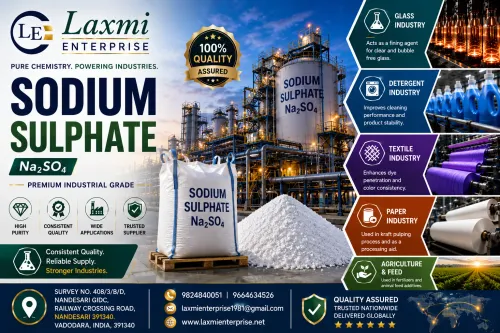

Sodium Sulphate in Textile Dyeing and Printing: Complete Technical Guide, Dyeing Chemistry, Process Applications, Quality Standards, and Industrial Buying Guide
Introduction
The textile industry is one of the world's largest manufacturing sectors, supplying fabrics for apparel, home furnishings, technical textiles, automotive interiors, medical products, industrial filtration, protective clothing, and countless other applications. Every stage of textile production—from spinning and weaving to dyeing, finishing, and printing—depends on carefully controlled chemical processes that determine the appearance, durability, and performance of the finished fabric.
Among these processes, textile dyeing is one of the most technically demanding. Manufacturers must achieve uniform color shades, excellent reproducibility, high fixation efficiency, and minimum batch variation while operating under increasing pressure to reduce water consumption, chemical usage, and production costs. Achieving these objectives requires not only high-quality dyes but also carefully selected auxiliary chemicals that control dye uptake and process stability.
One of the most widely used auxiliary chemicals in cotton dyeing is sodium sulphate (Na₂SO₄). Particularly in reactive dyeing and direct dyeing of cellulosic fibers, sodium sulphate functions as an electrolyte that promotes dye exhaustion by modifying interactions between dye molecules and textile fibers. Although it is not itself a dye, its controlled use can significantly influence dye bath behavior, shade reproducibility, and process consistency.
The role of sodium sulphate should not be confused with that of sodium chloride. While both salts are used in certain dyeing operations, their selection depends on the dye class, process requirements, mill practices, wastewater considerations, and customer specifications. Many textile manufacturers prefer sodium sulphate for selected applications because of its compatibility with specific dye systems and its contribution to controlled dye uptake.
As textile production continues to emphasize quality, sustainability, automation, and process optimization, consistent sodium sulphate quality remains an important factor in achieving reliable dyeing performance. Textile mills therefore evaluate not only chemical purity but also particle size, moisture content, insoluble matter, packaging quality, and supplier reliability before approving a source of supply.
This comprehensive guide explains the technical role of sodium sulphate in textile dyeing and printing, its interaction with dye chemistry, quality requirements, process considerations, procurement strategy, and best practices for industrial users.
Overview of Textile Wet Processing
Textile manufacturing involves several wet processing stages before a fabric is ready for use.
A typical production sequence includes:
Desizing
Scouring
Bleaching
Mercerization (where applicable)
Dyeing
Washing
Neutralization
Finishing
Drying
Quality Inspection
Each stage prepares the fabric for the next operation. Variations introduced during dyeing are particularly difficult to correct later, making process control essential.
Understanding Dyeing Chemistry
Dyeing is the process of transferring color molecules from a dye bath onto textile fibers and retaining them through physical or chemical interactions.
A successful dyeing process aims to achieve:
Uniform shade across the fabric.
High color reproducibility.
Efficient dye utilization.
Minimal unreacted dye.
Excellent wash fastness.
Controlled process economics.
Several factors influence dye uptake, including fiber type, dye chemistry, temperature, pH, liquor ratio, time, and the concentration of auxiliary chemicals such as sodium sulphate.
Why Electrolytes Are Used in Dyeing
Many dyes used on cotton fibers are anionic, meaning they carry a negative electrical charge when dissolved in water. Cotton fibers also develop negatively charged sites in aqueous dye baths.
Because like charges repel, dye molecules do not naturally migrate toward the fiber surface as efficiently as required for uniform dyeing.
Electrolytes such as sodium sulphate reduce this electrostatic repulsion by increasing the ionic strength of the dye bath. This promotes the movement of dye molecules from the solution toward the fiber, improving dye exhaustion under controlled process conditions.
The amount of electrolyte required depends on:
Dye class.
Shade depth.
Fiber type.
Liquor ratio.
Dye concentration.
Process recipe.
Optimizing electrolyte dosage is an important aspect of modern dyehouse process control.
Why Sodium Sulphate Is Used
Sodium sulphate offers several characteristics that make it suitable for textile dyeing.
High Water Solubility
The material dissolves readily, allowing consistent preparation of dye baths.
Chemical Stability
Its stable inorganic nature makes it compatible with many dyeing formulations.
Low Impurity Levels
High-purity sodium sulphate minimizes the risk of unwanted contaminants affecting shade reproducibility.
Uniform Particle Size
Consistent particle size improves dissolution and simplifies automated chemical dosing.
Reliable Storage Stability
When stored correctly, sodium sulphate maintains its physical properties over extended periods.
Dye Classes Where Sodium Sulphate Is Commonly Used
Sodium sulphate is associated primarily with the dyeing of cellulosic fibers.
Typical applications include:
Reactive dyes
Direct dyes
Certain vat dye preparation processes
Selected continuous dyeing systems
The specific formulation and dosage depend on the dye manufacturer's recommendations and mill process conditions.
Cotton Dyeing
Cotton remains the world's most widely dyed natural fiber.
Reactive dyes are commonly used because they form covalent bonds with cellulose, providing excellent wash fastness and bright shades.
Before fixation occurs, however, dye molecules must migrate uniformly from the dye bath to the cotton fiber.
This is where sodium sulphate serves an important role by promoting controlled dye exhaustion.
Proper electrolyte management contributes to:
Uniform shade development.
Better reproducibility.
Controlled dye uptake.
Reduced patchiness.
Improved batch consistency.
Reactive Dyeing Process
A simplified reactive dyeing sequence generally includes:
Fabric preparation.
Dye bath preparation.
Dye addition.
Electrolyte addition.
Controlled dye exhaustion.
Alkali addition for fixation.
Washing.
Soaping.
Final rinsing.
Drying.
Each stage must be carefully controlled to achieve high-quality dyeing results.
Direct Dyeing Applications
Direct dyes also rely on electrolyte addition to improve dye uptake by cellulose fibers.
Although the mechanism differs from reactive dye fixation, sodium sulphate again assists in promoting efficient dye exhaustion under appropriate process conditions.
Because direct dyes remain important for certain industrial textile applications, sodium sulphate continues to be widely used throughout the textile industry.
Textile Mills Require Consistent Chemical Quality
Modern dyehouses process thousands of meters of fabric every day.
Even small variations in auxiliary chemical quality may affect process consistency.
Textile manufacturers therefore commonly evaluate:
Sodium sulphate purity.
Moisture content.
Water-insoluble matter.
Particle size distribution.
Appearance.
Packaging quality.
Batch-to-batch consistency.
Supplier reliability.
Consistent raw material quality supports predictable dyehouse performance.