Sodium Sulphate Chemical & Physical Properties: Complete Technical Guide for Industrial Buyers (2026)
Primary Keyword: Sodium Sulphate Properties
Secondary Keywords: Sodium Sulphate Chemical Properties, Sodium Sulphate Physical Properties, Na₂SO₄ Properties, Sodium Sulphate Specifications, Industrial Sodium Sulphate
Technical Product Identity
Property Details
Product Name Sodium Sulphate
Chemical Name (IUPAC) Sodium Sulfate / Sodium Sulphate
Chemical Formula Na₂SO₄
CAS Number 7757-82-6
HSN Code (India) 2833 11 00
EINECS Number 231-820-9
Molecular Weight 142.04 g/mol
Appearance White crystalline powder or granules
Odour Odourless
Common Industrial Form Anhydrous Sodium Sulphate
Quick Answer
Sodium Sulphate (Na₂SO₄, CAS No. 7757-82-6, HSN Code 2833 11 00) is an inorganic sodium salt valued for its stable chemical properties, water solubility, and suitability for multiple industrial processes. Manufacturers in the detergent, glass, textile, kraft pulp, and chemical sectors evaluate its physical and chemical characteristics to ensure compatibility with their production requirements and quality standards.
Table of Contents
Introduction
Chemical Identity
Physical Properties
Chemical Properties
Thermal Behaviour
Solubility Characteristics
Industrial Quality Parameters
Laboratory Testing
Industry-Specific Property Requirements
Packaging & Storage
Buyer Checklist
FAQs
Conclusion
1. Introduction
Understanding the physical and chemical properties of Sodium Sulphate is important for selecting the appropriate grade, planning storage, designing quality control procedures, and evaluating supplier documentation.
Rather than relying on a single parameter such as purity, industrial buyers generally assess a combination of physical characteristics, laboratory results, and application-specific requirements.
2. Chemical Identity
Quick Answer
Correct product identification reduces procurement errors and supports traceability. Buyers should verify the product name, chemical formula, CAS Number, and supporting documentation before approving incoming material.
Property Value
Product Name Sodium Sulphate
Formula Na₂SO₄
CAS Number 7757-82-6
HSN Code 2833 11 00
EINECS Number 231-820-9
Molecular Weight 142.04 g/mol
3. Physical Properties
Quick Answer
The physical properties of Sodium Sulphate influence handling, storage, transportation, dissolution, and suitability for different industrial processes. These characteristics are commonly reviewed during technical evaluation and procurement.
Property Typical Description
Appearance White crystalline powder or granules
Odour Odourless
Physical State Solid
Colour White
Water Solubility Soluble
Hygroscopic Behaviour Storage conditions should minimise moisture exposure
The exact values and test methods should be confirmed through supplier documentation where relevant.
4. Chemical Properties
Sodium Sulphate is an inorganic sulfate salt composed of sodium ions and sulfate ions.
Industrial users value it because it generally exhibits:
Stable chemical composition.
Compatibility with many industrial processes.
Good storage stability under appropriate conditions.
Water solubility suitable for applications such as textile dyeing.
The significance of these properties depends on the intended application.
5. Thermal Behaviour
Quick Answer
Thermal behaviour is relevant in applications such as glass manufacturing and certain industrial processes. Process temperatures and operating conditions are determined by the manufacturer's process design and should not be generalized across industries.
Industrial users should rely on validated process data and supplier technical information when evaluating high-temperature applications.
6. Solubility Characteristics
Water solubility is one of the reasons Sodium Sulphate is used in several industrial applications.
Examples include:
Textile Processing
Consistent dissolution supports preparation of dye baths where Sodium Sulphate is used as an electrolyte in many reactive dyeing processes.
Chemical Manufacturing
Some chemical processes require complete dissolution before further processing.
Laboratory Testing
Solubility characteristics may be considered during quality evaluation and analytical testing.
7. Industrial Quality Parameters
Quick Answer
Industrial buyers generally review a combination of quality parameters rather than focusing only on purity. The required specification depends on the application and the buyer's internal standards.
Typical parameters include:
Parameter Why It Matters
Purity Product consistency
Moisture Storage and handling
Water-Insoluble Matter Process cleanliness
Particle Size Blending and handling
Appearance Incoming inspection
Batch Consistency Repeatable production
Iron (where applicable) Application-specific quality requirement
Chloride (where applicable) Process-specific requirement
8. Laboratory Testing
Many industrial laboratories evaluate Sodium Sulphate during incoming inspection or supplier qualification.
Common tests may include:
Appearance.
Purity.
Moisture.
Water-insoluble matter.
Particle size.
Iron (where specified).
Chloride (where specified).
Testing frequency depends on the buyer's quality management system and supplier qualification program.
9. Industry-Specific Property Requirements
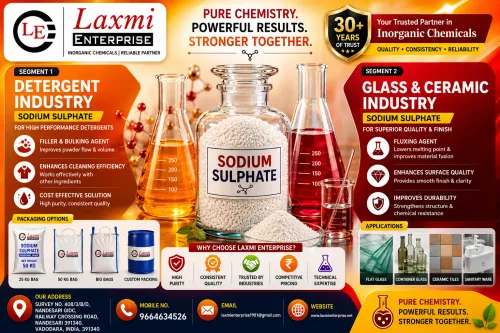
Detergent Manufacturing
Detergent manufacturers often evaluate:
Particle size.
Flowability.
Moisture.
Bulk density.
Batch consistency.
Glass Manufacturing
Glass manufacturers commonly review:
Purity.
Iron.
Moisture.
Water-insoluble matter.
Textile Dyeing
Textile processors generally focus on:
Purity.
Chloride.
Dissolution characteristics.
Moisture.
Water-insoluble matter.
Kraft Pulping
Paper and pulp mills typically consider:
Product consistency.
Documentation.
Handling characteristics.
10. Packaging & Storage
To help maintain product quality:
Store in a dry warehouse.
Protect packaging from moisture.
Keep bags sealed until use.
Use pallets to reduce floor moisture exposure.
Follow FIFO inventory management where appropriate.
Storage practices should align with the buyer's quality system and site conditions.
11. Buyer Checklist
Before approving a shipment:
✔ Verify CAS Number: 7757-82-6.
✔ Verify HSN Code: 2833 11 00.
✔ Review the COA.
✔ Review the TDS.
✔ Obtain the SDS/MSDS.
✔ Confirm batch identification.
✔ Inspect packaging.
✔ Compare quality parameters with the purchase specification.
12. Frequently Asked Questions
What is the chemical formula of Sodium Sulphate?
Na₂SO₄.
What is the CAS Number?
7757-82-6.
What is the HSN Code?
2833 11 00.
Why are physical properties important?
They influence handling, storage, processing, and application suitability.
Why do industries evaluate multiple quality parameters?
Because product performance depends on the complete specification rather than a single property such as purity.
13. Conclusion
The chemical and physical properties of Sodium Sulphate form the basis for its use in several industrial applications, including detergent manufacturing, glass production, textile dyeing, kraft pulping, and selected chemical processes. Understanding these properties helps buyers define suitable specifications, evaluate supplier documentation, and support consistent manufacturing.
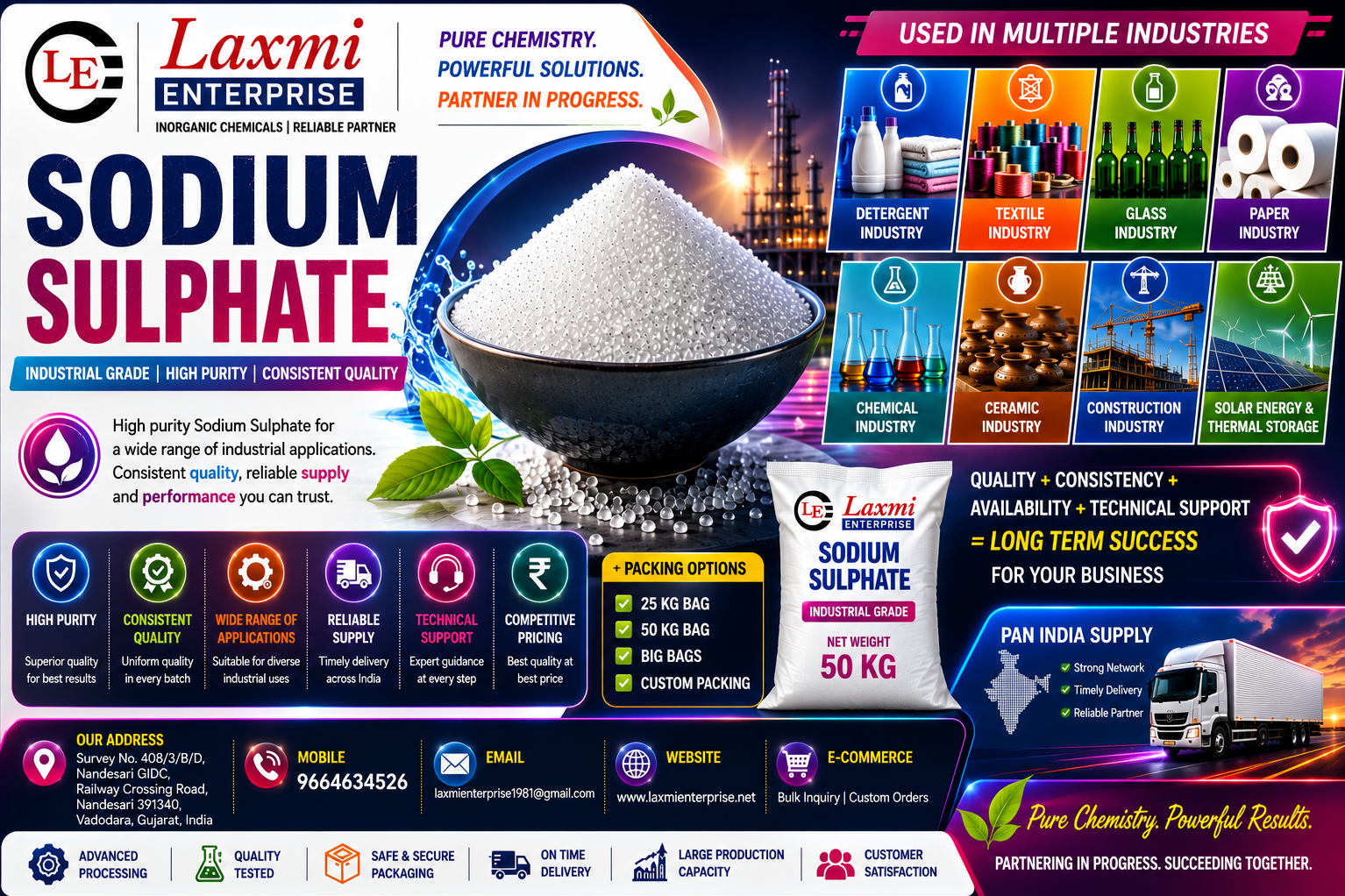
Laxmi Enterprise, located in Nandesari GIDC, Vadodara, Gujarat, supplies Sodium Sulphate (CAS No. 7757-82-6, HSN Code 2833 11 00) to customers across Pan India. The company supports industrial buyers with technical documentation, application-focused guidance, and dependable supply for a wide range of industrial requirements.
Strategic Recommendation for Your Content Hub
At this stage, you have enough foundational content to begin creating topic clusters. For example:
Detergent Cluster
Detergent Grade Sodium Sulphate
Powder Detergent Manufacturing
Packaging for Detergent Plants
Procurement Guide for Detergent Manufacturers
Glass Cluster
Glass Grade Sodium Sulphate
Glass Manufacturing Applications
Raw Material Quality
Supplier Selection
Textile Cluster
Reactive Dyeing
Sodium Sulphate vs Sodium Chloride
Textile Procurement
Quality Testing
Keywords