Sodium Sulphate vs. Sodium Chloride in Reactive Textile Dyeing: Complete Technical Comparison & Buyer's Guide (2026)
Primary Keyword: Sodium Sulphate vs Sodium Chloride
Secondary Keywords: Reactive Dyeing Salt, Textile Dyeing Chemicals, Sodium Sulphate for Textile Industry, Sodium Chloride vs Sodium Sulphate, Dyeing Electrolyte
Technical Product Identity
Sodium Sulphate
Property Details
Chemical Name Sodium Sulphate
Formula Na₂SO₄
CAS Number 7757-82-6
HSN Code (India) 2833 11 00
Molecular Weight 142.04 g/mol
Appearance White crystalline powder or granules
Sodium Chloride
Property Details
Chemical Name Sodium Chloride
Formula NaCl
CAS Number 7647-14-5
HSN Code (India) Commonly 2501 classification for salt products; the exact HSN depends on the product type and commercial classification. Buyers should confirm the applicable code for the product being purchased.
Appearance White crystalline solid
Quick Answer
Both Sodium Sulphate and Sodium Chloride are used as electrolytes in many reactive dyeing processes for cellulosic fibres. The appropriate choice depends on the dye system, fibre type, process design, wastewater management strategy, and mill-specific operating procedures. Textile manufacturers should evaluate technical performance, quality specifications, and process compatibility rather than assuming one product is universally superior.
Why Is Salt Used in Reactive Dyeing?
Reactive dyes are anionic (negatively charged), and cellulose fibres in aqueous dye baths also develop a negative surface charge.
Electrolytes help reduce electrostatic repulsion, supporting dye movement from the dye bath toward the fibre before fixation.
The specific electrolyte, dosage, and addition sequence should follow validated dyeing procedures.
Comparison Overview
Feature Sodium Sulphate Sodium Chloride
Formula Na₂SO₄ NaCl
CAS Number 7757-82-6 7647-14-5
Typical Role Electrolyte in many reactive dyeing systems Electrolyte in many reactive dyeing systems
Water Solubility Soluble Soluble
Industrial Availability Widely available Widely available
Product Selection Process-dependent Process-dependent
How Sodium Sulphate Works
Quick Answer
Sodium Sulphate increases the ionic strength of the dye bath, helping reduce electrostatic repulsion between reactive dye molecules and cellulose fibres. This supports dye exhaustion before the fixation stage.
The overall dyeing result depends on:
Dye selection.
Fibre type.
Liquor ratio.
Temperature profile.
pH control.
Process timing.
Machine design.
How Sodium Chloride Works
Sodium Chloride also functions as an electrolyte in many reactive dyeing processes by increasing the ionic strength of the dye bath.
Its use depends on:
Dye chemistry.
Mill operating procedures.
Environmental considerations.
Customer requirements.
Cost and availability.
Many mills develop validated recipes based on their own production experience.
Key Selection Factors
Fibre Type
Reactive dyeing is most commonly associated with:
Cotton.
Viscose.
Modal.
Lyocell.
Other cellulosic fibres.
The electrolyte should be compatible with the complete dyeing process.
Dye Chemistry
Different reactive dye systems may respond differently to process variables.
The dye supplier's recommendations should be considered when selecting process chemicals.
Water Quality
Water quality may influence dyeing performance.
Parameters commonly monitored include:
Hardness.
Conductivity.
pH.
Dissolved solids.
Water treatment practices vary between textile mills.
Environmental Considerations
Some textile manufacturers evaluate wastewater treatment requirements and local environmental regulations when selecting process chemicals.
Requirements vary according to jurisdiction and facility design.
Procurement Considerations
When sourcing either product, buyers commonly review:
Purity.
Moisture.
Particle size (where relevant).
Batch consistency.
COA.
TDS.
SDS/MSDS.
Packaging.
Supply reliability.
The specification should match the intended process.
Textile Industry Buying Guide
Quick Answer
Procurement teams should define technical requirements before requesting quotations. Comparing products only on price may overlook important quality, documentation, and logistics considerations.
Typical evaluation criteria include:
Process compatibility.
Supplier documentation.
Product consistency.
Delivery reliability.
Packaging.
Technical support.
Pan-India Supply
Textile manufacturing centres throughout Gujarat, Rajasthan, Maharashtra, Punjab, Haryana, Tamil Nadu, Karnataka, Telangana, Andhra Pradesh, Uttar Pradesh, and West Bengal require dependable supplies of textile process chemicals.
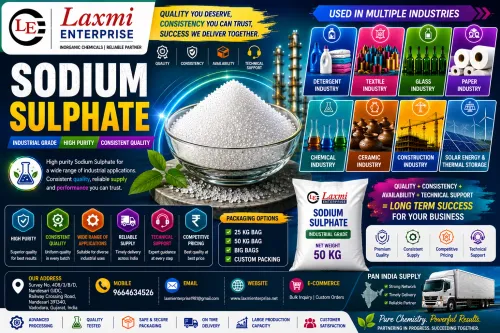
Laxmi Enterprise, based in Nandesari GIDC, Vadodara, Gujarat, supplies Sodium Sulphate (CAS No. 7757-82-6, HSN Code 2833 11 00) to textile manufacturers across Pan India, supporting procurement teams with technical documentation, packaging options, and reliable logistics.
Buyer Checklist
Before selecting a dyeing electrolyte:
✔ Confirm the fibre type.
✔ Review the dye supplier's recommendations.
✔ Define process requirements.
✔ Verify the product specification.
✔ Review the COA, TDS, and SDS/MSDS.
✔ Confirm packaging and delivery schedules.
✔ Evaluate supplier capability.
Frequently Asked Questions
Is Sodium Sulphate better than Sodium Chloride?
Neither is universally better. The appropriate choice depends on the dyeing process, fibre type, environmental considerations, and validated mill practices.
Can the same recipe be used with both products?
Recipe changes should only be made after appropriate laboratory and production trials. Process validation is important before implementing changes.
Why is documentation important?
Documentation supports quality verification, traceability, and safe handling.
Why include the CAS Number?
The CAS Number (7757-82-6) uniquely identifies Sodium Sulphate during procurement, quality control, and regulatory communication.
Conclusion
Both Sodium Sulphate and Sodium Chloride play important roles in reactive textile dyeing, and the most suitable choice depends on the complete manufacturing process rather than a single technical parameter. Textile mills should evaluate dye chemistry, fibre type, process requirements, environmental considerations, and supplier capability before selecting an electrolyte.
For textile manufacturers across Pan India, Laxmi Enterprise, located in Nandesari GIDC, Vadodara, Gujarat, supplies Sodium Sulphate (CAS No. 7757-82-6, HSN Code 2833 11 00) with technical documentation, flexible packaging, and dependable logistics to support consistent procurement and production.
Keywords