

SULFATE CONCENTRATION ANALYSIS IN ENVIRONMENTAL SAMPLES
Sulfate (SO₄²⁻) concentration analysis in environmental samples—such as groundwater, surface water, industrial effluents, soil extracts, and wastewater—is crucial for monitoring water quality, ecosystem health, regulatory compliance, and industrial process control. Below is a complete technical overview covering methods, sample preparation approaches, instrumentation, accuracy considerations, and common interference mitigation.
Filter sample through 0.45 µm membrane
Dilute if sulfate > instrument calibration range
Add suppressor regeneration agent system compatible (if needed)
High TDS samples: pretreat with Ba²⁺ precipitation or sulfate selective cartridge/guard column
Column: AS14/AS23/AS19 carbonate-bicarbonate columns
Eluent: 3.5 mM Na₂CO₃ / 1.0 mM NaHCO₃ (example)
Detector: Conductivity with chemical suppression
Run time: 8–20 minutes depending on column
Prepare standards at 1, 5, 10, 50, 100 mg/L
Plot peak area vs concentration
R² > 0.999 desirable
- Add barium chloride solution to sample.
- Add stabilizing/conditioning reagent (buffer + gum arabic/PEG).
- Allow turbidity development for 5–10 min.
- Measure absorbance using UV-Vis at ~420 nm.
- Compare using calibration curve prepared using known sulfate standards.
Acidify sample with HCl.
Heat and add BaCl₂ solution → form BaSO₄ precipitate.
Filter using ash-free filter paper.
Dry/ignite residue at 800 ±25°C.
Weigh BaSO₄ → calculate SO₄²⁻
Wavelength: 420 ± 20 nm
Detection range: 1–100 mg/L SO₄²⁻ (extendable to higher with dilution)
Barium chloride crystals/solution
Conditioning reagent (typically contains glycerol/PEG + HCl + NaCl + stabilizers)
Standard sulfate stock (usually K₂SO₄)
Pipette sample into a cuvette.
Add conditioning reagent.
Add BaCl₂ solution rapidly with mixing.
Allow 5–10 min development for stable turbidity.
Measure absorbance vs blank.
Prepare calibration curve using 0–100 mg/L standards.
Thorin dye indicator
Sodium chloride (ionic strength adjuster)
Hydrochloric acid (acid medium)
Prepare buffered sample with NaCl + HCl.
Add Thorin reagent.
Allow 20–30 min for color development.
Measure absorbance against reagent blank.
Sensitivity lowers with high sulfate levels → dilution required.
Thorin is toxic—handle with care.
Principle
Sulfate forms a measurable metal-dye complex displacement with MTB, producing a color change.
Conditions
- Mg²⁺ often used to form sulfate complex first
- Measurement around 600–650 nm
Xylene cyanol is adsorbed onto BaSO₄ precipitate causing measurable color loss, indirectly quantifying sulfate.
Measurement
- Wavelength: 610–620 nm
Use Case
Mainly research or specialized field kits.
Method: Spectrophotometric Turbidimetric (BaCl₂)
Sample: Groundwater – GW-07
Wavelength: 420 nm
Sulfate Concentration:78 mg/L (as SO₄²⁻)
Remarks: Within required permissible standards for potable water.
Removal technologies vary based on concentration, flowrate, co-contaminants, required discharge limits, and operating cost.
Very effective even at high sulfate (>3000 mg/L)
Produces low-solubility BaSO₄
Expensive due to barium salts
Ba-containing sludge requires safe disposal
- Forms CaSO₄/gypsum
- Suitable for sulfate reduction to around 1500–2000 mg/L
- Inexpensive & scalable
- High sludge generation
Achievable discharge < 250 mg/L
Requires pH 10.5–12
Sludge can be recycled (alum recovery)
Used widely in mining & power plant wastewater
Selectively rejects sulfate
Achieves < 50 mg/L sulfate
Ideal for reuse applications
Concentrate management needed
High removal efficiency (> 95%)
Produces high-quality permeate
Fouling control required (antiscalants)
Energy efficient for moderate salinity
Good for partial sulfate reduction
Strong base resins → high sulfate affinity
Regeneration with NaCl/NaOH
Suitable for low–medium sulfate streams
Nitrate/Sulfate selective
High capacity, reduced fouling
Activated alumina
Iron coated media
Layered double hydroxides
Biochar-based composites (emerging)
Converts sulfate → sulfide using organic carbon
Effective for high sulfate wastewater (>2000 mg/L)
Requires sulfide polishing step (aeration/iron precipitation)
UASB (Upflow Anaerobic Sludge Blanket)
Anaerobic moving bed bio-reactor (AnMBBR)
Fixed film/packed bed
pH optimization (Ettringite requires high pH)
Scaling control (gypsum precipitation in RO)
Co-contaminants (Cl⁻, metals, organics)
Sludge disposal cost
Brine management if membranes used
Carbon source for BSR (ethanol, acetate, lactate, industrial waste organics)
Use clean, sulfate-free bottles (HDPE or glass)
Filter through 0.45 µm membrane for dissolved sulfate
Preserve at 4°C, analyze within 48–72 hours
pH & redox potential (Eh)
Conductivity, TDS
Major anions (Cl⁻, NO₃⁻, HCO₃⁻)
Metals (Fe, Mn, Al, Ca, Mg)
Organic content (COD/BOD)
Sulfide and sulfur species in reducing zones
GPS-tagged sampling
Drone-assisted catchment surveys
Real-time sensors + IoT water monitoring stations
GIS spatial mapping for plume tracking
Project: Stream Monitoring – Downstream of Industrial Zone
Sulfate Result: 385 mg/L (as SO₄²⁻)
Method: Ion Chromatography
Location: GPS 22.30°N, 73.18°E
Sampling Date: 30-Dec-2025
Remarks: Exceeds discharge guideline; mitigation required.
Action: Recommend source investigation and sulfate control treatment.
Very low solubility → high removal efficiency
Effective even at high sulfate concentrations (3000–20000 mg/L)
High cost and toxic sludge disposal challenges
High removal efficiency required
Small wastewater volumes or high-value recovery
Polishing after other treatments
Cost-effective
Reduces sulfate moderately (50–70%)
Combines well with metals removal
Reduces sulfate <250 mg/L, sometimes <100 mg/L
Applicable to high TDS industrial wastewater
Sludge reusable for co-precipitation
- pH 10.5–12
- Alum or sodium aluminate dosing
- Solids separation unit
Widely used in mining, power plants, ETP upgrades
Strengths
- Removes 90–99% sulfate
- Suitable for water reuse
- Lower pressure than RO
Limitations
- Requires pretreatment to prevent fouling/scaling
- Generates concentrate stream
High-pressure separation
Pros
95% sulfate rejection
- High-quality permeate
Cons
- Sensitive to scaling → require antiscalants
- Concentrate handling required (ZLD integration)
Lower energy cost for moderate salinity
Selectively removes ions with reversible polarity switching
Suitable for medium sulfate loads
- Strong base anion resins (Cl⁻ form)
- Highly selective sulfate removal
Ideal for
- Polishing after precipitation/MF/UF
- Achieving low discharge limits
Regeneration chemicals: NaCl, NaOH
Produces brine waste → manage responsibly
Options:
- Activated alumina
- Iron hydroxide-coated sands
- Layered double hydroxides
- Biochar composites (emerging green tech)
Good for low–moderate sulfate & polishing.
- Cost-effective for high sulfate loads
- Converts sulfate to sulfide → recovered as elemental sulfur
Systems
- Anaerobic bioreactors (UASB, MBBR, packed bed)
- Requires carbon source (ethanol, acetate, molasses)
Need post-treatment
- Air oxidation → S⁰
- Fe salt → FeS precipitation
Sensitivity: ~0.5–5 µg/L (ppb)
Gold standard for trace sulfate quantification.
Principle: Separation of anions using ion-exchange column followed by conductivity detection after eluent suppression.
- Capillary IC systems
- High-capacity anion columns (AS19, AS11-HC)
- Eluent suppression optimization
- Sample concentration via preconcentration columns
Sensitivity: Low ppt levels achievable
Use cases: Complex matrices requiring high selectivity
- Bioanalytical samples
- Pharmaceutical excipients
- Ultra-trace water analysis
Sensitivity: ~0.1–0.5 mg/L (100–500 ppb) after improvements
Improvements include:
- Micro-turbidimetry using nanoparticles
- Flow Injection Analysis (FIA) spectrophotometry
- Turbidity amplification reagents / polymer stabilizers
- Longer optical path cuvettes (50–100 mm)
Used for low-cost high-throughput screening.
Very low reagent consumption
Fast separations
Suitable for small sample volumes
Emerging technology using selective electrodes/nanostructured surfaces.
Techniques
- Sulfate Ion-Selective Electrodes (ISE) – ppm-level
- Microelectrodes with graphene/metal oxides – improved sensitivity
- Amperometric sulfate biosensors – research stage
- Rare-earth doped nanoparticles
- Metal–organic frameworks (MOFs)
- Quantum dots
- Sulfate-responsive dye systems
Applications:
- Real-time sensing
- Microfluidics and lab-on-chip devices
Contamination source tracking
Geological and hydrochemical studies
Sample: Ultrapure boiler feedwater
Technique: IC–MS
Sulfate:0.45 µg/L (ppb)
LOD: 0.1 µg/L
RSD: 3.2%
Interpretation: Suitable for high-pressure boiler use.
Gypsum & barite scaling
Sulphate-induced corrosion
Environmental discharge limit exceedance
High sulfate removal without complete salinity reduction
Lower pressure & energy than RO (5–25 bar typical)
Compact modular configuration
Continuous operation + easy automation
Valuable for reuse and zero-liquid-discharge (ZLD) systems
- Membrane fouling by organics, silica, and suspended solids
- Scaling by CaSO₄ / BaSO₄ requires antiscalants or softening
- Requires periodic cleaning (CIP)
- Concentrate brine disposal or recycling needed
Cartridge/Micron filtration (5 µm → 1 µm)
Sand & activated carbon filters
UF as an excellent pretreatment
Antiscalants for sulfate scaling
Softening (lime/soda) if hardness is high
Spiral-wound NF modules (most common)
Hollow-fiber or plate-frame for high-fouling streams
Two-stage arrangement for higher recovery
- Thin Film Composite (TFC) Polyamide NF membranes
- PES & PVDF supports
- Surface modified & low-fouling variants available
Leading membrane series:
- Dow FilmTec NF270
- Hydranautics ESNA series
- Toray NANO series
- Vontron / LG Chem NF membranes
Mining effluent: Feed sulfate 3500 mg/L
After NF treatment → <200 mg/L in permeate
Recovery: 75–80%
Concentrate used for crystallization + recovery of sulfate salts
Typical detection limit (LOD): 0.5–5 µg/L
Linear range: 0.01–100 mg/L (extendable to 1000 mg/L with dilution)
Precision (RSD): <2%
Recovery: 95–105% for most matrices
ASTM D516 – sulfate in water by IC
EPA 300.0 & 300.1 – inorganic anions in water
ISO 10304-1 – water quality sulfate determination
APHA 4110 B – IC for drinking/wastewater anions
Filter through 0.45 µm membrane
Dilute if sulfate >100 mg/L
Dilution with DI water (10–100×)
Cation exchange cartridge to remove Ca²⁺ / Mg²⁺ scaling risk
Sulfate trap/guard column to protect analytical column
Pre-treatment to remove organics (SPE or UV digestion)
Use concentrator column for trace-level detection
Perform matrix elimination using Inline dilution or Inline neutralization
3.2 mM Na₂CO₃ / 1.0 mM NaHCO₃ (classic EP method)
Good for routine multi-anion analysis
Start 5 mM → ramp to 50 mM
Ideal for samples with high sulfate + nitrate + chloride
External calibration (5–7 points typical)
Internal standard optional (e.g. oxalate)
QC controls every 10 samples recommended
- Functional group: Quaternary ammonium (R–N⁺(CH₃)₃)
- High sulfate selectivity due to divalent anion affinity
- Operate in chloride, hydroxide, or bicarbonate form
Typical structure:
Polystyrene–DVB matrix with cationic sites that attract sulfate.
Purolite A520E
LANXESS Lewatit S 6368 A
Dow AmberLite PWA15
Less selective for sulfate
Used mainly for polishing, not primary removal
Suitable for lower sulfate concentration streams
Higher ionic charge (SO₄²⁻ preferred over Cl⁻)
Higher crosslink density
Macroporous matrix design
High selectivity for sulfate even in saline water
Low operating cost compared to RO/NF for moderate sulfate loads
Suitable for polishing after membrane systems
Regenerable & reusable for many cycles
High dissolved solids reduce capacity
Competitive ions like nitrate may interfere at high levels
Requires periodic brine regeneration
Resin fouling by organics, iron, silica possible → pretreatment needed
Turbidity <1 NTU
Iron <0.1 mg/L (use oxidation + filtration)
Oil/organics → activated carbon or coagulation
Hardness control to prevent scaling
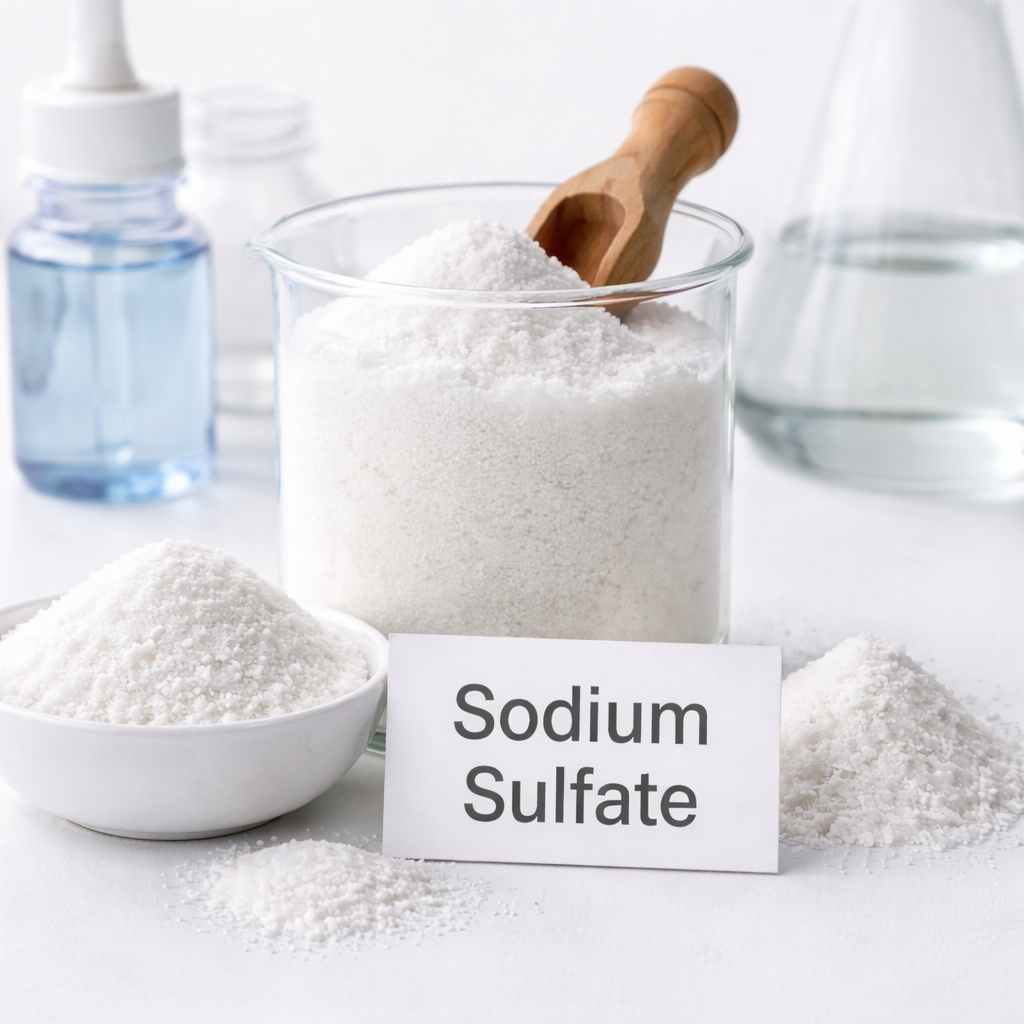
- sodium sulphate
- sodium sulfate
- Na2SO4
- CAS 7757-82-6 (anhydrous)
- CAS 7727-73-3 (decahydrate)
- E514
- EC 231-820-9
- sodium sulphate SDS
- sodium sulphate MSDS