SULFATE DETECTION BY ION CHROMATOGRAPHY
1. Principle
Sulfate ions are separated on an anion-exchange column using a low-strength carbonate or hydroxide eluent. After suppression, sulfate is detected by conductivity detection.
Peak area is directly proportional to the sulfate concentration.
Example: Short Validation Summary (to include in final report)
- Method: IC (suppressed conductivity), column: AS18, eluent: 3.5 mM Na₂CO₃/1 mM NaHCO₃, flow 1.0 mL/min, inj 25 µL.
- Linearity: 0.1–50 mg/L, R² = 0.9996.
- LOD = 0.033 mg/L, LOQ = 0.10 mg/L (calculated from SD_blank and slope).
- Precision (repeatability) at 5 mg/L: RSD = 0.52% (n=5).
- Recovery in drinking water (5 mg/L spike): mean = 97.7% (n=3).
- Robustness: method robust to ±10% flow; column temp ±5°C affected RT < 2% and concentration < ±3%.
Instrumentation
Anion IC system with:
- Anion-exchange analytical column (e.g., Dionex AS14, AS18, AS22, AS23)
- Guard column
- Suppressor (chemical or electrolytic)
- Conductivity detector
- Autosampler (optional)
Sample Preparation
Drinking water & surface water
- Filter through 0.45 µm membrane.
- Dilute sample if expected sulfate > calibration range.
Industrial effluent
- Pre-filter: 1 µm → 0.45 µm
- Centrifuge if high TSS
- Avoid acidification with sulfate-containing acids
- Dilution often required (1:10 to 1:100)
High salinity / seawater
- Dilute 1:100 or higher to avoid suppressor overload.
IC-specific practical notes
- Use freshly prepared eluent and degas. Eluent variation affects retention and slope.
- Suppressor must be conditioned and functioning — suppressed conductivity baseline drift indicates suppressor trouble.
- For chloride-rich samples (salt water), reduce injection volume and increase dilution or use columns with better Cl/SO4 separation (AS23, AS18).
- Filter all samples (0.45 µm) to protect column; document filter brand and lot for traceability.
- Use matrix-matched QC if matrix effects suspected.
Suggested Validation Tables & Report Items
- Table: Calibration concentrations, areas, back-calculated concentrations, residuals
- Table: LOD/LOQ calculation (SD_blank, slope, LOD, LOQ)
- Table: Precision data (replicate concentrations, mean, SD, RSD)
- Table: Recovery data (native conc, spiked conc, measured, recovery%)
- Robustness summary table (parameter changed, effect on concentration, acceptance)
- System suitability results
- Chromatograms: blank, low standard (LOQ), mid standard, high standard, representative sample
- Final statement: method valid for [matrices], range [x–y mg/L], LOD, LOQ, precision, accuracy
Calibration Procedure
- Prepare at least 6 standards: (e.g., 0.1–50 mg/L).
- Run from lowest to highest concentration.
- Plot Area (y) vs Concentration (x).
- Verify R² ≥ 0.999.
- Use linear regression for quantification.
Troubleshooting
Poor peak shape / tailing
- Column contamination → flush with NaOH or replace guard column
- Check for particulates
High baseline / noise
- Suppressor issue (degas, regenerate)
- Carbonate contamination in water
Retention time shift
- Wrong eluent concentration
- Pump flow instability
Low response
- Suppressor aging
- Leaks in injection valve or tubing
Optional Add-Ons (tell me if you need them):
I can generate any of the following:
*Full, detailed SOP for Sulfate by IC
* Method Validation Protocol (LOD, LOQ, Accuracy, Precision)
* Sample Pretreatment Workflow (Effluents)
* Chromatogram interpretation guide
* Calibration curve dataset & Excel sheet
Carryover and Blank Checks
- Run blank immediately after high calibration standard (e.g., 50 mg/L).
- Carryover acceptance: peak area in blank ≤ area corresponding to LOQ OR ≤ 5% of high standard signal.
- If carryover observed, increase flush, consider autosampler wash solvent.
System Suitability (before each batch)
- Inject mid-level standard 6 times; check:
- Peak area RSD ≤ 2%
- Retention time RSD ≤ 1%
- Theoretical plates (N) within expected range
- Peak symmetry (0.8–1.5)
- If fails, troubleshoot (degassing, pump, suppressor).
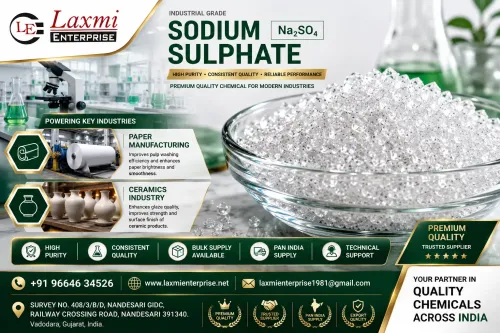
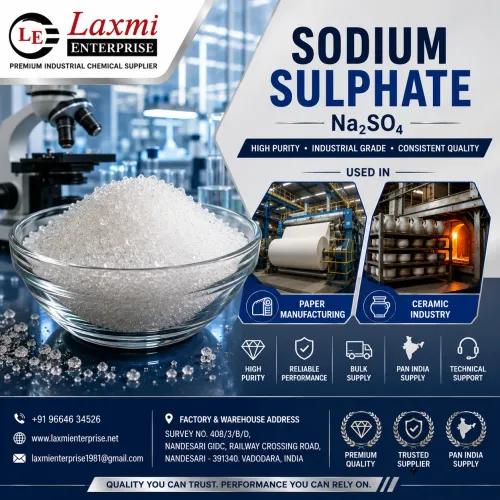
· Detergent Industry: As a filler in powdered laundry detergents
· Textile Industry: Dyeing and finishing agent
· Glass Manufacturing: Used in refining molten glass
· Paper Industry: For kraft pulping processes
· Other Uses: Ceramics, pharmaceuticals, and lab reagents
- Glauber's salt
- mirabilite
- thenardite
- sulfate of soda
- salt cake
- disodium sulfate
Keywords