

Below is a technical, mechanism-focused explanation of how sulfate interferes with weak acid detection in Ion Chromatography, and guidance on how to mitigate the problem when sensitivity toward low-level organic acids (especially acetate) is required.
SULFATE INTERFERENCE IN WEAK ACID DETECTION (IC)
Weak organic acids (acetate, formate, lactate, glycolate, propionate, citrate, etc.) are typically monovalent or weakly retained, while sulfate is strongly retained and divalent. High sulfate levels disrupt the chromatographic environment, suppressor performance, and conductivity detection — leading to false low results, peak suppression, and poor quantification for weak acids.
1. Mechanisms of Interference
A. Retention Competition on Anion-Exchange Column
- SO₄²⁻ has high affinity for the stationary phase compared to monovalent weak acids.
- SULFATE INTERFERENCE WEAK ACID DETECTION
- SO₄²⁻ has high affinity for the stationary phase compared to monovalent weak acids.
- Occupies resin sites → weak acids experience reduced interaction.
- Causes elution shifts and peak suppression.
Outcome:
▪ Weak acids elute earlier or co-elute
▪ Resolution loss between early peaks
- ▪ Quantification becomes inaccurate at low ppm levels
Sulfate elutes as a very large, broad conductivity peak, with a long tail.
Effects:
- Weak acid peaks near the sulfate retention zone are absorbed into the tail.
- Integration becomes unreliable.
- Low-level peaks drown under conductivity background.
Critical risk zone:
- Weak acids eluting just before or after SO₄²⁻ in gradient methods.
- Divalent sulfate consumes suppressor capacity rapidly.
- Incomplete suppression → elevated baseline + noise.
- Small conductivity changes from weak acids become indistinguishable.
- Their molar conductivity change is small → S/N drops sharply under noise.
Weak acids are partially ionized depending on pH.
If column pH shifts (due to sulfate load or carbonate contamination):
- Analyte remains partially protonated → lower detector response.
- Particularly pronounced for acetate, lactate (pKa ~3.8).
- ProblemRoot CauseWeak or missing acetate peakCompetition + sulfate overloadPoor S/N at low ppm levelsBaseline noise from suppressor stressPeak shouldering/merging near sulfateSulfate tail
- interferenceResponse varies sample-to-sampleMatrix effect → capacity fluctuationsRetention shifting with run countColumn loading + eluent depletion
- Move weak acids to earlier retention window, away from sulfate zone.
- Use internal standards for peak response normalization.
- Pair detection (Conductivity + UV for organic acids).
- 2D-IC heart-cutting to physically remove sulfate fraction.
Sulfate interferes with weak acid detection by dominating ion-exchange sites, overloading the suppressor,
and producing large, noisy conductivity peaks that mask low-level analytes. Effective quantification requires reducing sulfate burden or shifting weak acid retention away from the sulfate zone using column, method, or matrix modifications.
Here’s a detailed, technical summary on sulfate peak broadening and resolution issues in Ion Chromatography (IC), focusing on causes, mechanisms, analytical consequences, and mitigation strategies:
- High sulfate concentrations saturate the column’s exchange sites.
- Limited free sites cause slower elution and peak tailing.
- Adjacent weak acid peaks may merge or co-elute.
- Sulfate binds strongly to stationary phase → slower mass transfer.
- Leads to longer residence times and asymmetrical peaks.
- Peak front may be sharp, but tailing dominates.
- High sulfate load consumes suppressor capacity.
- Conductivity baseline rises → apparent broadening.
- Small analytes eluting near sulfate are partially masked.
- Coexisting salts (Na⁺, K⁺, phosphate, chloride) affect sulfate migration.
- High TDS → viscosity changes, resin competition, and band spreading.
- Weak acids can co-elute or show retention variability.
- Regularly regenerate suppressor to prevent baseline drift.
- Use high-capacity suppressors for high sulfate matrices.
- Monitor suppressor performance with standard sulfate injections.
- Inject smaller volumes when sulfate is high.
- Elute weak acids early to avoid sulfate tail overlap.
- Run a blank or matrix-matched standard to check for peak distortion.
- If quantitative recovery is critical, consider 2D-IC: cut off sulfate fraction before analysis.
Sulfate peak broadening is primarily caused by column overload, strong ionic binding, and suppressor stress, leading to poor resolution of weak acids. Managing sample load, using high-capacity columns, optimizing elution gradients, and mitigating suppressor stress are essential to maintain reproducibility and accurate quantitation.
Sulfate (SO₄²⁻) is a strongly retained divalent anion that can disrupt chromatography, detection, and quantitation. Effective mitigation involves instrumental adjustments, sample preparation, suppressor management, and method optimization.
- Reduce injection volume to avoid column saturation.
- Optimize eluent strength and gradient to elute sulfate earlier or separately from analytes.
- Include a post-run flush to clear residual sulfate and maintain column capacity.
- Simple, quick method.
- Reduces sulfate concentration and ionic strength.
- Best when analyte remains above LOQ after dilution.
- Ideal for biopharma or high-matrix TDS samples.
- Removes small ions including sulfate while retaining proteins and large molecules.
- Shift weak acid retention away from sulfate peak region (early elution or 2D-IC separation).
- Internal standards can correct for variable suppression or matrix effects.
- Heart-cutting or 2D-IC: physically separates sulfate fraction before sensitive analytes.
- Method validation: include recovery studies across sulfate concentration ranges to ensure quantification accuracy.
- Sulfate interferes via peak broadening, suppressor overloading, baseline noise, and competition for column sites.
- Combination of sample prep, column choice, gradient optimization, and suppressor management is most effective.
- Quantitative reliability improves with internal standards, matrix-matched calibration, and method validation under high sulfate loads.
Sulfate (SO₄²⁻) is a strongly retained divalent anion. High sulfate concentrations in a sample matrix can profoundly influence column performance, detection, suppressor efficiency, and quantitation of target analytes, especially weak acids like acetate, formate, and lactate.
- Strong binding to anion-exchange sites.
- Competes with monovalent and weak acids for resin capacity.
- Leads to:
- Peak broadening
- Retention time shifts
- Reduced resolution between analytes
Divalent sulfate consumes suppressor capacity more rapidly than monovalent anions.
Incomplete suppression causes:
- Elevated baseline conductivity
- Increased noise
- Reduced sensitivity for weak acids
- Sulfate generates large, high-conductivity peaks.
- Tails of sulfate peaks can mask low-concentration analytes eluting nearby.
- Sensitivity for weak acids is compromised.
High total dissolved solids (TDS) or coexisting salts influence sulfate migration.
Causes band spreading, diffusion-related tailing, and variability in weak acid retention
- High-capacity suppressors for high-sulfate matrices.
- Increase regeneration flow or frequency.
- Monitor suppressor performance with sulfate standards.
- Shift weak acids away from sulfate elution window.
- Use internal standards for weak acid quantification.
- Dual detection (conductivity + UV) can improve sensitivity.
- 2D-IC or heart-cutting to remove sulfate fraction.
Check sulfate concentration before analysis; high loads often require pre-treatment.
Optimize injection volume and gradient to reduce peak broadening.
Use high-capacity columns and suppressors when sulfate > analyte by >10×.
Monitor baseline and suppressor efficiency regularly
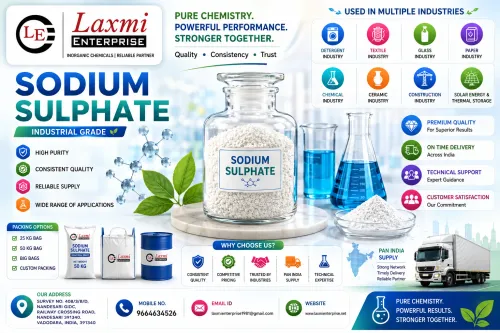
- Informational: what is sodium sulphate, uses of sodium sulphate
- Commercial: sodium sulphate price per kg, supplier comparison
- Transactional: buy sodium sulphate online, bulk sodium sulphate for sale
- Long-tail: sodium sulphate for detergents, sodium sulphate for glass industry- sodium sulphate
- sodium sulfate
- Na2SO4
- CAS 7757-82-6 (anhydrous)
- CAS 7727-73-3 (decahydrate)
- E514
- EC 231-820-9
- sodium sulphate SDS
- sodium sulphate MSDS