
Understanding Molten Salt Systems and the Role of Sodium Nitrate in High Temperature Industrial Applications
Every industrial process is designed to solve a specific engineering challenge.
Some processes require extremely low temperatures, while others depend on maintaining very high temperatures for long periods without losing efficiency. Achieving this consistently requires more than advanced equipment. It also depends on selecting materials that perform reliably under demanding operating conditions.
One technology that has gained significant importance over the years is the molten salt system. These systems are used in selected industrial applications where heat must be transferred or stored efficiently over extended periods.
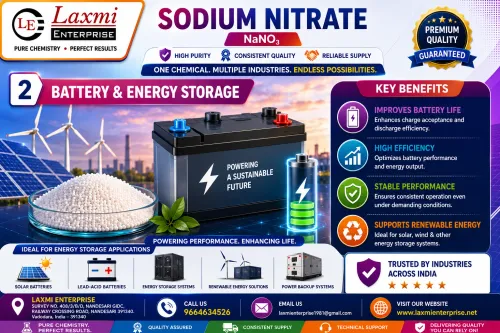
Among the materials used in carefully engineered molten salt formulations, Sodium Nitrate is one of the chemicals that may be selected depending on the design requirements of the process.
Understanding why molten salt systems are used helps engineers, project managers and industrial buyers make more informed decisions when selecting raw materials.
## What Is a Molten Salt System
A molten salt system is a process in which specially selected salts are heated until they become liquid.
Once in the molten state, the salt mixture can transfer or store heat efficiently.
These systems are used in applications where maintaining stable temperatures is essential for process performance.
The exact salt composition depends on the engineering design, operating temperature and intended industrial application.
## Why Engineers Use Molten Salt Technology
Industrial processes often require heat to be transferred from one location to another.
Traditional heating methods may not always provide the required efficiency or temperature stability.
Molten salt systems are selected in certain applications because they can help maintain controlled thermal conditions over long operating periods.
This makes them valuable in industries where process stability is critical.
## Where Molten Salt Systems Are Used
Depending on the engineering design, molten salt technology may be found in several industrial sectors.
Renewable energy projects.
Thermal energy storage systems.
Selected heat treatment operations.
Research facilities.
Pilot process plants.
Industrial testing environments.
Each application has its own technical requirements, which determine the most suitable salt formulation.
## Why Material Quality Matters
A molten salt system is designed to operate continuously under carefully controlled conditions.
Engineers therefore expect every raw material to meet the required quality standards.
Consistent raw materials contribute to predictable operating conditions.
Reliable quality also supports maintenance planning and long term process performance.
For large industrial projects, material consistency is often considered just as important as equipment quality.
## Engineering Projects Require Long Term Planning
Large industrial installations are rarely completed in a few weeks.
Planning often begins months before commissioning.
Engineers prepare technical specifications.
Procurement teams identify suitable suppliers.
Quality departments establish inspection procedures.
Warehouse teams prepare storage arrangements.
Reliable material supply becomes part of the overall project schedule.
Good planning reduces uncertainty throughout the installation process.
## Storage Before Installation
Industrial chemicals intended for engineering projects may remain in storage before they are introduced into the process.
Proper storage helps preserve product quality.
Materials should be stored in clean and dry conditions.
Packaging should remain sealed until required.
Inventory should be identified clearly.
Regular warehouse inspections help maintain good storage conditions.
These simple practices support efficient project execution.
## Working With Experienced Suppliers
Large engineering projects usually involve close cooperation between customers and suppliers.
Project schedules.
Packaging requirements.
Delivery planning.
Documentation.
Commercial coordination.
When suppliers understand industrial project requirements, communication becomes more efficient and project execution becomes smoother.
Experience often reduces avoidable delays during implementation.
## Looking Ahead
Investment in advanced manufacturing, renewable energy and industrial infrastructure continues to grow across many countries.
As new technologies are adopted, demand for high quality industrial chemicals used in specialized applications is expected to increase.
Companies that focus on quality, planning and technical understanding will be well positioned to support these developments.
## Final Thoughts
Molten salt systems represent an important technology in several high temperature industrial applications.
Although every project has unique engineering requirements, one principle remains the same.
Reliable materials contribute to reliable performance.
Understanding the role of Sodium Nitrate within selected molten salt formulations helps engineers and industrial buyers appreciate why consistent quality and dependable supply remain important for long term operational success.
# Frequently Asked Questions
## What is a molten salt system?
A molten salt system uses specially selected salts in a liquid state to transfer or store heat in specific industrial applications.
## Why are molten salt systems used?
They are used where controlled heat transfer or thermal energy storage is required for efficient industrial operation.
## Is Sodium Nitrate used in every molten salt system?
No. The composition of a molten salt mixture depends on the engineering design and application. Sodium Nitrate is used in selected formulations.
## Which industries use molten salt technology?
Depending on the application, molten salt systems may be used in renewable energy, thermal storage, selected heat treatment operations, research facilities and other specialized industrial processes.
## Why is consistent material quality important?
Consistent quality helps support predictable operating conditions and long term process reliability.
## How should Sodium Nitrate be stored before use?
It should be stored in a clean, dry and well managed warehouse with the packaging kept sealed until required.
## Why is planning important for industrial projects?
Careful planning helps coordinate procurement, deliveries, storage, quality verification and project execution.
## What should buyers evaluate before selecting a supplier?
Buyers should consider product quality, manufacturing capability, documentation, delivery performance, packaging and long term reliability.
## Can Sodium Nitrate be supplied for large industrial projects?
Yes. Supply arrangements can be planned according to project schedules, packaging requirements and consumption volumes.
## Why do industrial companies choose Laxmi Enterprise?
Industrial companies choose Laxmi Enterprise because of consistent product quality, dependable deliveries, professional service and long term commitment to supporting industrial manufacturing.
## About Laxmi Enterprise
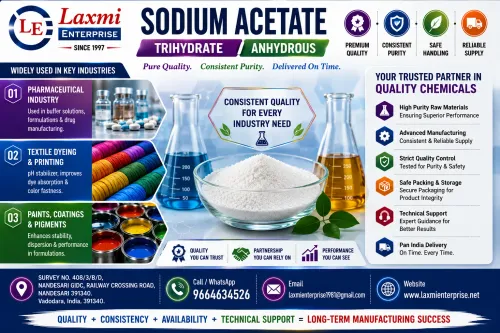
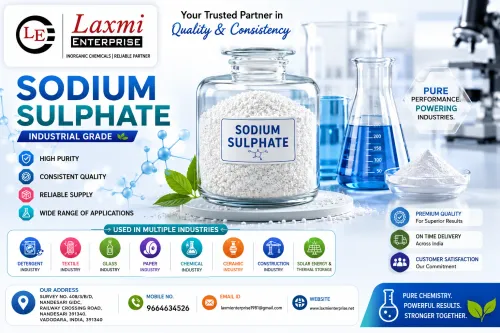
Laxmi Enterprise is a trusted manufacturer, supplier and distributor of industrial chemicals based in Nandesari GIDC, Vadodara, Gujarat. We supply Sodium Nitrate, Sodium Sulphate, Sodium Acetate, Tri Sodium Phosphate and other industrial chemicals to manufacturers and industrial projects across India.
Our commitment is to deliver consistent quality products, dependable logistics and responsive customer support that help customers achieve reliable manufacturing, efficient project execution and long term operational success.