Supplier Audit Checklist for Sodium Sulphate: What Every Procurement and Quality Team Should Verify Before Approval
Choosing a Sodium Sulphate supplier is one of the most important decisions for any manufacturing company. Once a supplier becomes part of the approved vendor list, that relationship often continues for years. The quality of the supplier directly influences production efficiency, inventory management, customer satisfaction and overall business performance.
Many organisations evaluate suppliers only through quotations and sample approvals. While these steps are necessary, they do not provide a complete picture of the supplier's capability.
A structured supplier audit helps procurement and quality teams understand whether a supplier can consistently meet technical, commercial and operational expectations.
Whether your company manufactures detergents, glass, textiles, paper, ceramics or specialty chemicals, conducting a supplier audit before placing regular purchase orders is a practical way to reduce procurement risks.
What Is a Supplier Audit?
A supplier audit is a systematic evaluation of a supplier's ability to consistently provide products and services that meet customer requirements.
The purpose is not to identify faults.
The purpose is to understand how the supplier manages quality, production, storage, documentation and customer service.
An effective audit helps manufacturers build long-term partnerships with dependable suppliers instead of reacting to problems after they occur.
Start with Company Background
Before discussing technical matters, understand the supplier's business.
How long has the company been operating?
Which industries does it serve?
What products does it manufacture or distribute?
Does it have experience supplying businesses similar to yours?
Companies with long-term industry experience often have better process discipline and a stronger understanding of customer expectations.
Experience alone does not guarantee quality, but it provides useful context during evaluation.
Evaluate Manufacturing and Supply Capability
Procurement teams should understand whether the supplier has the capacity to support current and future business requirements.
Questions to consider include:
Can the supplier handle regular bulk orders?
Can production increase if demand grows?
How are peak season requirements managed?
Is inventory maintained for regular customers?
A supplier should be able to demonstrate that it can support business growth without compromising service quality.
Review Quality Management Practices
Quality management is one of the most important parts of a supplier audit.
Rather than focusing only on the final product, evaluate the systems used to maintain consistency.
How are incoming materials inspected?
How is batch consistency monitored?
How are customer complaints investigated?
How are corrective actions implemented?
A disciplined quality system creates confidence that consistent performance can be maintained over time.
Inspect Warehouse Operations
Warehouse organisation often reflects the overall discipline of a business.
Observe how materials are stored.
Are storage areas clean and organised?
Is inventory clearly identified?
Are products protected from damage?
Is stock rotated systematically?
Well-managed warehouses reduce handling errors and improve inventory accuracy.
These practices ultimately benefit the customer.
Examine Packaging Standards
Packaging should protect the product throughout transportation and storage.
During the audit, inspect the packaging carefully.
Are bags strong and properly sealed?
Are labels easy to read?
Is palletisation organised?
Can warehouse personnel handle the material safely?
Professional packaging demonstrates that the supplier values product integrity throughout the supply chain.
Assess Documentation Systems
Industrial customers depend on accurate documentation.
Review how the supplier manages purchase orders, invoices, dispatch records and quality documentation.
Well-organised documentation supports traceability, internal audits and regulatory compliance where applicable.
It also reflects the professionalism of the supplier's business operations.
Evaluate Logistics and Delivery Planning
Reliable logistics are essential for continuous manufacturing.
Ask how deliveries are planned.
How are transport partners selected?
How are delivery schedules monitored?
What happens if unexpected delays occur?
A supplier with organised logistics can respond more effectively to changing customer requirements.
Reliable delivery performance is one of the strongest indicators of supplier dependability.
Review Customer Support
Customer service should continue after the shipment leaves the supplier's facility.
Evaluate how enquiries are handled.
How quickly are technical questions answered?
Is communication clear and professional?
Are concerns resolved promptly?
Strong customer support builds confidence and strengthens long-term business relationships.
Verify Continuous Improvement
A good supplier does not remain satisfied with current performance.
Look for evidence of continuous improvement.
Investment in infrastructure.
Employee training.
Warehouse upgrades.
Process improvements.
Customer feedback reviews.
Businesses that continuously improve are better prepared to meet future customer expectations.
Create a Supplier Scorecard
After completing the audit, convert observations into measurable scores.
Typical evaluation areas include:
Product quality consistency
Manufacturing capability
Packaging quality
Warehouse management
Documentation accuracy
Delivery reliability
Technical support
Communication
Commercial competitiveness
Overall business professionalism
Using a structured scorecard allows procurement teams to compare suppliers objectively instead of relying on personal opinions.
How Laxmi Enterprise Supports Customer Supplier Qualification
At Laxmi Enterprise, we understand that professional manufacturers evaluate suppliers carefully before establishing long-term business relationships.
Operating from Nandesari GIDC, Vadodara, we welcome technical discussions because we believe transparency builds trust.
Our focus is on maintaining consistent product quality, organised warehouse operations, professional packaging, dependable logistics and responsive customer service.
Every shipment reflects our commitment to helping customers strengthen their procurement processes through reliable industrial chemical supply.
Final Thoughts
A supplier audit is not an administrative exercise.
It is an investment in manufacturing stability.
Companies that evaluate suppliers thoroughly experience fewer procurement challenges, stronger production planning and better long-term business relationships.
Choosing the right Sodium Sulphate supplier requires more than reviewing quotations.
It requires understanding how the supplier operates every day.
The strongest supplier relationships are built on transparency, consistency and continuous improvement.
Frequently Asked Questions
Why should manufacturers conduct a supplier audit?
A supplier audit helps evaluate a supplier's quality systems, operational capability, logistics, documentation and overall reliability before establishing a long-term business relationship.
What should procurement teams inspect during an audit?
Procurement teams should evaluate manufacturing capability, warehouse management, packaging quality, documentation, logistics, customer support and quality management practices.
How often should supplier performance be reviewed?
Supplier performance should be reviewed regularly, especially for strategic raw materials that directly influence production continuity and product quality.
What is the benefit of using a supplier scorecard?
A scorecard provides an objective method for comparing suppliers and helps procurement teams make consistent, data-driven decisions.
Why do manufacturers across India choose Laxmi Enterprise?
Manufacturers choose Laxmi Enterprise because we provide consistent-quality Sodium Sulphate supported by professional documentation, reliable deliveries, organised operations and responsive customer service. Based in Nandesari GIDC, Vadodara, we are committed to building long-term partnerships through quality, transparency and dependable industrial chemical supply.
About Laxmi Enterprise
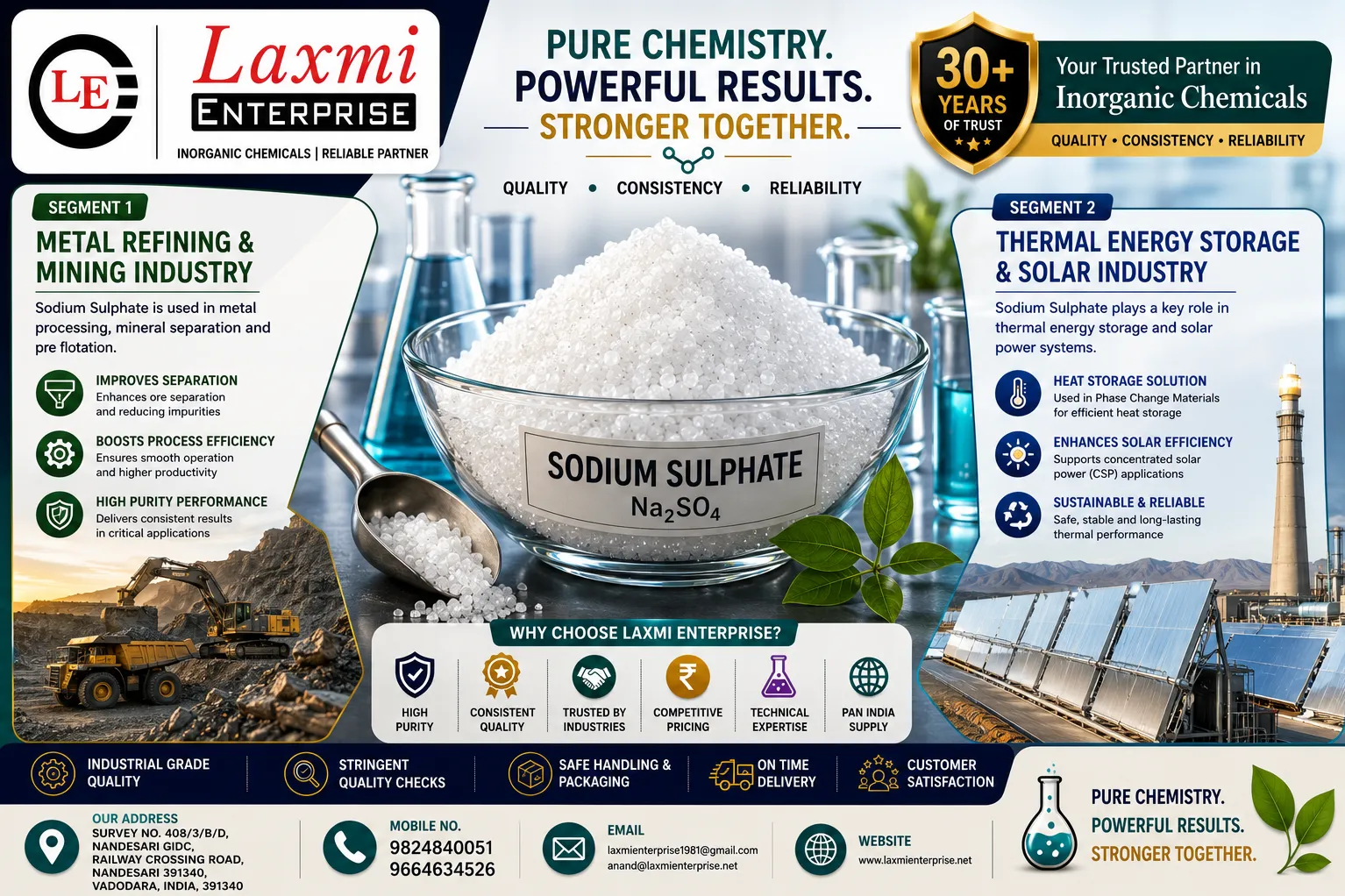
Laxmi Enterprise is a trusted manufacturer, supplier and distributor of industrial chemicals based in Nandesari GIDC, Vadodara, Gujarat. Since 1981, we have been supplying Sodium Sulphate, Sodium Nitrate, Sodium Acetate, Tri Sodium Phosphate and other industrial chemicals to the detergent, glass, paper, textile, ceramic, construction, water treatment and chemical processing industries across India.
With over four decades of experience, we are committed to consistent product quality, reliable logistics and professional customer service. Our goal is to help manufacturers improve procurement efficiency, strengthen quality systems and build dependable supply chains through trusted industrial chemical solutions.
Choosing a Sodium Sulphate supplier is one of the most important decisions for any manufacturing company. Once a supplier becomes part of the approved vendor list, that relationship often continues for years. The quality of the supplier directly influences production efficiency, inventory management, customer satisfaction and overall business performance.
Many organisations evaluate suppliers only through quotations and sample approvals. While these steps are necessary, they do not provide a complete picture of the supplier's capability.
A structured supplier audit helps procurement and quality teams understand whether a supplier can consistently meet technical, commercial and operational expectations.
Whether your company manufactures detergents, glass, textiles, paper, ceramics or specialty chemicals, conducting a supplier audit before placing regular purchase orders is a practical way to reduce procurement risks.
What Is a Supplier Audit?
A supplier audit is a systematic evaluation of a supplier's ability to consistently provide products and services that meet customer requirements.
The purpose is not to identify faults.
The purpose is to understand how the supplier manages quality, production, storage, documentation and customer service.
An effective audit helps manufacturers build long-term partnerships with dependable suppliers instead of reacting to problems after they occur.
Start with Company Background
Before discussing technical matters, understand the supplier's business.
How long has the company been operating?
Which industries does it serve?
What products does it manufacture or distribute?
Does it have experience supplying businesses similar to yours?
Companies with long-term industry experience often have better process discipline and a stronger understanding of customer expectations.
Experience alone does not guarantee quality, but it provides useful context during evaluation.
Evaluate Manufacturing and Supply Capability
Procurement teams should understand whether the supplier has the capacity to support current and future business requirements.
Questions to consider include:
Can the supplier handle regular bulk orders?
Can production increase if demand grows?
How are peak season requirements managed?
Is inventory maintained for regular customers?
A supplier should be able to demonstrate that it can support business growth without compromising service quality.
Review Quality Management Practices
Quality management is one of the most important parts of a supplier audit.
Rather than focusing only on the final product, evaluate the systems used to maintain consistency.
How are incoming materials inspected?
How is batch consistency monitored?
How are customer complaints investigated?
How are corrective actions implemented?
A disciplined quality system creates confidence that consistent performance can be maintained over time.
Inspect Warehouse Operations
Warehouse organisation often reflects the overall discipline of a business.
Observe how materials are stored.
Are storage areas clean and organised?
Is inventory clearly identified?
Are products protected from damage?
Is stock rotated systematically?
Well-managed warehouses reduce handling errors and improve inventory accuracy.
These practices ultimately benefit the customer.
Examine Packaging Standards
Packaging should protect the product throughout transportation and storage.
During the audit, inspect the packaging carefully.
Are bags strong and properly sealed?
Are labels easy to read?
Is palletisation organised?
Can warehouse personnel handle the material safely?
Professional packaging demonstrates that the supplier values product integrity throughout the supply chain.
Assess Documentation Systems
Industrial customers depend on accurate documentation.
Review how the supplier manages purchase orders, invoices, dispatch records and quality documentation.
Well-organised documentation supports traceability, internal audits and regulatory compliance where applicable.
It also reflects the professionalism of the supplier's business operations.
Evaluate Logistics and Delivery Planning
Reliable logistics are essential for continuous manufacturing.
Ask how deliveries are planned.
How are transport partners selected?
How are delivery schedules monitored?
What happens if unexpected delays occur?
A supplier with organised logistics can respond more effectively to changing customer requirements.
Reliable delivery performance is one of the strongest indicators of supplier dependability.
Review Customer Support
Customer service should continue after the shipment leaves the supplier's facility.
Evaluate how enquiries are handled.
How quickly are technical questions answered?
Is communication clear and professional?
Are concerns resolved promptly?
Strong customer support builds confidence and strengthens long-term business relationships.
Verify Continuous Improvement
A good supplier does not remain satisfied with current performance.
Look for evidence of continuous improvement.
Investment in infrastructure.
Employee training.
Warehouse upgrades.
Process improvements.
Customer feedback reviews.
Businesses that continuously improve are better prepared to meet future customer expectations.
Create a Supplier Scorecard
After completing the audit, convert observations into measurable scores.
Typical evaluation areas include:
Product quality consistency
Manufacturing capability
Packaging quality
Warehouse management
Documentation accuracy
Delivery reliability
Technical support
Communication
Commercial competitiveness
Overall business professionalism
Using a structured scorecard allows procurement teams to compare suppliers objectively instead of relying on personal opinions.
How Laxmi Enterprise Supports Customer Supplier Qualification
At Laxmi Enterprise, we understand that professional manufacturers evaluate suppliers carefully before establishing long-term business relationships.
Operating from Nandesari GIDC, Vadodara, we welcome technical discussions because we believe transparency builds trust.
Our focus is on maintaining consistent product quality, organised warehouse operations, professional packaging, dependable logistics and responsive customer service.
Every shipment reflects our commitment to helping customers strengthen their procurement processes through reliable industrial chemical supply.
Final Thoughts
A supplier audit is not an administrative exercise.
It is an investment in manufacturing stability.
Companies that evaluate suppliers thoroughly experience fewer procurement challenges, stronger production planning and better long-term business relationships.
Choosing the right Sodium Sulphate supplier requires more than reviewing quotations.
It requires understanding how the supplier operates every day.
The strongest supplier relationships are built on transparency, consistency and continuous improvement.
Frequently Asked Questions
Why should manufacturers conduct a supplier audit?
A supplier audit helps evaluate a supplier's quality systems, operational capability, logistics, documentation and overall reliability before establishing a long-term business relationship.
What should procurement teams inspect during an audit?
Procurement teams should evaluate manufacturing capability, warehouse management, packaging quality, documentation, logistics, customer support and quality management practices.
How often should supplier performance be reviewed?
Supplier performance should be reviewed regularly, especially for strategic raw materials that directly influence production continuity and product quality.
What is the benefit of using a supplier scorecard?
A scorecard provides an objective method for comparing suppliers and helps procurement teams make consistent, data-driven decisions.
Why do manufacturers across India choose Laxmi Enterprise?
Manufacturers choose Laxmi Enterprise because we provide consistent-quality Sodium Sulphate supported by professional documentation, reliable deliveries, organised operations and responsive customer service. Based in Nandesari GIDC, Vadodara, we are committed to building long-term partnerships through quality, transparency and dependable industrial chemical supply.
About Laxmi Enterprise
Laxmi Enterprise is a trusted manufacturer, supplier and distributor of industrial chemicals based in Nandesari GIDC, Vadodara, Gujarat. Since 1981, we have been supplying Sodium Sulphate, Sodium Nitrate, Sodium Acetate, Tri Sodium Phosphate and other industrial chemicals to the detergent, glass, paper, textile, ceramic, construction, water treatment and chemical processing industries across India.
With over four decades of experience, we are committed to consistent product quality, reliable logistics and professional customer service. Our goal is to help manufacturers improve procurement efficiency, strengthen quality systems and build dependable supply chains through trusted industrial chemical solutions.
Keywords