What Is Sodium Sulphate? Complete Industrial Guide for Indian Buyers (2026)
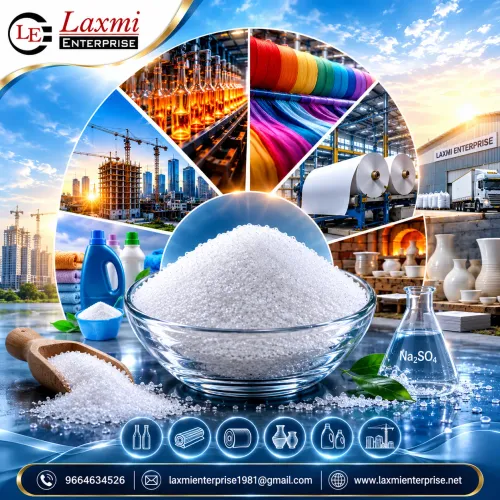
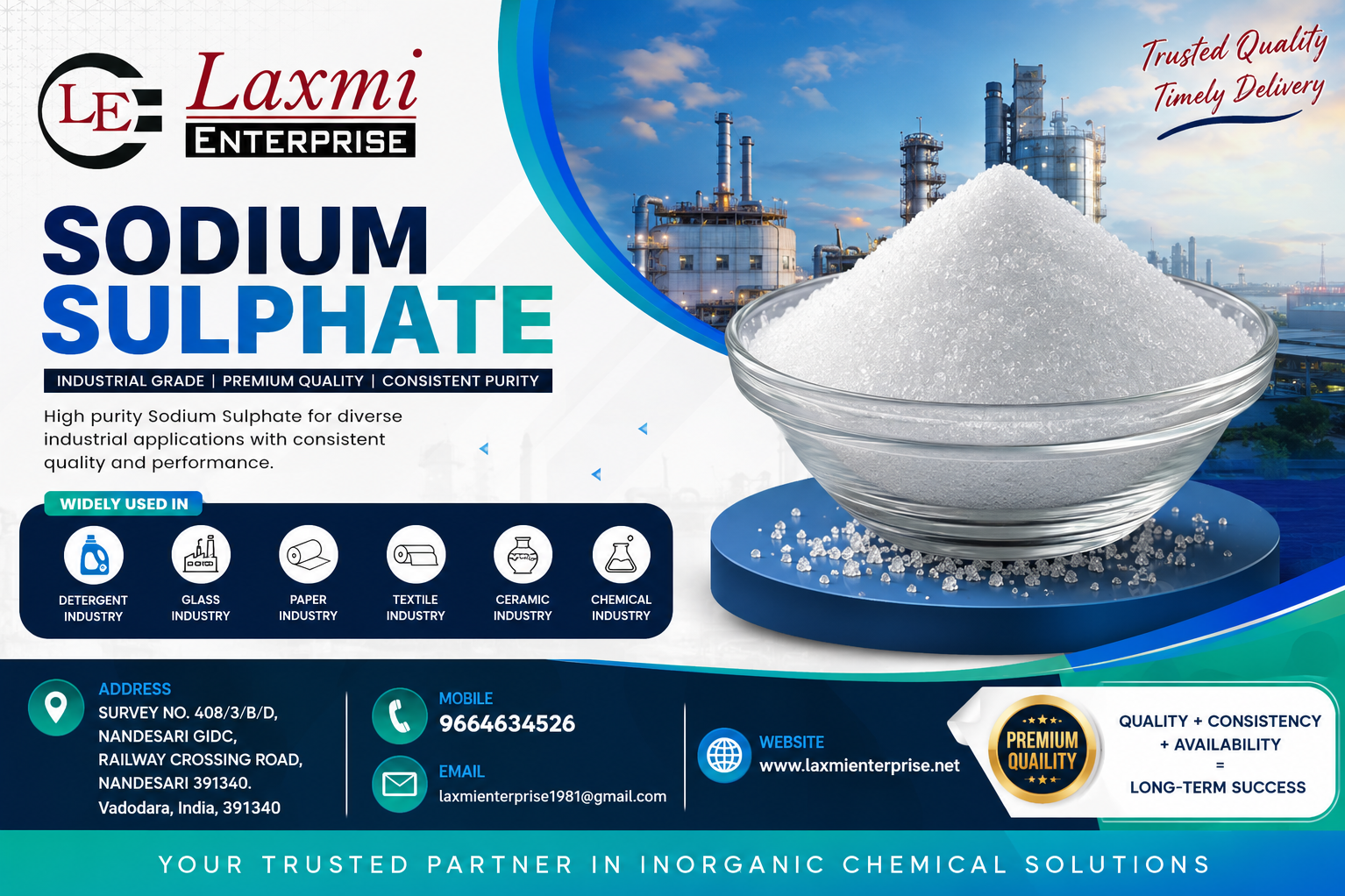
Sodium Sulphate (Na₂SO₄) is an inorganic salt widely used in glass manufacturing, detergent production, textile dyeing, paper processing, ceramics, and numerous chemical processes. Industrial buyers select Sodium Sulphate based on purity, particle size, moisture content, and application requirements. Companies such as Laxmi Enterprise, based in Nandesari GIDC, Vadodara, Gujarat, supply industrial-grade Sodium Sulphate to customers across Pan India, supporting manufacturers in major industrial regions with consistent quality and technical assistance.
What Is Sodium Sulphate?
Sodium Sulphate (chemical formula Na₂SO₄) is a white, crystalline, odorless inorganic compound composed of sodium and sulfate ions. It occurs naturally in mineral deposits and salt lakes and is also produced as a by-product or through dedicated manufacturing processes.
Its combination of chemical stability, water solubility, low cost, and compatibility with many industrial processes has made it one of the most widely used inorganic salts in manufacturing.
Unlike reactive chemicals, Sodium Sulphate functions primarily as a process material, filler, flux, or supporting raw material depending on the application. This versatility explains its demand across multiple industries.
Why Is Sodium Sulphate Important in Industry?
Sodium Sulphate plays different roles depending on the manufacturing process.
In glass manufacturing, it helps remove trapped gas bubbles from molten glass, improving clarity and reducing defects.
In detergent manufacturing, it serves as a filler that supports consistent product composition and handling characteristics.
In textile dyeing, it promotes more uniform dye uptake during reactive dyeing, contributing to even coloration.
In paper processing, ceramics, and chemical manufacturing, it supports specific production processes where stable inorganic salts are required.
Its broad applicability makes it a high-volume raw material for many industrial sectors.
Chemical Identity
Property Value
Chemical Name Sodium Sulphate
Chemical Formula Na₂SO₄
Molecular Weight 142.04 g/mol
CAS Number 7757-82-6
EINECS Number 231-820-9
Appearance White crystalline powder or granules
Odor Odorless
Water Solubility Highly soluble
Nature Neutral inorganic salt
Physical Characteristics
Industrial users often evaluate Sodium Sulphate using characteristics such as:
Purity
Moisture content
Water-insoluble matter
Chloride level
Iron content
Particle size distribution
Bulk density
Flowability
Packaging integrity
These properties influence storage, handling, and suitability for specific manufacturing processes.
Common Industrial Grades
The grade selected depends on the intended application and required quality specifications.
Typical categories include:
Technical Grade
Industrial Grade
Commercial Grade
Detergent Grade
Glass Industry Grade
Textile Grade
High-Purity Grade (for selected industrial uses)
Buyers should always verify the supplier's specifications rather than relying on grade names alone, as requirements vary between industries.
Which Industries Use Sodium Sulphate?
Sodium Sulphate is widely used across India in:
Glass manufacturing
Detergent production
Textile dyeing and processing
Paper and pulp mills
Ceramic manufacturing
Chemical processing
Mining operations
Construction chemicals
Leather processing
Pigments and dyes
Industrial formulations
Demand is concentrated in industrial regions such as Gujarat, Maharashtra, Rajasthan, Uttar Pradesh, Tamil Nadu, Karnataka, Telangana, Andhra Pradesh, West Bengal, Punjab, Haryana, Madhya Pradesh, Chhattisgarh, Odisha, and Delhi NCR, though supply networks extend nationwide.
Why Industrial Buyers Choose Reliable Suppliers
For bulk procurement, buyers typically evaluate suppliers on more than price alone. Key considerations include:
Consistent product quality
Batch-to-batch uniformity
Reliable documentation (such as COA, TDS, and SDS/MSDS)
Suitable packaging options
Inventory availability
Technical support
Logistics capability
Timely delivery
Transparent communication
A supplier with established industrial experience can help reduce production disruptions and improve procurement confidence.
Sodium Sulphate Supply Across India
Manufacturing facilities across India require dependable logistics to avoid interruptions in production.
Industrial chemical suppliers based in Gujarat often serve customers throughout the country because of the state's established chemical infrastructure and transport connectivity.
From Nandesari GIDC, Vadodara, Laxmi Enterprise supplies Sodium Sulphate to customers in Gujarat, Maharashtra, Rajasthan, Delhi NCR, Punjab, Haryana, Uttar Pradesh, Madhya Pradesh, Chhattisgarh, West Bengal, Odisha, Telangana, Andhra Pradesh, Karnataka, Tamil Nadu, Kerala, and other industrial locations, subject to order quantities and logistics arrangements.
How Buyers Can Choose the Right Grade
Before placing an order, procurement teams should define:
End-use application.
Required purity.
Acceptable impurity limits.
Particle size requirements.
Moisture limits.
Packaging preferences.
Annual consumption.
Delivery schedule.
Documentation requirements.
Regulatory or customer specifications.
Providing this information to the supplier helps ensure the selected grade matches the manufacturing process.
Frequently Asked Questions
Is Sodium Sulphate the same as Glauber's Salt?
No. Glauber's Salt refers to the decahydrate form (Na₂SO₄·10H₂O), while industrial applications often use the anhydrous form (Na₂SO₄).
Is Sodium Sulphate hazardous?
Under normal industrial handling, it is generally considered a low-hazard inorganic salt, but appropriate workplace safety practices and the supplier's Safety Data Sheet should always be followed.
Can Sodium Sulphate absorb moisture?
Anhydrous Sodium Sulphate can absorb moisture under certain storage conditions. Dry storage in sealed packaging helps maintain product quality.
What documents should accompany a shipment?
Industrial buyers commonly request a Certificate of Analysis (COA), Technical Data Sheet (TDS), Safety Data Sheet (SDS/MSDS), commercial invoice, and other transport or regulatory documents as applicable.
Conclusion
Sodium Sulphate is a versatile industrial raw material with applications across glass, detergents, textiles, paper, ceramics, chemicals, and other manufacturing sectors. Selecting the appropriate grade, verifying quality specifications, and partnering with a reliable supplier are key steps in ensuring consistent production performance.
For manufacturers across India, sourcing from an experienced supplier with technical knowledge, dependable documentation, and nationwide logistics can support efficient procurement and long-term operational reliability.
Keywords