100+ Sodium Sulphate FAQs: Complete Technical, Industrial & Procurement Guide (2026)
Technical Product Identity
Property Details
Product Name Sodium Sulphate
Chemical Formula Na₂SO₄
CAS Number 7757-82-6
HSN Code (India) 2833 11 00
Molecular Weight 142.04 g/mol
EINECS Number 231-820-9
Appearance White crystalline powder or granules
Primary Industrial Applications Detergents, Glass Manufacturing, Textile Dyeing, Kraft Pulping, Chemical Manufacturing
Quick Answer
Sodium Sulphate (CAS 7757-82-6, HSN 2833 11 00) is an inorganic salt used in several industrial applications, particularly detergent manufacturing, glass production, reactive textile dyeing, kraft pulping, and selected chemical processes. Industrial buyers typically evaluate it based on quality specifications, documentation, packaging, logistics, and supplier capability.
Section A – General Questions
1. What is Sodium Sulphate?
Sodium Sulphate (Na₂SO₄) is an inorganic sodium salt widely used in industrial manufacturing. Depending on the application, it may function as a fining agent in glass production, an electrolyte in reactive textile dyeing, a makeup chemical in kraft pulping, or a formulation component in many powdered detergents.
2. What is the chemical formula of Sodium Sulphate?
The chemical formula is:
Na₂SO₄
This indicates two sodium atoms, one sulfur atom, and four oxygen atoms.
3. What is the CAS Number?
The internationally recognized CAS Number is:
7757-82-6
Industrial buyers frequently include this identifier in procurement documents, technical specifications, and quality records.
4. What is the HSN Code?
The commonly used Indian HSN Code for Sodium Sulphate is:
2833 11 00
This classification is used for GST, commercial invoicing, customs documentation, and logistics.
5. Is Sodium Sulphate hazardous?
Industrial users should always refer to the supplier's Safety Data Sheet (SDS/MSDS) for guidance on safe handling, storage, and emergency procedures. Workplace risk depends on the specific product, workplace conditions, and exposure scenarios.
6. What does Sodium Sulphate look like?
Industrial Sodium Sulphate is typically supplied as:
White crystalline powder.
White crystalline granules.
Appearance may vary slightly depending on the manufacturing process and grade.
7. Is Sodium Sulphate soluble in water?
Yes.
Sodium Sulphate is water-soluble, making it suitable for applications such as textile dyeing where dissolution is an important process step.
8. Can Sodium Sulphate absorb moisture?
Storage conditions influence handling characteristics. Keeping the product in sealed packaging and a dry warehouse helps maintain product quality and flowability.
9. How should Sodium Sulphate be stored?
Good storage practices include:
Clean warehouse.
Dry environment.
Protected from rain.
Original sealed packaging.
FIFO inventory rotation.
10. How long can Sodium Sulphate be stored?
Storage duration depends on packaging integrity, environmental conditions, and the user's quality management practices. Buyers should follow supplier guidance and inspect material before use.
Section B – Detergent Industry FAQs
11. Why is Sodium Sulphate used in detergent manufacturing?
In many powdered detergent formulations, Sodium Sulphate contributes to the physical characteristics of the finished product and supports efficient manufacturing. The exact formulation depends on the detergent manufacturer's product design.
12. Which detergent products commonly use Sodium Sulphate?
It is commonly associated with:
Laundry powders.
Industrial detergent powders.
Institutional cleaning powders.
Commercial washing formulations.
The exact formulation is determined by the manufacturer.
13. Which quality parameters matter most for detergent plants?
Detergent manufacturers often evaluate:
Particle size.
Flowability.
Moisture.
Purity.
Bulk density.
Batch consistency.
These parameters help support efficient powder processing.
14. Which packaging is preferred by detergent manufacturers?
Many high-volume detergent plants choose:
50 kg bags.
500 kg FIBC.
1000 kg FIBC.
The appropriate packaging depends on handling systems and production volume.
15. Can inconsistent quality affect detergent production?
Variations in raw material characteristics may influence blending, handling, and production efficiency. Incoming inspection and supplier qualification help reduce these risks.
Section C – Glass Industry FAQs
16. Why is Sodium Sulphate used in glass manufacturing?
In many glass formulations, Sodium Sulphate functions as a fining agent that assists in removing gas bubbles from molten glass, contributing to the quality of the finished glass.
17. Which glass industries commonly use Sodium Sulphate?
Applications may include:
Float glass.
Container glass.
Architectural glass.
Automotive glass.
Selected specialty glass products.
18. Which quality parameters are important for glass manufacturers?
Glass manufacturers often review:
Purity.
Iron content.
Water-insoluble matter.
Moisture.
Batch consistency.
Specifications vary according to the glass formulation.
19. Why is batch consistency important?
Consistent raw material quality helps support stable manufacturing processes and repeatable production results.
20. What documents should accompany glass industry shipments?
Industrial buyers commonly request:
COA.
TDS.
SDS/MSDS.
Batch identification.
Commercial documents.
Section D – Textile Industry FAQs
21. Why is Sodium Sulphate used in reactive dyeing?
It is commonly used as an electrolyte in many reactive dyeing processes for cellulosic fibres, where it supports dye exhaustion before fixation.
22. Does every textile mill use Sodium Sulphate?
No.
Its use depends on the fibre, dye class, and process employed by the textile manufacturer.
23. Why is chloride controlled?
Some textile manufacturers specify chloride limits based on their internal process requirements and quality standards.
24. Which textile regions consume large quantities?
Major textile manufacturing regions include:
Surat.
Ahmedabad.
Tiruppur.
Ludhiana.
Panipat.
Bhilwara.
Pali.
25. How do textile mills inspect incoming Sodium Sulphate?
Inspection commonly includes:
COA review.
Packaging inspection.
Batch verification.
Laboratory testing where required.
Visual examination.
Section E – Procurement FAQs
26. What should I include in an RFQ?
A complete RFQ typically includes:
Product name.
Grade.
Quantity.
Packaging.
Delivery location.
Required documentation.
Technical specifications.
27. How do I compare suppliers?
Evaluate:
Quality systems.
Documentation.
Technical support.
Logistics.
Packaging.
Delivery performance.
Commercial terms.
28. Why is documentation important?
COA, TDS, and SDS/MSDS support:
Quality verification.
Traceability.
Safe handling.
Procurement compliance.
29. What packaging options are available?
Common options include:
25 kg bags.
50 kg bags.
500 kg FIBC.
1000 kg FIBC.
30. Does Laxmi Enterprise supply across India?
Yes.
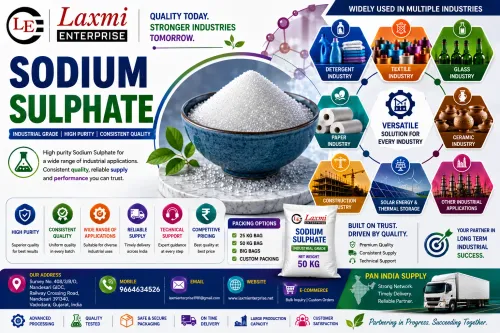
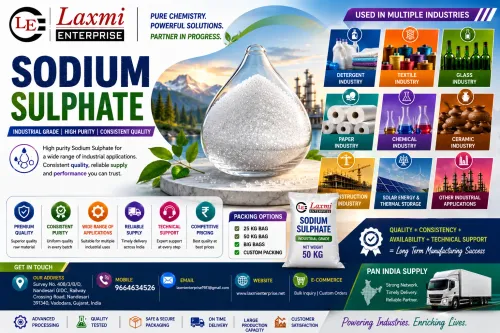
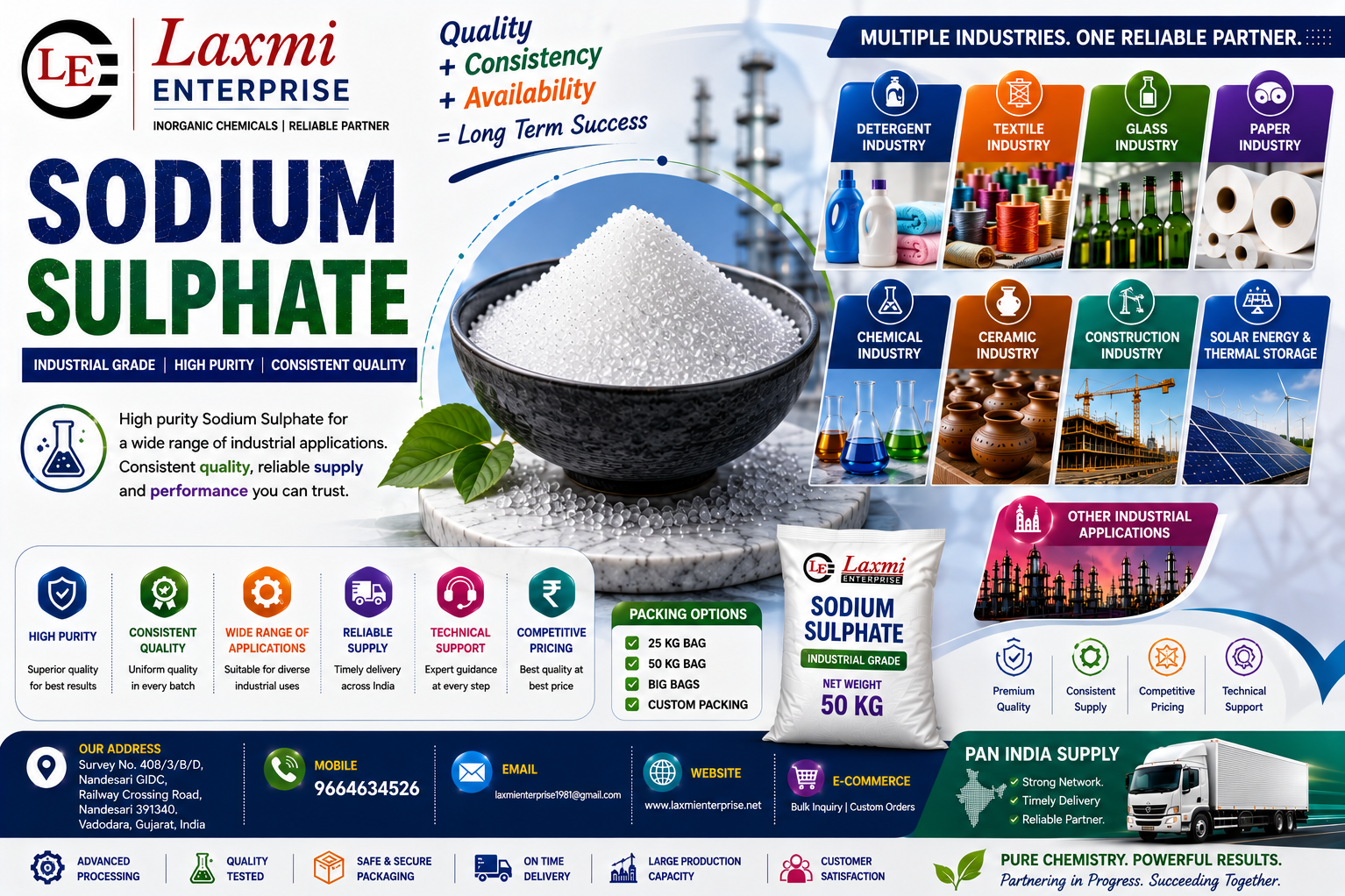
Laxmi Enterprise, located in Nandesari GIDC, Vadodara, Gujarat, supplies industrial-grade Sodium Sulphate across Pan India, supporting detergent, textile, glass, paper & pulp, and chemical manufacturing industries with technical documentation, packaging options, and logistics planning.
Keywords