Sodium Sulphate COA, TDS & SDS/MSDS Explained:
Technical Product Identity
Property Details
Product Name Sodium Sulphate
Chemical Formula Na₂SO₄
CAS Number 7757-82-6
HSN Code (India) 2833 11 00
Molecular Weight 142.04 g/mol
EINECS Number 231-820-9
Appearance White crystalline powder or granules
Common Grades Industrial Grade, Technical Grade, Application-Specific Grades
Quick Answer
When purchasing Sodium Sulphate, three documents are especially important: the Certificate of Analysis (COA), the Technical Data Sheet (TDS), and the Safety Data Sheet (SDS, also commonly called MSDS). Together, these documents help buyers verify product identity, review technical specifications, understand safe handling practices, and maintain traceability within their quality management systems.
Why Documentation Matters
Industrial procurement involves more than receiving the correct quantity of material.
Documentation helps buyers:
Verify product identity.
Confirm technical specifications.
Support incoming quality inspection.
Maintain batch traceability.
Meet internal quality requirements.
Facilitate customer and regulatory audits.
Well-organized documentation can simplify communication between suppliers and buyers throughout the procurement process.
What Is a Certificate of Analysis (COA)?
Quick Answer
A Certificate of Analysis (COA) is a batch-specific quality document. It reports the test results for the particular batch supplied and allows the buyer to compare those results with the agreed purchase specification.
A COA is generally linked to a specific manufacturing or dispatch batch rather than representing all future production.
Information Commonly Found on a COA
A typical COA may include:
Section Purpose
Product Name Confirms the material supplied
Chemical Formula Identifies the chemical composition
CAS Number Confirms the chemical identity
Batch Number Enables traceability
Manufacturing / Dispatch Date Identifies the production or shipment timeframe
Test Results Reports measured quality parameters
Approval Indicates review or release by the supplier
The exact format varies between suppliers.
Typical Quality Parameters on a Sodium Sulphate COA
Depending on the agreed specification, a COA may report values for:
Purity.
Moisture.
Water-insoluble matter.
Chloride.
Iron.
Particle size (where applicable).
Appearance.
The buyer should compare these values with the purchase specification rather than relying solely on historical results.
How to Read a COA
Quick Answer
Reading a COA involves comparing the reported batch results with the quality requirements defined in the purchase order or technical specification.
A simple review process includes:
Confirm the product identity.
Verify the CAS Number (7757-82-6).
Check the batch number against the delivered packaging.
Review each reported quality parameter.
Confirm that results meet the agreed specification.
File the document for traceability.
If any result falls outside the agreed specification, the material should be reviewed according to the organization's quality procedures before use.
What Is a Technical Data Sheet (TDS)?
Quick Answer
A Technical Data Sheet (TDS) provides general technical information about the product rather than batch-specific test results. It describes the material's typical characteristics, applications, handling guidance, and technical properties.
A TDS often includes:
Product description.
Chemical identity.
Typical physical properties.
Typical quality parameters.
Packaging information.
Storage recommendations.
Common applications.
Unlike a COA, a TDS is generally not specific to a single batch.
COA vs. TDS
Feature COA TDS
Batch-specific Yes No
Test results Yes Typical values or product information
Traceability Yes General reference
Quality verification Yes Product overview
Used during incoming inspection Yes Supporting reference
Both documents are valuable, but they serve different purposes.
What Is an SDS (Safety Data Sheet)?
Quick Answer
A Safety Data Sheet (SDS) provides information about safe handling, storage, transportation, emergency measures, and other safety-related aspects of a chemical product. Many organizations still use the older term MSDS (Material Safety Data Sheet), but SDS is the current terminology used under the Globally Harmonized System (GHS).
An SDS is intended to support workplace safety rather than verify product quality.
Information Commonly Included in an SDS
Although the exact format may vary, an SDS typically covers topics such as:
Product identification.
Hazard identification.
Composition information.
First-aid measures.
Fire-fighting measures.
Accidental release guidance.
Handling and storage recommendations.
Exposure controls.
Physical and chemical properties.
Stability and reactivity.
Disposal considerations.
Transport information.
Users should always follow the SDS provided by the supplier for the specific product supplied.
Why Batch Traceability Is Important
Batch traceability helps organizations:
Investigate quality concerns.
Support customer complaints.
Conduct product recalls if necessary.
Demonstrate compliance with quality systems.
Improve supplier performance monitoring.
Maintaining records of batch numbers and associated documentation is a common quality management practice.
Incoming Material Inspection
Before releasing Sodium Sulphate for production, many organizations perform an incoming inspection.
Typical checks include:
Product identity.
CAS Number (7757-82-6).
HSN Code (2833 11 00) on commercial documents.
Packaging condition.
Batch number.
COA review.
TDS availability.
SDS/MSDS availability.
Visual inspection.
Inspection procedures vary according to each organization's quality management system.
Documentation by Industry
Detergent Manufacturing
Detergent manufacturers often retain documentation to support:
Raw material approval.
Batch traceability.
Quality assurance.
Production records.
Textile Processing
Textile dyeing units commonly review COAs to confirm that supplied material matches agreed specifications before production.
Glass Manufacturing
Glass manufacturers often use technical documentation as part of incoming raw material verification and supplier quality management.
Kraft Pulp Mills
Paper and pulp producers typically maintain documentation for incoming chemicals to support traceability and quality control within their procurement systems.
Pan-India Supply
Manufacturers across India—including Gujarat, Maharashtra, Rajasthan, Delhi NCR, Uttar Pradesh, Punjab, Haryana, Madhya Pradesh, Chhattisgarh, Odisha, West Bengal, Karnataka, Telangana, Andhra Pradesh, Tamil Nadu, and Kerala—commonly require complete product documentation as part of their procurement process.
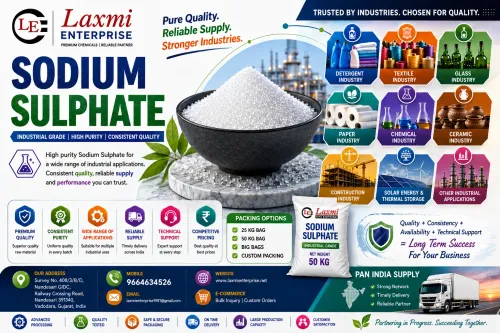
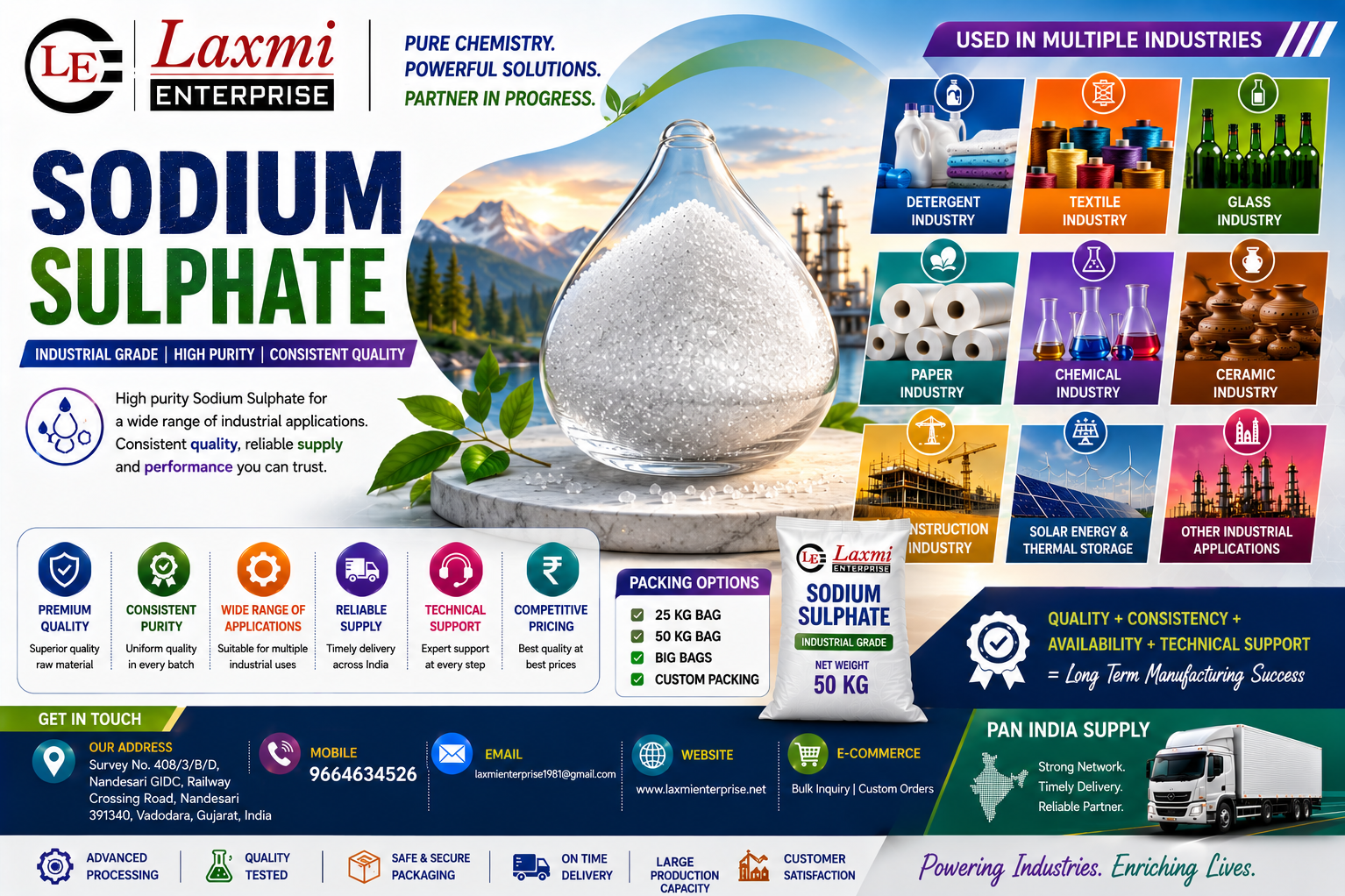
Laxmi Enterprise, based in Nandesari GIDC, Vadodara, Gujarat, supplies Sodium Sulphate (CAS No. 7757-82-6, HSN Code 2833 11 00) to customers across Pan India, supporting buyers with technical documentation, packaging options, and logistics planning.
Buyer Checklist
Before approving a shipment:
Verify CAS Number: 7757-82-6.
Verify HSN Code: 2833 11 00.
Review the COA.
Review the TDS.
Obtain the SDS/MSDS.
Confirm batch identification.
Check packaging condition.
Compare the COA with the purchase specification.
File documentation for traceability.
Frequently Asked Questions
Is a COA the same as a TDS?
No. A COA contains batch-specific test results, while a TDS provides general technical information about the product.
Why is an SDS important?
An SDS supports safe handling, storage, emergency response, and workplace safety.
Should every shipment include documentation?
Documentation requirements vary by supplier and customer agreement, but many industrial buyers request a COA, TDS, SDS/MSDS, invoice, and packing list for each shipment.
Why are the CAS Number and HSN Code included?
The CAS Number (7757-82-6) uniquely identifies Sodium Sulphate internationally, while the HSN Code (2833 11 00) is used in India for commercial classification, GST, and logistics.
Conclusion
COA, TDS, and SDS/MSDS documents each serve a distinct purpose in industrial procurement. Together they help buyers verify product identity, review technical specifications, support safe handling, and maintain traceability.
For manufacturers across India, Laxmi Enterprise, located in Nandesari GIDC, Vadodara, Gujarat, supplies Sodium Sulphate (CAS No. 7757-82-6, HSN Code 2833 11 00) with supporting technical documentation to help procurement teams manage quality assurance and supply chain requirements across detergent, textile, glass, paper & pulp, and chemical manufacturing industries.
Keywords