Detergent Grade Sodium Sulphate: Complete Manufacturing, Quality & Procurement Guide (2026)
Primary Keyword: Detergent Grade Sodium Sulphate
Secondary Keywords: Sodium Sulphate for Detergent Industry, Washing Powder Raw Material, Industrial Sodium Sulphate, Sodium Sulphate Supplier India, Detergent Chemical Supplier
Technical Product Identity
Property Details
Product Name Detergent Grade Sodium Sulphate
Chemical Formula Na₂SO₄
CAS Number 7757-82-6
HSN Code (India) 2833 11 00
Molecular Weight 142.04 g/mol
EINECS Number 231-820-9
Appearance White crystalline powder or granules
Typical Supply Form Industrial grade supplied for detergent manufacturing according to customer specifications
Quick Answer
Detergent Grade Sodium Sulphate is widely used in many powdered detergent formulations as a formulation component. Manufacturers generally seek consistent particle size, controlled moisture, reliable flowability, and batch-to-batch consistency to support efficient blending, packaging, and large-scale production. The required specification depends on the detergent formulation and manufacturing process.
What Is Detergent Grade Sodium Sulphate?
Detergent Grade Sodium Sulphate refers to Sodium Sulphate supplied to detergent manufacturers according to agreed technical specifications.
Depending on the customer's process, procurement teams may define requirements for:
Product consistency.
Particle size.
Moisture.
Purity.
Packaging.
Documentation.
The exact specification varies by manufacturer and product formulation.
Why Is Sodium Sulphate Used in Powder Detergents?
Quick Answer
In many powdered detergent formulations, Sodium Sulphate contributes to the physical characteristics of the finished product and supports efficient manufacturing. Its use and dosage are determined by the detergent manufacturer's formulation, performance requirements, and production process.
Potential process benefits include:
Uniform blending.
Good powder flow.
Consistent handling.
Efficient packaging operations.
Batch-to-batch consistency.
These benefits depend on the complete formulation and process design.
Desired Quality Parameters
Quick Answer
Detergent manufacturers generally evaluate a combination of quality parameters rather than relying on purity alone. The purchase specification should reflect the intended application and production requirements.
Parameter Why It Matters
Purity Product consistency
Moisture Storage and handling
Particle Size Uniform blending
Bulk Density Filling and packaging efficiency
Flowability Automated processing
Appearance Incoming inspection
Batch Consistency Stable production
Documentation Traceability
Acceptance criteria should be agreed between the buyer and supplier.
Manufacturing Considerations
During powder detergent production, procurement teams commonly look for:
Consistent raw material quality.
Reliable deliveries.
Stable packaging.
Complete documentation.
Traceable batches.
These factors help support continuous production and quality management.
Packaging Options for Detergent Plants
25 kg Bags
Suitable for:
Product development.
Small production runs.
Laboratory work.
50 kg Bags
Commonly used by:
Regional detergent manufacturers.
Medium-scale production facilities.
500 kg FIBC
Often selected by:
Automated blending facilities.
Medium- to high-volume manufacturers.
1000 kg FIBC
Frequently used by:
Large detergent plants.
High-capacity production lines.
The choice depends on handling equipment, warehouse layout, and production volume.
Quality Control Before Production
Many detergent manufacturers verify incoming Sodium Sulphate by:
Reviewing the COA.
Checking the TDS.
Reviewing the SDS/MSDS.
Inspecting packaging.
Confirming batch numbers.
Performing laboratory testing where required.
Incoming inspection procedures vary according to the organization's quality management system.
Common Procurement Challenges
Procurement teams may encounter challenges such as:
Inconsistent particle size.
Variable moisture.
Packaging damage.
Documentation gaps.
Delivery delays.
A structured supplier qualification process can help reduce these risks.
Supplier Selection Criteria
Quick Answer
When selecting a Sodium Sulphate supplier for detergent manufacturing, buyers should consider technical capability, quality systems, logistics, and documentation in addition to commercial terms.
A practical evaluation includes:
Technical
Product specifications.
COA.
TDS.
SDS/MSDS.
Batch traceability.
Operational
Inventory availability.
Packaging flexibility.
Dispatch capability.
Delivery reliability.
Commercial
Transparent quotations.
Communication.
Long-term supply capability.
Pan-India Supply
Major detergent manufacturing clusters are located in:
Gujarat
Maharashtra
Rajasthan
Delhi NCR
Uttar Pradesh
Madhya Pradesh
Karnataka
Tamil Nadu
Telangana
Andhra Pradesh
West Bengal
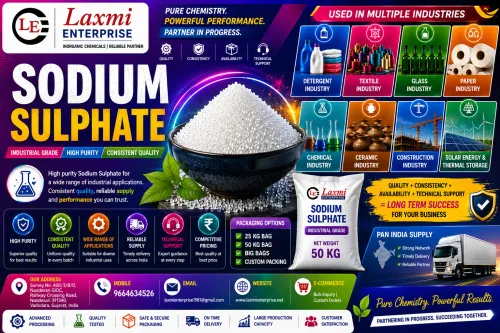
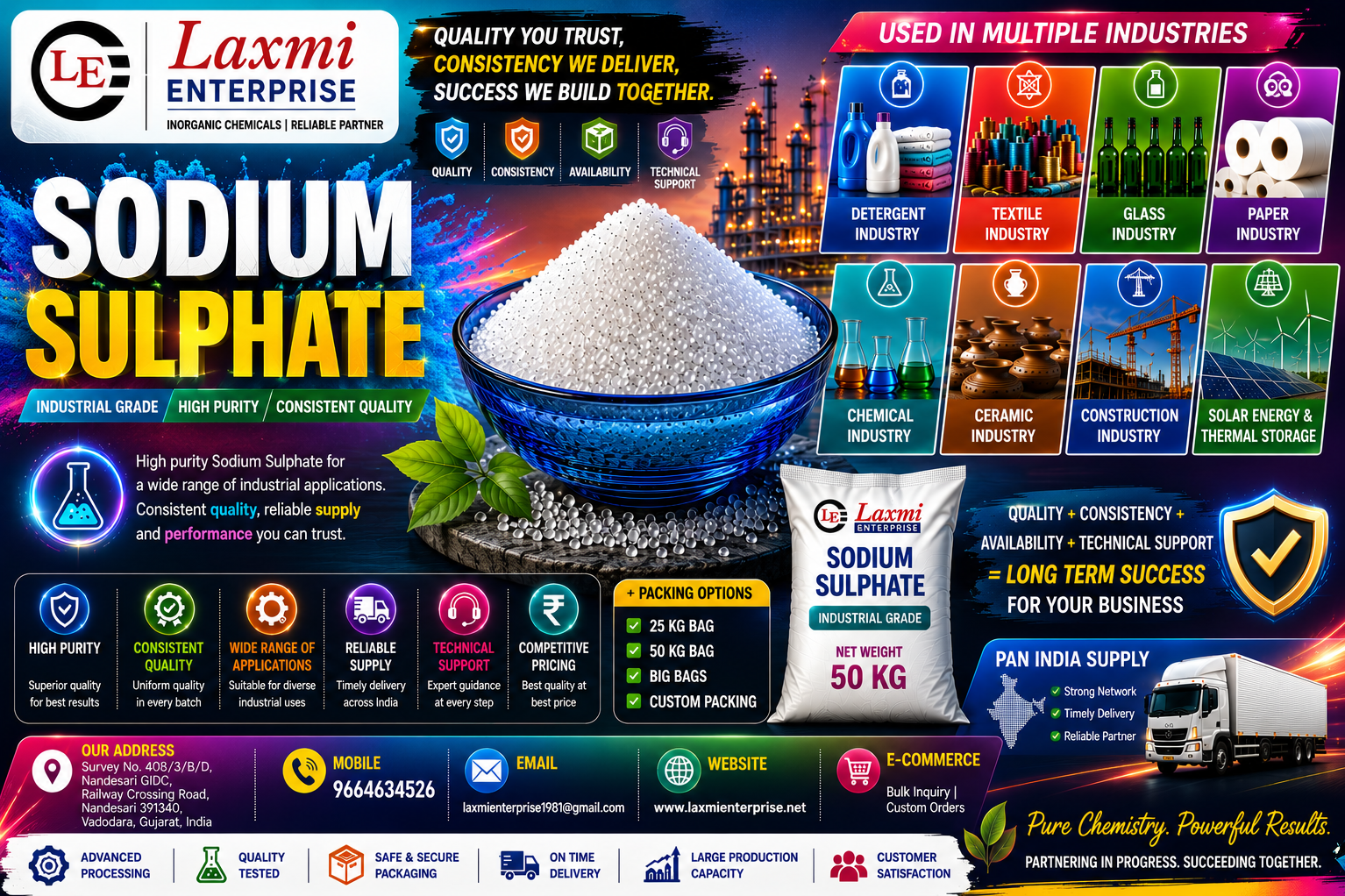
Laxmi Enterprise, based in Nandesari GIDC, Vadodara, Gujarat, supplies Detergent Grade Sodium Sulphate (CAS No. 7757-82-6, HSN Code 2833 11 00) to customers across Pan India, supporting detergent manufacturers with technical documentation, flexible packaging options, and dependable logistics.
Buyer Checklist
Before placing an order:
✔ Confirm the detergent formulation requirements.
✔ Verify CAS Number: 7757-82-6.
✔ Verify HSN Code: 2833 11 00.
✔ Define quality specifications.
✔ Select appropriate packaging.
✔ Request COA, TDS, and SDS/MSDS.
✔ Confirm delivery schedules.
✔ Review supplier capability.
Frequently Asked Questions
Is Detergent Grade Sodium Sulphate suitable for all detergents?
No. Its suitability depends on the specific detergent formulation and manufacturing process.
Which packaging is most suitable?
The best packaging depends on production volume, warehouse facilities, and material handling equipment. High-volume plants often use FIBC bags, while smaller manufacturers may prefer 25 kg or 50 kg bags.
Why is batch consistency important?
Consistent batches help support stable production, predictable blending, and efficient quality control.
Why include the CAS Number and HSN Code?
The CAS Number (7757-82-6) uniquely identifies Sodium Sulphate, while the HSN Code (2833 11 00) is used in India for commercial documentation, GST, and logistics.
Conclusion
Detergent Grade Sodium Sulphate is an important raw material for many powdered detergent manufacturers. Successful procurement depends on selecting a supplier that can consistently provide the required specification, documentation, packaging, and logistics support.
For detergent manufacturers across Pan India, Laxmi Enterprise, located in Nandesari GIDC, Vadodara, Gujarat, supplies Sodium Sulphate (CAS No. 7757-82-6, HSN Code 2833 11 00) with quality-focused sourcing, technical documentation, and reliable supply to support efficient detergent production.
Keywords