How to Choose the Right Sodium Acetate Supplier?
Choosing the right Sodium Acetate supplier is one of the most important decisions an industrial buyer can make. A reliable supplier does much more than deliver a chemical—they provide consistent quality, complete documentation, dependable logistics, technical assistance, and long-term supply stability.
For industries such as textiles, pharmaceuticals, food processing, laboratories, water treatment, biotechnology, leather, and chemical manufacturing, interruptions in raw material supply can affect production schedules, increase operating costs, and impact customer commitments.
When evaluating suppliers, buyers should consider the total value offered, rather than focusing only on the purchase price.
Why Supplier Selection Matters
A dependable supplier helps manufacturers achieve:
Consistent production quality
Stable process performance
Reliable inventory planning
Reduced production downtime
Better audit readiness
Strong technical support
Long-term procurement stability
Improved customer confidence
Supplier Evaluation Matrix
Evaluation Parameter Why It Matters Questions to Ask
Product Quality Supports consistent manufacturing Does the product meet agreed specifications?
Batch Consistency Reduces production variability Are quality levels maintained across every batch?
Manufacturing Capability Indicates production reliability Can the supplier handle regular bulk orders?
Technical Documentation Supports quality assurance Are COA, TDS and SDS supplied with every batch?
Traceability Essential for audits and investigations Is every batch fully traceable?
Packaging Quality Protects product during transport Are moisture-resistant bags used?
Delivery Performance Prevents production delays Are deliveries consistently on schedule?
Technical Support Helps solve application challenges Is technical guidance available when required?
Commercial Stability Supports long-term partnerships How long has the supplier served the industry?
Customer Service Improves procurement experience Is communication responsive and professional?
Procurement Insight
The lowest quotation is not always the lowest total cost. A lower-priced product that causes production delays, quality complaints, or reprocessing can cost significantly more than a consistently performing material supplied by a reliable partner.
Manufacturer vs Distributor vs Stockist
Industrial buyers frequently ask whether they should purchase directly from a manufacturer or from an authorized distributor or stockist.
The answer depends on order quantity, delivery requirements, technical support, and inventory availability.
Supplier Type Advantages Considerations
Manufacturer Direct production source, process knowledge May have larger minimum order quantities
Authorized Distributor Regional availability, technical assistance Product sourced from approved manufacturers
Stockist Ready inventory, faster deliveries Product availability depends on stock levels
Industrial Chemical Partner Technical guidance, procurement support, flexible supply Evaluate documentation and quality systems
Many companies prefer working with experienced industrial suppliers that combine technical knowledge, dependable inventory, and responsive customer service.
Questions Every Buyer Should Ask Before Purchasing
Before approving a new supplier, procurement teams should obtain clear answers to the following questions:
Question Why It Is Important
Which grade is being supplied? Confirms suitability for the intended application
What is the CAS Number? Confirms product identity
Does every batch include a COA? Supports quality verification
Is a TDS available? Provides technical information
Is an SDS available? Supports safe handling
What packaging options are available? Confirms logistics compatibility
Is batch traceability maintained? Supports audits and investigations
What is the expected lead time? Supports production planning
Can the supplier provide regular monthly quantities? Confirms long-term supply capability
Is technical assistance available? Helps resolve application issues
Procurement Checklist
A structured procurement process helps reduce purchasing risks.
Before Placing the Purchase Order
Checklist Item Status
Product grade confirmed □
CAS Number verified □
HSN Code confirmed □
Packaging agreed □
Quantity finalized □
Delivery schedule confirmed □
COA requested □
TDS requested □
SDS requested □
Supplier approved □
Before Material Acceptance
Inspection Point Verify
Packaging condition No damage
Product label Correct identification
Batch Number Present and readable
Manufacturing details Available where applicable
Quantity Matches purchase order
COA Received
TDS Received
SDS Received
Certificate of Analysis (COA)
The Certificate of Analysis (COA) is a batch-specific quality document issued after laboratory testing.
A typical COA includes:
Section Purpose
Product Name Product identification
Grade Product classification
CAS Number Chemical identification
Batch Number Traceability
Test Parameters Laboratory evaluation
Test Results Batch-specific quality data
Date of Analysis Testing reference
Approval Quality authorization
Always compare the COA with the agreed purchase specification before accepting the shipment.
Technical Data Sheet (TDS)
The Technical Data Sheet (TDS) explains the product from a technical perspective.
Typical contents include:
Product description
Chemical identity
CAS Number
HSN Code
Physical properties
Typical applications
Storage recommendations
Packaging information
Handling guidance
The TDS helps engineers, laboratory personnel, and production teams understand how the product is intended to be used.
Safety Data Sheet (SDS)
The Safety Data Sheet (SDS) provides information related to:
Safe handling
Personal protective equipment (PPE)
Storage recommendations
First-aid measures
Fire-fighting guidance
Spill response
Disposal considerations
Every facility handling industrial chemicals should ensure that employees have access to the latest SDS.
Laboratory Insight
Quality documentation should not remain only in the procurement department. Laboratory personnel, production supervisors, warehouse teams, and safety officers should all have access to current technical documents relevant to their responsibilities.
Domestic vs Imported Sodium Acetate
Industrial buyers often compare domestic and imported products.
The best choice depends on quality requirements, supply continuity, technical support, logistics, and commercial considerations rather than country of origin alone.
Evaluation Factor Domestic Supply Imported Supply
Delivery Time Generally shorter May depend on shipping schedules
Technical Support Usually easier to access Depends on importer or manufacturer
Inventory Flexibility Often higher Depends on import planning
Documentation Available from supplier Available through importer
Supply Continuity Depends on supplier capability Depends on global logistics
Warehouse Management Best Practices
Proper warehouse management protects product quality after delivery.
Warehouse Checklist
Storage Practice Recommendation
Storage Area Clean, dry, ventilated
Pallets Keep bags above floor level
Moisture Protect from humidity
Inventory Rotation Follow FIFO principles
Housekeeping Maintain cleanliness
Inspection Conduct periodic warehouse checks
Transportation Best Practices
Reliable transportation helps preserve packaging integrity and product quality.
Transport Factor Recommendation
Vehicle Cleanliness Ensure clean loading area
Weather Protection Protect from rain and moisture
Loading Avoid excessive stacking pressure
Documentation Carry shipping documents with the consignment
Delivery Inspection Verify packaging before unloading
Export Documentation
Export buyers generally request complete technical documentation before shipment.
Typical documents include:
Document Purpose
Commercial Invoice Commercial transaction
Packing List Shipment details
Certificate of Analysis (COA) Product quality
Technical Data Sheet (TDS) Technical information
Safety Data Sheet (SDS) Safe handling guidance
Certificate of Origin (where applicable) Country of origin verification
Additional documentation may be required depending on the destination country's import regulations.
Common Procurement Mistakes
Many purchasing problems arise from process gaps rather than product quality.
Common Mistake Potential Impact Recommended Practice
Buying only on price Higher long-term costs Evaluate total supplier performance
Skipping documentation review Audit observations Review COA, TDS and SDS before approval
Frequent supplier changes Process inconsistency Develop long-term supplier relationships
Poor warehouse storage Product deterioration Follow recommended storage practices
No incoming inspection Production risks Verify every incoming batch
About Laxmi Enterprise
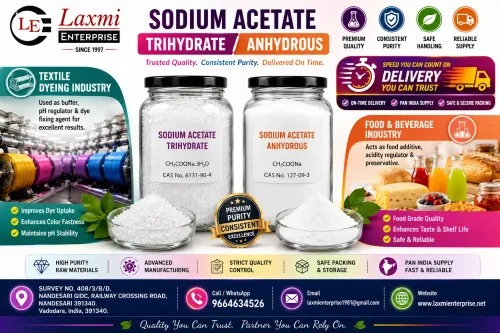
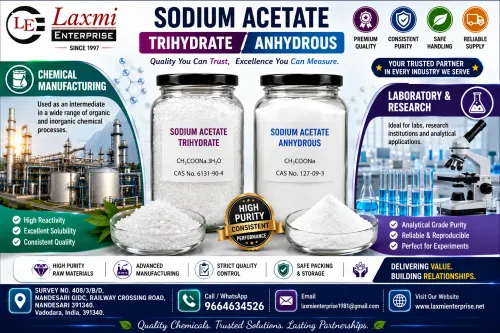
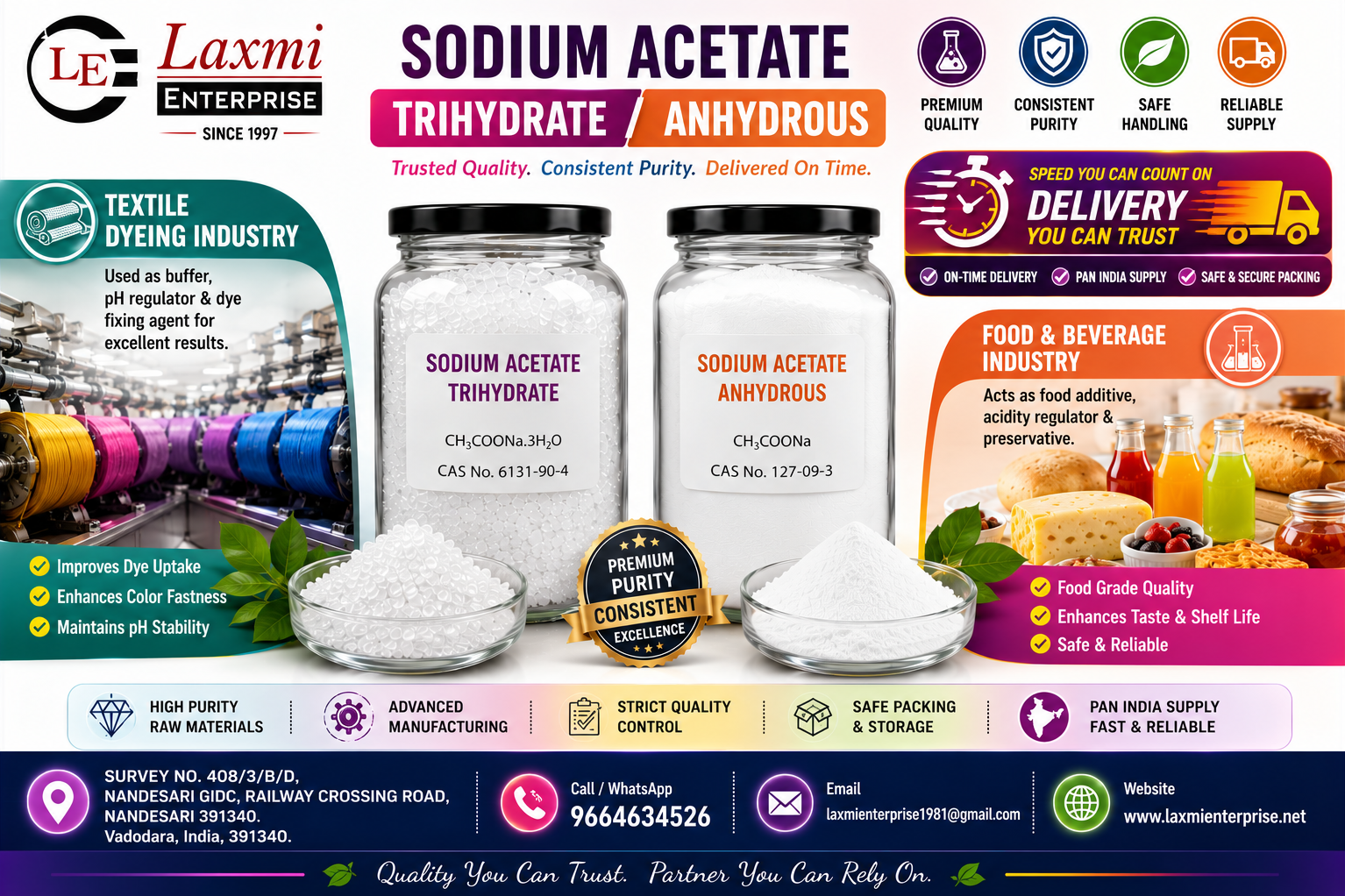
Laxmi Enterprise, located in Nandesari GIDC, Vadodara, Gujarat, supplies Sodium Acetate Anhydrous (CAS No. 127-09-3) and Sodium Acetate Trihydrate (CAS No. 6131-90-4) to industries across India. Customers in Ahmedabad, Surat, Ankleshwar, Bharuch, Dahej, Vapi, Mumbai, Pune, Hyderabad, Chennai, Bengaluru, Coimbatore, Tiruppur, Kanpur, Kolkata, Ludhiana, Jaipur, Indore, Visakhapatnam, and other industrial centers rely on dependable product availability, quality documentation, and responsive technical support for their procurement requirements.
Frequently Asked Questions (FAQ)
1. What should buyers verify before purchasing Sodium Acetate?
Confirm the required grade, CAS Number, HSN Code, technical specifications, packaging, COA, TDS, SDS, and supplier capability before placing the order.
2. Why is supplier consistency more important than price?
Consistent quality reduces production interruptions, minimizes waste, improves process stability, and often lowers the overall cost of manufacturing.
3. Should every shipment include a Certificate of Analysis?
Yes. A batch-specific COA helps verify that the supplied material meets the agreed quality specification.
4. What documents are commonly required by industrial buyers?
COA, TDS, SDS, product specification, batch details, and commercial shipping documents are typically requested.
5. Why is batch traceability important?
Traceability supports quality investigations, customer audits, regulatory compliance, and efficient inventory management.
6. Can the same supplier support multiple industries?
Yes. A qualified supplier may serve textile, pharmaceutical, food, laboratory, water treatment, chemical manufacturing, and other industries by supplying the appropriate product grade and documentation.
7. What factors influence lead time?
Inventory availability, order quantity, packaging requirements, transportation, and delivery location all influence lead time.
8. How should Sodium Acetate be stored after delivery?
Store it in a clean, dry warehouse, protect it from moisture, keep it in original sealed packaging, and follow FIFO inventory practices.
Key Takeaways
Successful procurement is based on more than obtaining the lowest quotation. Buyers achieve better long-term results by selecting suppliers with consistent product quality, strong documentation, reliable logistics, responsive technical support, and proven quality systems. A structured procurement process—from supplier evaluation to incoming inspection and warehouse management—helps reduce operational risk and supports stable manufacturing across a wide range of industries.
Keywords