Sodium Sulphate in Detergent Manufacturing: Applications,
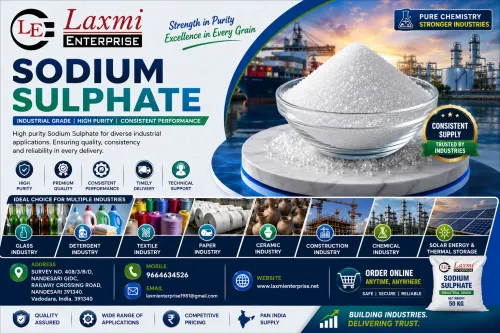
Sodium Sulphate is widely used in powdered detergent manufacturing as a functional filler that helps achieve consistent product composition, supports powder flow, and assists manufacturing efficiency. Detergent manufacturers typically evaluate Sodium Sulphate based on purity, particle size distribution, moisture content, flowability, and batch consistency. Choosing a supplier with reliable quality control, technical documentation, and dependable logistics helps maintain stable production and consistent finished products.
Table of Contents
Why Sodium Sulphate Is Used in Detergent Manufacturing
Role in Powder Detergent Formulations
Benefits for Manufacturers
Key Quality Parameters
Particle Size and Flowability
Moisture Control
Storage and Handling
Packaging Options
Procurement Guide
Supplier Evaluation Checklist
Pan-India Supply
Frequently Asked Questions
Conclusion
Why Is Sodium Sulphate Used in Detergent Manufacturing?
Quick Answer
Powder detergent formulations often contain multiple active and inactive ingredients. Sodium Sulphate is commonly used as a filler to help achieve the desired formulation characteristics and improve the physical properties of the finished detergent powder. The exact formulation depends on the manufacturer's product design and performance requirements.
Modern detergent production emphasizes:
Consistent powder quality.
Uniform ingredient distribution.
Efficient manufacturing.
Reliable packaging performance.
Stable storage characteristics.
The quality of every raw material—including Sodium Sulphate—can influence these objectives.
Understanding Powder Detergent Manufacturing
A detergent powder is not a single chemical but a carefully balanced formulation.
Typical ingredients may include:
Surfactants.
Builders.
Fillers.
Enzymes.
Fragrances.
Optical brighteners.
Processing aids.
Sodium Sulphate (where used).
Each ingredient contributes a specific function, and the formulation varies depending on the intended application, such as household laundry, industrial cleaning, or institutional use.
Role of Sodium Sulphate in Powder Detergents
Quick Answer
In many detergent formulations, Sodium Sulphate serves as a filler that contributes to the physical characteristics of the powder, including handling and flow. It can also support consistent manufacturing by helping achieve the desired composition.
Manufacturers may select Sodium Sulphate because it:
Blends well with other dry ingredients.
Supports uniform powder characteristics.
Flows efficiently through many processing systems when properly stored.
Is compatible with a wide range of detergent formulations.
The exact percentage used depends on the formulation developed by the detergent manufacturer.
Why Consistency Matters
Detergent manufacturers operate high-volume production lines where variations in raw materials can affect:
Mixing efficiency.
Powder density.
Packaging performance.
Product appearance.
Flow through automated filling equipment.
For this reason, procurement teams often prioritize batch-to-batch consistency over isolated quality results.
Key Quality Parameters
Quick Answer
Detergent manufacturers evaluate several quality parameters together. Rather than focusing only on purity, they consider moisture, particle size, flowability, and consistency because these characteristics influence manufacturing efficiency and finished product quality.
Commonly Reviewed Parameters
Parameter Importance
Purity Supports formulation consistency
Moisture Helps maintain storage stability
Particle Size Influences blending and flow
Bulk Density Affects packaging and dosing
Appearance Indicates consistency
Flowability Supports automated processing
Batch Uniformity Improves production reliability
The acceptable limits for each parameter should be defined by the manufacturer's internal quality standards.
Particle Size Distribution
Particle size plays an important role in detergent manufacturing.
A consistent particle size distribution can help:
Improve blending.
Reduce segregation during handling.
Support uniform filling.
Minimize dust generation.
Enhance production efficiency.
Material with highly variable particle sizes may require additional handling controls.
Flowability
Quick Answer
Good flowability allows Sodium Sulphate to move efficiently through storage hoppers, conveyors, mixers, and packaging systems. Proper storage and controlled moisture levels help maintain this characteristic.
Poor flow may contribute to:
Feeding interruptions.
Inconsistent batching.
Increased manual intervention.
Reduced production efficiency.
Regular incoming inspection helps verify material condition before use.
Moisture Control
Moisture influences:
Powder flow.
Storage stability.
Packaging performance.
Caking tendency.
Material handling.
Manufacturers generally prefer material that remains free-flowing under normal storage conditions.
Recommended practices include:
Storing bags in a dry warehouse.
Protecting material from rain and condensation.
Keeping packaging sealed until use.
Following FIFO inventory rotation.
Packaging Options
Industrial suppliers commonly provide:
Packaging Typical Use
25 kg Bags Smaller production batches or R& D
50 kg Bags Standard industrial use
500 kg Jumbo Bags Medium-volume production
1000 kg Jumbo Bags Large manufacturing plants
Bulk Deliveries Continuous high-volume operations, where available
Packaging should match the customer's storage facilities and material handling systems.
Documents Buyers Should Request
Before approving a shipment, procurement teams commonly request:
Certificate of Analysis (COA).
Technical Data Sheet (TDS).
Safety Data Sheet (SDS/MSDS).
Batch identification.
Commercial invoice.
Packing list.
Transport documentation, where applicable.
These documents support quality assurance and traceability.
Procurement Guide
Quick Answer
Successful procurement involves evaluating the supplier's technical capability, product consistency, documentation, and logistics—not just the quoted price.
Before placing an order, buyers should confirm:
Required grade.
Purity expectations.
Moisture limits.
Particle size requirements.
Packaging format.
Delivery schedule.
Documentation requirements.
Batch traceability.
Storage recommendations.
Providing complete specifications helps suppliers recommend the most suitable product.
How to Evaluate a Supplier
Technical Capability
Documented quality control.
Laboratory testing.
Batch traceability.
Technical support.
Supply Capability
Inventory availability.
Packaging flexibility.
Consistent dispatch planning.
Reliable transportation.
Service Capability
Responsive communication.
Application guidance.
Documentation support.
Long-term supply planning.
A supplier that performs consistently across these areas can contribute to a more stable manufacturing process.
Pan-India Supply for Detergent Manufacturers
India's detergent industry includes manufacturing facilities in many industrial regions, including:
Gujarat
Maharashtra
Rajasthan
Delhi NCR
Uttar Pradesh
Punjab
Haryana
Madhya Pradesh
Telangana
Andhra Pradesh
Karnataka
Tamil Nadu
Kerala
West Bengal
Odisha
Chhattisgarh
Jharkhand
Assam
These facilities produce household, industrial, institutional, and specialty detergent products.
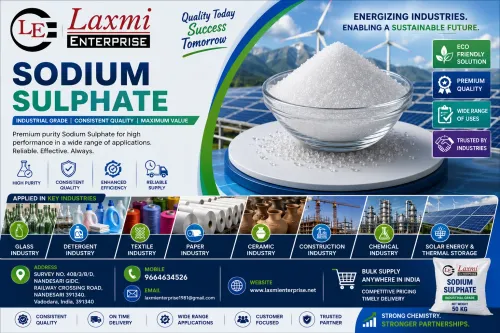
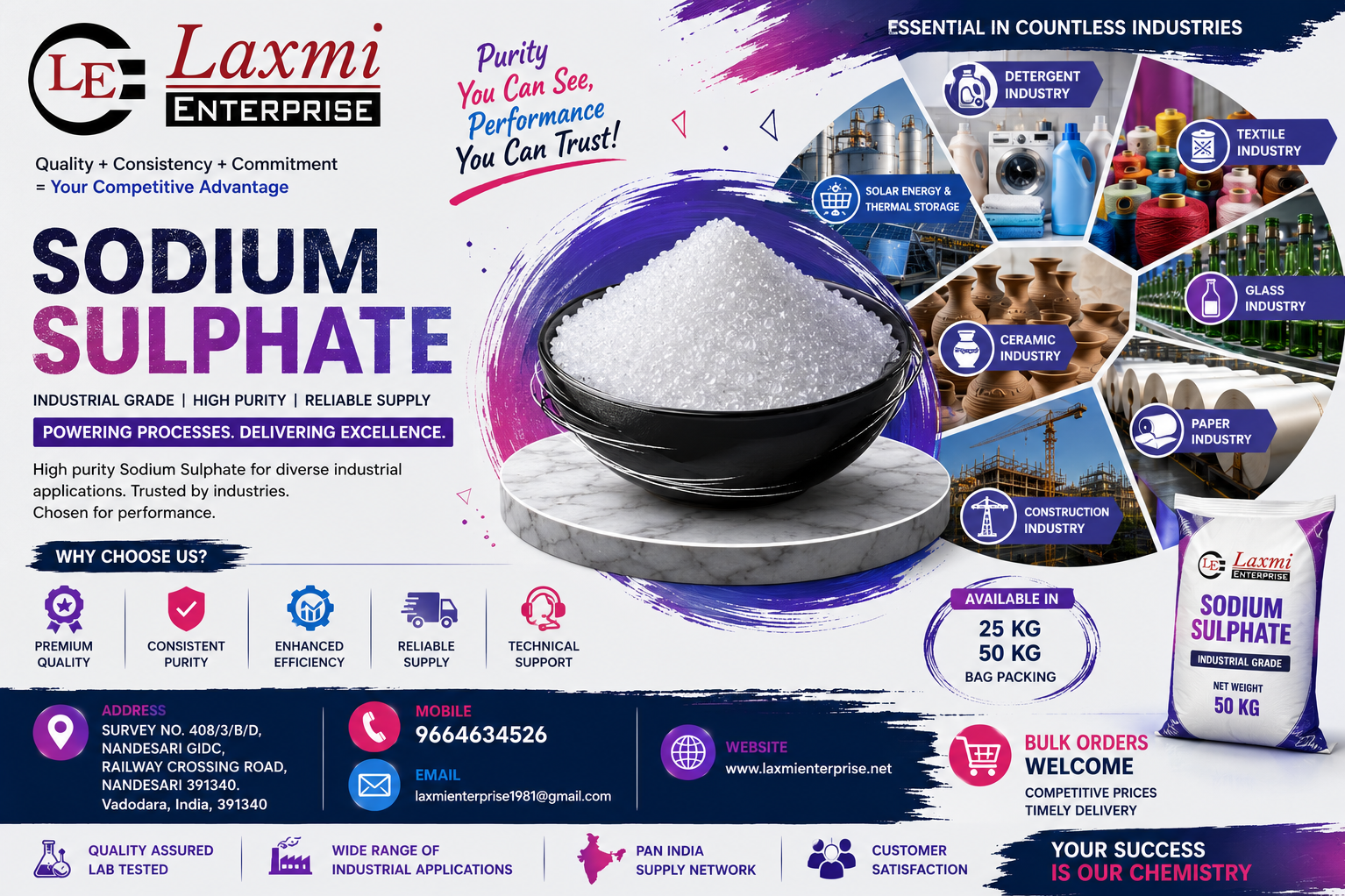
Laxmi Enterprise, based in Nandesari GIDC, Vadodara, Gujarat, supplies industrial-grade Sodium Sulphate to detergent manufacturers across Pan India, providing technical documentation, quality-focused sourcing, and logistics support aligned with production schedules and customer requirements.
Frequently Asked Questions
Is Sodium Sulphate used in all detergent products?
No. Its use depends on the specific formulation and product design developed by the detergent manufacturer.
Why is particle size important?
Consistent particle size supports uniform blending, efficient material handling, and stable packaging performance.
Can moisture affect detergent production?
Yes. Excess moisture may reduce flowability, contribute to caking, and affect storage performance. Proper storage and handling help minimize these issues.
What documentation should accompany every shipment?
Industrial buyers commonly request a Certificate of Analysis (COA), Technical Data Sheet (TDS), Safety Data Sheet (SDS/MSDS), batch identification, and relevant commercial shipping documents.
Conclusion
Sodium Sulphate continues to be an important raw material in many powder detergent formulations because it contributes to consistent product composition and manufacturing efficiency. Successful procurement depends on evaluating the complete technical specification, product consistency, packaging, documentation, and supplier capability rather than focusing solely on price.
For detergent manufacturers across India, a dependable supplier can help support uninterrupted production, consistent product quality, and efficient logistics. Laxmi Enterprise, located in Nandesari GIDC, Vadodara, Gujarat, supplies industrial-grade Sodium Sulphate to customers throughout Pan India, offering technical support, quality documentation, and reliable supply for the detergent manufacturing sector.
Sodium Sulphate is widely used in powdered detergent manufacturing as a functional filler that helps achieve consistent product composition, supports powder flow, and assists manufacturing efficiency. Detergent manufacturers typically evaluate Sodium Sulphate based on purity, particle size distribution, moisture content, flowability, and batch consistency. Choosing a supplier with reliable quality control, technical documentation, and dependable logistics helps maintain stable production and consistent finished products.
Table of Contents
Why Sodium Sulphate Is Used in Detergent Manufacturing
Role in Powder Detergent Formulations
Benefits for Manufacturers
Key Quality Parameters
Particle Size and Flowability
Moisture Control
Storage and Handling
Packaging Options
Procurement Guide
Supplier Evaluation Checklist
Pan-India Supply
Frequently Asked Questions
Conclusion
Why Is Sodium Sulphate Used in Detergent Manufacturing?
Quick Answer
Powder detergent formulations often contain multiple active and inactive ingredients. Sodium Sulphate is commonly used as a filler to help achieve the desired formulation characteristics and improve the physical properties of the finished detergent powder. The exact formulation depends on the manufacturer's product design and performance requirements.
Modern detergent production emphasizes:
Consistent powder quality.
Uniform ingredient distribution.
Efficient manufacturing.
Reliable packaging performance.
Stable storage characteristics.
The quality of every raw material—including Sodium Sulphate—can influence these objectives.
Understanding Powder Detergent Manufacturing
A detergent powder is not a single chemical but a carefully balanced formulation.
Typical ingredients may include:
Surfactants.
Builders.
Fillers.
Enzymes.
Fragrances.
Optical brighteners.
Processing aids.
Sodium Sulphate (where used).
Each ingredient contributes a specific function, and the formulation varies depending on the intended application, such as household laundry, industrial cleaning, or institutional use.
Role of Sodium Sulphate in Powder Detergents
Quick Answer
In many detergent formulations, Sodium Sulphate serves as a filler that contributes to the physical characteristics of the powder, including handling and flow. It can also support consistent manufacturing by helping achieve the desired composition.
Manufacturers may select Sodium Sulphate because it:
Blends well with other dry ingredients.
Supports uniform powder characteristics.
Flows efficiently through many processing systems when properly stored.
Is compatible with a wide range of detergent formulations.
The exact percentage used depends on the formulation developed by the detergent manufacturer.
Why Consistency Matters
Detergent manufacturers operate high-volume production lines where variations in raw materials can affect:
Mixing efficiency.
Powder density.
Packaging performance.
Product appearance.
Flow through automated filling equipment.
For this reason, procurement teams often prioritize batch-to-batch consistency over isolated quality results.
Key Quality Parameters
Quick Answer
Detergent manufacturers evaluate several quality parameters together. Rather than focusing only on purity, they consider moisture, particle size, flowability, and consistency because these characteristics influence manufacturing efficiency and finished product quality.
Commonly Reviewed Parameters
Parameter Importance
Purity Supports formulation consistency
Moisture Helps maintain storage stability
Particle Size Influences blending and flow
Bulk Density Affects packaging and dosing
Appearance Indicates consistency
Flowability Supports automated processing
Batch Uniformity Improves production reliability
The acceptable limits for each parameter should be defined by the manufacturer's internal quality standards.
Particle Size Distribution
Particle size plays an important role in detergent manufacturing.
A consistent particle size distribution can help:
Improve blending.
Reduce segregation during handling.
Support uniform filling.
Minimize dust generation.
Enhance production efficiency.
Material with highly variable particle sizes may require additional handling controls.
Flowability
Quick Answer
Good flowability allows Sodium Sulphate to move efficiently through storage hoppers, conveyors, mixers, and packaging systems. Proper storage and controlled moisture levels help maintain this characteristic.
Poor flow may contribute to:
Feeding interruptions.
Inconsistent batching.
Increased manual intervention.
Reduced production efficiency.
Regular incoming inspection helps verify material condition before use.
Moisture Control
Moisture influences:
Powder flow.
Storage stability.
Packaging performance.
Caking tendency.
Material handling.
Manufacturers generally prefer material that remains free-flowing under normal storage conditions.
Recommended practices include:
Storing bags in a dry warehouse.
Protecting material from rain and condensation.
Keeping packaging sealed until use.
Following FIFO inventory rotation.
Packaging Options
Industrial suppliers commonly provide:
Packaging Typical Use
25 kg Bags Smaller production batches or R& D
50 kg Bags Standard industrial use
500 kg Jumbo Bags Medium-volume production
1000 kg Jumbo Bags Large manufacturing plants
Bulk Deliveries Continuous high-volume operations, where available
Packaging should match the customer's storage facilities and material handling systems.
Documents Buyers Should Request
Before approving a shipment, procurement teams commonly request:
Certificate of Analysis (COA).
Technical Data Sheet (TDS).
Safety Data Sheet (SDS/MSDS).
Batch identification.
Commercial invoice.
Packing list.
Transport documentation, where applicable.
These documents support quality assurance and traceability.
Procurement Guide
Quick Answer
Successful procurement involves evaluating the supplier's technical capability, product consistency, documentation, and logistics—not just the quoted price.
Before placing an order, buyers should confirm:
Required grade.
Purity expectations.
Moisture limits.
Particle size requirements.
Packaging format.
Delivery schedule.
Documentation requirements.
Batch traceability.
Storage recommendations.
Providing complete specifications helps suppliers recommend the most suitable product.
How to Evaluate a Supplier
Technical Capability
Documented quality control.
Laboratory testing.
Batch traceability.
Technical support.
Supply Capability
Inventory availability.
Packaging flexibility.
Consistent dispatch planning.
Reliable transportation.
Service Capability
Responsive communication.
Application guidance.
Documentation support.
Long-term supply planning.
A supplier that performs consistently across these areas can contribute to a more stable manufacturing process.
Pan-India Supply for Detergent Manufacturers
India's detergent industry includes manufacturing facilities in many industrial regions, including:
Gujarat
Maharashtra
Rajasthan
Delhi NCR
Uttar Pradesh
Punjab
Haryana
Madhya Pradesh
Telangana
Andhra Pradesh
Karnataka
Tamil Nadu
Kerala
West Bengal
Odisha
Chhattisgarh
Jharkhand
Assam
These facilities produce household, industrial, institutional, and specialty detergent products.
Laxmi Enterprise, based in Nandesari GIDC, Vadodara, Gujarat, supplies industrial-grade Sodium Sulphate to detergent manufacturers across Pan India, providing technical documentation, quality-focused sourcing, and logistics support aligned with production schedules and customer requirements.
Frequently Asked Questions
Is Sodium Sulphate used in all detergent products?
No. Its use depends on the specific formulation and product design developed by the detergent manufacturer.
Why is particle size important?
Consistent particle size supports uniform blending, efficient material handling, and stable packaging performance.
Can moisture affect detergent production?
Yes. Excess moisture may reduce flowability, contribute to caking, and affect storage performance. Proper storage and handling help minimize these issues.
What documentation should accompany every shipment?
Industrial buyers commonly request a Certificate of Analysis (COA), Technical Data Sheet (TDS), Safety Data Sheet (SDS/MSDS), batch identification, and relevant commercial shipping documents.
Conclusion
Sodium Sulphate continues to be an important raw material in many powder detergent formulations because it contributes to consistent product composition and manufacturing efficiency. Successful procurement depends on evaluating the complete technical specification, product consistency, packaging, documentation, and supplier capability rather than focusing solely on price.
For detergent manufacturers across India, a dependable supplier can help support uninterrupted production, consistent product quality, and efficient logistics. Laxmi Enterprise, located in Nandesari GIDC, Vadodara, Gujarat, supplies industrial-grade Sodium Sulphate to customers throughout Pan India, offering technical support, quality documentation, and reliable supply for the detergent manufacturing sector.
Keywords