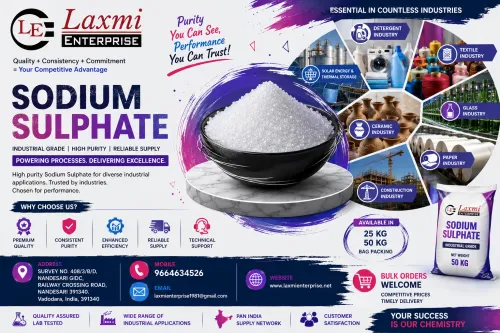
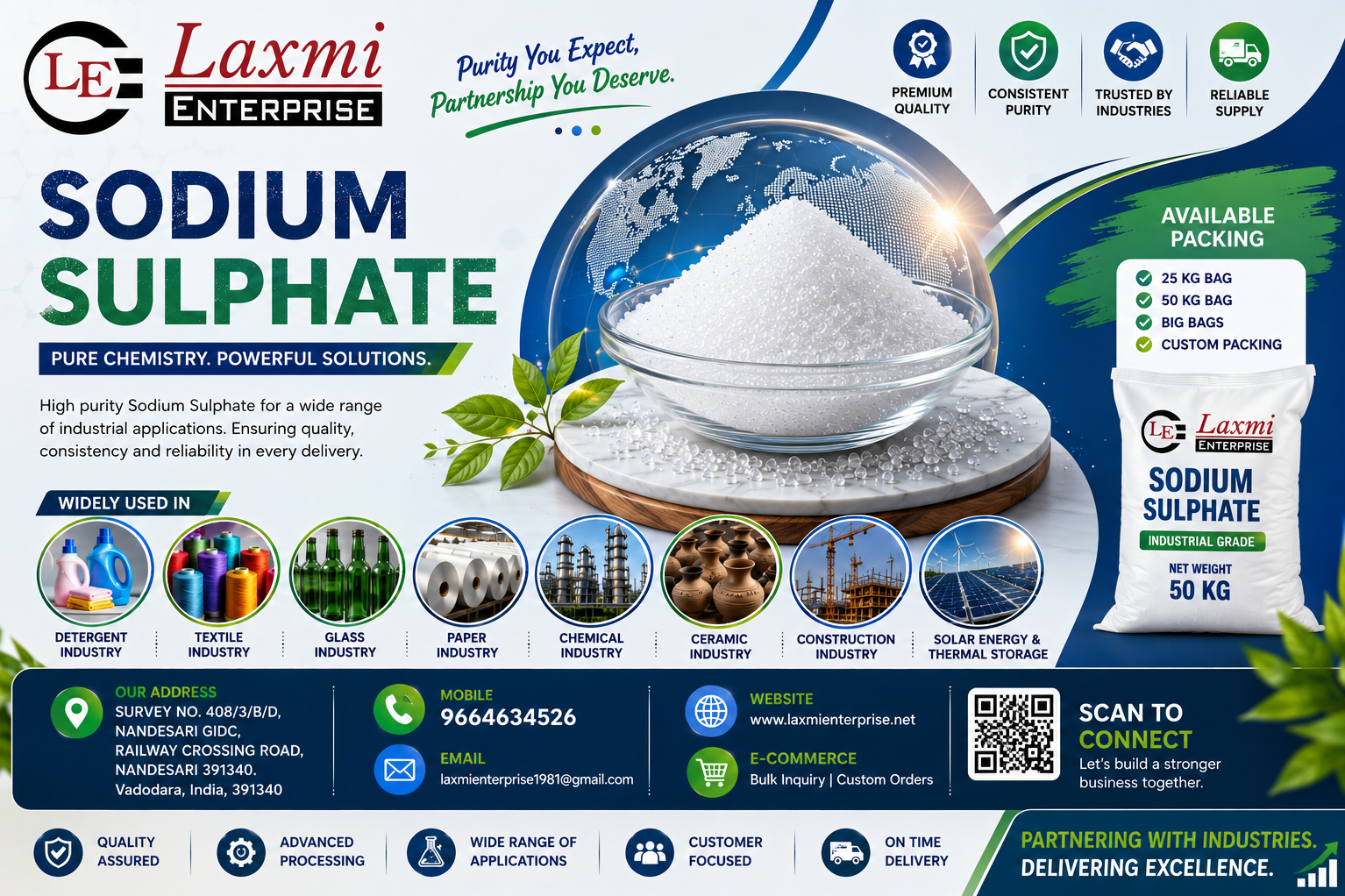
Sodium Sulphate in Textile Dyeing & Processing:
Sodium Sulphate is one of the most widely used inorganic salts in textile dyeing, particularly in reactive dyeing of cotton and other cellulosic fibres. It promotes uniform dye uptake by reducing the electrostatic repulsion between negatively charged dye molecules and fibre surfaces, helping achieve more even colour distribution. Textile manufacturers evaluate Sodium Sulphate based on purity, chloride content, moisture, water-insoluble matter, particle size, and batch consistency. Selecting the correct grade and a technically reliable supplier supports consistent dyeing performance, quality control, and efficient production.
Table of Contents
Introduction
Why Sodium Sulphate Is Important in Textile Dyeing
Overview of the Indian Textile Industry
Understanding the Textile Dyeing Process
Why Salt Is Required During Dyeing
How Sodium Sulphate Works in Reactive Dyeing
Sodium Sulphate vs Sodium Chloride
Key Benefits in Textile Processing
Quality Requirements for Textile Manufacturers
Storage and Handling
Pan-India Supply
Frequently Asked Questions
Conclusion
Introduction
The textile industry is one of the largest consumers of industrial chemicals in India. Every stage of textile production—from pretreatment and dyeing to finishing—depends on carefully selected raw materials that influence colour consistency, process efficiency, and product quality.
Among these materials, Sodium Sulphate (Na₂SO₄) plays a significant role in many reactive dyeing processes. Although it is not itself a dye, it helps create conditions that allow dyes to be absorbed more evenly by the fibre. For textile mills producing consistent shades across large production batches, the quality and consistency of Sodium Sulphate can influence overall process stability.
For this reason, procurement teams often evaluate not only price but also purity, particle size, moisture content, documentation, and the supplier's ability to deliver consistent quality.
Industrial suppliers such as Laxmi Enterprise, located in Nandesari GIDC, Vadodara, Gujarat, supply industrial-grade Sodium Sulphate to textile manufacturers across Pan India, supporting mills with quality documentation, technical guidance, and dependable logistics.
Why Is Sodium Sulphate Used in Textile Dyeing?
Quick Answer
In many reactive dyeing processes, Sodium Sulphate is used to encourage dye molecules to move from the dye bath onto the fibre. This promotes more uniform dye uptake and helps achieve consistent colour development when used under controlled process conditions.
Cellulosic fibres such as cotton naturally develop a negative surface charge in aqueous dye baths. Reactive dyes also carry negative charges. Because like charges repel, dye uptake can initially be less efficient.
The addition of Sodium Sulphate increases the ionic strength of the dye bath, reducing this electrostatic repulsion. As a result, dye molecules are better able to approach and be absorbed by the fibre before the fixation stage.
This mechanism is one reason Sodium Sulphate has become an important auxiliary chemical in many textile dyeing operations.
Overview of the Indian Textile Industry
India is among the world's largest producers and exporters of textiles. The sector includes spinning, weaving, knitting, dyeing, printing, finishing, garment manufacturing, and technical textiles.
Major textile manufacturing clusters include:
Surat (Gujarat) – Synthetic fabrics, dyeing, and processing.
Ahmedabad (Gujarat) – Cotton textiles and processing.
Vadodara (Gujarat) – Chemical supply and industrial support.
Bhilwara (Rajasthan) – Suiting fabrics and textile processing.
Pali (Rajasthan) – Textile dyeing and printing.
Ludhiana (Punjab) – Hosiery and knitwear.
Panipat (Haryana) – Home textiles.
Tiruppur (Tamil Nadu) – Knitwear and garment exports.
Karur (Tamil Nadu) – Home furnishings.
Erode (Tamil Nadu) – Textile processing.
Ichalkaranji (Maharashtra) – Weaving and fabric production.
Bhiwandi (Maharashtra) – Power loom manufacturing.
These industrial regions require a dependable supply of textile chemicals, including Sodium Sulphate, to maintain continuous production.
Understanding the Textile Dyeing Process
Quick Answer
Textile dyeing involves preparing the fibre, introducing dye molecules under controlled conditions, fixing the dye, and removing unfixed colour. Sodium Sulphate is commonly added during the dyeing stage to support uniform dye absorption before fixation.
A simplified dyeing sequence may include:
Fabric preparation.
Scouring and bleaching (where required).
Dye bath preparation.
Controlled addition of Sodium Sulphate.
Dye absorption.
Alkali addition for fixation (in reactive dyeing).
Washing and soaping.
Drying and finishing.
Each stage influences the final colour consistency, and process parameters such as temperature, pH, liquor ratio, and chemical dosing must be controlled according to the dye manufacturer's recommendations.
Why Is Salt Required During Dyeing?
Quick Answer
Salt is commonly used in many reactive dyeing systems because it modifies the ionic environment of the dye bath. This encourages negatively charged dye molecules to migrate toward negatively charged cellulose fibres, improving dye exhaustion before fixation.
Without an appropriate electrolyte, dye uptake may be slower or less uniform, potentially affecting shade consistency.
The exact salt type, dosage, and addition sequence depend on:
Dye chemistry.
Fibre type.
Shade depth.
Machine type.
Process parameters.
Manufacturers should always follow validated dyeing procedures and supplier recommendations.
How Sodium Sulphate Works in Reactive Dyeing
Reactive dyes form covalent bonds with cellulose during the fixation stage. Before this bond can form, the dye molecules must first move from the dye liquor to the fibre surface.
Sodium Sulphate assists this stage by increasing the ionic strength of the solution, which reduces electrostatic repulsion and supports more effective dye exhaustion.
Benefits may include:
Improved dye migration.
More uniform shade development.
Better batch consistency.
Enhanced process reproducibility.
Actual performance depends on the complete dyeing recipe, equipment, and operating conditions.
Sodium Sulphate vs. Sodium Chloride
Quick Answer
Both Sodium Sulphate and Sodium Chloride are used as electrolytes in textile dyeing, but the preferred choice depends on the dyeing process, fibre type, environmental considerations, cost, and mill-specific operating practices. The selection should be based on technical evaluation rather than general preference.
Parameter Sodium Sulphate Sodium Chloride
Chemical Formula Na₂SO₄ NaCl
Common Use Reactive dyeing Reactive dyeing
Solubility High High
Typical Selection Process-dependent Process-dependent
Storage Dry conditions Dry conditions
Documentation COA, TDS, SDS COA, TDS, SDS
Each mill should validate the most suitable electrolyte for its own process through laboratory and production trials.
Benefits of High-Quality Sodium Sulphate in Textile Mills
When supplied with consistent quality, Sodium Sulphate can support:
Stable dye bath preparation.
Uniform dye absorption.
Better batch repeatability.
Predictable processing.
Reduced variability between production lots.
Efficient material handling.
Improved storage performance.
These benefits depend on appropriate process control and adherence to validated dyeing procedures.
Quality Parameters Important for Textile Manufacturers
Quick Answer
Textile processors evaluate more than just purity. They also review chloride content, water-insoluble matter, moisture, particle size, and batch consistency because these characteristics can influence dyeing performance and operational efficiency.
Parameter Why It Matters
Purity Consistent chemical composition
Moisture Storage stability and flowability
Water-Insoluble Matter Supports clean dye bath preparation
Chloride Controlled according to process requirements
Particle Size Uniform dissolution and handling
Appearance Visual quality check
Batch Consistency Repeatable production results
Incoming inspection should verify that each batch meets the agreed purchase specification.
Storage and Handling
Proper storage helps maintain the quality of Sodium Sulphate before it enters the dye house.
Recommended practices include:
Store indoors in a clean, dry warehouse.
Protect bags from rain and excessive humidity.
Keep packaging sealed until use.
Use pallets to prevent ground moisture exposure.
Rotate inventory using the FIFO (First-In, First-Out) method.
Inspect packaging before transferring material to production.
Good warehouse management reduces the risk of caking and contamination.
Pan-India Supply for Textile Manufacturers
India's textile industry operates around the clock, requiring reliable deliveries of process chemicals to avoid production interruptions.
Laxmi Enterprise, based in Nandesari GIDC, Vadodara, Gujarat, supplies industrial-grade Sodium Sulphate to textile manufacturers across Pan India, including major textile regions such as Gujarat, Rajasthan, Maharashtra, Tamil Nadu, Punjab, Haryana, Karnataka, Telangana, Andhra Pradesh, Uttar Pradesh, West Bengal, Madhya Pradesh, and other manufacturing centres.
The company supports customers with:
Industrial-grade Sodium Sulphate.
Batch-wise technical documentation.
COA, TDS, and SDS/MSDS (where applicable).
Flexible packaging options.
Logistics planning based on customer requirements.
Technical support for procurement teams.
Frequently Asked Questions
Is Sodium Sulphate used in every textile dyeing process?
No. Its use depends on the fibre, dye class, and process. It is commonly associated with many reactive dyeing systems for cellulosic fibres, but individual dyeing recipes vary.
Why is consistency important?
Consistent quality supports predictable dyeing results and helps reduce batch-to-batch variation in production.
Does particle size matter?
Yes. Uniform particle size can contribute to predictable dissolution and easier handling in industrial operations.
What documents should buyers request?
Procurement teams commonly request a Certificate of Analysis (COA), Technical Data Sheet (TDS), Safety Data Sheet (SDS/MSDS), batch identification, and relevant commercial documentation.
Conclusion
Sodium Sulphate remains an important process chemical in many textile dyeing operations because of its role in promoting efficient dye uptake and supporting consistent colour development. Successful application depends on selecting the appropriate grade, maintaining process control, and sourcing material from suppliers capable of providing consistent quality and technical documentation.
For textile manufacturers across India, dependable supply, batch consistency, and responsive technical support are key procurement considerations. Laxmi Enterprise, located in Nandesari GIDC, Vadodara, Gujarat, supplies industrial-grade Sodium Sulphate to customers throughout Pan India, supporting the textile sector with quality-focused sourcing and reliable logistics.
Keywords