Material Science of Sodium Nitrate Free Flow
Understanding the Material Science Behind Sodium Nitrate Free Flow
Material science studies how a material's internal structure influences its physical behavior and industrial performance. For Sodium Nitrate Free Flow, material science explains why factors such as crystal morphology, particle size distribution, bulk density, moisture content, and flowability are important in manufacturing.
Although Sodium Nitrate is chemically represented by the formula NaNO₃, its performance in industrial environments depends on much more than chemical composition. A product with consistent physical properties is generally easier to store, transport, weigh, blend, and process.
Modern industries therefore evaluate Sodium Nitrate from both a chemical and a material engineering perspective.
Crystal Morphology
Crystal morphology refers to the shape and physical form of individual Sodium Nitrate crystals.
Uniform crystal morphology contributes to:
Better flowability
Reduced segregation
Improved handling
More consistent blending
Better storage performance
Improved packaging efficiency
Irregular crystal shapes may influence how the material behaves during storage and handling.
Particle Engineering
Particle engineering focuses on producing crystals with controlled size and distribution.
The objective is to achieve a balance between:
Dissolution performance
Material handling
Storage stability
Packaging efficiency
Dust reduction
Process consistency
Controlled particle engineering contributes to more predictable industrial performance.
Surface Characteristics
The surface condition of crystalline particles influences how they interact during storage and movement.
Surface characteristics can affect:
Material flow
Bulk movement
Dust generation
Packing behavior
Blending performance
A well-controlled manufacturing process helps maintain consistent surface characteristics across production batches.
Bulk Solid Behaviour
Unlike liquids, bulk solids behave differently when transported or stored.
Important characteristics include:
Flowability
Compressibility
Packing efficiency
Hopper discharge
Storage stability
Understanding bulk solid behavior helps engineers design more reliable storage and handling systems.
Free Flow Characteristics
Free Flow is one of the most important physical properties for industrial users.
A quality Free Flow Sodium Nitrate product should demonstrate:
Smooth discharge
Uniform movement
Low tendency to bridge
Reduced lump formation
Good storage behaviour
Easy handling
These characteristics help improve production efficiency and reduce manual intervention.
Density Characteristics
Density influences both storage and transportation.
Important density-related considerations include:
Warehouse capacity
Packaging efficiency
Material handling
Inventory planning
Shipping calculations
Maintaining consistent bulk density supports repeatable industrial operations.
Storage Stability
Storage stability depends upon:
Product quality
Moisture protection
Packaging condition
Warehouse environment
Inventory management
Following recommended storage practices helps preserve the product's free-flowing characteristics over time.
Moisture Interaction
Like many industrial salts, Sodium Nitrate can be affected by moisture exposure.
Excess moisture may contribute to:
Reduced flowability
Particle agglomeration
Handling difficulties
Packaging deterioration
Protecting the product from unnecessary moisture exposure helps maintain its physical quality.
Packaging Performance
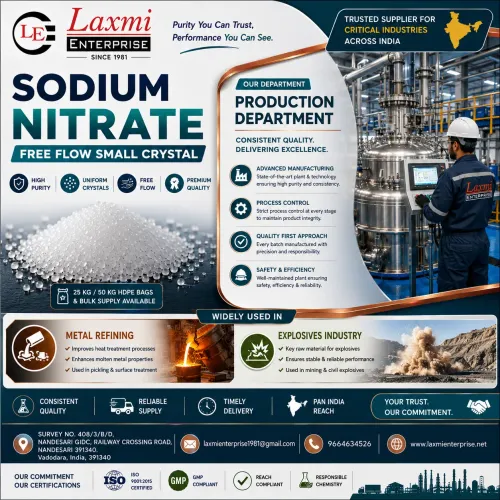
Packaging is designed to preserve both chemical quality and physical characteristics.
Standard commercial options include:
Packing Size Typical Industrial Use
25 kg Bags Small and medium-scale manufacturing
50 kg Bags Routine industrial production
500 kg Jumbo Bags Bulk storage and automated handling
Selecting the correct packaging helps reduce handling costs and improve warehouse efficiency.
Material Performance During Transportation
Transportation can influence the condition of bulk chemicals.
Good logistics practices help maintain:
Packaging integrity
Batch identification
Product cleanliness
Moisture protection
Traceability
Proper transportation contributes to consistent product quality upon delivery.
Engineering Perspective
From a material science standpoint, Sodium Nitrate Free Flow should be viewed as an engineered industrial material whose performance depends on a combination of:
Chemical composition
Crystal morphology
Particle size distribution
Moisture control
Packaging quality
Storage conditions
Handling practices
Each of these factors contributes to reliable industrial performance.
Material Science FAQs
What is material science in relation to Sodium Nitrate?
Material science examines how the physical structure of Sodium Nitrate—such as crystal shape, particle size, and bulk behavior—affects handling, storage, and manufacturing performance.
Why is crystal morphology important?
Crystal morphology influences how particles pack together, flow through equipment, and behave during storage and transportation. More uniform crystals generally provide more predictable handling characteristics.
What is particle engineering?
Particle engineering is the process of controlling particle size and distribution during manufacturing to improve physical performance, such as flowability, blending, and storage stability.
How does bulk solid behaviour affect industrial operations?
Bulk solid behaviour influences how Sodium Nitrate moves through silos, hoppers, conveyors, and packaging systems. Understanding these properties helps optimize material handling.
Why is Free Flow performance important?
Free Flow performance reduces handling problems, supports automated production systems, and helps maintain consistent material movement throughout manufacturing.
How does moisture affect material properties?
Moisture exposure can reduce flowability, encourage particle agglomeration, and affect storage performance. Proper packaging and dry storage help preserve the product's physical characteristics.
Why is consistent bulk density valuable?
Consistent bulk density supports accurate weighing, efficient packaging, reliable inventory calculations, and repeatable manufacturing operations.
Does packaging influence material performance?
Yes. Appropriate packaging helps protect the product from moisture and physical damage, maintaining its free-flowing characteristics during storage and transportation.
Technical Insight for Engineers
When evaluating Sodium Nitrate Free Flow, engineers should consider both the chemistry and the material science. High purity alone does not guarantee smooth industrial performance. Consistent crystal morphology, controlled particle size, low moisture, reliable flowability, and robust packaging together determine how efficiently the material can be stored, transported, and integrated into modern manufacturing processes.
Understanding the Material Science Behind Sodium Nitrate Free Flow
Material science studies how a material's internal structure influences its physical behavior and industrial performance. For Sodium Nitrate Free Flow, material science explains why factors such as crystal morphology, particle size distribution, bulk density, moisture content, and flowability are important in manufacturing.
Although Sodium Nitrate is chemically represented by the formula NaNO₃, its performance in industrial environments depends on much more than chemical composition. A product with consistent physical properties is generally easier to store, transport, weigh, blend, and process.
Modern industries therefore evaluate Sodium Nitrate from both a chemical and a material engineering perspective.
Crystal Morphology
Crystal morphology refers to the shape and physical form of individual Sodium Nitrate crystals.
Uniform crystal morphology contributes to:
Better flowability
Reduced segregation
Improved handling
More consistent blending
Better storage performance
Improved packaging efficiency
Irregular crystal shapes may influence how the material behaves during storage and handling.
Particle Engineering
Particle engineering focuses on producing crystals with controlled size and distribution.
The objective is to achieve a balance between:
Dissolution performance
Material handling
Storage stability
Packaging efficiency
Dust reduction
Process consistency
Controlled particle engineering contributes to more predictable industrial performance.
Surface Characteristics
The surface condition of crystalline particles influences how they interact during storage and movement.
Surface characteristics can affect:
Material flow
Bulk movement
Dust generation
Packing behavior
Blending performance
A well-controlled manufacturing process helps maintain consistent surface characteristics across production batches.
Bulk Solid Behaviour
Unlike liquids, bulk solids behave differently when transported or stored.
Important characteristics include:
Flowability
Compressibility
Packing efficiency
Hopper discharge
Storage stability
Understanding bulk solid behavior helps engineers design more reliable storage and handling systems.
Free Flow Characteristics
Free Flow is one of the most important physical properties for industrial users.
A quality Free Flow Sodium Nitrate product should demonstrate:
Smooth discharge
Uniform movement
Low tendency to bridge
Reduced lump formation
Good storage behaviour
Easy handling
These characteristics help improve production efficiency and reduce manual intervention.
Density Characteristics
Density influences both storage and transportation.
Important density-related considerations include:
Warehouse capacity
Packaging efficiency
Material handling
Inventory planning
Shipping calculations
Maintaining consistent bulk density supports repeatable industrial operations.
Storage Stability
Storage stability depends upon:
Product quality
Moisture protection
Packaging condition
Warehouse environment
Inventory management
Following recommended storage practices helps preserve the product's free-flowing characteristics over time.
Moisture Interaction
Like many industrial salts, Sodium Nitrate can be affected by moisture exposure.
Excess moisture may contribute to:
Reduced flowability
Particle agglomeration
Handling difficulties
Packaging deterioration
Protecting the product from unnecessary moisture exposure helps maintain its physical quality.
Packaging Performance
Packaging is designed to preserve both chemical quality and physical characteristics.
Standard commercial options include:
Packing Size Typical Industrial Use
25 kg Bags Small and medium-scale manufacturing
50 kg Bags Routine industrial production
500 kg Jumbo Bags Bulk storage and automated handling
Selecting the correct packaging helps reduce handling costs and improve warehouse efficiency.
Material Performance During Transportation
Transportation can influence the condition of bulk chemicals.
Good logistics practices help maintain:
Packaging integrity
Batch identification
Product cleanliness
Moisture protection
Traceability
Proper transportation contributes to consistent product quality upon delivery.
Engineering Perspective
From a material science standpoint, Sodium Nitrate Free Flow should be viewed as an engineered industrial material whose performance depends on a combination of:
Chemical composition
Crystal morphology
Particle size distribution
Moisture control
Packaging quality
Storage conditions
Handling practices
Each of these factors contributes to reliable industrial performance.
Material Science FAQs
What is material science in relation to Sodium Nitrate?
Material science examines how the physical structure of Sodium Nitrate—such as crystal shape, particle size, and bulk behavior—affects handling, storage, and manufacturing performance.
Why is crystal morphology important?
Crystal morphology influences how particles pack together, flow through equipment, and behave during storage and transportation. More uniform crystals generally provide more predictable handling characteristics.
What is particle engineering?
Particle engineering is the process of controlling particle size and distribution during manufacturing to improve physical performance, such as flowability, blending, and storage stability.
How does bulk solid behaviour affect industrial operations?
Bulk solid behaviour influences how Sodium Nitrate moves through silos, hoppers, conveyors, and packaging systems. Understanding these properties helps optimize material handling.
Why is Free Flow performance important?
Free Flow performance reduces handling problems, supports automated production systems, and helps maintain consistent material movement throughout manufacturing.
How does moisture affect material properties?
Moisture exposure can reduce flowability, encourage particle agglomeration, and affect storage performance. Proper packaging and dry storage help preserve the product's physical characteristics.
Why is consistent bulk density valuable?
Consistent bulk density supports accurate weighing, efficient packaging, reliable inventory calculations, and repeatable manufacturing operations.
Does packaging influence material performance?
Yes. Appropriate packaging helps protect the product from moisture and physical damage, maintaining its free-flowing characteristics during storage and transportation.
Technical Insight for Engineers
When evaluating Sodium Nitrate Free Flow, engineers should consider both the chemistry and the material science. High purity alone does not guarantee smooth industrial performance. Consistent crystal morphology, controlled particle size, low moisture, reliable flowability, and robust packaging together determine how efficiently the material can be stored, transported, and integrated into modern manufacturing processes.
Keywords