Sodium Sulphate in Textile Dyeing & Processing
Reactive Dye Chemistry – Why Sodium Sulphate Is Used
Reactive dyes are negatively charged (anionic) molecules that must move from the dye liquor to the cotton fibre before chemical fixation occurs. Because cellulose fibres in water also develop a negative surface charge, electrostatic repulsion can reduce dye uptake. Sodium Sulphate increases the ionic strength of the dye bath, helping reduce this repulsion and supporting more efficient dye exhaustion before the fixation stage.
Understanding the Dyeing Mechanism
Reactive dyeing is generally completed in two distinct phases:
Phase 1 – Dye Exhaustion
The dye migrates from the dye liquor toward the textile fibre.
During this stage:
Dye molecules remain dissolved.
Cotton fibres absorb water.
Dye approaches the fibre surface.
Salt promotes movement of dye toward the fibre.
This stage determines:
Shade uniformity
Level dyeing
Colour penetration
Batch consistency
Phase 2 – Dye Fixation
After sufficient exhaustion:
Alkali is introduced.
Typical alkalis include:
Soda Ash
Caustic Soda (certain processes)
At this stage:
Reactive groups on the dye chemically react with cellulose.
A permanent covalent bond is formed.
Only after fixation does the colour become durable.
Why Salt Is Added Before Alkali
One of the most common production mistakes is misunderstanding the sequence.
The normal sequence is:
Prepare Dye Bath
↓
Add Dye
↓
Add Sodium Sulphate
↓
Allow Exhaustion
↓
Add Alkali
↓
Fixation
↓
Wash
↓
Soap
↓
Rinse
↓
Finish
Adding alkali before adequate exhaustion can reduce levelness because fixation begins before dye distribution is complete.
Why Uniform Dye Exhaustion Matters
Large textile mills dye:
Hundreds of kilograms
Several tonnes
Continuous production lots
A difference of only a small percentage in dye exhaustion may produce:
Side-to-side variation
Centre shade differences
Batch mismatch
Reprocessing
Every reprocessing cycle increases:
Water consumption
Steam usage
Labour
Chemical cost
Production time
Process Variables Affecting Sodium Sulphate Performance
Sodium Sulphate does not work independently.
Its effectiveness depends on multiple interacting process variables.
Temperature
Temperature influences:
Dye diffusion
Fibre swelling
Dye migration
Reaction rate
Temperature should be increased according to the dye supplier's recommended profile rather than rapidly changing process conditions.
Liquor Ratio
Liquor ratio affects:
Dye concentration
Salt concentration
Chemical distribution
Uniformity
Lower liquor ratios require careful process optimization.
Agitation
Poor circulation may create:
Dead zones.
Uneven concentration.
Localized dye accumulation.
Colour streaks.
Modern dyeing machines rely on efficient liquor circulation to promote uniform dye distribution.
Time
Adequate exhaustion time allows dye molecules to approach and enter the fibre before fixation.
Reducing process time to increase production may negatively affect reproducibility if not properly validated.
Factors Influencing Shade Consistency
Textile buyers expect colour consistency across production lots.
Important factors include:
✓ Dye quality
✓ Sodium Sulphate consistency
✓ Water quality
✓ Machine condition
✓ Recipe accuracy
✓ Temperature profile
✓ Operator control
✓ Process repeatability
Even when the same recipe is used, changes in any of these factors may influence the final shade.
Why Water Quality Matters
Many dye houses focus only on dyes.
Water quality is equally important.
Parameters commonly monitored include:
Hardness
Conductivity
Dissolved solids
pH
Iron
Suspended matter
Variations in water quality may influence dyeing behaviour and should be considered as part of overall process control.
Quality Parameters of Sodium Sulphate for Textile Mills
Quick Answer
Textile processors generally require Sodium Sulphate that dissolves consistently, contains controlled impurity levels, and demonstrates repeatable batch quality. Procurement decisions should be based on the complete specification rather than a single parameter such as purity.
Typical evaluation parameters include:
Parameter Why It Is Evaluated
Purity Product consistency
Moisture Storage and flowability
Water-insoluble matter Clean dye bath preparation
Chloride Process-specific requirements
Iron Quality-sensitive applications
Particle size Uniform dissolution
Appearance Incoming inspection
Batch consistency Repeatable production
Importance of Water-Insoluble Matter
Undissolved particles may:
Increase filtration load.
Affect liquor clarity.
Require additional cleaning.
Increase maintenance.
Applications requiring complete dissolution often monitor this parameter closely.
Moisture Control
Excess moisture may contribute to:
Caking.
Reduced flow.
Feeding difficulties.
Warehouse handling problems.
Recommended storage practices include:
Dry warehouses.
Sealed packaging.
Palletized storage.
Protection from rain.
FIFO inventory management.
Chloride Control
Some textile manufacturers include chloride limits within their purchasing specifications.
The acceptable level depends on:
Internal standards.
Customer requirements.
Dye chemistry.
Production process.
Suppliers should provide batch documentation demonstrating compliance with agreed specifications.
Incoming Quality Inspection
Before approving material, many textile manufacturers verify:
Packaging
↓
Product identity
↓
Batch number
↓
COA
↓
Appearance
↓
Moisture condition
↓
Laboratory confirmation (where required)
↓
Warehouse release
This process helps reduce the risk of introducing off-specification material into production.
Laboratory Testing
Quality laboratories commonly evaluate:
Appearance.
Purity.
Moisture.
Water-insoluble matter.
Chloride.
Iron.
Particle size.
Bulk density.
Testing frequency depends on:
Supplier qualification.
Production criticality.
Internal quality systems.
Customer requirements.
How to Read a COA
A Certificate of Analysis should clearly identify:
Product Name
Batch Number
Manufacturing Date
Dispatch Date
Purity
Moisture
Iron
Chloride
Water Insoluble Matter
Appearance
Approval Status
Authorized Signature
Every incoming shipment should be compared against the agreed purchase specification rather than relying solely on historical performance.
Common Dyeing Problems and Possible Causes
Observation Possible Factors to Investigate
Uneven shade Recipe, machine circulation, process conditions, raw material consistency
Slow dye uptake Dyeing procedure, electrolyte addition sequence, process parameters
Batch variation Raw material consistency, water quality, operating conditions
Poor dissolution Particle size, storage condition, mixing practice
Flow problems Moisture exposure, warehouse conditions, packaging damage
These examples are intended as troubleshooting starting points. Multiple factors can contribute to dyeing defects, and investigations should consider the complete process.
Supplier Qualification Checklist
A technically capable supplier should be able to provide:
✓ Batch traceability
✓ COA
✓ TDS
✓ SDS/MSDS
✓ Quality documentation
✓ Consistent specifications
✓ Technical assistance
✓ Packaging options
✓ Reliable dispatch planning
✓ Long-term supply capability
Supplier audits should review both quality systems and operational performance.
Pan-India Supply for Textile Processing Units
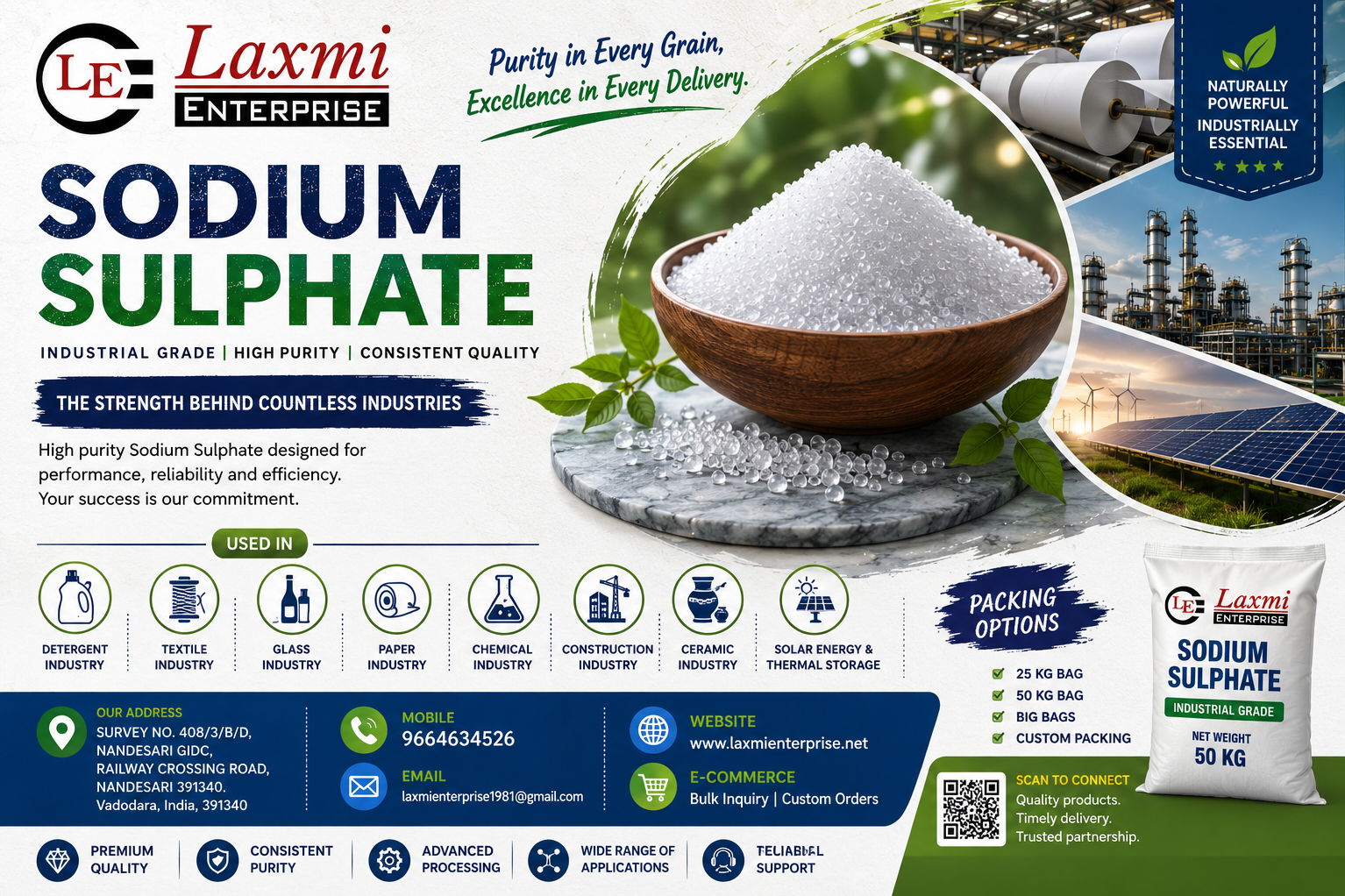
India's textile industry spans a wide network of processing centres, including Surat, Ahmedabad, Vadodara, Pali, Bhilwara, Ludhiana, Panipat, Tiruppur, Karur, Erode, Ichalkaranji, Bhiwandi, and other textile hubs.
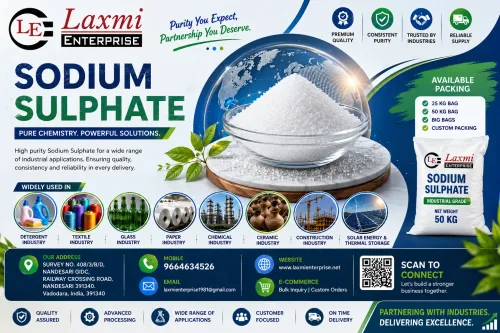
Laxmi Enterprise, based in Nandesari GIDC, Vadodara, Gujarat, supplies industrial-grade Sodium Sulphate to textile manufacturers across Pan India. The company supports customers with:
Industrial-grade Sodium Sulphate.
Batch-wise quality documentation.
COA, TDS, and SDS/MSDS (where applicable).
Flexible packaging options.
Logistics planning.
Technical support for procurement and production teams.
Key Takeaways
Sodium Sulphate is widely used as an electrolyte in many reactive dyeing processes for cellulosic fibres.
Dyeing performance depends on the complete process, including dye selection, water quality, temperature, pH, liquor ratio, and operating procedures.
Procurement teams should evaluate the full specification—purity, moisture, particle size, chloride, water-insoluble matter, documentation, and consistency—rather than focusing on price alone.
Consistent quality and reliable documentation support stable production and repeatable dyeing results.
Reactive Dye Chemistry – Why Sodium Sulphate Is Used
Reactive dyes are negatively charged (anionic) molecules that must move from the dye liquor to the cotton fibre before chemical fixation occurs. Because cellulose fibres in water also develop a negative surface charge, electrostatic repulsion can reduce dye uptake. Sodium Sulphate increases the ionic strength of the dye bath, helping reduce this repulsion and supporting more efficient dye exhaustion before the fixation stage.
Understanding the Dyeing Mechanism
Reactive dyeing is generally completed in two distinct phases:
Phase 1 – Dye Exhaustion
The dye migrates from the dye liquor toward the textile fibre.
During this stage:
Dye molecules remain dissolved.
Cotton fibres absorb water.
Dye approaches the fibre surface.
Salt promotes movement of dye toward the fibre.
This stage determines:
Shade uniformity
Level dyeing
Colour penetration
Batch consistency
Phase 2 – Dye Fixation
After sufficient exhaustion:
Alkali is introduced.
Typical alkalis include:
Soda Ash
Caustic Soda (certain processes)
At this stage:
Reactive groups on the dye chemically react with cellulose.
A permanent covalent bond is formed.
Only after fixation does the colour become durable.
Why Salt Is Added Before Alkali
One of the most common production mistakes is misunderstanding the sequence.
The normal sequence is:
Prepare Dye Bath
↓
Add Dye
↓
Add Sodium Sulphate
↓
Allow Exhaustion
↓
Add Alkali
↓
Fixation
↓
Wash
↓
Soap
↓
Rinse
↓
Finish
Adding alkali before adequate exhaustion can reduce levelness because fixation begins before dye distribution is complete.
Why Uniform Dye Exhaustion Matters
Large textile mills dye:
Hundreds of kilograms
Several tonnes
Continuous production lots
A difference of only a small percentage in dye exhaustion may produce:
Side-to-side variation
Centre shade differences
Batch mismatch
Reprocessing
Every reprocessing cycle increases:
Water consumption
Steam usage
Labour
Chemical cost
Production time
Process Variables Affecting Sodium Sulphate Performance
Sodium Sulphate does not work independently.
Its effectiveness depends on multiple interacting process variables.
Temperature
Temperature influences:
Dye diffusion
Fibre swelling
Dye migration
Reaction rate
Temperature should be increased according to the dye supplier's recommended profile rather than rapidly changing process conditions.
Liquor Ratio
Liquor ratio affects:
Dye concentration
Salt concentration
Chemical distribution
Uniformity
Lower liquor ratios require careful process optimization.
Agitation
Poor circulation may create:
Dead zones.
Uneven concentration.
Localized dye accumulation.
Colour streaks.
Modern dyeing machines rely on efficient liquor circulation to promote uniform dye distribution.
Time
Adequate exhaustion time allows dye molecules to approach and enter the fibre before fixation.
Reducing process time to increase production may negatively affect reproducibility if not properly validated.
Factors Influencing Shade Consistency
Textile buyers expect colour consistency across production lots.
Important factors include:
✓ Dye quality
✓ Sodium Sulphate consistency
✓ Water quality
✓ Machine condition
✓ Recipe accuracy
✓ Temperature profile
✓ Operator control
✓ Process repeatability
Even when the same recipe is used, changes in any of these factors may influence the final shade.
Why Water Quality Matters
Many dye houses focus only on dyes.
Water quality is equally important.
Parameters commonly monitored include:
Hardness
Conductivity
Dissolved solids
pH
Iron
Suspended matter
Variations in water quality may influence dyeing behaviour and should be considered as part of overall process control.
Quality Parameters of Sodium Sulphate for Textile Mills
Quick Answer
Textile processors generally require Sodium Sulphate that dissolves consistently, contains controlled impurity levels, and demonstrates repeatable batch quality. Procurement decisions should be based on the complete specification rather than a single parameter such as purity.
Typical evaluation parameters include:
Parameter Why It Is Evaluated
Purity Product consistency
Moisture Storage and flowability
Water-insoluble matter Clean dye bath preparation
Chloride Process-specific requirements
Iron Quality-sensitive applications
Particle size Uniform dissolution
Appearance Incoming inspection
Batch consistency Repeatable production
Importance of Water-Insoluble Matter
Undissolved particles may:
Increase filtration load.
Affect liquor clarity.
Require additional cleaning.
Increase maintenance.
Applications requiring complete dissolution often monitor this parameter closely.
Moisture Control
Excess moisture may contribute to:
Caking.
Reduced flow.
Feeding difficulties.
Warehouse handling problems.
Recommended storage practices include:
Dry warehouses.
Sealed packaging.
Palletized storage.
Protection from rain.
FIFO inventory management.
Chloride Control
Some textile manufacturers include chloride limits within their purchasing specifications.
The acceptable level depends on:
Internal standards.
Customer requirements.
Dye chemistry.
Production process.
Suppliers should provide batch documentation demonstrating compliance with agreed specifications.
Incoming Quality Inspection
Before approving material, many textile manufacturers verify:
Packaging
↓
Product identity
↓
Batch number
↓
COA
↓
Appearance
↓
Moisture condition
↓
Laboratory confirmation (where required)
↓
Warehouse release
This process helps reduce the risk of introducing off-specification material into production.
Laboratory Testing
Quality laboratories commonly evaluate:
Appearance.
Purity.
Moisture.
Water-insoluble matter.
Chloride.
Iron.
Particle size.
Bulk density.
Testing frequency depends on:
Supplier qualification.
Production criticality.
Internal quality systems.
Customer requirements.
How to Read a COA
A Certificate of Analysis should clearly identify:
Product Name
Batch Number
Manufacturing Date
Dispatch Date
Purity
Moisture
Iron
Chloride
Water Insoluble Matter
Appearance
Approval Status
Authorized Signature
Every incoming shipment should be compared against the agreed purchase specification rather than relying solely on historical performance.
Common Dyeing Problems and Possible Causes
Observation Possible Factors to Investigate
Uneven shade Recipe, machine circulation, process conditions, raw material consistency
Slow dye uptake Dyeing procedure, electrolyte addition sequence, process parameters
Batch variation Raw material consistency, water quality, operating conditions
Poor dissolution Particle size, storage condition, mixing practice
Flow problems Moisture exposure, warehouse conditions, packaging damage
These examples are intended as troubleshooting starting points. Multiple factors can contribute to dyeing defects, and investigations should consider the complete process.
Supplier Qualification Checklist
A technically capable supplier should be able to provide:
✓ Batch traceability
✓ COA
✓ TDS
✓ SDS/MSDS
✓ Quality documentation
✓ Consistent specifications
✓ Technical assistance
✓ Packaging options
✓ Reliable dispatch planning
✓ Long-term supply capability
Supplier audits should review both quality systems and operational performance.
Pan-India Supply for Textile Processing Units
India's textile industry spans a wide network of processing centres, including Surat, Ahmedabad, Vadodara, Pali, Bhilwara, Ludhiana, Panipat, Tiruppur, Karur, Erode, Ichalkaranji, Bhiwandi, and other textile hubs.
Laxmi Enterprise, based in Nandesari GIDC, Vadodara, Gujarat, supplies industrial-grade Sodium Sulphate to textile manufacturers across Pan India. The company supports customers with:
Industrial-grade Sodium Sulphate.
Batch-wise quality documentation.
COA, TDS, and SDS/MSDS (where applicable).
Flexible packaging options.
Logistics planning.
Technical support for procurement and production teams.
Key Takeaways
Sodium Sulphate is widely used as an electrolyte in many reactive dyeing processes for cellulosic fibres.
Dyeing performance depends on the complete process, including dye selection, water quality, temperature, pH, liquor ratio, and operating procedures.
Procurement teams should evaluate the full specification—purity, moisture, particle size, chloride, water-insoluble matter, documentation, and consistency—rather than focusing on price alone.
Consistent quality and reliable documentation support stable production and repeatable dyeing results.
Keywords