Should You Import Sodium Sulphate or Buy from an Indian Supplier? A Practical Guide for Industrial Manufacturers
Every procurement team eventually faces this question.
Should we import Sodium Sulphate or continue purchasing from an Indian supplier?
At first glance, importing may appear to be an attractive option. International quotations sometimes look competitive, especially when prices fluctuate in the domestic market. Some buyers assume imported material automatically offers better quality, while others believe local suppliers cannot always meet large industrial requirements.
In reality, the decision is rarely that simple.
The true cost of purchasing Sodium Sulphate goes far beyond the price quoted per tonne. Freight charges, customs procedures, delivery timelines, inventory planning, currency fluctuations and supply reliability all influence the final value received by the manufacturer.
Before making a decision, it is worth looking at the complete picture.
The Lowest Price Does Not Always Mean the Lowest Cost
Imagine receiving an imported quotation that appears five percent cheaper than a domestic offer.
On paper, the savings look significant.
Now consider everything that happens before the material reaches your factory.
International freight.
Port handling.
Custom clearance.
Transportation from the port to your plant.
Longer lead times.
Additional inventory requirements.
Exchange rate fluctuations.
Suddenly, the actual cost begins to look very different from the original quotation.
Experienced procurement professionals calculate total procurement cost rather than purchase price alone.
That approach usually leads to better long-term decisions.
Lead Time Can Influence Production Planning
One of the biggest differences between imported and locally supplied material is delivery time.
Domestic suppliers can usually respond much faster to changing production requirements.
Imported shipments often require weeks of planning before they reach the manufacturing plant.
If production suddenly increases, obtaining additional imported material at short notice may not always be practical.
Manufacturers operating with continuous production schedules often value flexibility just as much as pricing.
A dependable domestic supplier can provide that flexibility.
Inventory Requirements Change
Longer delivery times usually require larger inventories.
Manufacturers importing raw materials often maintain additional stock to avoid supply interruptions.
While this improves security, it also increases working capital requirements.
More warehouse space is required.
More money remains tied up in inventory.
Insurance costs may increase.
Inventory management becomes more complex.
Purchasing from a dependable domestic supplier often allows businesses to operate with more efficient inventory levels while maintaining confidence in supply continuity.
Communication Is Easier
Business relationships become stronger when communication is straightforward.
Time zone differences, international documentation and longer communication chains can occasionally slow decision-making when dealing with overseas suppliers.
Domestic suppliers are generally easier to reach.
Questions can often be answered quickly.
Urgent dispatches are easier to discuss.
Business meetings can be arranged whenever necessary.
Although communication may seem like a small detail, it becomes extremely valuable when production schedules change unexpectedly.
Quality Should Be Evaluated, Not Assumed
One common misconception is that imported material is always superior.
Another misconception is that domestic material is automatically more economical.
Neither assumption is always correct.
Quality should be evaluated based on consistency, reliability and suitability for the intended application.
Many Indian manufacturers have developed excellent quality standards and supply products that meet the requirements of demanding industrial customers.
Likewise, imported material should always be evaluated on actual performance rather than country of origin.
Reliable quality can be found in both domestic and international markets.
The supplier's commitment matters more than geography.
Supporting Indian Manufacturing
India has developed one of the world's largest chemical manufacturing industries.
Industrial regions such as Nandesari, Ankleshwar, Dahej, Bharuch and Vapi have become recognised centres for chemical production and distribution.
Many Indian suppliers have invested heavily in quality systems, logistics and customer support.
Working with domestic suppliers also strengthens the local manufacturing ecosystem and often simplifies procurement for industrial customers.
For businesses focused on long-term partnerships, local suppliers frequently provide practical advantages beyond pricing.
When Importing May Be the Right Choice
There are situations where importing makes commercial sense.
A customer may require a specialised grade that is not readily available in India.
A long-term international contract may offer strategic advantages.
Certain industries may have technical specifications linked to particular global sources.
These situations are genuine and should be evaluated carefully.
The objective is not to choose domestic or imported material by default.
The objective is to select the option that best supports production, quality and business continuity.
What Experienced Purchase Managers Usually Consider
When procurement teams evaluate suppliers, they generally look beyond quotations.
They ask practical questions.
Can the supplier maintain regular inventory?
How quickly can additional material be dispatched?
How consistent is the quality?
Will communication remain responsive after the first order?
Can the supplier support our business as production expands?
These questions often determine the long-term success of a supplier relationship.
Price attracts attention.
Performance earns trust.
How Laxmi Enterprise Supports Indian Manufacturers
At Laxmi Enterprise, we understand that every manufacturer wants confidence in their supply chain.
Our customers depend on timely deliveries because their production schedules depend on them.
From our operations in Nandesari GIDC, Vadodara, we supply Sodium Sulphate and other industrial chemicals to customers across India.
Many of our customers choose to work with us because they value quick response times, consistent quality and dependable service.
Being located within one of India's leading chemical manufacturing regions allows us to respond efficiently to industrial requirements across multiple states.
We believe that strong supplier relationships are built through reliability rather than promises.
Making the Right Decision for Your Business
There is no single answer that suits every manufacturer.
The right sourcing strategy depends on production volume, inventory policy, delivery requirements, technical specifications and long-term business goals.
The most successful procurement teams evaluate the complete picture before making a decision.
They look beyond immediate pricing and consider reliability, flexibility, communication and supply continuity.
In many cases, these factors create more value than the difference between two quotations.
A reliable supplier contributes to stable production.
Stable production supports satisfied customers.
Satisfied customers build successful businesses.
Frequently Asked Questions
Is imported Sodium Sulphate always better than Indian material?
Not necessarily. Quality should be evaluated based on consistency, technical suitability and supplier reliability rather than country of origin.
What are the advantages of buying from an Indian supplier?
Domestic suppliers often provide shorter delivery times, easier communication, lower inventory requirements and greater flexibility for urgent orders.
When does importing make sense?
Importing may be appropriate when specialised grades are required, long-term international agreements offer strategic advantages or specific technical requirements cannot be met locally.
Why is total procurement cost more important than purchase price?
Total procurement cost includes freight, inventory, delivery time, logistics, working capital and operational risks in addition to the quoted material price.
Why do manufacturers choose Laxmi Enterprise?
Manufacturers across India work with Laxmi Enterprise because of our consistent quality, dependable deliveries, responsive customer support and long-term commitment to industrial manufacturing. Operating from Nandesari GIDC, Vadodara, we help businesses maintain stable and efficient supply chains.
About Laxmi Enterprise
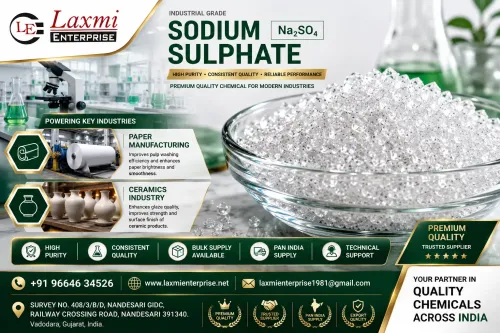
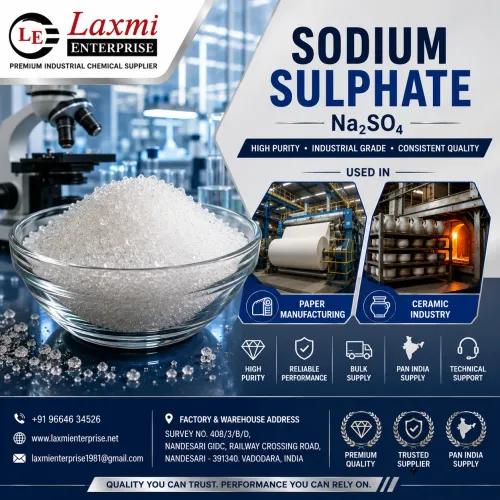
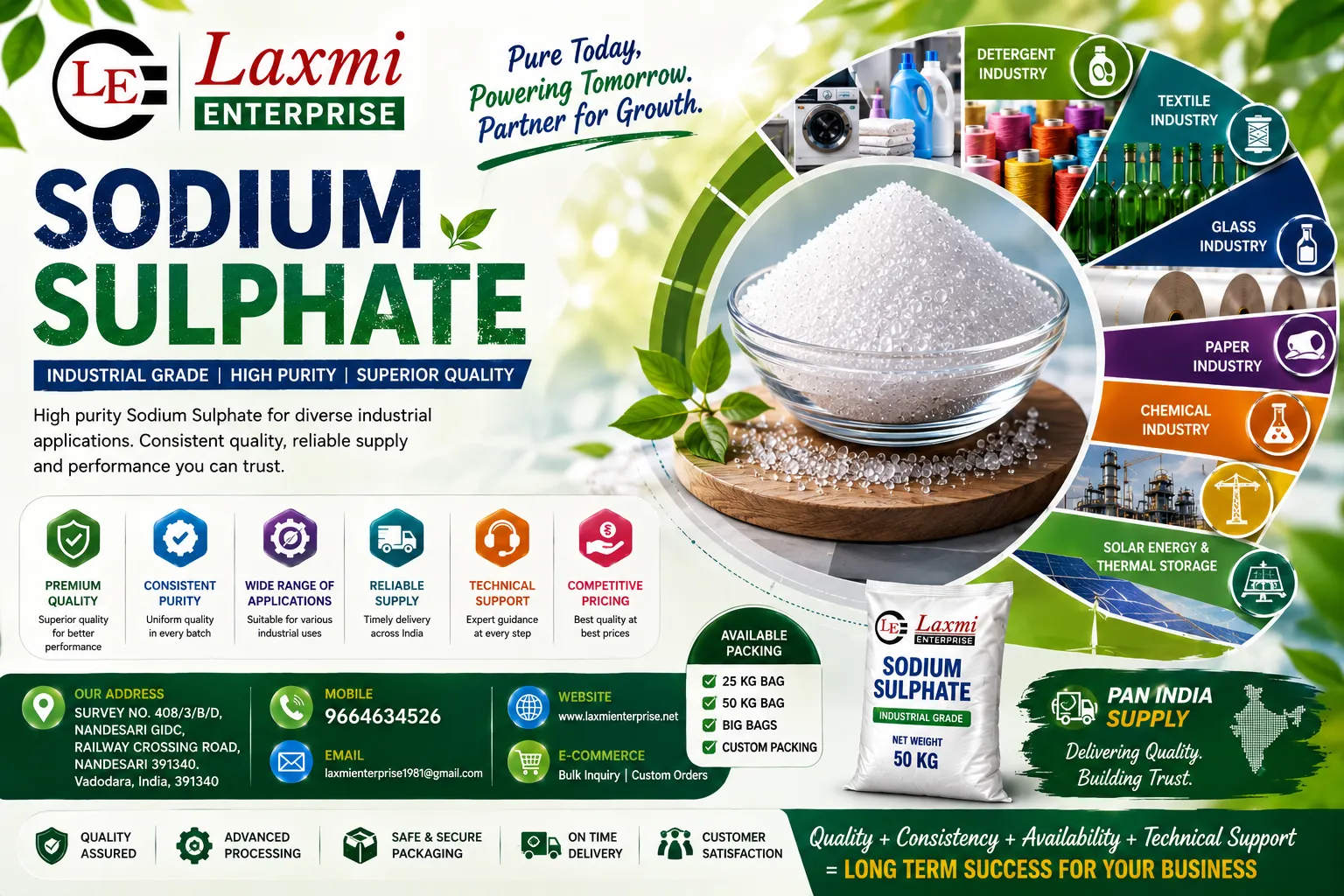
Laxmi Enterprise is a trusted manufacturer, supplier and distributor of industrial chemicals based in Nandesari GIDC, Vadodara, Gujarat. We supply Sodium Sulphate, Sodium Nitrate, Sodium Acetate, Tri Sodium Phosphate and other inorganic chemicals to manufacturers across detergent, textile, glass, paper, ceramic, construction, water treatment and chemical processing industries.
For decades, our focus has remained the same. Deliver consistent quality, maintain dependable supply and build lasting relationships with customers who value reliability as much as we do.
Every procurement team eventually faces this question.
Should we import Sodium Sulphate or continue purchasing from an Indian supplier?
At first glance, importing may appear to be an attractive option. International quotations sometimes look competitive, especially when prices fluctuate in the domestic market. Some buyers assume imported material automatically offers better quality, while others believe local suppliers cannot always meet large industrial requirements.
In reality, the decision is rarely that simple.
The true cost of purchasing Sodium Sulphate goes far beyond the price quoted per tonne. Freight charges, customs procedures, delivery timelines, inventory planning, currency fluctuations and supply reliability all influence the final value received by the manufacturer.
Before making a decision, it is worth looking at the complete picture.
The Lowest Price Does Not Always Mean the Lowest Cost
Imagine receiving an imported quotation that appears five percent cheaper than a domestic offer.
On paper, the savings look significant.
Now consider everything that happens before the material reaches your factory.
International freight.
Port handling.
Custom clearance.
Transportation from the port to your plant.
Longer lead times.
Additional inventory requirements.
Exchange rate fluctuations.
Suddenly, the actual cost begins to look very different from the original quotation.
Experienced procurement professionals calculate total procurement cost rather than purchase price alone.
That approach usually leads to better long-term decisions.
Lead Time Can Influence Production Planning
One of the biggest differences between imported and locally supplied material is delivery time.
Domestic suppliers can usually respond much faster to changing production requirements.
Imported shipments often require weeks of planning before they reach the manufacturing plant.
If production suddenly increases, obtaining additional imported material at short notice may not always be practical.
Manufacturers operating with continuous production schedules often value flexibility just as much as pricing.
A dependable domestic supplier can provide that flexibility.
Inventory Requirements Change
Longer delivery times usually require larger inventories.
Manufacturers importing raw materials often maintain additional stock to avoid supply interruptions.
While this improves security, it also increases working capital requirements.
More warehouse space is required.
More money remains tied up in inventory.
Insurance costs may increase.
Inventory management becomes more complex.
Purchasing from a dependable domestic supplier often allows businesses to operate with more efficient inventory levels while maintaining confidence in supply continuity.
Communication Is Easier
Business relationships become stronger when communication is straightforward.
Time zone differences, international documentation and longer communication chains can occasionally slow decision-making when dealing with overseas suppliers.
Domestic suppliers are generally easier to reach.
Questions can often be answered quickly.
Urgent dispatches are easier to discuss.
Business meetings can be arranged whenever necessary.
Although communication may seem like a small detail, it becomes extremely valuable when production schedules change unexpectedly.
Quality Should Be Evaluated, Not Assumed
One common misconception is that imported material is always superior.
Another misconception is that domestic material is automatically more economical.
Neither assumption is always correct.
Quality should be evaluated based on consistency, reliability and suitability for the intended application.
Many Indian manufacturers have developed excellent quality standards and supply products that meet the requirements of demanding industrial customers.
Likewise, imported material should always be evaluated on actual performance rather than country of origin.
Reliable quality can be found in both domestic and international markets.
The supplier's commitment matters more than geography.
Supporting Indian Manufacturing
India has developed one of the world's largest chemical manufacturing industries.
Industrial regions such as Nandesari, Ankleshwar, Dahej, Bharuch and Vapi have become recognised centres for chemical production and distribution.
Many Indian suppliers have invested heavily in quality systems, logistics and customer support.
Working with domestic suppliers also strengthens the local manufacturing ecosystem and often simplifies procurement for industrial customers.
For businesses focused on long-term partnerships, local suppliers frequently provide practical advantages beyond pricing.
When Importing May Be the Right Choice
There are situations where importing makes commercial sense.
A customer may require a specialised grade that is not readily available in India.
A long-term international contract may offer strategic advantages.
Certain industries may have technical specifications linked to particular global sources.
These situations are genuine and should be evaluated carefully.
The objective is not to choose domestic or imported material by default.
The objective is to select the option that best supports production, quality and business continuity.
What Experienced Purchase Managers Usually Consider
When procurement teams evaluate suppliers, they generally look beyond quotations.
They ask practical questions.
Can the supplier maintain regular inventory?
How quickly can additional material be dispatched?
How consistent is the quality?
Will communication remain responsive after the first order?
Can the supplier support our business as production expands?
These questions often determine the long-term success of a supplier relationship.
Price attracts attention.
Performance earns trust.
How Laxmi Enterprise Supports Indian Manufacturers
At Laxmi Enterprise, we understand that every manufacturer wants confidence in their supply chain.
Our customers depend on timely deliveries because their production schedules depend on them.
From our operations in Nandesari GIDC, Vadodara, we supply Sodium Sulphate and other industrial chemicals to customers across India.
Many of our customers choose to work with us because they value quick response times, consistent quality and dependable service.
Being located within one of India's leading chemical manufacturing regions allows us to respond efficiently to industrial requirements across multiple states.
We believe that strong supplier relationships are built through reliability rather than promises.
Making the Right Decision for Your Business
There is no single answer that suits every manufacturer.
The right sourcing strategy depends on production volume, inventory policy, delivery requirements, technical specifications and long-term business goals.
The most successful procurement teams evaluate the complete picture before making a decision.
They look beyond immediate pricing and consider reliability, flexibility, communication and supply continuity.
In many cases, these factors create more value than the difference between two quotations.
A reliable supplier contributes to stable production.
Stable production supports satisfied customers.
Satisfied customers build successful businesses.
Frequently Asked Questions
Is imported Sodium Sulphate always better than Indian material?
Not necessarily. Quality should be evaluated based on consistency, technical suitability and supplier reliability rather than country of origin.
What are the advantages of buying from an Indian supplier?
Domestic suppliers often provide shorter delivery times, easier communication, lower inventory requirements and greater flexibility for urgent orders.
When does importing make sense?
Importing may be appropriate when specialised grades are required, long-term international agreements offer strategic advantages or specific technical requirements cannot be met locally.
Why is total procurement cost more important than purchase price?
Total procurement cost includes freight, inventory, delivery time, logistics, working capital and operational risks in addition to the quoted material price.
Why do manufacturers choose Laxmi Enterprise?
Manufacturers across India work with Laxmi Enterprise because of our consistent quality, dependable deliveries, responsive customer support and long-term commitment to industrial manufacturing. Operating from Nandesari GIDC, Vadodara, we help businesses maintain stable and efficient supply chains.
About Laxmi Enterprise
Laxmi Enterprise is a trusted manufacturer, supplier and distributor of industrial chemicals based in Nandesari GIDC, Vadodara, Gujarat. We supply Sodium Sulphate, Sodium Nitrate, Sodium Acetate, Tri Sodium Phosphate and other inorganic chemicals to manufacturers across detergent, textile, glass, paper, ceramic, construction, water treatment and chemical processing industries.
For decades, our focus has remained the same. Deliver consistent quality, maintain dependable supply and build lasting relationships with customers who value reliability as much as we do.
Keywords