
How to Develop a Quality Control System for Incoming Sodium Sulphate in Industrial Manufacturing
Every finished product begins with a raw material.
If the raw material entering the factory is consistent, the production process becomes easier to control.
If the incoming material varies from one delivery to another, quality teams spend more time investigating problems instead of preventing them.
This is why experienced manufacturers place great importance on incoming raw material inspection.
They understand that quality should not begin at the production line.
It should begin at the receiving dock.
A structured quality control system for Sodium Sulphate helps manufacturers reduce production risks, improve process consistency and strengthen customer confidence.
More importantly, it allows every department to work with greater certainty.
Incoming Inspection Is the First Step Towards Stable Production
The first opportunity to verify material quality comes when the delivery vehicle reaches the factory.
Many companies perform only a quick quantity check before sending the material to the warehouse.
Leading manufacturers follow a more disciplined approach.
They inspect the condition of the vehicle.
They verify packaging.
They review documentation.
They confirm product identification.
They record observations before unloading is completed.
This systematic approach reduces the possibility of unsuitable material entering the production process.
Every Shipment Should Follow the Same Procedure
One common mistake in many factories is changing inspection methods depending on the supplier or urgency of production.
Quality systems become stronger when every shipment follows the same inspection process.
Consistency in inspection produces consistency in decision making.
Whether the supplier is new or has worked with the company for many years, every delivery should pass through the same quality procedure.
This creates fairness, improves traceability and strengthens confidence across the organisation.
Verify Documentation Before Material Is Accepted
Documentation should always be checked before the material is moved into storage.
The purchase order should match the delivery.
The product description should be correct.
The quantity received should be verified.
Packaging labels should correspond with internal inventory records.
Accurate documentation supports inventory management, traceability and future quality investigations.
Administrative discipline is an important part of technical quality.
Inspect Packaging Before Opening Any Bags
The condition of the packaging often provides useful information.
Warehouse and quality personnel should look for torn bags.
Broken stitching.
Evidence of moisture.
Damaged pallets.
Improper stacking during transportation.
If packaging damage is identified, it should be recorded immediately.
Photographs can also become valuable records if clarification is required later.
Good packaging reflects professional handling throughout the supply chain.
Develop a Standard Sampling Procedure
Sampling should never depend on individual judgement.
Every manufacturing company should establish a documented sampling procedure based on its own quality management system.
The objective is to obtain representative samples that accurately reflect the shipment received.
Using the same procedure every time improves consistency and strengthens confidence in quality decisions.
Quality control should always follow established internal procedures.
Laboratory Testing Supports Better Decisions
Laboratory analysis helps quality teams confirm that incoming material meets internal manufacturing requirements.
However, laboratory testing should be viewed as one part of the evaluation rather than the complete evaluation.
Technical results should be considered together with packaging condition, delivery performance and production observations.
Combining multiple sources of information creates a stronger quality management process.
Production Feedback Should Reach the Quality Department
Quality control should not end after laboratory testing.
Production operators often notice valuable practical information during manufacturing.
Does the material blend consistently?
Does production remain stable?
Have operators observed any unusual handling characteristics?
Regular communication between production and quality teams improves future purchasing decisions.
The most effective quality systems connect every department rather than working independently.
Maintain Complete Inspection Records
Good records support continuous improvement.
Every incoming shipment should have an inspection history.
Inspection date.
Supplier.
Quantity received.
Packaging observations.
Laboratory results.
Warehouse comments.
Production feedback.
These records become valuable references when reviewing supplier performance over time.
Reliable data leads to reliable decisions.
Review Supplier Performance Periodically
Quality control should extend beyond individual shipments.
Every few months, quality teams should review supplier performance.
Have inspection results remained consistent?
Has packaging improved?
Are deliveries becoming more reliable?
Have production observations changed?
This broader review helps identify long-term trends rather than focusing only on isolated deliveries.
Quality management is most effective when viewed over time.
Quality Is a Shared Responsibility
Many people believe quality belongs only to the laboratory.
Successful manufacturers think differently.
Procurement selects suppliers.
Warehouse teams inspect deliveries.
Quality departments evaluate incoming material.
Production teams observe process performance.
Management reviews supplier relationships.
Each department contributes to the overall quality system.
When everyone follows the same objective, manufacturing becomes more consistent.
Reliable Suppliers Simplify Quality Control
Well-organised suppliers help customers maintain efficient quality systems.
Consistent packaging reduces receiving issues.
Reliable documentation simplifies verification.
Predictable product quality reduces unnecessary investigations.
Professional communication allows faster problem resolution whenever required.
Choosing dependable suppliers is therefore one of the simplest ways to strengthen incoming quality control.
How Laxmi Enterprise Supports Customer Quality Systems
At Laxmi Enterprise, we understand that every shipment entering a customer's factory becomes part of their quality management process.
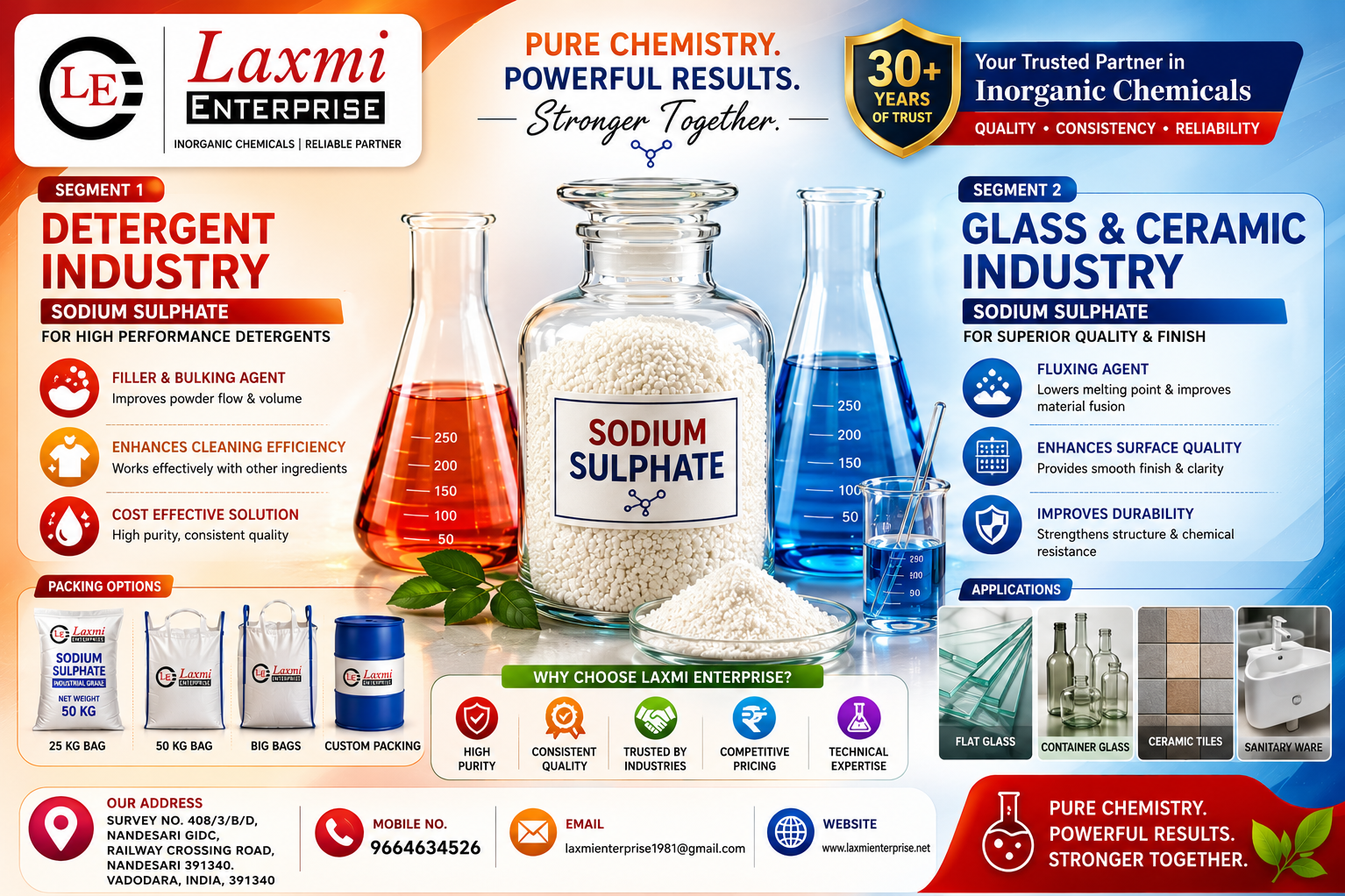
Operating from Nandesari GIDC, Vadodara, we supply Sodium Sulphate and other industrial chemicals to manufacturers across India.
We focus on maintaining consistent product quality, professional packaging, organised documentation and dependable deliveries because we know these factors support efficient quality control.
Many of our customers operate under disciplined manufacturing systems and expect suppliers who maintain the same professional standards.
Our commitment is to help customers receive material that supports smooth inspections, reliable production and long-term manufacturing confidence.
Final Thoughts
Incoming quality control is one of the most valuable investments a manufacturer can make.
It protects production.
It strengthens supplier relationships.
It improves traceability.
It supports consistent product quality.
Most importantly, it prevents avoidable problems before they reach the production line.
Manufacturers who develop disciplined inspection systems build stronger factories, more reliable supply chains and greater customer confidence over time.
Frequently Asked Questions
Why is incoming inspection important for Sodium Sulphate?
Incoming inspection helps verify product quality, packaging condition, documentation accuracy and shipment consistency before the material enters production.
What should be checked during incoming inspection?
Manufacturers should verify documentation, packaging condition, product identification, shipment quantity, sampling requirements and overall material condition.
Should production teams provide quality feedback?
Yes. Production observations help quality departments evaluate real manufacturing performance and improve future supplier assessments.
Why should supplier performance be reviewed regularly?
Periodic reviews help manufacturers identify quality trends, improve supplier relationships and support continuous improvement in procurement and production.
Why do manufacturers across India choose Laxmi Enterprise?
Manufacturers choose Laxmi Enterprise because we combine consistent-quality Sodium Sulphate with dependable packaging, organised documentation and reliable deliveries. Operating from Nandesari GIDC, Vadodara, we help manufacturers strengthen their quality management systems through professional industrial chemical supply.
About Laxmi Enterprise
Laxmi Enterprise is a trusted manufacturer, supplier and distributor of industrial chemicals based in Nandesari GIDC, Vadodara, Gujarat. We supply Sodium Sulphate, Sodium Nitrate, Sodium Acetate, Tri Sodium Phosphate and other industrial chemicals to detergent, glass, textile, paper, ceramic, construction, water treatment and chemical processing industries across India.
Our commitment is to deliver more than quality chemicals. We work to support our customers with dependable logistics, consistent product quality, professional documentation and long-term business partnerships that contribute to efficient manufacturing and sustainable growth.